The M/M/1 and M/M/1/K queuing system: Consider the M/M/1 and M/M/1/K queuing systems [see in class notes]. For the M/M/1/K system show that, for ρ < 1,
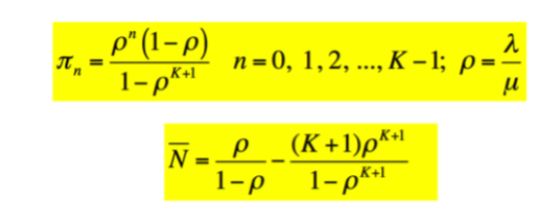
in class notes:
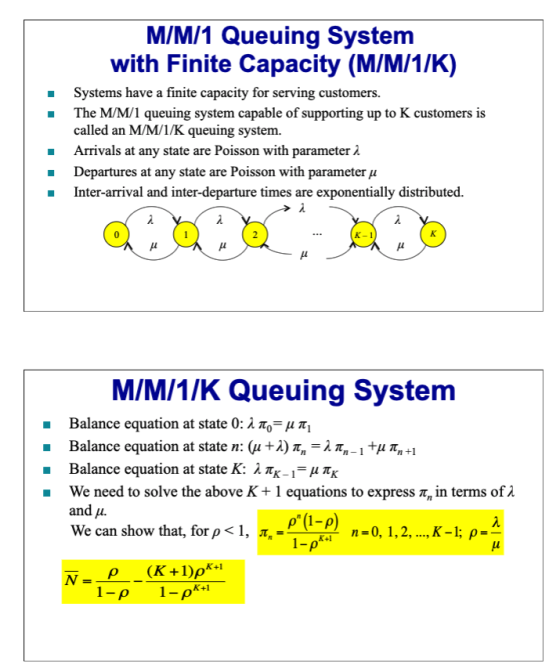
M/M/1 Queuing System with Finite Capacity (M/M/1/K) Systems have a finite capacity for serving customers. The M/M/1 queuing system capable of supporting up to K customers is called an M/M/1/K queuing system. Arrivals at any state are Poisson with parameter A Departures at any state are Poisson with parameter u Inter-arrival and inter-departure times are exponentially distributed K 2 M/M/1/K Queuing System Balance equation at state 0: A n-u Balance equation at state n: (u +A) , A n,1 +H n Balance equation at state K: Anr 1=4 We need to solve the above K + 1 equations to express 7, in terms ofA and We can show that, for p
Homework Answers
Request Answer!
We need at least 9 more requests to produce the answer.
1 / 10 have requested this problem solution
The more requests, the faster the answer.
Add Answer to:
The M/M/1 and M/M/1/K queuing system: Consider the M/M/1 and M/M/1/K queuing systems [see in class notes]. For the M/M/1...
The M/M/m/m Server Loss System: Consider the queuing system given by the following state- transition diagram. Each arri...
 The M/M/m/m Server Loss System: Consider the queuing system
given by the following state- transition diagram.
Each arriving customer is given a private server, but there is a
maximum of m servers available. If a customer arrives when all m
servers are busy, the customer is denied service and is turned
away. The arrival rate is Poisson with parameter λ and the service
rate is kμ with 1 ≤ k ≤ m as shown. Use the results obtained in Set...
The M/M/m/m Server Loss System: Consider the queuing system
given by the following state- transition diagram.
Each arriving customer is given a private server, but there is a
maximum of m servers available. If a customer arrives when all m
servers are busy, the customer is denied service and is turned
away. The arrival rate is Poisson with parameter λ and the service
rate is kμ with 1 ≤ k ≤ m as shown. Use the results obtained in Set...
What does the Pollaczek- Khinchin (P-K) formula explain in an M/G/1 system? Write the P-K formula and use it to show the average number of customers in the M/G/1 queuing system (including customers i...
 What does the Pollaczek- Khinchin (P-K) formula explain in an M/G/1 system? Write the P-K formula and use it to show the average number of customers in the M/G/1 queuing system (including customers in the queue and in service).
What does the Pollaczek- Khinchin (P-K) formula explain in an M/G/1 system? Write the P-K formula and use it to show the average number of customers in the M/G/1 queuing system (including customers in the queue and in service).
What does the Pollaczek- Khinchin (P-K) formula explain in an M/G/1 system? Write the P-K formula and use it to show the average number of customers in the M/G/1 queuing system (including customers in the queue and in service).
Problem 8: 10 points Consider a queuing system M/M/1 with one server. Customer arrivals form a...
 Problem 8: 10 points Consider a queuing system M/M/1 with one server. Customer arrivals form a Poisson process with the intensity A 15 per hour. Service times are exponentially distributed with the expectation3 minutes Assume that the number of customers at t-0, has the stationary distribution. 1. Find the average queue length, (L) 2. What is the expected waiting time, (W), for a customer? 3. Determine the expected number of customers that have completed their services within the 8-hour shift
Consider the M/M/1/GD/∞/∞ queuing system where λ and μ are the arrival and server rate, respectively....
Consider the M/M/1/GD/∞/∞ queuing system where λ and μ are the arrival and server rate, respectively. Suppose customers arrive according to a rate given by λ = 12 customers per hour and that service time is exponential with a mean equal to 3 minutes. Suppose the arrival rate is increased by 20%. Determine the change in the average number of customers in the system and the average time a customer spends in the system.
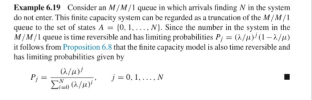
Example 6.19 Consider an M/M/1 queue in which arrivals finding N in the system do not enter. This...
 explain further please
Example 6.19 Consider an M/M/1 queue in which arrivals finding N in the system do not enter. This finite capacity system can be regarded as a truncation of the M/M/1 queue to the set of states A-: {0, I, , N). Since the number in the system in the M/M/1 queue is time reversible and has limiting probabilities P(/ X/) it follows from Proposition 6.8 that the finite capacity model is also time reversible and has limiting...
explain further please
Example 6.19 Consider an M/M/1 queue in which arrivals finding N in the system do not enter. This finite capacity system can be regarded as a truncation of the M/M/1 queue to the set of states A-: {0, I, , N). Since the number in the system in the M/M/1 queue is time reversible and has limiting probabilities P(/ X/) it follows from Proposition 6.8 that the finite capacity model is also time reversible and has limiting...
d. p2the system is NOT stable a. p=2: the system is stable 1. Consider an M/M/1...
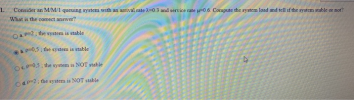 d. p2the system is NOT stable a. p=2: the system is stable 1. Consider an M/M/1 queuing system with an arrival rate a=0.3 and service rate u=0.6. Compute the system load and tell if the system stable or not? What is the correct answer? b.p=0,5; the system is stable OP=0,5; the system is NOT stable
Consider the M/M/16 queuing system λ=8 μ=14 and p = λ/(sμ) (a) average number of customers in the system (b) average waiting time of each customer who enters the system (c) probability that all se...
Consider the M/M/16 queuing system λ=8 μ=14 and p = λ/(sμ) (a) average number of customers in the system (b) average waiting time of each customer who enters the system (c) probability that all servers are occupied We were unable to transcribe this imageWe were unable to transcribe this imagePU > s) = (s!)(1-p) We were unable to transcribe this image PU > s) = (s!)(1-p)
Question 3: Recursive Least Squares Simulate the following system: y(k)-1.5 y(k-1+0.7y(k-2)u(k1e(k) Where e(k) is a white...
 Question 3: Recursive Least Squares Simulate the following system: y(k)-1.5 y(k-1+0.7y(k-2)u(k1e(k) Where e(k) is a white noise with variance 4.0 and u(k) is a random binary signal with u(k) - Simulate the data set with N 400 points. a) Use the obtained data sets of (y, u) from part a) to identify the parameters using the recursive least squares algorithm. Plot the parameter estimates and the trace of the covariance matrix P. Let the forgetting factor 2 - 1.0 and...
Consider a paramagnetic system of N elementary dipoles (with dipole moment μ) that can only have ...
 Using MATLAB
Consider a paramagnetic system of N elementary dipoles (with dipole moment μ) that can only have states of parallel ↑ or antiparallel ↓ to the applied magnetic field B. The energies associated with each dipole is ±μ-B, the lower energy state being when the dipole is parallel to the B field. The macrostate state of the system will be defined by Nt, or equivalently, the total energy: The multiplicity of a given macrostate of a paramagnet is given...
Using MATLAB
Consider a paramagnetic system of N elementary dipoles (with dipole moment μ) that can only have states of parallel ↑ or antiparallel ↓ to the applied magnetic field B. The energies associated with each dipole is ±μ-B, the lower energy state being when the dipole is parallel to the B field. The macrostate state of the system will be defined by Nt, or equivalently, the total energy: The multiplicity of a given macrostate of a paramagnet is given...
3 Mike Greenberg opened Grouper Window Washing Co. on July 1, 2020. During July, the following...
 3 Mike Greenberg opened Grouper Window Washing Co. on July 1, 2020. During July, the following transactions were complet July 1 Owner invested $10,300 cash in the company. 1 Purchased used truck for $6,880, paying $1,720 cash and the balance on account Purchased cleaning supplies for $770 on account. 5 Paid $1,560 cash on a 1-year insurance policy effective July 1. 12 Billed customers $3,180 for cleaning services performed Paid $860 cash on amount owed on truck and $430 on...
 The M/M/m/m Server Loss System: Consider the queuing system
given by the following state- transition diagram.
Each arriving customer is given a private server, but there is a
maximum of m servers available. If a customer arrives when all m
servers are busy, the customer is denied service and is turned
away. The arrival rate is Poisson with parameter λ and the service
rate is kμ with 1 ≤ k ≤ m as shown. Use the results obtained in Set...
The M/M/m/m Server Loss System: Consider the queuing system
given by the following state- transition diagram.
Each arriving customer is given a private server, but there is a
maximum of m servers available. If a customer arrives when all m
servers are busy, the customer is denied service and is turned
away. The arrival rate is Poisson with parameter λ and the service
rate is kμ with 1 ≤ k ≤ m as shown. Use the results obtained in Set...
 What does the Pollaczek- Khinchin (P-K) formula explain in an M/G/1 system? Write the P-K formula and use it to show the average number of customers in the M/G/1 queuing system (including customers in the queue and in service).
What does the Pollaczek- Khinchin (P-K) formula explain in an M/G/1 system? Write the P-K formula and use it to show the average number of customers in the M/G/1 queuing system (including customers in the queue and in service).
What does the Pollaczek- Khinchin (P-K) formula explain in an M/G/1 system? Write the P-K formula and use it to show the average number of customers in the M/G/1 queuing system (including customers in the queue and in service).
 Problem 8: 10 points Consider a queuing system M/M/1 with one server. Customer arrivals form a Poisson process with the intensity A 15 per hour. Service times are exponentially distributed with the expectation3 minutes Assume that the number of customers at t-0, has the stationary distribution. 1. Find the average queue length, (L) 2. What is the expected waiting time, (W), for a customer? 3. Determine the expected number of customers that have completed their services within the 8-hour shift
 explain further please
Example 6.19 Consider an M/M/1 queue in which arrivals finding N in the system do not enter. This finite capacity system can be regarded as a truncation of the M/M/1 queue to the set of states A-: {0, I, , N). Since the number in the system in the M/M/1 queue is time reversible and has limiting probabilities P(/ X/) it follows from Proposition 6.8 that the finite capacity model is also time reversible and has limiting...
explain further please
Example 6.19 Consider an M/M/1 queue in which arrivals finding N in the system do not enter. This finite capacity system can be regarded as a truncation of the M/M/1 queue to the set of states A-: {0, I, , N). Since the number in the system in the M/M/1 queue is time reversible and has limiting probabilities P(/ X/) it follows from Proposition 6.8 that the finite capacity model is also time reversible and has limiting...
 d. p2the system is NOT stable a. p=2: the system is stable 1. Consider an M/M/1 queuing system with an arrival rate a=0.3 and service rate u=0.6. Compute the system load and tell if the system stable or not? What is the correct answer? b.p=0,5; the system is stable OP=0,5; the system is NOT stable
 Question 3: Recursive Least Squares Simulate the following system: y(k)-1.5 y(k-1+0.7y(k-2)u(k1e(k) Where e(k) is a white noise with variance 4.0 and u(k) is a random binary signal with u(k) - Simulate the data set with N 400 points. a) Use the obtained data sets of (y, u) from part a) to identify the parameters using the recursive least squares algorithm. Plot the parameter estimates and the trace of the covariance matrix P. Let the forgetting factor 2 - 1.0 and...
 Using MATLAB
Consider a paramagnetic system of N elementary dipoles (with dipole moment μ) that can only have states of parallel ↑ or antiparallel ↓ to the applied magnetic field B. The energies associated with each dipole is ±μ-B, the lower energy state being when the dipole is parallel to the B field. The macrostate state of the system will be defined by Nt, or equivalently, the total energy: The multiplicity of a given macrostate of a paramagnet is given...
Using MATLAB
Consider a paramagnetic system of N elementary dipoles (with dipole moment μ) that can only have states of parallel ↑ or antiparallel ↓ to the applied magnetic field B. The energies associated with each dipole is ±μ-B, the lower energy state being when the dipole is parallel to the B field. The macrostate state of the system will be defined by Nt, or equivalently, the total energy: The multiplicity of a given macrostate of a paramagnet is given...
 3 Mike Greenberg opened Grouper Window Washing Co. on July 1, 2020. During July, the following transactions were complet July 1 Owner invested $10,300 cash in the company. 1 Purchased used truck for $6,880, paying $1,720 cash and the balance on account Purchased cleaning supplies for $770 on account. 5 Paid $1,560 cash on a 1-year insurance policy effective July 1. 12 Billed customers $3,180 for cleaning services performed Paid $860 cash on amount owed on truck and $430 on...
Most questions answered within 3 hours.
-
Where is the error in this code sequence?
String s1 = "Hello";
String s2 = "ello";...
asked 11 months ago -
Financial data for Joel de Paris, Inc., for last year
follow:
Joel de Paris, Inc.
Balance...
asked 11 months ago -
Consider this reaction:
Al2(SO4)3 (aq)+ BaCl3
(aq) Al2Cl6 (aq)- +
3BaSO4(s) . What is the...
asked 11 months ago -
Suppose that Savneet is considering increasing her
recent random sample from 20 car rentals to 40...
asked 11 months ago -
Trucks arrive at an unloading terminal at an average rate of 120
per hour.
Trucks arrive...
asked 11 months ago -
Why are methanol and ethanol completely soluble in water while
octanol is not very little soluble....
asked 11 months ago -
A facilities manager at a university reads in a research report
that the mean amount of...
asked 11 months ago -
When the CuSO4 is rehydrated by adding water to the anhydrous
compound, is this an endothermic...
asked 11 months ago -
A ray of sunlight is passing from diamond into crown glass; the
angle of incidence is...
asked 11 months ago -
A block of mass 0.249 kg is placed on top of a light, vertical
spring of...
asked 11 months ago -
how do the kidneys compensate in the presences of acidosis
a) trigger hyperventilate
b) reserve acid...
asked 11 months ago -
Question 501 pts
The rental rate of capital to the firm increases. Which of the
following...
asked 11 months ago