
Homework Answers
Request Answer!
We need at least 10 more requests to produce the answer.
0 / 10 have requested this problem solution
The more requests, the faster the answer.
Add Answer to:
14. faj Dcrive Langmuir adsorption isotherm expression for the proccas O3lg)30(ads Calculate the equilibrium constant,...
Find an expression for the rate of adsorption (d theta/dt)_ads, and an expression for the rate...
 Find an expression for the rate of adsorption (d theta/dt)_ads, and an expression for the rate of desorption (d theta/dt)_des, where k_a and k_d are the adsorption and desorption rate constants, respectively. Using your result found in Step 2 above, show that at equilibrium theta = Kp/Kp + 1 Where K is the equilibrium constant for the adsorption/desorption process. FYI, this is called the Langmuir isotherm.
1.) (14 pts.) An extension of the Langmuir adsorption isotherm is when a catalyst has separate...
 1.) (14 pts.) An extension of the Langmuir adsorption isotherm is when a catalyst has separate sites that selectively choose one material over another. An example of when this happens is the catalytic oxidation of H2S over a bed of iron oxide granules. The overall reaction is H2S + 12 02 → 2 S2 + H2O The proposed mechanism is provided on the following page where the reaction of the adsorbed O and H2S is the rate limiting step. H2S+S'...
PLease show all work. Thank you. 1.) The adsorption of CO on activated carbon was followed...
 PLease show all work. Thank
you.
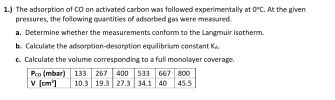
1.) The adsorption of CO on activated carbon was followed experimentally at 0°C. At the given e es, the following que pressures, the following quantities of adsorbed gas were measured a. Determine whether the measurements conform to the Langmuir isotherm b. Calculate the adsorption-desorption equilibrium constant KA c. Calculate the volume corresponding to a full monolayer coverage. Co V [cm3]10.3 19.3 27.3 34.1 4045.5
PLease show all work. Thank
you.
1.) The adsorption of CO on activated carbon was followed experimentally at 0°C. At the given e es, the following que pressures, the following quantities of adsorbed gas were measured a. Determine whether the measurements conform to the Langmuir isotherm b. Calculate the adsorption-desorption equilibrium constant KA c. Calculate the volume corresponding to a full monolayer coverage. Co V [cm3]10.3 19.3 27.3 34.1 4045.5
solve question 15 14. Calculate the probability of finding the particle in a one dilesO 'L'...
 solve question 15
14. Calculate the probability of finding the particle in a one dilesO 'L' in the region between L/4 & 3 L/4 for quantum number n = 1. 15. Identity which of the following operator is Not Hermitian with reasons? A) (h/i) lfr Derive the Langmuir adsorption isotherm. How this isotherm tested? 1l sfo cunoint group.
solve question 15
14. Calculate the probability of finding the particle in a one dilesO 'L' in the region between L/4 & 3 L/4 for quantum number n = 1. 15. Identity which of the following operator is Not Hermitian with reasons? A) (h/i) lfr Derive the Langmuir adsorption isotherm. How this isotherm tested? 1l sfo cunoint group.
Question 14 4 pts The expression for the equilibrium constant, K, for the general reaction: a...
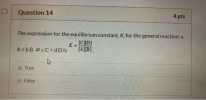 Question 14 4 pts The expression for the equilibrium constant, K, for the general reaction: a K - [CID] A+bB =cC+d Dis [A][B] True False
a. 14. What is the correct equilibrium constant expression for the following reaction? CO2(g) + 2H2O(8)...
 a. 14. What is the correct equilibrium constant expression for the following reaction? CO2(g) + 2H2O(8) CH4(g) + 2O2(g) Poo, PH₂O PcH, X PO, Рcн, хро, K= b. Pool x Pн,о c. K= Pch, *(Po,) Pco, x (Ph,0) Pco, (P2,0) Pch, *(Po,) d. 1 K- e, none of the above
Using data from Appendix C in the textbook, write the equilibrium-constant expression and calculate the value...
Using data from Appendix C in the textbook, write the equilibrium-constant expression and calculate the value of the equilibrium constant and the free-energy change for these reactions at 298 K . A) NaHCO3(s) ⇌ NaOH(s)+CO2(g) What is the free-energy change for this reaction at 298 K? Express the free energy in kilojoules to one decimal place. B) 2HBr(g)+Cl2(g) ⇌ 2HCl(g)+Br2(g) Which is the equilibrium-constant expression for this reaction? K=P2HClPBr2P2HBrPCl2 K=P2HBrPCl2 K=P2HBrPCl2P2HClPBr2 K=PHClPBr2PHBrPCl2 C) 2SO2(g)+O2(g) ⇌ 2SO3(g) Which is the equilibrium-constant...
help with questions please TA'[B Write the expression for the equilibrium constant for the following reactions:...
 help with questions please
TA'[B Write the expression for the equilibrium constant for the following reactions: N204 (g) 2NO2 (g) N2 (9) + 3H2 (g) = 2NH3 (9) Solids are not included in the expression since the concentrations do not change. After you write the expression, explain why the solid concentrations do not change. MgCO3(s) = MgO(s) + CO2(g) Solvents are not included in the expression since the concentrations do not change. After you write the expression, explain why the...
help with questions please
TA'[B Write the expression for the equilibrium constant for the following reactions: N204 (g) 2NO2 (g) N2 (9) + 3H2 (g) = 2NH3 (9) Solids are not included in the expression since the concentrations do not change. After you write the expression, explain why the solid concentrations do not change. MgCO3(s) = MgO(s) + CO2(g) Solvents are not included in the expression since the concentrations do not change. After you write the expression, explain why the...
help QUESTION 14 Which of the following expressions is the correct equilibrium-constant expression for the reaction...
 help
QUESTION 14 Which of the following expressions is the correct equilibrium-constant expression for the reaction below? P4(s) + 5 O2(g) = P4010(5) [P4010] [P][0,1/5 O [021-5 O [02]5 [P][021 OP 010) [P4010] [P[021 QUESTION 15 A particular reaction has an activation energy. E. of 148 kJ/mol. If the rate constant for the reaction is 0.00387 3 582 °C, at what temperature in°C) would the rate constant be 0.487 s 111? *Please report 3 significant figures. Numbers only, no unit....
help
QUESTION 14 Which of the following expressions is the correct equilibrium-constant expression for the reaction below? P4(s) + 5 O2(g) = P4010(5) [P4010] [P][0,1/5 O [021-5 O [02]5 [P][021 OP 010) [P4010] [P[021 QUESTION 15 A particular reaction has an activation energy. E. of 148 kJ/mol. If the rate constant for the reaction is 0.00387 3 582 °C, at what temperature in°C) would the rate constant be 0.487 s 111? *Please report 3 significant figures. Numbers only, no unit....
Question 7 of 11> Write the equilibrium-constant expression for the reaction shown in terms of [NO],...
 Question 7 of 11> Write the equilibrium-constant expression for the reaction shown in terms of [NO], [O,1, and [NO,]. 2 NO(g)+0,(g) 2 NO, (g) Ke, which is sometimes symbolized as K or Keg, denotes that the equilibrium constant is expressed using molar concentrations. For this question, K means the same thing as K and Ko Ke =
 Find an expression for the rate of adsorption (d theta/dt)_ads, and an expression for the rate of desorption (d theta/dt)_des, where k_a and k_d are the adsorption and desorption rate constants, respectively. Using your result found in Step 2 above, show that at equilibrium theta = Kp/Kp + 1 Where K is the equilibrium constant for the adsorption/desorption process. FYI, this is called the Langmuir isotherm.
 1.) (14 pts.) An extension of the Langmuir adsorption isotherm is when a catalyst has separate sites that selectively choose one material over another. An example of when this happens is the catalytic oxidation of H2S over a bed of iron oxide granules. The overall reaction is H2S + 12 02 → 2 S2 + H2O The proposed mechanism is provided on the following page where the reaction of the adsorbed O and H2S is the rate limiting step. H2S+S'...
 PLease show all work. Thank
you.
1.) The adsorption of CO on activated carbon was followed experimentally at 0°C. At the given e es, the following que pressures, the following quantities of adsorbed gas were measured a. Determine whether the measurements conform to the Langmuir isotherm b. Calculate the adsorption-desorption equilibrium constant KA c. Calculate the volume corresponding to a full monolayer coverage. Co V [cm3]10.3 19.3 27.3 34.1 4045.5
PLease show all work. Thank
you.
1.) The adsorption of CO on activated carbon was followed experimentally at 0°C. At the given e es, the following que pressures, the following quantities of adsorbed gas were measured a. Determine whether the measurements conform to the Langmuir isotherm b. Calculate the adsorption-desorption equilibrium constant KA c. Calculate the volume corresponding to a full monolayer coverage. Co V [cm3]10.3 19.3 27.3 34.1 4045.5
 solve question 15
14. Calculate the probability of finding the particle in a one dilesO 'L' in the region between L/4 & 3 L/4 for quantum number n = 1. 15. Identity which of the following operator is Not Hermitian with reasons? A) (h/i) lfr Derive the Langmuir adsorption isotherm. How this isotherm tested? 1l sfo cunoint group.
solve question 15
14. Calculate the probability of finding the particle in a one dilesO 'L' in the region between L/4 & 3 L/4 for quantum number n = 1. 15. Identity which of the following operator is Not Hermitian with reasons? A) (h/i) lfr Derive the Langmuir adsorption isotherm. How this isotherm tested? 1l sfo cunoint group.
 Question 14 4 pts The expression for the equilibrium constant, K, for the general reaction: a K - [CID] A+bB =cC+d Dis [A][B] True False
 a. 14. What is the correct equilibrium constant expression for the following reaction? CO2(g) + 2H2O(8) CH4(g) + 2O2(g) Poo, PH₂O PcH, X PO, Рcн, хро, K= b. Pool x Pн,о c. K= Pch, *(Po,) Pco, x (Ph,0) Pco, (P2,0) Pch, *(Po,) d. 1 K- e, none of the above
 help with questions please
TA'[B Write the expression for the equilibrium constant for the following reactions: N204 (g) 2NO2 (g) N2 (9) + 3H2 (g) = 2NH3 (9) Solids are not included in the expression since the concentrations do not change. After you write the expression, explain why the solid concentrations do not change. MgCO3(s) = MgO(s) + CO2(g) Solvents are not included in the expression since the concentrations do not change. After you write the expression, explain why the...
help with questions please
TA'[B Write the expression for the equilibrium constant for the following reactions: N204 (g) 2NO2 (g) N2 (9) + 3H2 (g) = 2NH3 (9) Solids are not included in the expression since the concentrations do not change. After you write the expression, explain why the solid concentrations do not change. MgCO3(s) = MgO(s) + CO2(g) Solvents are not included in the expression since the concentrations do not change. After you write the expression, explain why the...
 help
QUESTION 14 Which of the following expressions is the correct equilibrium-constant expression for the reaction below? P4(s) + 5 O2(g) = P4010(5) [P4010] [P][0,1/5 O [021-5 O [02]5 [P][021 OP 010) [P4010] [P[021 QUESTION 15 A particular reaction has an activation energy. E. of 148 kJ/mol. If the rate constant for the reaction is 0.00387 3 582 °C, at what temperature in°C) would the rate constant be 0.487 s 111? *Please report 3 significant figures. Numbers only, no unit....
help
QUESTION 14 Which of the following expressions is the correct equilibrium-constant expression for the reaction below? P4(s) + 5 O2(g) = P4010(5) [P4010] [P][0,1/5 O [021-5 O [02]5 [P][021 OP 010) [P4010] [P[021 QUESTION 15 A particular reaction has an activation energy. E. of 148 kJ/mol. If the rate constant for the reaction is 0.00387 3 582 °C, at what temperature in°C) would the rate constant be 0.487 s 111? *Please report 3 significant figures. Numbers only, no unit....
 Question 7 of 11> Write the equilibrium-constant expression for the reaction shown in terms of [NO], [O,1, and [NO,]. 2 NO(g)+0,(g) 2 NO, (g) Ke, which is sometimes symbolized as K or Keg, denotes that the equilibrium constant is expressed using molar concentrations. For this question, K means the same thing as K and Ko Ke =
Most questions answered within 3 hours.
-
Where is the error in this code sequence?
String s1 = "Hello";
String s2 = "ello";...
asked 10 months ago -
Financial data for Joel de Paris, Inc., for last year
follow:
Joel de Paris, Inc.
Balance...
asked 10 months ago -
Consider this reaction:
Al2(SO4)3 (aq)+ BaCl3
(aq) Al2Cl6 (aq)- +
3BaSO4(s) . What is the...
asked 10 months ago -
Suppose that Savneet is considering increasing her
recent random sample from 20 car rentals to 40...
asked 10 months ago -
Trucks arrive at an unloading terminal at an average rate of 120
per hour.
Trucks arrive...
asked 10 months ago -
Why are methanol and ethanol completely soluble in water while
octanol is not very little soluble....
asked 10 months ago -
A facilities manager at a university reads in a research report
that the mean amount of...
asked 10 months ago -
When the CuSO4 is rehydrated by adding water to the anhydrous
compound, is this an endothermic...
asked 10 months ago -
A ray of sunlight is passing from diamond into crown glass; the
angle of incidence is...
asked 10 months ago -
A block of mass 0.249 kg is placed on top of a light, vertical
spring of...
asked 10 months ago -
how do the kidneys compensate in the presences of acidosis
a) trigger hyperventilate
b) reserve acid...
asked 10 months ago -
Question 501 pts
The rental rate of capital to the firm increases. Which of the
following...
asked 10 months ago