
Homework Answers
Request Answer!
We need at least 10 more requests to produce the answer.
0 / 10 have requested this problem solution
The more requests, the faster the answer.
Add Answer to:
1) Jamie received a new record player 100y1/ where y is the number of records he owns and r his leftover money. Jamie b...
1. Jason has $60 and wants to spend all his money on bread(X) and ham(Y) for...
 1. Jason has $60 and wants to spend all his money on bread(X) and ham(Y) for lunch. As we know, he tends to consume 3 units of bread with every 2 units of ham. Suppose the price of goods are $2(X) and $7(Y) respectively. A. Write down Jason's utility function and budget constraint. B. Calculate Jason's optimal point. C. Show the optimal point in graph. From now on, Jason's preference changes but budget constraint doesn't. The new utility function is:...
Sam’s utility function is U(x, y) = 2x + y, where x is the number of...
Sam’s utility function is U(x, y) = 2x + y, where x is the number of x’s he consumes per week and y is the number of y’s he consumes per week. Sam has $200 a week to spend. The price of x is $4. Sam currently doesn’t consume any y. Sam has received an invitation to join a club devoted to the consumption of y. If he joins the club, Sam can get a discount on the purchase of...
- H u y | | | | - 2. Xin is a foodie and loves to spend all his money on food(x) and drinks(Y). As we know, the pric...
 - H u y | | | | - 2. Xin is a foodie and loves to spend all his money on food(x) and drinks(Y). As we know, the price of food and drinks are $8 and $3 per unit respectively. Please answer the following questions. A. Assume that Xin has 168 dollars, please write down his budget constraint and make a graph of it. Slope and intercepts have to be marked clearly. B. Xin's utility function is U =...
how do you solve without lagrangians? 12 Pablo's utility function is U(x,y)= x+10y- y2/2, where x...
 how do you solve without
lagrangians?
12 Pablo's utility function is U(x,y)= x+10y- y2/2, where x is the number of x's he consumes per week and y is the number of y's he consumes per week. Pablo has $200 a week to spend. The price of x is $1. The price ofy is currently $5 per unit. Pablo has received an invitation to join a club devoted to the consumption of y. If he joins the club, Pablo can get...
how do you solve without
lagrangians?
12 Pablo's utility function is U(x,y)= x+10y- y2/2, where x is the number of x's he consumes per week and y is the number of y's he consumes per week. Pablo has $200 a week to spend. The price of x is $1. The price ofy is currently $5 per unit. Pablo has received an invitation to join a club devoted to the consumption of y. If he joins the club, Pablo can get...
1. Jason has $60 and wants to spend all his money on bread(X) and ham(Y) for...
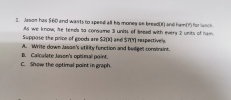 1. Jason has $60 and wants to spend all his money on bread(X) and ham(Y) for lunch. As we know, he tends to consume 3 units of bread with every 2 units of ham. Suppose the price of goods are $2(X) and $7(Y) respectively. A. Write down Jason's utility function and budget constraint. B. Calculate Jason's optimal point. C. Show the optimal point in graph. We were unable to transcribe this image
4. Malachi only consumes 2 goods: DVD rentals and coffee. His utility function is U(R,C)=R0.4C0.6 where...
 4. Malachi only consumes 2 goods: DVD rentals and coffee. His utility function is U(R,C)=R0.4C0.6 where R is the number of DVD rentals and C is cups of coffee. Malachi has $30 in his pocket right now, and he plans to spend all of the money on rentals and coffee today. a. The price of one rental is $3 and the price of one cup of coffee is $2 per cup. Solve for the optimal bundle. b. Suppose that Malachi...
1. Consider an individual demand function g 100-5P a. Solve for inverse demand. Plot. b. Suppose...
 1. Consider an individual demand function g 100-5P a. Solve for inverse demand. Plot. b. Suppose the market consisted of 5 buyers, each having the same individual demand. Find and plot the market demand c. Use the found market demand to determine the price (and quantity) that would maximize sellers revenue (assuming 1 seller). Ililustrate. (Attempt) If the seller's costs were $5 per unit, what would be the seller's profit-maximizing price and quantity? Illustrate your solution. d. 2. Suppose a...
Comprehensive Income Tax Course: Module 1 4. Randy turned 16 last year and had his first...
Comprehensive Income Tax Course: Module 1 4. Randy turned 16 last year and had his first summer job. Even though his parents are claiming him as a dependent he wants to file a return in order to get his refund. He receives his W-2 and decides he can do his own return using form 1040-EZ. Which of the following information is not found on a Form W-2? a) The taxpayer’s Social Security number b) The taxpayer’s wages, tips and other...
1) Decreasing returns to scale may occur as increasing the amount of inputs used A) increases...
 1) Decreasing returns to scale may occur as increasing the amount of inputs used A) increases specialization B) may cause coordination difficulties. C) always increases the amount of output produced D) increases efficiency. 2) Which of the following statements is NOT true? A) AFC = AC - AVC C) AVC = wage/MPL B) AC = AFC + AVC D) C=F-VC 3) The more elastic the demand curve, a monopoly A) will have a larger Lemer Index. will face a lower...
Can someone please tell me what chapters (1-5) these questions are based on? I have already answered the questions and u...
 Can someone please tell me what chapters (1-5) these questions
are based on? I have already answered the questions and understand
how to solve the material, but i want to be able to pinpoint where
i can find this info. in the book. I am using Brigham’s
Fundamentals of Financial Management (pictures attached). If it is
hard to read, please let me know. i will post better pictures. i
know the time vale of money stuff already
EDIT: HERE IS...
Can someone please tell me what chapters (1-5) these questions
are based on? I have already answered the questions and understand
how to solve the material, but i want to be able to pinpoint where
i can find this info. in the book. I am using Brigham’s
Fundamentals of Financial Management (pictures attached). If it is
hard to read, please let me know. i will post better pictures. i
know the time vale of money stuff already
EDIT: HERE IS...
 1. Jason has $60 and wants to spend all his money on bread(X) and ham(Y) for lunch. As we know, he tends to consume 3 units of bread with every 2 units of ham. Suppose the price of goods are $2(X) and $7(Y) respectively. A. Write down Jason's utility function and budget constraint. B. Calculate Jason's optimal point. C. Show the optimal point in graph. From now on, Jason's preference changes but budget constraint doesn't. The new utility function is:...
 - H u y | | | | - 2. Xin is a foodie and loves to spend all his money on food(x) and drinks(Y). As we know, the price of food and drinks are $8 and $3 per unit respectively. Please answer the following questions. A. Assume that Xin has 168 dollars, please write down his budget constraint and make a graph of it. Slope and intercepts have to be marked clearly. B. Xin's utility function is U =...
 how do you solve without
lagrangians?
12 Pablo's utility function is U(x,y)= x+10y- y2/2, where x is the number of x's he consumes per week and y is the number of y's he consumes per week. Pablo has $200 a week to spend. The price of x is $1. The price ofy is currently $5 per unit. Pablo has received an invitation to join a club devoted to the consumption of y. If he joins the club, Pablo can get...
how do you solve without
lagrangians?
12 Pablo's utility function is U(x,y)= x+10y- y2/2, where x is the number of x's he consumes per week and y is the number of y's he consumes per week. Pablo has $200 a week to spend. The price of x is $1. The price ofy is currently $5 per unit. Pablo has received an invitation to join a club devoted to the consumption of y. If he joins the club, Pablo can get...
 1. Jason has $60 and wants to spend all his money on bread(X) and ham(Y) for lunch. As we know, he tends to consume 3 units of bread with every 2 units of ham. Suppose the price of goods are $2(X) and $7(Y) respectively. A. Write down Jason's utility function and budget constraint. B. Calculate Jason's optimal point. C. Show the optimal point in graph. We were unable to transcribe this image
 4. Malachi only consumes 2 goods: DVD rentals and coffee. His utility function is U(R,C)=R0.4C0.6 where R is the number of DVD rentals and C is cups of coffee. Malachi has $30 in his pocket right now, and he plans to spend all of the money on rentals and coffee today. a. The price of one rental is $3 and the price of one cup of coffee is $2 per cup. Solve for the optimal bundle. b. Suppose that Malachi...
 1. Consider an individual demand function g 100-5P a. Solve for inverse demand. Plot. b. Suppose the market consisted of 5 buyers, each having the same individual demand. Find and plot the market demand c. Use the found market demand to determine the price (and quantity) that would maximize sellers revenue (assuming 1 seller). Ililustrate. (Attempt) If the seller's costs were $5 per unit, what would be the seller's profit-maximizing price and quantity? Illustrate your solution. d. 2. Suppose a...
 1) Decreasing returns to scale may occur as increasing the amount of inputs used A) increases specialization B) may cause coordination difficulties. C) always increases the amount of output produced D) increases efficiency. 2) Which of the following statements is NOT true? A) AFC = AC - AVC C) AVC = wage/MPL B) AC = AFC + AVC D) C=F-VC 3) The more elastic the demand curve, a monopoly A) will have a larger Lemer Index. will face a lower...
 Can someone please tell me what chapters (1-5) these questions
are based on? I have already answered the questions and understand
how to solve the material, but i want to be able to pinpoint where
i can find this info. in the book. I am using Brigham’s
Fundamentals of Financial Management (pictures attached). If it is
hard to read, please let me know. i will post better pictures. i
know the time vale of money stuff already
EDIT: HERE IS...
Can someone please tell me what chapters (1-5) these questions
are based on? I have already answered the questions and understand
how to solve the material, but i want to be able to pinpoint where
i can find this info. in the book. I am using Brigham’s
Fundamentals of Financial Management (pictures attached). If it is
hard to read, please let me know. i will post better pictures. i
know the time vale of money stuff already
EDIT: HERE IS...
Most questions answered within 3 hours.
-
Where is the error in this code sequence?
String s1 = "Hello";
String s2 = "ello";...
asked 10 months ago -
Financial data for Joel de Paris, Inc., for last year
follow:
Joel de Paris, Inc.
Balance...
asked 10 months ago -
Consider this reaction:
Al2(SO4)3 (aq)+ BaCl3
(aq) Al2Cl6 (aq)- +
3BaSO4(s) . What is the...
asked 10 months ago -
Suppose that Savneet is considering increasing her
recent random sample from 20 car rentals to 40...
asked 10 months ago -
Trucks arrive at an unloading terminal at an average rate of 120
per hour.
Trucks arrive...
asked 10 months ago -
Why are methanol and ethanol completely soluble in water while
octanol is not very little soluble....
asked 10 months ago -
A facilities manager at a university reads in a research report
that the mean amount of...
asked 10 months ago -
When the CuSO4 is rehydrated by adding water to the anhydrous
compound, is this an endothermic...
asked 10 months ago -
A ray of sunlight is passing from diamond into crown glass; the
angle of incidence is...
asked 10 months ago -
A block of mass 0.249 kg is placed on top of a light, vertical
spring of...
asked 10 months ago -
how do the kidneys compensate in the presences of acidosis
a) trigger hyperventilate
b) reserve acid...
asked 10 months ago -
Question 501 pts
The rental rate of capital to the firm increases. Which of the
following...
asked 10 months ago