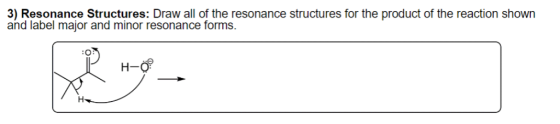
please provide explannation of the process, thanks.
Homework Answers
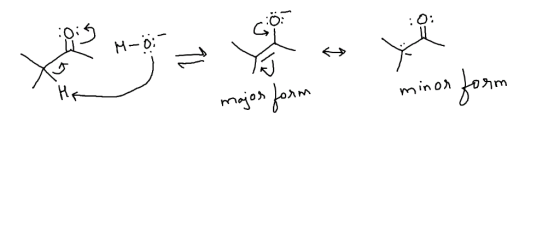
Major resonance form is more stable form. This is because Oxygen being more electronegative stabilizes negative charge better than Carbon. Hence O- is more stable than C-. Hence major resonance form has O-.
Add Answer to:
please provide explannation of the process, thanks. 3) Resonance Structures: Draw all of the resonance structures for t...
Assigned Problem Set #4 1. Draw all the significant resonance forms for the following structures, and...
 Assigned Problem Set #4 1. Draw all the significant resonance forms for the following structures, and indicate which are major and which are minor, or if you have two equally important forms, say so. The number of new forms you need to draw is shown in parentheses below the arrow. ankara (e) i to
1. Draw all the significant resonance forms for the following structures, and indicate which are major...
 1. Draw all the significant resonance forms for the following structures, and indicate which are major and which are minor, or if you have two equally important forms, say so. The number of new forms you need to draw is shown in parentheses below the arrow. (a) N co 4. In each of the following reactions, indicate which structure is the nucleophile and which is the electrophile. Also draw the products (use the electron pair arrows to guide you). (a)...
Chemistry 341 1. Draw all the significant resonance to major and which are minor, or if you have two cd Assigned Pr...
 Chemistry 341 1. Draw all the significant resonance to major and which are minor, or if you have two cd Assigned Problem Set #4 ant resonance forms for the following structures, and indicate which are are minor, or if you have two equally important forms, say so. The number forms you need to draw is shown in parentheses below the arrow. (a) N 29 (1) o (1)
Please provide explainations for your answers. Thanks! 1. Draw 3 contributing resonance structures of the molecule...
 Please provide explainations for your answers. Thanks!
1. Draw 3 contributing resonance structures of the molecule shown. OCH H2N OCH3 A B Which structure do you suppose contributes most? Why? 2. Provide the IUPAC name for the molecule shown below. Br IUPAC name: Ph 3. Draw the 6 Newman projections for the molecule shown, looking down the C(2)-C(3) bond. Circle the Newman projection that you think would be most stable. Use the table of gauche interactions to determine your answer...
Please provide explainations for your answers. Thanks!
1. Draw 3 contributing resonance structures of the molecule shown. OCH H2N OCH3 A B Which structure do you suppose contributes most? Why? 2. Provide the IUPAC name for the molecule shown below. Br IUPAC name: Ph 3. Draw the 6 Newman projections for the molecule shown, looking down the C(2)-C(3) bond. Circle the Newman projection that you think would be most stable. Use the table of gauche interactions to determine your answer...
1. Please draw all resonance structures (if there are any, not all structures may have resonance...
 1. Please draw all resonance structures (if there are any, not all structures may have resonance structures) for the carbocations A-E (make sure you use resonance arrows (<->). Then circle the carbons that can react with a nucleophile in a SN1-type reaction.
1. There are four resonance structures for the N2O4 molecule. (1) Draw all the resonance structures...
1. There are four resonance structures for the N2O4 molecule. (1) Draw all the resonance structures using the skeletal structure shown below; (2) Calculate the formal charges of each atom in the molecule; (3) What is the average N-O bond order? (Please refer to example 8.10 in your book for guidance.)
#3 and 4 please 3. Draw 2 reasonable resonance structures for a molecule with the following...
 #3 and 4 please
3. Draw 2 reasonable resonance structures for a molecule with the following skeletal structure (count electrons) H H C C-N-O Draw 2 reasonable resonance structures for a molecule with the following skeletal structure (count electrons) 4. H C N C O H- H -I
#3 and 4 please
3. Draw 2 reasonable resonance structures for a molecule with the following skeletal structure (count electrons) H H C C-N-O Draw 2 reasonable resonance structures for a molecule with the following skeletal structure (count electrons) 4. H C N C O H- H -I
Draw all resonance structures for this molecule and determine the major and minor resonance contributor. Where do you s...
 Draw all resonance structures for this molecule and determine
the major and minor resonance contributor.
Where do you start when there are two groups attached to a
benzene ring?
:0 CH3
Draw all resonance structures for this molecule and determine
the major and minor resonance contributor.
Where do you start when there are two groups attached to a
benzene ring?
:0 CH3
Please show all work for Number 5: CH3OH and number 3, HF one. Thank you Complete...
 Please show all work for
Number 5: CH3OH and number 3, HF one. Thank you
Complete the following reaction and provide forget resonance structures when applicable. a. a detailed arrow-pushing mechanism. Don't HF OH 5. (28 pt.) Complete the following reactions with the correct structures of starting material or product(s) Indicate 'major' and 'minor' if applicable. Don't forget to specify the stereochemistry and draw both enantiomers if applicable. Provide mechanism only if indicated. Cl2/H20 Et AV Use the provided template...
Please show all work for
Number 5: CH3OH and number 3, HF one. Thank you
Complete the following reaction and provide forget resonance structures when applicable. a. a detailed arrow-pushing mechanism. Don't HF OH 5. (28 pt.) Complete the following reactions with the correct structures of starting material or product(s) Indicate 'major' and 'minor' if applicable. Don't forget to specify the stereochemistry and draw both enantiomers if applicable. Provide mechanism only if indicated. Cl2/H20 Et AV Use the provided template...
Draw both resonance structures or draw the major organic product(s) as outlined in the instructions. Draw...
 Draw both resonance structures or draw the major organic
product(s) as outlined in the instructions.
Draw both resonance structures of the anion formed by the reaction of the most acidic C-H bond of the compound below with base. H3C OCH Include all valence lone pairs in your answer. For structures having different hydrogens of comparable acidity, assume that the reaction occurs at the less-substituted carbon. Draw one structure per sketcher. Add additional sketchers using the drop-down menu in the bottom...
Draw both resonance structures or draw the major organic
product(s) as outlined in the instructions.
Draw both resonance structures of the anion formed by the reaction of the most acidic C-H bond of the compound below with base. H3C OCH Include all valence lone pairs in your answer. For structures having different hydrogens of comparable acidity, assume that the reaction occurs at the less-substituted carbon. Draw one structure per sketcher. Add additional sketchers using the drop-down menu in the bottom...
 Assigned Problem Set #4 1. Draw all the significant resonance forms for the following structures, and indicate which are major and which are minor, or if you have two equally important forms, say so. The number of new forms you need to draw is shown in parentheses below the arrow. ankara (e) i to
 1. Draw all the significant resonance forms for the following structures, and indicate which are major and which are minor, or if you have two equally important forms, say so. The number of new forms you need to draw is shown in parentheses below the arrow. (a) N co 4. In each of the following reactions, indicate which structure is the nucleophile and which is the electrophile. Also draw the products (use the electron pair arrows to guide you). (a)...
 Chemistry 341 1. Draw all the significant resonance to major and which are minor, or if you have two cd Assigned Problem Set #4 ant resonance forms for the following structures, and indicate which are are minor, or if you have two equally important forms, say so. The number forms you need to draw is shown in parentheses below the arrow. (a) N 29 (1) o (1)
 Please provide explainations for your answers. Thanks!
1. Draw 3 contributing resonance structures of the molecule shown. OCH H2N OCH3 A B Which structure do you suppose contributes most? Why? 2. Provide the IUPAC name for the molecule shown below. Br IUPAC name: Ph 3. Draw the 6 Newman projections for the molecule shown, looking down the C(2)-C(3) bond. Circle the Newman projection that you think would be most stable. Use the table of gauche interactions to determine your answer...
Please provide explainations for your answers. Thanks!
1. Draw 3 contributing resonance structures of the molecule shown. OCH H2N OCH3 A B Which structure do you suppose contributes most? Why? 2. Provide the IUPAC name for the molecule shown below. Br IUPAC name: Ph 3. Draw the 6 Newman projections for the molecule shown, looking down the C(2)-C(3) bond. Circle the Newman projection that you think would be most stable. Use the table of gauche interactions to determine your answer...
 1. Please draw all resonance structures (if there are any, not all structures may have resonance structures) for the carbocations A-E (make sure you use resonance arrows (<->). Then circle the carbons that can react with a nucleophile in a SN1-type reaction.
 #3 and 4 please
3. Draw 2 reasonable resonance structures for a molecule with the following skeletal structure (count electrons) H H C C-N-O Draw 2 reasonable resonance structures for a molecule with the following skeletal structure (count electrons) 4. H C N C O H- H -I
#3 and 4 please
3. Draw 2 reasonable resonance structures for a molecule with the following skeletal structure (count electrons) H H C C-N-O Draw 2 reasonable resonance structures for a molecule with the following skeletal structure (count electrons) 4. H C N C O H- H -I
 Draw all resonance structures for this molecule and determine
the major and minor resonance contributor.
Where do you start when there are two groups attached to a
benzene ring?
:0 CH3
Draw all resonance structures for this molecule and determine
the major and minor resonance contributor.
Where do you start when there are two groups attached to a
benzene ring?
:0 CH3
 Please show all work for
Number 5: CH3OH and number 3, HF one. Thank you
Complete the following reaction and provide forget resonance structures when applicable. a. a detailed arrow-pushing mechanism. Don't HF OH 5. (28 pt.) Complete the following reactions with the correct structures of starting material or product(s) Indicate 'major' and 'minor' if applicable. Don't forget to specify the stereochemistry and draw both enantiomers if applicable. Provide mechanism only if indicated. Cl2/H20 Et AV Use the provided template...
Please show all work for
Number 5: CH3OH and number 3, HF one. Thank you
Complete the following reaction and provide forget resonance structures when applicable. a. a detailed arrow-pushing mechanism. Don't HF OH 5. (28 pt.) Complete the following reactions with the correct structures of starting material or product(s) Indicate 'major' and 'minor' if applicable. Don't forget to specify the stereochemistry and draw both enantiomers if applicable. Provide mechanism only if indicated. Cl2/H20 Et AV Use the provided template...
 Draw both resonance structures or draw the major organic
product(s) as outlined in the instructions.
Draw both resonance structures of the anion formed by the reaction of the most acidic C-H bond of the compound below with base. H3C OCH Include all valence lone pairs in your answer. For structures having different hydrogens of comparable acidity, assume that the reaction occurs at the less-substituted carbon. Draw one structure per sketcher. Add additional sketchers using the drop-down menu in the bottom...
Draw both resonance structures or draw the major organic
product(s) as outlined in the instructions.
Draw both resonance structures of the anion formed by the reaction of the most acidic C-H bond of the compound below with base. H3C OCH Include all valence lone pairs in your answer. For structures having different hydrogens of comparable acidity, assume that the reaction occurs at the less-substituted carbon. Draw one structure per sketcher. Add additional sketchers using the drop-down menu in the bottom...
Most questions answered within 3 hours.
-
Where is the error in this code sequence?
String s1 = "Hello";
String s2 = "ello";...
asked 10 months ago -
Financial data for Joel de Paris, Inc., for last year
follow:
Joel de Paris, Inc.
Balance...
asked 10 months ago -
Consider this reaction:
Al2(SO4)3 (aq)+ BaCl3
(aq) Al2Cl6 (aq)- +
3BaSO4(s) . What is the...
asked 10 months ago -
Suppose that Savneet is considering increasing her
recent random sample from 20 car rentals to 40...
asked 10 months ago -
Trucks arrive at an unloading terminal at an average rate of 120
per hour.
Trucks arrive...
asked 10 months ago -
Why are methanol and ethanol completely soluble in water while
octanol is not very little soluble....
asked 10 months ago -
A facilities manager at a university reads in a research report
that the mean amount of...
asked 10 months ago -
When the CuSO4 is rehydrated by adding water to the anhydrous
compound, is this an endothermic...
asked 10 months ago -
A ray of sunlight is passing from diamond into crown glass; the
angle of incidence is...
asked 10 months ago -
A block of mass 0.249 kg is placed on top of a light, vertical
spring of...
asked 10 months ago -
how do the kidneys compensate in the presences of acidosis
a) trigger hyperventilate
b) reserve acid...
asked 10 months ago -
Question 501 pts
The rental rate of capital to the firm increases. Which of the
following...
asked 10 months ago