

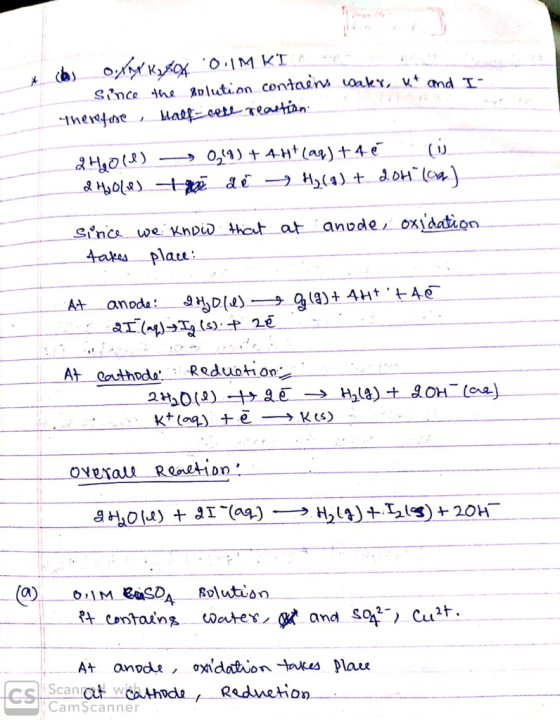
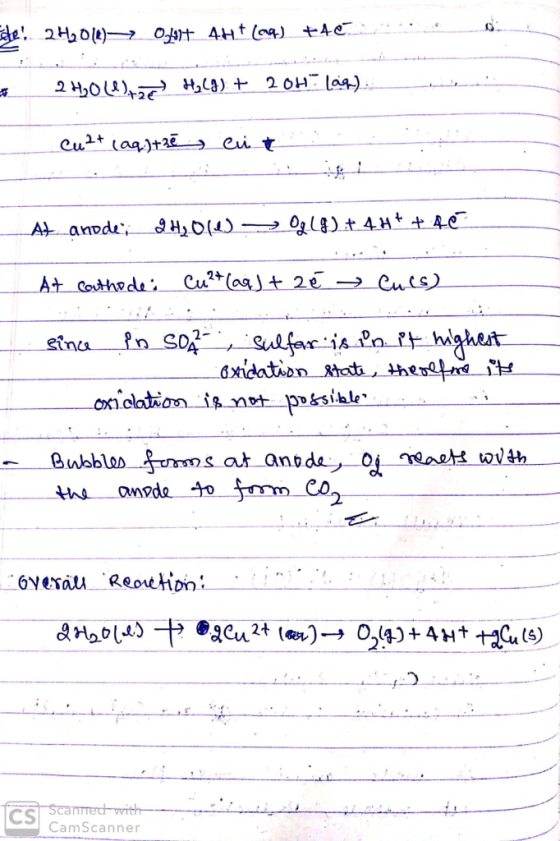
Note that the pencil leads are black graphite (carbon) that conduct electricity 0.1 mol L1 copper sulfate: (a) Observation: at the anode: at the cathode: Reaction: at anode: at cathode: overall: 0.1 mol L1 potassium iodide: (b) Observation: at the anode: at the cathode: at anode Reaction: at cathode: overall
Homework Answers
Add Answer to:
Write the species that act as electron acceptors in electrolysis in (a) and (b): Write the species that act a...
what is electrolysis and what is the overall reaction in this experiment? write out the half...
 what is electrolysis and what is the overall reaction in this
experiment? write out the half reactions occurring at each
electrode (assuming you are electroplating copper.
Electroplating is the process by which a thin layer of metal is deposited on an electrically conducting surface. In electroplating, the metal to be plated is used as the anode and the electrolytic solution contains an ion derived from that metal. In this experiment, the copper electrode will be used in a solution of...
what is electrolysis and what is the overall reaction in this
experiment? write out the half reactions occurring at each
electrode (assuming you are electroplating copper.
Electroplating is the process by which a thin layer of metal is deposited on an electrically conducting surface. In electroplating, the metal to be plated is used as the anode and the electrolytic solution contains an ion derived from that metal. In this experiment, the copper electrode will be used in a solution of...
1. Identify the anode, the cathode, the reduced species and the oxidized species for the following...
 1. Identify the anode, the cathode, the reduced species and the oxidized species for the following electrochemical cells. Write the half reactions for the anode and cathode, the overall reaction. Calculate the total cell potential. a) Fe (8)| Fe (aq) (0.2 M) || Ni” (aq) (0.1 M) | Ni(s) b) Zn (s) | Zn? (aq) (1.0 x 10' M)||Cl(aq)(0.3 M) CI, (g) (0.100 bar) Pt (S) c) Pb (s) Pb2(aq) (1.0 x 10ʻM) || Cu (aq) (1.0 x 10M) Cu...
18. Identify the metal if during a 1.000 hour long 2 electron electrolysis reaction 8.388 g...
 18. Identify the metal if during a 1.000 hour long 2 electron electrolysis reaction 8.388 g of metal is deposited using a constant current of 4.000 A. 19. The standard cell potential (F) of a voltaic cell constructed using the cell reaction below is 0.76 V: Zn(s) +2H (aq) Zn2+(aq)+ H2(g) With PH2 1.0 atm and [Zn2]-1.0 mol L-1, the cell potential is 0.45 V. The concentration of Ht in the cathode compartment ismol L-1, Long Answer 20. A galvanic...
Folder Electro Test 10 Point Questions 6. Calculate ΔG° for the following reaction at 25°C 7. Exp...
 PLEASE ANSWER ALL OF QUESTION
9 WITH ALL WORK SHOWN. THANK YOU!
Folder Electro Test 10 Point Questions 6. Calculate ΔG° for the following reaction at 25°C 7. Explain the following using principles of atomic str nciples of atomic structure a K cannot be easily oxidized b. CI cannot be easily reduced How many moles of electrons Consider an uranium-bromine cell in which U is oxidized and Br, is reduced. If the s 8. are transferred in an electrolytic cell...
PLEASE ANSWER ALL OF QUESTION
9 WITH ALL WORK SHOWN. THANK YOU!
Folder Electro Test 10 Point Questions 6. Calculate ΔG° for the following reaction at 25°C 7. Explain the following using principles of atomic str nciples of atomic structure a K cannot be easily oxidized b. CI cannot be easily reduced How many moles of electrons Consider an uranium-bromine cell in which U is oxidized and Br, is reduced. If the s 8. are transferred in an electrolytic cell...
need help with questions EXPERIMENT 9: ELECTROLYSIS AND AVOGADRO'S NUMBER QUESTIONS 1. What solution is used...
 need help with questions
EXPERIMENT 9: ELECTROLYSIS AND AVOGADRO'S NUMBER QUESTIONS 1. What solution is used in the apparatus for this experiment? a. Would anything else work? b. If so, what are some examples? 2. What gas forms at the cathode in this experiment? 3. What gas forms at the anode in this experiment? 4. How is the temperature of each of the gases determined? EXPERIMENT ELECTROLYSIS & AVOGADRO'S NUMBER UUUUUUUUUUU INTRODUCTION Electrolysis is the process of causing a chemical...
need help with questions
EXPERIMENT 9: ELECTROLYSIS AND AVOGADRO'S NUMBER QUESTIONS 1. What solution is used in the apparatus for this experiment? a. Would anything else work? b. If so, what are some examples? 2. What gas forms at the cathode in this experiment? 3. What gas forms at the anode in this experiment? 4. How is the temperature of each of the gases determined? EXPERIMENT ELECTROLYSIS & AVOGADRO'S NUMBER UUUUUUUUUUU INTRODUCTION Electrolysis is the process of causing a chemical...
When you write the answers, please write the page number for which the question is located....
 When you write the answers, please write the page number for
which the question is located. Thank you!
Experiment 8 Name: Double Replacement Reactions Background: Some reactions have the net effect of causing the cation of cach reactant to trade places, forming a compound with the other anion. These reactions are known as double replacement reactions. In the example below (unbalanced equation), the barium and sodium cations switch places so that barium forms a product with sulfate while sodium forms...
When you write the answers, please write the page number for
which the question is located. Thank you!
Experiment 8 Name: Double Replacement Reactions Background: Some reactions have the net effect of causing the cation of cach reactant to trade places, forming a compound with the other anion. These reactions are known as double replacement reactions. In the example below (unbalanced equation), the barium and sodium cations switch places so that barium forms a product with sulfate while sodium forms...
Experiment 8 Double Replacement Reactions Background: Some reactions have the net effect of causing the cation...
 Experiment 8 Double Replacement Reactions Background: Some reactions have the net effect of causing the cation of each reactant to trade places, forming a compound with the other anion. These reactions are known as double replacement reactions. In the example below (unbalanced equation), the barium and sodium cations switch places so that barium forms a product with sulfate while sodium forms a product with chloride. Note that the formula of each product is determined by the charges of the ions,...
CHM 1210 Final practice Name: Know electrolyte table, 5 solubility rules; 26 polyatomics (name/formula) Write 7...
 CHM 1210 Final practice Name: Know electrolyte table, 5 solubility rules; 26 polyatomics (name/formula) Write 7 naturally occurring diatomic molecules (name; formula, phase , charge) Write rite out strong acids and weak acids by name; formula, phase ,charge Write out the molecular, complete, and net-ionic equations for the following reactions The mixing of Cobalt(IlI) chloride and silver nitrate The mixing of acetic acid and sodium hydroxide The mixing of hydrochloric acid and cakcium hydroxide The mixing of barium chloride and...
5. What was the purpose of the NaNO3 solution in this experiment? 6. Could a solution...
 5. What was the purpose of the NaNO3 solution in this experiment? 6. Could a solution of NaCl be used instead of NaNO3? 7. What was the purpose of FeSO4 solution in this experiment? 8. Could a solution of FeCl, be used instead of FeSO4? 9. Could a solution of NaSO4 be used instead of FeSO4? 10. Calculate the standard cell potential for the spontaneous redox reaction between a Pb(s)/Pb(NO3)2(aq) half-cell and a Ag(s)/AgNO3(aq) half-cell. Which metal would be oxidized?...
1. [6.4% ) Write down the electron configuration for Br. 2. [6.4 %) Draw resonance structures...
 1. [6.4% ) Write down the electron configuration for Br. 2. [6.4 %) Draw resonance structures for (a) NO:, (b) NNO (a) N-NEO (b) NN-o 3. [6.4%) In which pair do both compounds exhibit predominantly covalent bonding? A. BaCl and H-O B. NaBr and SO C. K O and NBr D. CCl and Asl 4. [6.4 % ) Rank the following hydrocarbons in order of increasing vapor pressure: CHe, CvoH, CH, CH16, C22H 5. [6.4%) O and N2 in air...
 what is electrolysis and what is the overall reaction in this
experiment? write out the half reactions occurring at each
electrode (assuming you are electroplating copper.
Electroplating is the process by which a thin layer of metal is deposited on an electrically conducting surface. In electroplating, the metal to be plated is used as the anode and the electrolytic solution contains an ion derived from that metal. In this experiment, the copper electrode will be used in a solution of...
what is electrolysis and what is the overall reaction in this
experiment? write out the half reactions occurring at each
electrode (assuming you are electroplating copper.
Electroplating is the process by which a thin layer of metal is deposited on an electrically conducting surface. In electroplating, the metal to be plated is used as the anode and the electrolytic solution contains an ion derived from that metal. In this experiment, the copper electrode will be used in a solution of...
 1. Identify the anode, the cathode, the reduced species and the oxidized species for the following electrochemical cells. Write the half reactions for the anode and cathode, the overall reaction. Calculate the total cell potential. a) Fe (8)| Fe (aq) (0.2 M) || Ni” (aq) (0.1 M) | Ni(s) b) Zn (s) | Zn? (aq) (1.0 x 10' M)||Cl(aq)(0.3 M) CI, (g) (0.100 bar) Pt (S) c) Pb (s) Pb2(aq) (1.0 x 10ʻM) || Cu (aq) (1.0 x 10M) Cu...
 18. Identify the metal if during a 1.000 hour long 2 electron electrolysis reaction 8.388 g of metal is deposited using a constant current of 4.000 A. 19. The standard cell potential (F) of a voltaic cell constructed using the cell reaction below is 0.76 V: Zn(s) +2H (aq) Zn2+(aq)+ H2(g) With PH2 1.0 atm and [Zn2]-1.0 mol L-1, the cell potential is 0.45 V. The concentration of Ht in the cathode compartment ismol L-1, Long Answer 20. A galvanic...
 PLEASE ANSWER ALL OF QUESTION
9 WITH ALL WORK SHOWN. THANK YOU!
Folder Electro Test 10 Point Questions 6. Calculate ΔG° for the following reaction at 25°C 7. Explain the following using principles of atomic str nciples of atomic structure a K cannot be easily oxidized b. CI cannot be easily reduced How many moles of electrons Consider an uranium-bromine cell in which U is oxidized and Br, is reduced. If the s 8. are transferred in an electrolytic cell...
PLEASE ANSWER ALL OF QUESTION
9 WITH ALL WORK SHOWN. THANK YOU!
Folder Electro Test 10 Point Questions 6. Calculate ΔG° for the following reaction at 25°C 7. Explain the following using principles of atomic str nciples of atomic structure a K cannot be easily oxidized b. CI cannot be easily reduced How many moles of electrons Consider an uranium-bromine cell in which U is oxidized and Br, is reduced. If the s 8. are transferred in an electrolytic cell...
 need help with questions
EXPERIMENT 9: ELECTROLYSIS AND AVOGADRO'S NUMBER QUESTIONS 1. What solution is used in the apparatus for this experiment? a. Would anything else work? b. If so, what are some examples? 2. What gas forms at the cathode in this experiment? 3. What gas forms at the anode in this experiment? 4. How is the temperature of each of the gases determined? EXPERIMENT ELECTROLYSIS & AVOGADRO'S NUMBER UUUUUUUUUUU INTRODUCTION Electrolysis is the process of causing a chemical...
need help with questions
EXPERIMENT 9: ELECTROLYSIS AND AVOGADRO'S NUMBER QUESTIONS 1. What solution is used in the apparatus for this experiment? a. Would anything else work? b. If so, what are some examples? 2. What gas forms at the cathode in this experiment? 3. What gas forms at the anode in this experiment? 4. How is the temperature of each of the gases determined? EXPERIMENT ELECTROLYSIS & AVOGADRO'S NUMBER UUUUUUUUUUU INTRODUCTION Electrolysis is the process of causing a chemical...
 When you write the answers, please write the page number for
which the question is located. Thank you!
Experiment 8 Name: Double Replacement Reactions Background: Some reactions have the net effect of causing the cation of cach reactant to trade places, forming a compound with the other anion. These reactions are known as double replacement reactions. In the example below (unbalanced equation), the barium and sodium cations switch places so that barium forms a product with sulfate while sodium forms...
When you write the answers, please write the page number for
which the question is located. Thank you!
Experiment 8 Name: Double Replacement Reactions Background: Some reactions have the net effect of causing the cation of cach reactant to trade places, forming a compound with the other anion. These reactions are known as double replacement reactions. In the example below (unbalanced equation), the barium and sodium cations switch places so that barium forms a product with sulfate while sodium forms...
 Experiment 8 Double Replacement Reactions Background: Some reactions have the net effect of causing the cation of each reactant to trade places, forming a compound with the other anion. These reactions are known as double replacement reactions. In the example below (unbalanced equation), the barium and sodium cations switch places so that barium forms a product with sulfate while sodium forms a product with chloride. Note that the formula of each product is determined by the charges of the ions,...
 CHM 1210 Final practice Name: Know electrolyte table, 5 solubility rules; 26 polyatomics (name/formula) Write 7 naturally occurring diatomic molecules (name; formula, phase , charge) Write rite out strong acids and weak acids by name; formula, phase ,charge Write out the molecular, complete, and net-ionic equations for the following reactions The mixing of Cobalt(IlI) chloride and silver nitrate The mixing of acetic acid and sodium hydroxide The mixing of hydrochloric acid and cakcium hydroxide The mixing of barium chloride and...
 5. What was the purpose of the NaNO3 solution in this experiment? 6. Could a solution of NaCl be used instead of NaNO3? 7. What was the purpose of FeSO4 solution in this experiment? 8. Could a solution of FeCl, be used instead of FeSO4? 9. Could a solution of NaSO4 be used instead of FeSO4? 10. Calculate the standard cell potential for the spontaneous redox reaction between a Pb(s)/Pb(NO3)2(aq) half-cell and a Ag(s)/AgNO3(aq) half-cell. Which metal would be oxidized?...
 1. [6.4% ) Write down the electron configuration for Br. 2. [6.4 %) Draw resonance structures for (a) NO:, (b) NNO (a) N-NEO (b) NN-o 3. [6.4%) In which pair do both compounds exhibit predominantly covalent bonding? A. BaCl and H-O B. NaBr and SO C. K O and NBr D. CCl and Asl 4. [6.4 % ) Rank the following hydrocarbons in order of increasing vapor pressure: CHe, CvoH, CH, CH16, C22H 5. [6.4%) O and N2 in air...
Most questions answered within 3 hours.
-
Where is the error in this code sequence?
String s1 = "Hello";
String s2 = "ello";...
asked 10 months ago -
Financial data for Joel de Paris, Inc., for last year
follow:
Joel de Paris, Inc.
Balance...
asked 10 months ago -
Consider this reaction:
Al2(SO4)3 (aq)+ BaCl3
(aq) Al2Cl6 (aq)- +
3BaSO4(s) . What is the...
asked 10 months ago -
Suppose that Savneet is considering increasing her
recent random sample from 20 car rentals to 40...
asked 10 months ago -
Trucks arrive at an unloading terminal at an average rate of 120
per hour.
Trucks arrive...
asked 10 months ago -
Why are methanol and ethanol completely soluble in water while
octanol is not very little soluble....
asked 10 months ago -
A facilities manager at a university reads in a research report
that the mean amount of...
asked 10 months ago -
When the CuSO4 is rehydrated by adding water to the anhydrous
compound, is this an endothermic...
asked 10 months ago -
A ray of sunlight is passing from diamond into crown glass; the
angle of incidence is...
asked 10 months ago -
A block of mass 0.249 kg is placed on top of a light, vertical
spring of...
asked 10 months ago -
how do the kidneys compensate in the presences of acidosis
a) trigger hyperventilate
b) reserve acid...
asked 10 months ago -
Question 501 pts
The rental rate of capital to the firm increases. Which of the
following...
asked 10 months ago