![1. Let ab and f E C[a, b], and let E(0, ))- - (co +c)w(a) da for some weight function w(x) >0. (a) Use calculus to write down](http://img.homeworklib.com/images/83d1cc2f-36c8-4307-b36c-3b2ef03370eb.png?x-oss-process=image/resize,w_560)
Homework Answers
a) ![E(Co, C) [f(x) (coc1)] w(x) da](http://img.homeworklib.com/images/56526cb0-7f5e-418d-9939-504da1320ba4.latex?E%28c_0%2Cc_1%29%3D%5Cint_a%5Eb%20%5Cleft%5Bf%28x%29-%28c_0+c_1x%29%20%5Cright%20%5D%5E2w%28x%29%5C%2Cdx?x-oss-process=image/resize,w_560)
Then 
![a E(co, c1) 2 aco f(x) (coC1)] w(x) dr = 0](http://img.homeworklib.com/images/20edee74-aeab-4c09-95eb-75402dbf4945.latex?%5Cfrac%7B%5Cpartial%20%7D%7B%5Cpartial%20c_0%7DE%28c_0%2Cc_1%29%3D2%5Cint_a%5Eb%20%5Cleft%5Bf%28x%29-%28c_0+c_1x%29%20%5Cright%20%5Dw%28x%29%5C%2Cdx%3D0?x-oss-process=image/resize,w_560)
![-E(co, e) 2 [f (x) (coc1ax)] w (x) dar 0](http://img.homeworklib.com/images/75a3f82e-4268-4f40-b20a-74fb5f3ac0ce.latex?%5Cfrac%7B%5Cpartial%20%7D%7B%5Cpartial%20c_1%7DE%28c_0%2Cc_1%29%3D2%5Cint_a%5Eb%20x%5Cleft%5Bf%28x%29-%28c_0+c_1x%29%20%5Cright%20%5Dw%28x%29%5C%2Cdx%3D0?x-oss-process=image/resize,w_560)
So that 
b) The theorem is not known to me so I cannot comment if its the same set of equations or not
c) 


So that

Solving this, we get 
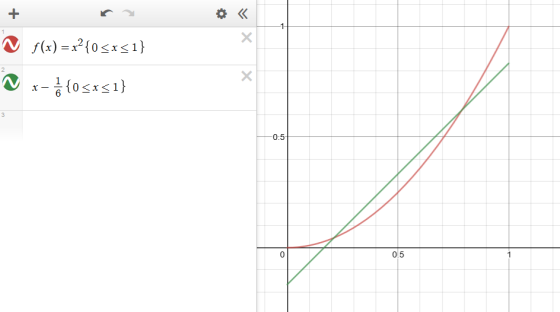
Meaning the required approximation to 

Graph of the two function is given below for reference:
Add Answer to:
1. Let ab and f E C[a, b], and let E(0, ))- - (co +c)w(a) da for some weight function w(x) >0. (a) Use calculus to w...
(5) Let f: [0, 1 R. We say that f is Hölder continuous of order a e (0,1) if \f(x) -- f(y)| . , y sup [0, 1] with 2 # 1...
 (5) Let f: [0, 1 R. We say that f is Hölder continuous of order a e (0,1) if \f(x) -- f(y)| . , y sup [0, 1] with 2 # 1£l\c° sup is finite. We define Co ((0, 1]) f: [0, 1] -R: f is Hölder continuous of order a}. = (a) For f,gE C ([0, 1]) define da(f,g) = ||f-9||c«. Prove that da is a well-defined metric Ca((0, 1) (b) Prove that (C ([0, 1]), da) is complete...
3. Consider the function f(x) - 1 from x=0 to x=5. a. Use Maple's Riemann Sums...
 3. Consider the function f(x) - 1 from x=0 to x=5. a. Use Maple's Riemann Sums function to compute Lon b. Use Maple's Riemann Sums function to compute M1000 c. Use the Fundamental Theorem of Calculus to compute the area under f from x r = 5.
(7) In this problem let X denote the vector space C(0, 1) with the sup norm. (a) Given f e X, define d(f) = f2. : X → X is differentiable, and Prove that φ find φ'(f). (b) Given f e X, define 9(f...
 (7) In this problem let X denote the vector space C(0, 1) with the sup norm. (a) Given f e X, define d(f) = f2. : X → X is differentiable, and Prove that φ find φ'(f). (b) Given f e X, define 9(f) = J0 [f(t)]2dt. Prove that Ψ : X → R is differentiable. and find Ψ(f).
(7) In this problem let X denote the vector space C(0, 1) with the sup norm. (a) Given f e X,...
(7) In this problem let X denote the vector space C(0, 1) with the sup norm. (a) Given f e X, define d(f) = f2. : X → X is differentiable, and Prove that φ find φ'(f). (b) Given f e X, define 9(f) = J0 [f(t)]2dt. Prove that Ψ : X → R is differentiable. and find Ψ(f).
(7) In this problem let X denote the vector space C(0, 1) with the sup norm. (a) Given f e X,...
Let A e Cpxp,A e C, and let 11-11 a multiplicative norm on Cpxp. Use Theorem 7.27 of your lecture notes to show that if Al > ll All , then 1. XIp A is invertible and Ip Theorem 7.27. If Il is a su...
 Let A e Cpxp,A e C, and let 11-11 a multiplicative norm on Cpxp. Use Theorem 7.27 of your lecture notes to show that if Al > ll All , then 1. XIp A is invertible and Ip Theorem 7.27. If Il is a sub-multiplicative norm on C, then pl 1. Moreover, i X E CPXP and |X|l < 1, then 1. Ip X is invertible. 2. (1,-X)-1-).X' ; i.e., the sum converges j-0 SI
Let A e Cpxp,A e...
Let A e Cpxp,A e C, and let 11-11 a multiplicative norm on Cpxp. Use Theorem 7.27 of your lecture notes to show that if Al > ll All , then 1. XIp A is invertible and Ip Theorem 7.27. If Il is a sub-multiplicative norm on C, then pl 1. Moreover, i X E CPXP and |X|l < 1, then 1. Ip X is invertible. 2. (1,-X)-1-).X' ; i.e., the sum converges j-0 SI
Let A e Cpxp,A e...
(b) Let f 0, 1-R be a C2 function and let g, h: [0, 00)-R be C1. Consider the initial-boundary value problem kwr w(...
 (b) Let f 0, 1-R be a C2 function and let g, h: [0, 00)-R be C1. Consider the initial-boundary value problem kwr w(r, 0) f(a) w(0, t) g(t) w(1, t) h(t) for a function w: [0,1 x [0, 0)- R such that w, wn, and wa exist and are continuous. Show that the solution to this problem is unique, that is, if w1 and w2 [0, 1] x [0, 00)- R both satisfy these conditions, then w1 = w2....
3. Let f be a continuous function on [a, b] with f(a)0< f(b). (a) The proof of Theorem 7-1 showed that there is a smallest x in [a, bl with f(x)0. If there is more than one x in [a, b] with...
 3. Let f be a continuous function on [a, b] with f(a)0< f(b). (a) The proof of Theorem 7-1 showed that there is a smallest x in [a, bl with f(x)0. If there is more than one x in [a, b] with f(x)0, is there necessarily a second smallest? Show that there is a largest x in [a, b] with f(x) -0. (Try to give an easy proof by considering a new function closely related to f.) b) The proof...
hint: H3. Let W1 = {ax? + bx² + 25x + a : a, b e...
 hint:
H3. Let W1 = {ax? + bx² + 25x + a : a, b e R}. (a) Prove that W is a subspace of P3(R). (b) Find a basis for W. (c) Find all pairs (a,b) of real numbers for which the subspace W2 = Span {x} + ax + 1, 3x + 1, x + x} satisfies dim(W. + W2) = 3 and dim(Win W2) = 1. H3. (a) Use Theorem 1.8.1. (b) Let p(x) = ax +...
hint:
H3. Let W1 = {ax? + bx² + 25x + a : a, b e R}. (a) Prove that W is a subspace of P3(R). (b) Find a basis for W. (c) Find all pairs (a,b) of real numbers for which the subspace W2 = Span {x} + ax + 1, 3x + 1, x + x} satisfies dim(W. + W2) = 3 and dim(Win W2) = 1. H3. (a) Use Theorem 1.8.1. (b) Let p(x) = ax +...
Let V = P1(R) and W = R2. Let B = (1,x) and y=((1,0), (0, 1))...
 Let V = P1(R) and W = R2. Let B = (1,x) and y=((1,0), (0, 1)) be the standard ordered bases for V and W respectively. Define a linear map T:V + W by T(P(x)) = (p(0) – 2p(1), p(0) + p'(0)). (a) Let FEW* be defined by f(a,b) = a – 26. Compute T*(f). (b) Compute [T]y,ß and (T*]*,y* using the definition of the matrix of a linear transformation.
Problem 1. Let the inner prodct )be deined by (u.v)xu (x) v (x) dx, and let the norm |I-ll be def...
 Problem 1. Let the inner prodct )be deined by (u.v)xu (x) v (x) dx, and let the norm |I-ll be defined by ull , ).Consider the target function f (x) with the approximating space P e', and work 2. Use Gram-Schmidt orthogonalization with this inner product to find orthogonal polynomials p (x) through degree four. Standardize your polynomials such that p, (1) 1 (b) Find the best degree 4 approximation to f(x) using the specified norm, and working with this...
Answer C 6. Let f be a continuous function on [0, oo) such that 0 f(z)...
 Answer C
6. Let f be a continuous function on [0, oo) such that 0 f(z) Cl- for some C,e> 0, and let a = fo° f(x) da. (The estimate on f implies the convergence of this integral.) Let fk(x) = kf(ka) a. Show that lim00 fk(x) = 0 for all r > 0 and that the convergence is uniform on [8, oo) for any 6> 0. b. Show that limk00 So ()dz = a. c. Show that lim00 So...
Answer C
6. Let f be a continuous function on [0, oo) such that 0 f(z) Cl- for some C,e> 0, and let a = fo° f(x) da. (The estimate on f implies the convergence of this integral.) Let fk(x) = kf(ka) a. Show that lim00 fk(x) = 0 for all r > 0 and that the convergence is uniform on [8, oo) for any 6> 0. b. Show that limk00 So ()dz = a. c. Show that lim00 So...
 (5) Let f: [0, 1 R. We say that f is Hölder continuous of order a e (0,1) if \f(x) -- f(y)| . , y sup [0, 1] with 2 # 1£l\c° sup is finite. We define Co ((0, 1]) f: [0, 1] -R: f is Hölder continuous of order a}. = (a) For f,gE C ([0, 1]) define da(f,g) = ||f-9||c«. Prove that da is a well-defined metric Ca((0, 1) (b) Prove that (C ([0, 1]), da) is complete...
 3. Consider the function f(x) - 1 from x=0 to x=5. a. Use Maple's Riemann Sums function to compute Lon b. Use Maple's Riemann Sums function to compute M1000 c. Use the Fundamental Theorem of Calculus to compute the area under f from x r = 5.
 (7) In this problem let X denote the vector space C(0, 1) with the sup norm. (a) Given f e X, define d(f) = f2. : X → X is differentiable, and Prove that φ find φ'(f). (b) Given f e X, define 9(f) = J0 [f(t)]2dt. Prove that Ψ : X → R is differentiable. and find Ψ(f).
(7) In this problem let X denote the vector space C(0, 1) with the sup norm. (a) Given f e X,...
(7) In this problem let X denote the vector space C(0, 1) with the sup norm. (a) Given f e X, define d(f) = f2. : X → X is differentiable, and Prove that φ find φ'(f). (b) Given f e X, define 9(f) = J0 [f(t)]2dt. Prove that Ψ : X → R is differentiable. and find Ψ(f).
(7) In this problem let X denote the vector space C(0, 1) with the sup norm. (a) Given f e X,...
 Let A e Cpxp,A e C, and let 11-11 a multiplicative norm on Cpxp. Use Theorem 7.27 of your lecture notes to show that if Al > ll All , then 1. XIp A is invertible and Ip Theorem 7.27. If Il is a sub-multiplicative norm on C, then pl 1. Moreover, i X E CPXP and |X|l < 1, then 1. Ip X is invertible. 2. (1,-X)-1-).X' ; i.e., the sum converges j-0 SI
Let A e Cpxp,A e...
Let A e Cpxp,A e C, and let 11-11 a multiplicative norm on Cpxp. Use Theorem 7.27 of your lecture notes to show that if Al > ll All , then 1. XIp A is invertible and Ip Theorem 7.27. If Il is a sub-multiplicative norm on C, then pl 1. Moreover, i X E CPXP and |X|l < 1, then 1. Ip X is invertible. 2. (1,-X)-1-).X' ; i.e., the sum converges j-0 SI
Let A e Cpxp,A e...
 (b) Let f 0, 1-R be a C2 function and let g, h: [0, 00)-R be C1. Consider the initial-boundary value problem kwr w(r, 0) f(a) w(0, t) g(t) w(1, t) h(t) for a function w: [0,1 x [0, 0)- R such that w, wn, and wa exist and are continuous. Show that the solution to this problem is unique, that is, if w1 and w2 [0, 1] x [0, 00)- R both satisfy these conditions, then w1 = w2....
 3. Let f be a continuous function on [a, b] with f(a)0< f(b). (a) The proof of Theorem 7-1 showed that there is a smallest x in [a, bl with f(x)0. If there is more than one x in [a, b] with f(x)0, is there necessarily a second smallest? Show that there is a largest x in [a, b] with f(x) -0. (Try to give an easy proof by considering a new function closely related to f.) b) The proof...
 hint:
H3. Let W1 = {ax? + bx² + 25x + a : a, b e R}. (a) Prove that W is a subspace of P3(R). (b) Find a basis for W. (c) Find all pairs (a,b) of real numbers for which the subspace W2 = Span {x} + ax + 1, 3x + 1, x + x} satisfies dim(W. + W2) = 3 and dim(Win W2) = 1. H3. (a) Use Theorem 1.8.1. (b) Let p(x) = ax +...
hint:
H3. Let W1 = {ax? + bx² + 25x + a : a, b e R}. (a) Prove that W is a subspace of P3(R). (b) Find a basis for W. (c) Find all pairs (a,b) of real numbers for which the subspace W2 = Span {x} + ax + 1, 3x + 1, x + x} satisfies dim(W. + W2) = 3 and dim(Win W2) = 1. H3. (a) Use Theorem 1.8.1. (b) Let p(x) = ax +...
 Let V = P1(R) and W = R2. Let B = (1,x) and y=((1,0), (0, 1)) be the standard ordered bases for V and W respectively. Define a linear map T:V + W by T(P(x)) = (p(0) – 2p(1), p(0) + p'(0)). (a) Let FEW* be defined by f(a,b) = a – 26. Compute T*(f). (b) Compute [T]y,ß and (T*]*,y* using the definition of the matrix of a linear transformation.
 Problem 1. Let the inner prodct )be deined by (u.v)xu (x) v (x) dx, and let the norm |I-ll be defined by ull , ).Consider the target function f (x) with the approximating space P e', and work 2. Use Gram-Schmidt orthogonalization with this inner product to find orthogonal polynomials p (x) through degree four. Standardize your polynomials such that p, (1) 1 (b) Find the best degree 4 approximation to f(x) using the specified norm, and working with this...
 Answer C
6. Let f be a continuous function on [0, oo) such that 0 f(z) Cl- for some C,e> 0, and let a = fo° f(x) da. (The estimate on f implies the convergence of this integral.) Let fk(x) = kf(ka) a. Show that lim00 fk(x) = 0 for all r > 0 and that the convergence is uniform on [8, oo) for any 6> 0. b. Show that limk00 So ()dz = a. c. Show that lim00 So...
Answer C
6. Let f be a continuous function on [0, oo) such that 0 f(z) Cl- for some C,e> 0, and let a = fo° f(x) da. (The estimate on f implies the convergence of this integral.) Let fk(x) = kf(ka) a. Show that lim00 fk(x) = 0 for all r > 0 and that the convergence is uniform on [8, oo) for any 6> 0. b. Show that limk00 So ()dz = a. c. Show that lim00 So...
Most questions answered within 3 hours.
-
Where is the error in this code sequence?
String s1 = "Hello";
String s2 = "ello";...
asked 11 months ago -
Financial data for Joel de Paris, Inc., for last year
follow:
Joel de Paris, Inc.
Balance...
asked 11 months ago -
Consider this reaction:
Al2(SO4)3 (aq)+ BaCl3
(aq) Al2Cl6 (aq)- +
3BaSO4(s) . What is the...
asked 11 months ago -
Suppose that Savneet is considering increasing her
recent random sample from 20 car rentals to 40...
asked 11 months ago -
Trucks arrive at an unloading terminal at an average rate of 120
per hour.
Trucks arrive...
asked 11 months ago -
Why are methanol and ethanol completely soluble in water while
octanol is not very little soluble....
asked 11 months ago -
A facilities manager at a university reads in a research report
that the mean amount of...
asked 11 months ago -
When the CuSO4 is rehydrated by adding water to the anhydrous
compound, is this an endothermic...
asked 11 months ago -
A ray of sunlight is passing from diamond into crown glass; the
angle of incidence is...
asked 11 months ago -
A block of mass 0.249 kg is placed on top of a light, vertical
spring of...
asked 11 months ago -
how do the kidneys compensate in the presences of acidosis
a) trigger hyperventilate
b) reserve acid...
asked 11 months ago -
Question 501 pts
The rental rate of capital to the firm increases. Which of the
following...
asked 11 months ago