![Let G be the following grammar: 1. S T 2. T O 3. T T 4. O V = E i [ E ] 5. V i 6. V i 7. E ( E) 8. E Construct the LR(0) DFA](http://img.homeworklib.com/images/9ac3aab4-8b78-4cd0-a89b-9cea4bd5b365.png?x-oss-process=image/resize,w_560)
Homework Answers
a)
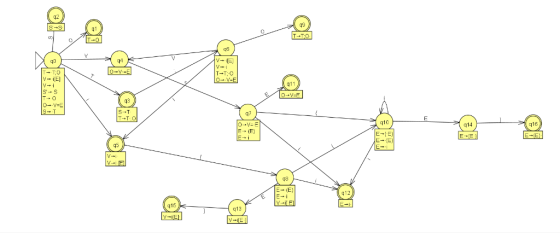
b)
LR(0) parsing table:
| ( | ) | ; | = | [ | ] | i | $ | E | O | S | T | V | |
| 0 | s5 | 1 | 2 | 3 | 4 | ||||||||
| 1 | r2 | r2 | r2 | r2 | r2 | r2 | r2 | r2 | |||||
| 2 | acc | ||||||||||||
| 3 | r1 | r1 | s6/r1 | r1 | r1 | r1 | r1 | r1 | |||||
| 4 | s7 | ||||||||||||
| 5 | r6 | r6 | r6 | r6 | s8/r6 | r6 | r6 | r6 | |||||
| 6 | s5 | 9 | 4 | ||||||||||
| 7 | s10 | s12 | 11 | ||||||||||
| 8 | s10 | s12 | 13 | ||||||||||
| 9 | r3 | r3 | r3 | r3 | r3 | r3 | r3 | r3 | |||||
| 10 | s10 | s12 | 14 | ||||||||||
| 11 | r4 | r4 | r4 | r4 | r4 | r4 | r4 | r4 | |||||
| 12 | r7 | r7 | r7 | r7 | r7 | r7 | r7 | r7 | |||||
| 13 | s15 | ||||||||||||
| 14 | s16 | ||||||||||||
| 15 | r5 | r5 | r5 | r5 | r5 | r5 | r5 | r5 | |||||
| 16 | r8 | r8 | r8 | r8 | r8 | r8 | r8 | r8 |
Row(5,[) - has shift reduce conflict
Row(3,;) - has shift reduce conflict
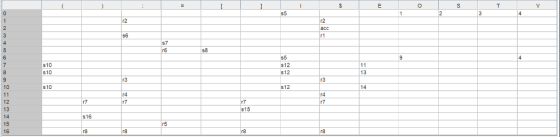
LR(0) parsing table has shift reduce conflicts, so we need to make SLR(1) parsing table.
Computing FIRST and FOLLOW
![FOLLOW FIRST { $. ), i. ]} S.:) =](http://img.homeworklib.com/images/0a430c56-d851-4397-aad0-0169e22f6eb1.png?x-oss-process=image/resize,w_560)
SLR(1) parsing table is as follows:
Add Answer to:
Let G be the following grammar: 1. S T 2. T O 3. T T 4. O V = E i [ E ] 5. V i 6. V i 7. E ( E) 8. E Construct the LR(0...
7- Show a complete LR(0) and SLR(1) parsers, including the canonical collection of LR(0) and parsing table, using the following grammar E-→ E + T / T T-, T F / F l a l b Is this grammar LR(0) or...
 7- Show a complete LR(0) and SLR(1) parsers, including the canonical collection of LR(0) and parsing table, using the following grammar E-→ E + T / T T-, T F / F l a l b Is this grammar LR(0) or SLR(1)? Why?
7- Show a complete LR(0) and SLR(1) parsers, including the canonical collection of LR(0) and parsing table, using the following grammar E-→ E + T / T T-, T F / F l a l b Is...
7- Show a complete LR(0) and SLR(1) parsers, including the canonical collection of LR(0) and parsing table, using the following grammar E-→ E + T / T T-, T F / F l a l b Is this grammar LR(0) or SLR(1)? Why?
7- Show a complete LR(0) and SLR(1) parsers, including the canonical collection of LR(0) and parsing table, using the following grammar E-→ E + T / T T-, T F / F l a l b Is...
Consider the following grammar. Construct the canonical collection of LR(0) items. E -> E + T...
Consider the following grammar. Construct the canonical collection of LR(0) items. E -> E + T (1) E -> T (2) T -> TF (3) T -> F (4) F -> F* (5) F -> a (6) F -> b (7)
Consider the following grammar G: S'S SA xb AaAb B 3. do ed bisbon s LR...
 Consider the following grammar G: S'S SA xb AaAb B 3. do ed bisbon s LR Bx where S, A, and B are nonterminals, and a, b and x are terminals (a) [10] Is G SLR(1)? If yes, give the parsing table. Otherwise, explain why (b) [15] Is G LR(1)? If yes, give the parsing table. Otherwise, explain why. (c) [15] Is G LALR(1)? If yes, give the parsing table. Otherwise, explain why. umi
Consider the following grammar G: S'S...
Consider the following grammar G: S'S SA xb AaAb B 3. do ed bisbon s LR Bx where S, A, and B are nonterminals, and a, b and x are terminals (a) [10] Is G SLR(1)? If yes, give the parsing table. Otherwise, explain why (b) [15] Is G LR(1)? If yes, give the parsing table. Otherwise, explain why. (c) [15] Is G LALR(1)? If yes, give the parsing table. Otherwise, explain why. umi
Consider the following grammar G: S'S...
(10] Eliminate left recursion from the grammar A Ba |Aa c B Bb | Ab 1...
 (10] Eliminate left recursion from the grammar A Ba |Aa c B Bb | Ab 1 d A Ad IB A BA ASJAE Consider the following grammar G: S'S S (S)S|e fa) (10] Construct the collection of the sets of LR(0) items (b) [5] When constructing the action table of SLR parser of G what are the rules to determine the parsing actions? That is, what is the rule for a shift action at state /? What is the rule...
busi 101 2021 1 4. Consider the following grammar G: S' S SiEtS iEtSeS E b...
 busi 101 2021 1 4. Consider the following grammar G: S' S SiEtS iEtSeS E b where S and E are nonterminals and i, t, e, a, and b are terminals (a) [5] Please identify the conflicts in the parsing table of G (b) [5] Build the parse tree of the word iEtiEtSeS if shift action is chosen (c) [5] Build the parse tree of the word iEtiEtSeS if reduce action is chosen mulo a
busi 101 2021 1 4....
busi 101 2021 1 4. Consider the following grammar G: S' S SiEtS iEtSeS E b where S and E are nonterminals and i, t, e, a, and b are terminals (a) [5] Please identify the conflicts in the parsing table of G (b) [5] Build the parse tree of the word iEtiEtSeS if shift action is chosen (c) [5] Build the parse tree of the word iEtiEtSeS if reduce action is chosen mulo a
busi 101 2021 1 4....
1) Create an LR(0) parse table for the following grammar. Show all steps (creating closures, the...
1) Create an LR(0) parse table for the following grammar. Show all steps (creating closures, the DFA, the transition table, and finally the parse table): E -> E + T | E * T | T T -> ( E ) | id 2) Show a complete bottom-up parse, including the parse stack contents, input string, and action for the string below using the parse table you created in step 6. Think about how I went through this in class....
busi 101 2021 1 4. Consider the following grammar G: S' S SiEtS iEtSeS E b...
 busi 101 2021 1 4. Consider the following grammar G: S' S SiEtS iEtSeS E b where S and E are nonterminals and i, t, e, a, and b are terminals (a) [5] Please identify the conflicts in the parsing table of G (b) [5] Build the parse tree of the word iEtiEtSeS if shift action is chosen (c) [5] Build the parse tree of the word iEtiEtSeS if reduce action is chosen mulo a
Construct a regular grammar G = {V,T,S,P} such that L(G)= L(r) where r is a regular...
 Construct a regular grammar G
= {V,T,S,P} such that L(G)= L(r) where r is a regular expression
(a+b)a(a+b)*.
Question 10 Construct a Regular grammar G = (V, T, S, P) such that L(G) = L(r) wherer is the regular expression (a+b)a(a+b). B I VA A IX E 12 XX, SEE 2 x G 14pt Paragraph
Construct a regular grammar G
= {V,T,S,P} such that L(G)= L(r) where r is a regular expression
(a+b)a(a+b)*.
Question 10 Construct a Regular grammar G = (V, T, S, P) such that L(G) = L(r) wherer is the regular expression (a+b)a(a+b). B I VA A IX E 12 XX, SEE 2 x G 14pt Paragraph
6. (20) Let G = (V, ∑, R, S) be a grammar with V = {Q,...
 6. (20) Let G = (V, ∑, R, S) be a grammar with V = {Q, R, T};
∑ = {q, r,ts}; and the set of rules:
S→Q
Q→q | RqT
R→r | rT | QQr
T→t | S| tT
a. (5) Convert G to a PDA using the method we described.
b. (15) Convert G to Chomsky normal form.
6. (20) Let G = (V, , R, S) be a grammar with V = {Q, R, T}; { =...
6. (20) Let G = (V, ∑, R, S) be a grammar with V = {Q, R, T};
∑ = {q, r,ts}; and the set of rules:
S→Q
Q→q | RqT
R→r | rT | QQr
T→t | S| tT
a. (5) Convert G to a PDA using the method we described.
b. (15) Convert G to Chomsky normal form.
6. (20) Let G = (V, , R, S) be a grammar with V = {Q, R, T}; { =...
6.(20) Let G=(V, S, R, S) be a grammar with V = {Q, R, T}; {...
 6.(20) Let G=(V, S, R, S) be a grammar with V = {Q, R, T}; { = {q, r,ts}; and the set of rules: SQ Qq RqT R~rrt Qor T>t | ST a. (5) Convert G to a PDA using the method we described. b. (15) Convert G to Chomsky normal form.
 7- Show a complete LR(0) and SLR(1) parsers, including the canonical collection of LR(0) and parsing table, using the following grammar E-→ E + T / T T-, T F / F l a l b Is this grammar LR(0) or SLR(1)? Why?
7- Show a complete LR(0) and SLR(1) parsers, including the canonical collection of LR(0) and parsing table, using the following grammar E-→ E + T / T T-, T F / F l a l b Is...
7- Show a complete LR(0) and SLR(1) parsers, including the canonical collection of LR(0) and parsing table, using the following grammar E-→ E + T / T T-, T F / F l a l b Is this grammar LR(0) or SLR(1)? Why?
7- Show a complete LR(0) and SLR(1) parsers, including the canonical collection of LR(0) and parsing table, using the following grammar E-→ E + T / T T-, T F / F l a l b Is...
 Consider the following grammar G: S'S SA xb AaAb B 3. do ed bisbon s LR Bx where S, A, and B are nonterminals, and a, b and x are terminals (a) [10] Is G SLR(1)? If yes, give the parsing table. Otherwise, explain why (b) [15] Is G LR(1)? If yes, give the parsing table. Otherwise, explain why. (c) [15] Is G LALR(1)? If yes, give the parsing table. Otherwise, explain why. umi
Consider the following grammar G: S'S...
Consider the following grammar G: S'S SA xb AaAb B 3. do ed bisbon s LR Bx where S, A, and B are nonterminals, and a, b and x are terminals (a) [10] Is G SLR(1)? If yes, give the parsing table. Otherwise, explain why (b) [15] Is G LR(1)? If yes, give the parsing table. Otherwise, explain why. (c) [15] Is G LALR(1)? If yes, give the parsing table. Otherwise, explain why. umi
Consider the following grammar G: S'S...
 (10] Eliminate left recursion from the grammar A Ba |Aa c B Bb | Ab 1 d A Ad IB A BA ASJAE Consider the following grammar G: S'S S (S)S|e fa) (10] Construct the collection of the sets of LR(0) items (b) [5] When constructing the action table of SLR parser of G what are the rules to determine the parsing actions? That is, what is the rule for a shift action at state /? What is the rule...
 busi 101 2021 1 4. Consider the following grammar G: S' S SiEtS iEtSeS E b where S and E are nonterminals and i, t, e, a, and b are terminals (a) [5] Please identify the conflicts in the parsing table of G (b) [5] Build the parse tree of the word iEtiEtSeS if shift action is chosen (c) [5] Build the parse tree of the word iEtiEtSeS if reduce action is chosen mulo a
busi 101 2021 1 4....
busi 101 2021 1 4. Consider the following grammar G: S' S SiEtS iEtSeS E b where S and E are nonterminals and i, t, e, a, and b are terminals (a) [5] Please identify the conflicts in the parsing table of G (b) [5] Build the parse tree of the word iEtiEtSeS if shift action is chosen (c) [5] Build the parse tree of the word iEtiEtSeS if reduce action is chosen mulo a
busi 101 2021 1 4....
 busi 101 2021 1 4. Consider the following grammar G: S' S SiEtS iEtSeS E b where S and E are nonterminals and i, t, e, a, and b are terminals (a) [5] Please identify the conflicts in the parsing table of G (b) [5] Build the parse tree of the word iEtiEtSeS if shift action is chosen (c) [5] Build the parse tree of the word iEtiEtSeS if reduce action is chosen mulo a
 Construct a regular grammar G
= {V,T,S,P} such that L(G)= L(r) where r is a regular expression
(a+b)a(a+b)*.
Question 10 Construct a Regular grammar G = (V, T, S, P) such that L(G) = L(r) wherer is the regular expression (a+b)a(a+b). B I VA A IX E 12 XX, SEE 2 x G 14pt Paragraph
Construct a regular grammar G
= {V,T,S,P} such that L(G)= L(r) where r is a regular expression
(a+b)a(a+b)*.
Question 10 Construct a Regular grammar G = (V, T, S, P) such that L(G) = L(r) wherer is the regular expression (a+b)a(a+b). B I VA A IX E 12 XX, SEE 2 x G 14pt Paragraph
 6. (20) Let G = (V, ∑, R, S) be a grammar with V = {Q, R, T};
∑ = {q, r,ts}; and the set of rules:
S→Q
Q→q | RqT
R→r | rT | QQr
T→t | S| tT
a. (5) Convert G to a PDA using the method we described.
b. (15) Convert G to Chomsky normal form.
6. (20) Let G = (V, , R, S) be a grammar with V = {Q, R, T}; { =...
6. (20) Let G = (V, ∑, R, S) be a grammar with V = {Q, R, T};
∑ = {q, r,ts}; and the set of rules:
S→Q
Q→q | RqT
R→r | rT | QQr
T→t | S| tT
a. (5) Convert G to a PDA using the method we described.
b. (15) Convert G to Chomsky normal form.
6. (20) Let G = (V, , R, S) be a grammar with V = {Q, R, T}; { =...
 6.(20) Let G=(V, S, R, S) be a grammar with V = {Q, R, T}; { = {q, r,ts}; and the set of rules: SQ Qq RqT R~rrt Qor T>t | ST a. (5) Convert G to a PDA using the method we described. b. (15) Convert G to Chomsky normal form.
Most questions answered within 3 hours.
-
Where is the error in this code sequence?
String s1 = "Hello";
String s2 = "ello";...
asked 11 months ago -
Financial data for Joel de Paris, Inc., for last year
follow:
Joel de Paris, Inc.
Balance...
asked 11 months ago -
Consider this reaction:
Al2(SO4)3 (aq)+ BaCl3
(aq) Al2Cl6 (aq)- +
3BaSO4(s) . What is the...
asked 11 months ago -
Suppose that Savneet is considering increasing her
recent random sample from 20 car rentals to 40...
asked 11 months ago -
Trucks arrive at an unloading terminal at an average rate of 120
per hour.
Trucks arrive...
asked 11 months ago -
Why are methanol and ethanol completely soluble in water while
octanol is not very little soluble....
asked 11 months ago -
A facilities manager at a university reads in a research report
that the mean amount of...
asked 11 months ago -
When the CuSO4 is rehydrated by adding water to the anhydrous
compound, is this an endothermic...
asked 11 months ago -
A ray of sunlight is passing from diamond into crown glass; the
angle of incidence is...
asked 11 months ago -
A block of mass 0.249 kg is placed on top of a light, vertical
spring of...
asked 11 months ago -
how do the kidneys compensate in the presences of acidosis
a) trigger hyperventilate
b) reserve acid...
asked 11 months ago -
Question 501 pts
The rental rate of capital to the firm increases. Which of the
following...
asked 11 months ago