
Homework Answers
Add Answer to:
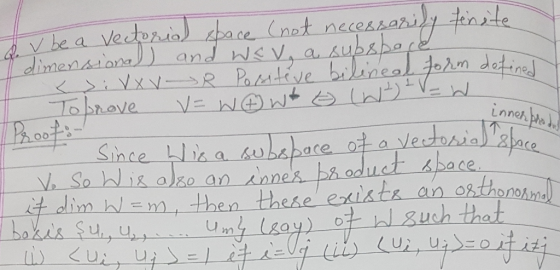
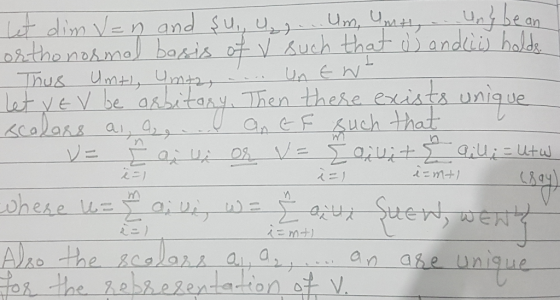
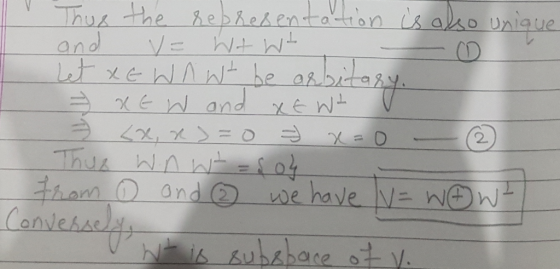
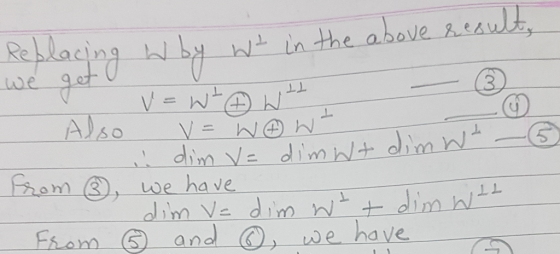
Algebra Challenge V vectorial space Cnot necessonly of finite dimcrion) wV KY:VVR. Positie blineal form defined a s...
4. Let T be a linear operator on the finite-dimensional space V with eharacteristie polynomial and minimal polynomial Let W be the null space of (T c) Elementary Canonical Forms Chap. 6 226 (a)...
 4. Let T be a linear operator on the finite-dimensional space V with eharacteristie polynomial and minimal polynomial Let W be the null space of (T c) Elementary Canonical Forms Chap. 6 226 (a) Prove that W, is the set of all vector8 α in V such that (T-cd)"a-0 for some positive integer 'n (which may depend upon α). (b) Prove that the dimension of W, is di. (Hint: If T, is the operator induced on Wi by T, then...
How can I proof if V a finite dimensional vector space over a field, and T...
How can I proof if V a finite dimensional vector space over a field, and T is a linear transformation V->V, V is cyclic relative to T iff minimal polynomial of T is equal to the characteristic polynomial of T?
Linear Algebra I need help with 2 of the 3 or with the 3): LINEAR ALGEBRA Lineal Functions May 23, 2019 LLet θι, θ2,...
 Linear Algebra
I need help with 2 of the 3 or with the 3):
LINEAR ALGEBRA Lineal Functions May 23, 2019 LLet θι, θ2, θ3 linear shapes in R2[x]defined as: Proof that {θι, θ2,0) is a base of R2[x]* and determines which is the dual base (pl,p2,p3 of R2[x that corresponds to him Attached Operators 2Proof that the application (-)": L(V,V)-+ L(V",V") given by ф is an isomorphism. 0' It 3·Let V {f : R → RIf it is differentiable)...
Linear Algebra
I need help with 2 of the 3 or with the 3):
LINEAR ALGEBRA Lineal Functions May 23, 2019 LLet θι, θ2, θ3 linear shapes in R2[x]defined as: Proof that {θι, θ2,0) is a base of R2[x]* and determines which is the dual base (pl,p2,p3 of R2[x that corresponds to him Attached Operators 2Proof that the application (-)": L(V,V)-+ L(V",V") given by ф is an isomorphism. 0' It 3·Let V {f : R → RIf it is differentiable)...
Let V be a finite-dimensional complex vector space and let T from V to V be...
Let V be a finite-dimensional complex vector space and let T from V to V be a linear transformation. Show that V is the direct sum of U and W where W and U are T-invariant subspaces and the restriction of T on U is nilpotent and the restriction of T on W is an isomorphism.
Suppose V is a finite dimensional inner product space, and dim V = n. If is...
 Suppose V is a finite dimensional inner product space, and dim V
= n.
If is an orthogonal subset
of V, prove that
a. W can be extended to an orthogonal basis for V.
b. is an orthogonal basis
for
c.
Suppose V is a finite dimensional inner product space, and dim V
= n.
If is an orthogonal subset
of V, prove that
a. W can be extended to an orthogonal basis for V.
b. is an orthogonal basis
for
c.
Let V be a finite-dimensional vector space over F. For every subset SCV, define Sº =...
 Let V be a finite-dimensional vector space over F. For every subset SCV, define Sº = {f EV* | f(s) = 0 Vs E S}. (a) Prove that sº is a subspace of V* (S may not be a subspace!) (b) If W is a subspace of V and x € W, prove that there exists an fe Wº with f(x) + 0. (c) If v inV, define û :V* + F by ū(f) = f(u). (This is linear and...
I need help with 2 of the 3 exercises or with the 3 exercises. LINEAR ALGEBRA TOPICS: Quadratic Forms and Sylvester&...
 I need help with 2 of the 3 exercises or with the 3
exercises.
LINEAR ALGEBRA TOPICS: Quadratic Forms and Sylvester's Theorem May 23, 2019 1.Let V be a real vector space of finite dimension and f: VR a function such that the expression F(v, w)-f(v+w)- f(v)-f(w) is bilinear. Assume further that f(λυ-λ2f(v) is satisfied for all λ E R and every vector UEV Prove that under these conditions f is in fact a quadratic form. Determine the bilinear form...
I need help with 2 of the 3 exercises or with the 3
exercises.
LINEAR ALGEBRA TOPICS: Quadratic Forms and Sylvester's Theorem May 23, 2019 1.Let V be a real vector space of finite dimension and f: VR a function such that the expression F(v, w)-f(v+w)- f(v)-f(w) is bilinear. Assume further that f(λυ-λ2f(v) is satisfied for all λ E R and every vector UEV Prove that under these conditions f is in fact a quadratic form. Determine the bilinear form...
How do I do these linear algebra questions? The question is: Consider the Vector Space V...
 How do I do these linear algebra questions?
The question is:
Consider the Vector Space V and its subset W given below.
Determine whether W forms a subspace of V. If your answer is
negative then you must provide which subspace requirement is
violated.
(b). V is P5, the vector space of all polynomials in x of degree s5 and W is the set of all polynomials divisible by x – 3. (c). V is P5, the vector space of...
How do I do these linear algebra questions?
The question is:
Consider the Vector Space V and its subset W given below.
Determine whether W forms a subspace of V. If your answer is
negative then you must provide which subspace requirement is
violated.
(b). V is P5, the vector space of all polynomials in x of degree s5 and W is the set of all polynomials divisible by x – 3. (c). V is P5, the vector space of...
Question 1. Let V be a finite dimensional vector space over a field F and let...
 Question 1. Let V be a finite dimensional vector space over a field F and let W be a subspace of Prove that the quotient space V/W is finite dimensional and dimr(V/IV) = dimF(V) _ dimF(W). Hint l. Start with a basis A = {wi, . . . , w,n} for W and extend it to a basis B = {wi , . . . , wm, V1 , . . . , va) for V. Hint 2. Our goal...
Advanced linear algebra, need full proof thanks Let V be an inner product space (real or comple...
 advanced linear algebra, need full proof thanks
Let V be an inner product space (real or complex, possibly
infinite-dimensional). Let
{v1, . . . , vn} be an orthonormal set of vectors.
4. Let V be an inner product space (real or complex, possibly infinite-dimensional. Let [vi,..., Vn) be an orthonormal set of vectors. a) Show that 1 (b) Show that for every x e V, with equality holding if and only if x spanfvi,..., vn) (c) Consider the space...
advanced linear algebra, need full proof thanks
Let V be an inner product space (real or complex, possibly
infinite-dimensional). Let
{v1, . . . , vn} be an orthonormal set of vectors.
4. Let V be an inner product space (real or complex, possibly infinite-dimensional. Let [vi,..., Vn) be an orthonormal set of vectors. a) Show that 1 (b) Show that for every x e V, with equality holding if and only if x spanfvi,..., vn) (c) Consider the space...
 4. Let T be a linear operator on the finite-dimensional space V with eharacteristie polynomial and minimal polynomial Let W be the null space of (T c) Elementary Canonical Forms Chap. 6 226 (a) Prove that W, is the set of all vector8 α in V such that (T-cd)"a-0 for some positive integer 'n (which may depend upon α). (b) Prove that the dimension of W, is di. (Hint: If T, is the operator induced on Wi by T, then...
 Linear Algebra
I need help with 2 of the 3 or with the 3):
LINEAR ALGEBRA Lineal Functions May 23, 2019 LLet θι, θ2, θ3 linear shapes in R2[x]defined as: Proof that {θι, θ2,0) is a base of R2[x]* and determines which is the dual base (pl,p2,p3 of R2[x that corresponds to him Attached Operators 2Proof that the application (-)": L(V,V)-+ L(V",V") given by ф is an isomorphism. 0' It 3·Let V {f : R → RIf it is differentiable)...
Linear Algebra
I need help with 2 of the 3 or with the 3):
LINEAR ALGEBRA Lineal Functions May 23, 2019 LLet θι, θ2, θ3 linear shapes in R2[x]defined as: Proof that {θι, θ2,0) is a base of R2[x]* and determines which is the dual base (pl,p2,p3 of R2[x that corresponds to him Attached Operators 2Proof that the application (-)": L(V,V)-+ L(V",V") given by ф is an isomorphism. 0' It 3·Let V {f : R → RIf it is differentiable)...
 Suppose V is a finite dimensional inner product space, and dim V
= n.
If is an orthogonal subset
of V, prove that
a. W can be extended to an orthogonal basis for V.
b. is an orthogonal basis
for
c.
Suppose V is a finite dimensional inner product space, and dim V
= n.
If is an orthogonal subset
of V, prove that
a. W can be extended to an orthogonal basis for V.
b. is an orthogonal basis
for
c.
 Let V be a finite-dimensional vector space over F. For every subset SCV, define Sº = {f EV* | f(s) = 0 Vs E S}. (a) Prove that sº is a subspace of V* (S may not be a subspace!) (b) If W is a subspace of V and x € W, prove that there exists an fe Wº with f(x) + 0. (c) If v inV, define û :V* + F by ū(f) = f(u). (This is linear and...
 I need help with 2 of the 3 exercises or with the 3
exercises.
LINEAR ALGEBRA TOPICS: Quadratic Forms and Sylvester's Theorem May 23, 2019 1.Let V be a real vector space of finite dimension and f: VR a function such that the expression F(v, w)-f(v+w)- f(v)-f(w) is bilinear. Assume further that f(λυ-λ2f(v) is satisfied for all λ E R and every vector UEV Prove that under these conditions f is in fact a quadratic form. Determine the bilinear form...
I need help with 2 of the 3 exercises or with the 3
exercises.
LINEAR ALGEBRA TOPICS: Quadratic Forms and Sylvester's Theorem May 23, 2019 1.Let V be a real vector space of finite dimension and f: VR a function such that the expression F(v, w)-f(v+w)- f(v)-f(w) is bilinear. Assume further that f(λυ-λ2f(v) is satisfied for all λ E R and every vector UEV Prove that under these conditions f is in fact a quadratic form. Determine the bilinear form...
 How do I do these linear algebra questions?
The question is:
Consider the Vector Space V and its subset W given below.
Determine whether W forms a subspace of V. If your answer is
negative then you must provide which subspace requirement is
violated.
(b). V is P5, the vector space of all polynomials in x of degree s5 and W is the set of all polynomials divisible by x – 3. (c). V is P5, the vector space of...
How do I do these linear algebra questions?
The question is:
Consider the Vector Space V and its subset W given below.
Determine whether W forms a subspace of V. If your answer is
negative then you must provide which subspace requirement is
violated.
(b). V is P5, the vector space of all polynomials in x of degree s5 and W is the set of all polynomials divisible by x – 3. (c). V is P5, the vector space of...
 Question 1. Let V be a finite dimensional vector space over a field F and let W be a subspace of Prove that the quotient space V/W is finite dimensional and dimr(V/IV) = dimF(V) _ dimF(W). Hint l. Start with a basis A = {wi, . . . , w,n} for W and extend it to a basis B = {wi , . . . , wm, V1 , . . . , va) for V. Hint 2. Our goal...
 advanced linear algebra, need full proof thanks
Let V be an inner product space (real or complex, possibly
infinite-dimensional). Let
{v1, . . . , vn} be an orthonormal set of vectors.
4. Let V be an inner product space (real or complex, possibly infinite-dimensional. Let [vi,..., Vn) be an orthonormal set of vectors. a) Show that 1 (b) Show that for every x e V, with equality holding if and only if x spanfvi,..., vn) (c) Consider the space...
advanced linear algebra, need full proof thanks
Let V be an inner product space (real or complex, possibly
infinite-dimensional). Let
{v1, . . . , vn} be an orthonormal set of vectors.
4. Let V be an inner product space (real or complex, possibly infinite-dimensional. Let [vi,..., Vn) be an orthonormal set of vectors. a) Show that 1 (b) Show that for every x e V, with equality holding if and only if x spanfvi,..., vn) (c) Consider the space...
Most questions answered within 3 hours.
-
Where is the error in this code sequence?
String s1 = "Hello";
String s2 = "ello";...
asked 10 months ago -
Financial data for Joel de Paris, Inc., for last year
follow:
Joel de Paris, Inc.
Balance...
asked 10 months ago -
Consider this reaction:
Al2(SO4)3 (aq)+ BaCl3
(aq) Al2Cl6 (aq)- +
3BaSO4(s) . What is the...
asked 10 months ago -
Suppose that Savneet is considering increasing her
recent random sample from 20 car rentals to 40...
asked 10 months ago -
Trucks arrive at an unloading terminal at an average rate of 120
per hour.
Trucks arrive...
asked 10 months ago -
Why are methanol and ethanol completely soluble in water while
octanol is not very little soluble....
asked 10 months ago -
A facilities manager at a university reads in a research report
that the mean amount of...
asked 10 months ago -
When the CuSO4 is rehydrated by adding water to the anhydrous
compound, is this an endothermic...
asked 10 months ago -
A ray of sunlight is passing from diamond into crown glass; the
angle of incidence is...
asked 10 months ago -
A block of mass 0.249 kg is placed on top of a light, vertical
spring of...
asked 10 months ago -
how do the kidneys compensate in the presences of acidosis
a) trigger hyperventilate
b) reserve acid...
asked 10 months ago -
Question 501 pts
The rental rate of capital to the firm increases. Which of the
following...
asked 10 months ago