
Homework Answers
Add Answer to:
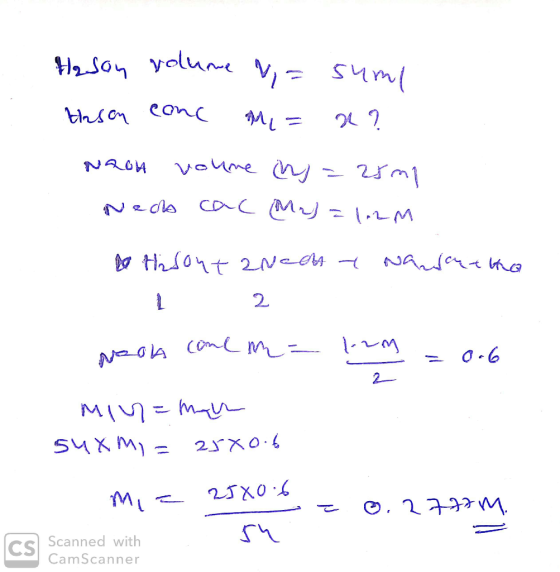
Use titration to determine the molar concentration of an unknown solution Question Calculate the molar concentratio...
Use titration to determine the molar concentration of an unknown solution Question Calculate the molar concentration...
 Use titration to determine the molar concentration of an unknown solution Question Calculate the molar concentration for H2SO4 for the following situation. When 27 ml of it was completely titrated by 19 ml of 0.9 M KOH, 1 mol of acid was titrated by 2 mol of base. Give your answer in two significant figures. Provide your answer below: OM B FEEDBACK MORE INSTRUCTION tent attribution revious
506 » Assi Day 24: K Learn Use titration to determine the molar concentration of an...
 506 » Assi Day 24: K Learn Use titration to determine the molar concentration of an unknown solution Question Calculate the molar concentration for H2SO4 when 41 mL of it was completely titrated by 10.9 mL of 0.95 M LiOH, where one mole of acid was titrated by two moles of base. Give your answer in two significant figures. rovide your answer below. м FEEDBACK
Use titration to determine the molar concentration of an unknown solution Question The end point in...
 Use titration to determine the molar concentration of an unknown solution Question The end point in a titration of a 36 ml sample of aqueous CH COOH was reached by addition of 12 ml of 0.17 M titrant. The titration reaction is CH3COOH + NaOH - CH3COONa+H2O What is the molar concentration of CH,COOH? Give your answer in two significant figures. Provide your answer below: M ORE INSTRUCTION SUB M B FEEDBACK
1.639 g of an unknown diprotic acid are used to make a 100.00 mL solution. Then 25.00 mL of this solution is transferred...
1.639 g of an unknown diprotic acid are used to make a 100.00 mL solution. Then 25.00 mL of this solution is transferred to an Erlenmeyer flask and is titrated with 0.1032 M NaOH. The titration endpoint is reached after 0.00414 mol of NaOH is added using the burette. What is the molar mass of the diprotic acid? Provide your answer to the correct number of significant figures.
1.639 g of an unknown diprotic acis are used to make a 100.00 mL solutiob. Then...
 1.639 g of an unknown diprotic acis are used to make a 100.00 mL
solutiob. Then 25.00 mL of this solution is trasferred to an
Erlenmeyer flask and is titrated with 0.1008 M NaOH. The titration
endpoint is reaxhed after 0.00432 mol of NaOH is added using the
burette. What is the molar mass of the diprotic acid? Provide your
answer to the correct nuber of significat figures
1.639 g of an unknown diprotic acid are used to make a...
1.639 g of an unknown diprotic acis are used to make a 100.00 mL
solutiob. Then 25.00 mL of this solution is trasferred to an
Erlenmeyer flask and is titrated with 0.1008 M NaOH. The titration
endpoint is reaxhed after 0.00432 mol of NaOH is added using the
burette. What is the molar mass of the diprotic acid? Provide your
answer to the correct nuber of significat figures
1.639 g of an unknown diprotic acid are used to make a...
Question 6 (1 point) 1.681 g of an unknown diprotic acid are used to make a 100.00 mL solution. Then 25.00 mL of th...
 Question 6 (1 point) 1.681 g of an unknown diprotic acid are used to make a 100.00 mL solution. Then 25.00 mL of this solution is transferred to an Erlenmeyer flask and is titrated with 0.1047 M NaOH. The titration endpoint is reached after 0.00411 mol of NaOH is added using the burette. What is the molar mass of the diprotic acid? Provide your answer to the correct number of significant figures. Your Answer: Answer units
To calculate the concentration of a solution using acid–base titration data. In an acid–base titration, an...
To calculate the concentration of a solution using acid–base titration data. In an acid–base titration, an acid (or base) of known concentration is added to a base (or acid) of unknown concentration until the number of moles of H+ and OH- are equal, a condition called the equivalence point. Since you know the number of moles of H+ (or OH- ) that you added, you can determine the number of moles of OH- (or H+) in the unknown solution. For...
To calculate the concentration of a solution using acid–base titration data. In an acid–base titration, an...
To calculate the concentration of a solution using acid–base titration data. In an acid–base titration, an acid (or base) of known concentration is added to a base (or acid) of unknown concentration until the number of moles of H+ and OH- are equal, a condition called the equivalence point. Since you know the number of moles of H+ (or OH- ) that you added, you can determine the number of moles of OH- (or H+) in the unknown solution. For...
The titration of 23.30 mL of HCl solution of unknown concentration requires 13.00 mL of a...
The titration of 23.30 mL of HCl solution of unknown concentration requires 13.00 mL of a 0.200 M NaOH solution to reach the equivalence point. What is the concentration of the unknown HCl solution in M? Express your answer in moles per liter to three significant figures. M(HCl)M(HCl) = _____________
Part A The titration of 23.40 mL of HCl solution of unknown concentration requires 12.18 mL...
 Part A The titration of 23.40 mL of HCl solution of unknown concentration requires 12.18 mL of a 0.140 M NaOH solution to reach the equivalence point. What is the concentration of the unknown HCl solution in M? Express your answer in moles per liter to three significant figures. We ΑΣΦ ? M(HCI) M Submit Request Answer
 Use titration to determine the molar concentration of an unknown solution Question Calculate the molar concentration for H2SO4 for the following situation. When 27 ml of it was completely titrated by 19 ml of 0.9 M KOH, 1 mol of acid was titrated by 2 mol of base. Give your answer in two significant figures. Provide your answer below: OM B FEEDBACK MORE INSTRUCTION tent attribution revious
 506 » Assi Day 24: K Learn Use titration to determine the molar concentration of an unknown solution Question Calculate the molar concentration for H2SO4 when 41 mL of it was completely titrated by 10.9 mL of 0.95 M LiOH, where one mole of acid was titrated by two moles of base. Give your answer in two significant figures. rovide your answer below. м FEEDBACK
 Use titration to determine the molar concentration of an unknown solution Question The end point in a titration of a 36 ml sample of aqueous CH COOH was reached by addition of 12 ml of 0.17 M titrant. The titration reaction is CH3COOH + NaOH - CH3COONa+H2O What is the molar concentration of CH,COOH? Give your answer in two significant figures. Provide your answer below: M ORE INSTRUCTION SUB M B FEEDBACK
 1.639 g of an unknown diprotic acis are used to make a 100.00 mL
solutiob. Then 25.00 mL of this solution is trasferred to an
Erlenmeyer flask and is titrated with 0.1008 M NaOH. The titration
endpoint is reaxhed after 0.00432 mol of NaOH is added using the
burette. What is the molar mass of the diprotic acid? Provide your
answer to the correct nuber of significat figures
1.639 g of an unknown diprotic acid are used to make a...
1.639 g of an unknown diprotic acis are used to make a 100.00 mL
solutiob. Then 25.00 mL of this solution is trasferred to an
Erlenmeyer flask and is titrated with 0.1008 M NaOH. The titration
endpoint is reaxhed after 0.00432 mol of NaOH is added using the
burette. What is the molar mass of the diprotic acid? Provide your
answer to the correct nuber of significat figures
1.639 g of an unknown diprotic acid are used to make a...
 Question 6 (1 point) 1.681 g of an unknown diprotic acid are used to make a 100.00 mL solution. Then 25.00 mL of this solution is transferred to an Erlenmeyer flask and is titrated with 0.1047 M NaOH. The titration endpoint is reached after 0.00411 mol of NaOH is added using the burette. What is the molar mass of the diprotic acid? Provide your answer to the correct number of significant figures. Your Answer: Answer units
 Part A The titration of 23.40 mL of HCl solution of unknown concentration requires 12.18 mL of a 0.140 M NaOH solution to reach the equivalence point. What is the concentration of the unknown HCl solution in M? Express your answer in moles per liter to three significant figures. We ΑΣΦ ? M(HCI) M Submit Request Answer
Most questions answered within 3 hours.
-
Where is the error in this code sequence?
String s1 = "Hello";
String s2 = "ello";...
asked 10 months ago -
Financial data for Joel de Paris, Inc., for last year
follow:
Joel de Paris, Inc.
Balance...
asked 10 months ago -
Consider this reaction:
Al2(SO4)3 (aq)+ BaCl3
(aq) Al2Cl6 (aq)- +
3BaSO4(s) . What is the...
asked 10 months ago -
Suppose that Savneet is considering increasing her
recent random sample from 20 car rentals to 40...
asked 10 months ago -
Trucks arrive at an unloading terminal at an average rate of 120
per hour.
Trucks arrive...
asked 10 months ago -
Why are methanol and ethanol completely soluble in water while
octanol is not very little soluble....
asked 10 months ago -
A facilities manager at a university reads in a research report
that the mean amount of...
asked 10 months ago -
When the CuSO4 is rehydrated by adding water to the anhydrous
compound, is this an endothermic...
asked 10 months ago -
A ray of sunlight is passing from diamond into crown glass; the
angle of incidence is...
asked 10 months ago -
A block of mass 0.249 kg is placed on top of a light, vertical
spring of...
asked 10 months ago -
how do the kidneys compensate in the presences of acidosis
a) trigger hyperventilate
b) reserve acid...
asked 10 months ago -
Question 501 pts
The rental rate of capital to the firm increases. Which of the
following...
asked 10 months ago