
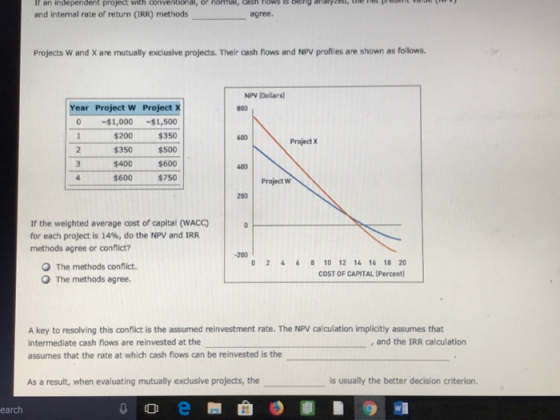
If an independent project with conventional, or nomal, Cash flow agree. and internal rate of return (IRR) methods cash flows and NPV profiles are shown as follows. Projects W and X are mutually exclusive projects. Their NPV IDollars) Year Project W Project X 800 -$1,000 -$1,500 1 $200 $350 600 Project X $500 2 $350 3 $400 009$ $750 400 $600 Project W 200 If the weighted average cost of capital (WACC) for each project is 14% , do the NPV and IRR methods agree or conflict? -200 The methods conflict. O The methods agree. 0 24 6 8 10 12 14 16 18 20 COST OF CAPITAL (Percent) A key to resolving this conflict is the assumed reinvestment rate. The NPV calculation implicitly assumes that ,and the IRR calculation intermediate cash flows are reinvested at the assumes that the rate at which cash flows can be reinvested is the As a result, when evaluating mutually exclusive projects, the is usually the better decision criterion. earch
Homework Answers
We need to caculate the exact NPV and IRR for both the projects in order to know the comparison.
[We can find the same through graphs also]
Through Graph
For NPV [Find Points where Cost of capital = 14%
For IRR [Find point where NPV = 0]
Now calculating via excel
| Discount Rate/WACC (r) | 14% | ||||
| PROJECT W | |||||
| years | 0 | 1 | 2 | 3 | 4 |
| Cash-Outflows | 1,000 | ||||
| Cash-Inflows | 200 | 350 | 400 | 600 | |
| Net Cashflows (Inflow - Outflow) | -1,000 | 200 | 350 | 400 | 600 |
| Discounted
Cashflow = Net CF / (1+r)^years |
-1,000 | 175 | 269 | 270 | 355 |
| NPV = sum of all discounted CF | 69.99 | ||||
| IRR = IRR (net CF) | 16.852% | ||||
| PROJECT X | |||||
| years | 0 | 1 | 2 | 3 | 4 |
| Cash-Outflows | 1,500 | ||||
| Cash-Inflows | 350 | 500 | 600 | 750 | |
| Net Cashflows (Inflow - Outflow) | -1,500 | 350 | 500 | 600 | 750 |
| Discounted
Cashflow = Net CF / (1+r)^years |
-1,500 | 307 | 385 | 405 | 444 |
| NPV = sum of all discounted CF | 40.79 | ||||
| IRR = IRR (net CF) | 15.167% |
Hence, we can see
NPV (Project W) > NPV (Project X), implies Project W is better than Project X
and IRR (Project W) > IRR (Project X).. both have IRR > WACC and hence both rae favourable, But Project W > Project X
Hence both methods AGREE.
Add Answer to:
s. Understanding the NPV profile Aa Aa If an independent project with conventional, or normal, cash flows is being...
If an independent project with conventional, or normal, cash flows is being analyzed, the net present...
 If an independent project with conventional, or normal, cash flows is being analyzed, the net present value (NPV) and internal rate of return (IRR) methods agree. Projects W and X are mutually exclusive projects. Their cash flows and NPV profiles are shown as follows. NPV (Dollars) 800 0 -$1,00 Year Project W -$1,000 1 $200 2 $350 $400 $600 Project x -$1,500 $350 $500 $600 $750 Project X Project W If the weighted average cost of capital (WACC) for each...
If an independent project with conventional, or normal, cash flows is being analyzed, the net present...
 If an independent project with conventional, or normal, cash flows is being analyzed, the net present value (NPV) and internal rate of return (IRR) methods agree Projects Y and Z are mutually exclusive projects. Their cash flows and NPV profiles are shown as follows. NPV (Dollars Year Project Y Project Z 800 -$1,500 -$1,500 0 $200 $900 1 600 Project Y $400 $600 2 $600 $300 400 $1,000 $200 4 Project Z 200 If the weighted average cost of capital...
If mutually exclusive projects with normal cash flows are being analyzed, the net present value (NPV)...
 If mutually exclusive projects with normal cash flows are being analyzed, the net present value (NPV) and internal rate of return (IRR) methods agree. Projects Y and Z are mutually exclusive projects. Their cash flows and NPV profiles are shown as follows. NPV (Dollars) 800 Year Project Y Project Z 0 -$1,500 -$1,500 1 $200 $900 2 $400 $600 $600 $300 4 $1,000 $200 Project Y Project 2 If the weighted average cost of capital (WACC) for each project is...
First Blank: always, sometimes, never Second Blank: IRR, MIRR, required rate of return Third Blank: IRR,...
 First Blank: always, sometimes, never
Second Blank: IRR, MIRR, required rate of return
Third Blank: IRR, MIRR, required rate of return
Fourth Blank: IRR method, NPV method
6. Understanding the NPV profile If projects are mutually exclusive, only one project can be chosen. The internal rate of return (IRR) and the net present value (NPV) methods will not always choose the same project. If the crossover rate on the NPV profile is below the horizontal axis, the methods will agree....
First Blank: always, sometimes, never
Second Blank: IRR, MIRR, required rate of return
Third Blank: IRR, MIRR, required rate of return
Fourth Blank: IRR method, NPV method
6. Understanding the NPV profile If projects are mutually exclusive, only one project can be chosen. The internal rate of return (IRR) and the net present value (NPV) methods will not always choose the same project. If the crossover rate on the NPV profile is below the horizontal axis, the methods will agree....
Dropdown options first 2 blanks: (internal rate of return IRR, required rate of return, modified internal...
 Dropdown options first 2 blanks: (internal rate of return IRR,
required rate of return, modified internal rate of return MIRR)
Dropdown options 3rd blank: (NPV method, IRR method)
If projects are mutually exclusive, only one project can be chosen. The internal rate of return (IRR) and the net present value (NPV) methods will not always choose the same project. If the crossover rate on the NPV profile is below the horizontal axis, the methods will agree. always Projects Y and...
Dropdown options first 2 blanks: (internal rate of return IRR,
required rate of return, modified internal rate of return MIRR)
Dropdown options 3rd blank: (NPV method, IRR method)
If projects are mutually exclusive, only one project can be chosen. The internal rate of return (IRR) and the net present value (NPV) methods will not always choose the same project. If the crossover rate on the NPV profile is below the horizontal axis, the methods will agree. always Projects Y and...
Help and verified and be clear. The net present value (NPV) and internal rate of return...
 Help
and verified and be clear.
The net present value (NPV) and internal rate of return (IRR) methods of investment analysis are interrelated and are sometimes used together to make capital budgeting decisions. Consider the case of Blue Hamster Manufacturing Inc.: Last Tuesday, Blue Hamster Manufacturing Inc. lost a portion of its planning and financial data when both its main and its backup servers crashed. The company's CFO remembers that the internal rate of return (IRR) of Project Lambda is...
Help
and verified and be clear.
The net present value (NPV) and internal rate of return (IRR) methods of investment analysis are interrelated and are sometimes used together to make capital budgeting decisions. Consider the case of Blue Hamster Manufacturing Inc.: Last Tuesday, Blue Hamster Manufacturing Inc. lost a portion of its planning and financial data when both its main and its backup servers crashed. The company's CFO remembers that the internal rate of return (IRR) of Project Lambda is...
If the projects were independent, which project(s) would be accepted according to the IRR method? a)...
 If the projects were independent, which project(s) would be
accepted according to the IRR method?
a) Neither
b) Project A
c) Project B
d) Both Projects A or B
If the projects were mutually exclusive, which project(s) would
be accepted according to the IRR method?
a) Neither
b) Project A
c) Project B
d) Both Projects A or B
The reason is
a) TheNPV and IRR approaches use the same reinvestment rate
assumption and so both approaches reach the same...
If the projects were independent, which project(s) would be
accepted according to the IRR method?
a) Neither
b) Project A
c) Project B
d) Both Projects A or B
If the projects were mutually exclusive, which project(s) would
be accepted according to the IRR method?
a) Neither
b) Project A
c) Project B
d) Both Projects A or B
The reason is
a) TheNPV and IRR approaches use the same reinvestment rate
assumption and so both approaches reach the same...
1a. Why might a financial analyst use the NPV method for making project decisions instead of...
1a. Why might a financial analyst use the NPV method for making project decisions instead of the IRR method? ------------------ 1b. Explain the reinvestment rate assumption in the context of a project’s cash flows over time. ------------------ 1c. When we create NPV profiles, what variable is on the y-axis and what variable is on the x-axis? ------------------ 1d. Suppose a firm’s WACC exceeds the IRR for both projects L and S, if the projects are mutually exclusive, which project should...
Which of the following statements is CORRECT? To find the MIRR, we first compound cash flows...
Which of the following statements is CORRECT? To find the MIRR, we first compound cash flows at the regular IRR to find the TV, and then we discount the TV at the WACC to find the PV. The NPV and IRR methods both assume that cash flows can be reinvested at the WACC. However, the MIRR method assumes reinvestment at the MIRR itself. If two projects have the same cost, and if their NPV profiles cross in the upper right...
Capital Budgeting Decision Criteria: IRR IRR A project's internal rate of return (IRR) is the -Select-compound...
Capital Budgeting Decision Criteria: IRR IRR A project's internal rate of return (IRR) is the -Select-compound ratediscount raterisk-free rateCorrect 1 of Item 1 that forces the PV of its inflows to equal its cost. The IRR is an estimate of the project's rate of return, and it is comparable to the -Select-YTMcoupongainCorrect 2 of Item 1 on a bond. The equation for calculating the IRR is: CFt is the expected cash flow in Period t and cash outflows are treated...
 If an independent project with conventional, or normal, cash flows is being analyzed, the net present value (NPV) and internal rate of return (IRR) methods agree. Projects W and X are mutually exclusive projects. Their cash flows and NPV profiles are shown as follows. NPV (Dollars) 800 0 -$1,00 Year Project W -$1,000 1 $200 2 $350 $400 $600 Project x -$1,500 $350 $500 $600 $750 Project X Project W If the weighted average cost of capital (WACC) for each...
 If an independent project with conventional, or normal, cash flows is being analyzed, the net present value (NPV) and internal rate of return (IRR) methods agree Projects Y and Z are mutually exclusive projects. Their cash flows and NPV profiles are shown as follows. NPV (Dollars Year Project Y Project Z 800 -$1,500 -$1,500 0 $200 $900 1 600 Project Y $400 $600 2 $600 $300 400 $1,000 $200 4 Project Z 200 If the weighted average cost of capital...
 If mutually exclusive projects with normal cash flows are being analyzed, the net present value (NPV) and internal rate of return (IRR) methods agree. Projects Y and Z are mutually exclusive projects. Their cash flows and NPV profiles are shown as follows. NPV (Dollars) 800 Year Project Y Project Z 0 -$1,500 -$1,500 1 $200 $900 2 $400 $600 $600 $300 4 $1,000 $200 Project Y Project 2 If the weighted average cost of capital (WACC) for each project is...
 First Blank: always, sometimes, never
Second Blank: IRR, MIRR, required rate of return
Third Blank: IRR, MIRR, required rate of return
Fourth Blank: IRR method, NPV method
6. Understanding the NPV profile If projects are mutually exclusive, only one project can be chosen. The internal rate of return (IRR) and the net present value (NPV) methods will not always choose the same project. If the crossover rate on the NPV profile is below the horizontal axis, the methods will agree....
First Blank: always, sometimes, never
Second Blank: IRR, MIRR, required rate of return
Third Blank: IRR, MIRR, required rate of return
Fourth Blank: IRR method, NPV method
6. Understanding the NPV profile If projects are mutually exclusive, only one project can be chosen. The internal rate of return (IRR) and the net present value (NPV) methods will not always choose the same project. If the crossover rate on the NPV profile is below the horizontal axis, the methods will agree....
 Dropdown options first 2 blanks: (internal rate of return IRR,
required rate of return, modified internal rate of return MIRR)
Dropdown options 3rd blank: (NPV method, IRR method)
If projects are mutually exclusive, only one project can be chosen. The internal rate of return (IRR) and the net present value (NPV) methods will not always choose the same project. If the crossover rate on the NPV profile is below the horizontal axis, the methods will agree. always Projects Y and...
Dropdown options first 2 blanks: (internal rate of return IRR,
required rate of return, modified internal rate of return MIRR)
Dropdown options 3rd blank: (NPV method, IRR method)
If projects are mutually exclusive, only one project can be chosen. The internal rate of return (IRR) and the net present value (NPV) methods will not always choose the same project. If the crossover rate on the NPV profile is below the horizontal axis, the methods will agree. always Projects Y and...
 Help
and verified and be clear.
The net present value (NPV) and internal rate of return (IRR) methods of investment analysis are interrelated and are sometimes used together to make capital budgeting decisions. Consider the case of Blue Hamster Manufacturing Inc.: Last Tuesday, Blue Hamster Manufacturing Inc. lost a portion of its planning and financial data when both its main and its backup servers crashed. The company's CFO remembers that the internal rate of return (IRR) of Project Lambda is...
Help
and verified and be clear.
The net present value (NPV) and internal rate of return (IRR) methods of investment analysis are interrelated and are sometimes used together to make capital budgeting decisions. Consider the case of Blue Hamster Manufacturing Inc.: Last Tuesday, Blue Hamster Manufacturing Inc. lost a portion of its planning and financial data when both its main and its backup servers crashed. The company's CFO remembers that the internal rate of return (IRR) of Project Lambda is...
 If the projects were independent, which project(s) would be
accepted according to the IRR method?
a) Neither
b) Project A
c) Project B
d) Both Projects A or B
If the projects were mutually exclusive, which project(s) would
be accepted according to the IRR method?
a) Neither
b) Project A
c) Project B
d) Both Projects A or B
The reason is
a) TheNPV and IRR approaches use the same reinvestment rate
assumption and so both approaches reach the same...
If the projects were independent, which project(s) would be
accepted according to the IRR method?
a) Neither
b) Project A
c) Project B
d) Both Projects A or B
If the projects were mutually exclusive, which project(s) would
be accepted according to the IRR method?
a) Neither
b) Project A
c) Project B
d) Both Projects A or B
The reason is
a) TheNPV and IRR approaches use the same reinvestment rate
assumption and so both approaches reach the same...
Most questions answered within 3 hours.
-
Where is the error in this code sequence?
String s1 = "Hello";
String s2 = "ello";...
asked 11 months ago -
Financial data for Joel de Paris, Inc., for last year
follow:
Joel de Paris, Inc.
Balance...
asked 11 months ago -
Consider this reaction:
Al2(SO4)3 (aq)+ BaCl3
(aq) Al2Cl6 (aq)- +
3BaSO4(s) . What is the...
asked 11 months ago -
Suppose that Savneet is considering increasing her
recent random sample from 20 car rentals to 40...
asked 11 months ago -
Trucks arrive at an unloading terminal at an average rate of 120
per hour.
Trucks arrive...
asked 11 months ago -
Why are methanol and ethanol completely soluble in water while
octanol is not very little soluble....
asked 11 months ago -
A facilities manager at a university reads in a research report
that the mean amount of...
asked 11 months ago -
When the CuSO4 is rehydrated by adding water to the anhydrous
compound, is this an endothermic...
asked 11 months ago -
A ray of sunlight is passing from diamond into crown glass; the
angle of incidence is...
asked 11 months ago -
A block of mass 0.249 kg is placed on top of a light, vertical
spring of...
asked 11 months ago -
how do the kidneys compensate in the presences of acidosis
a) trigger hyperventilate
b) reserve acid...
asked 11 months ago -
Question 501 pts
The rental rate of capital to the firm increases. Which of the
following...
asked 11 months ago