1)does the period of oscillation of a mass depend on the weight (not mass) ? Why or why not 2) what is the relationshi...
Homework Answers
Solution) The period of oscillation of simple pendulum do not depend upon mass but the period of oscillation of spring depends on mass .
Period of spring system , T = 2(pi)(m/K)^(1/2)
So it depends on mass m.
Solution) Acceleration , a = - (w^2)(x)
acceleration is opposite to direction of displacement .
Restoring force in spring , F = - (K)(x)
Here in this case force is opposite to direction of displacement .
So both acceleration and force are opposite to direction of displacement .
Add Answer to:
1)does the period of oscillation of a mass depend on the weight (not mass) ? Why or why not 2) what is the relationshi...
Referring to data table 4 and 5, what does the period depend on for the simple...
 Referring to data table 4 and 5, what does the period depend
on for the simple pendulum? explain
Data Table 4: Oscillation Time : 50 g Mass : Amplitude 7.0 cm: 86.7 84.5 sec. 200 g Mass : 766_sec. Amplitude = 14 cm : 97.1 sec. sec. Discuss the results in Data Table 4. Does the period of the simple pendulum depend on the mass? Does the period depend on the amplitude of oscillation? -> The period of a simple...
Referring to data table 4 and 5, what does the period depend
on for the simple pendulum? explain
Data Table 4: Oscillation Time : 50 g Mass : Amplitude 7.0 cm: 86.7 84.5 sec. 200 g Mass : 766_sec. Amplitude = 14 cm : 97.1 sec. sec. Discuss the results in Data Table 4. Does the period of the simple pendulum depend on the mass? Does the period depend on the amplitude of oscillation? -> The period of a simple...
1- Explain what the center of mass/gravity is. Can it move? Why does its location matter?...
1- Explain what the center of mass/gravity is. Can it move? Why does its location matter? 2- Define angular velocity, angular acceleration, period, frequency, moment of inertia, centripetal acceleration, and angular momentum. 3- . How does angular velocity relate to linear velocity? How does angular acceleration relate to liner acceleration? 4- Compare and contrast ‘uniform circular motion’ with ‘nonuniform circular motion
1. The longer the pendulum the __________ the period of oscillation. Group of answer choices longer...
1. The longer the pendulum the __________ the period of oscillation. Group of answer choices longer shorter 2. The shorter the period of oscillation, the __________ the frequency of oscillation. Group of answer choices lower higher 3. Which of the following does not affect the period of oscillation for a pendulum? Group of answer choices mass of the pendulum length of the pendulum acceleration due to gravity 4. The frequency of oscillation for a mass attached to a spring ____________...
1. An auto CD rotates at 480 rpm (rev/min). What is the period and frequency of...
1. An auto CD rotates at 480 rpm (rev/min). What is the period and frequency of the CD? 2. In physics class, your teacher shows you a demonstration of a spring � mass system. A spring is connected to a cart on an air track. She moves the cart 0.15 m from its equilibrium position and lets go at t = 0. The cart completes 1 oscillation every 3.0 seconds. What is the position of the cart at 0.30 seconds?...
Astronauts in orbit measure their own mass by measuring the period of oscillation while sitting in...
Astronauts in orbit measure their own mass by measuring the period of oscillation while sitting in a chair connected to a spring. The International Space Station has an instrument called a Space Linear Acceleration Mass Measurement Device (SLAMMD) which has a spring constant of 606 N/m. The empty chair of the SLAMMD oscillates with a period of 0.901 s. What is the mass of an astronaut who oscillates with a period of 2.29 s when sitting in the SLAMMD?
1. What is a linear restoring force? 2. What type of force must be acting to...
 1. What is a linear restoring force? 2. What type of force must be acting to produce simple harmonic motion? 3. If a pendulum is to undergo simple harmonic motion, should its displacement angle be large or small? 4. To what is the frequency of oscillation of a pendulum equal? 5. To what is the frequency of oscillation of a mass, m. suspended from a spring of mass, mis equal?
2. Does the measured gravitational acceleration g(exp) in Tables 1 and 2 depend on the falling...
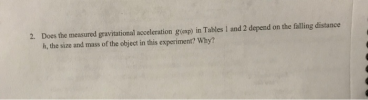 2. Does the measured gravitational acceleration g(exp) in Tables 1 and 2 depend on the falling distance h, the size and mass of the object in this experiment? Why?
A spring oscillates with a period of one second. As you know the force of oscillation...
A spring oscillates with a period of one second. As you know the force of oscillation is , the F = -kx, the k is a constant. First calculate the value of the constant K, so that truly an object of mass m = 0.5 Kg oscillates with a period of one second; Then answer: What is the numerical value of the return point with a positive sign, if the total energy is 14? Remember that the relationship between period...
A 0.33-kg mass is attached to the end of a spring and set into oscillation on...
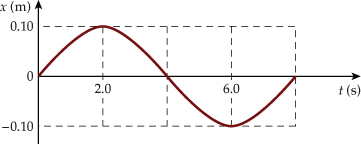 A 0.33-kg mass is attached to the end of a spring and set into
oscillation on a horizontal frictionless surface by releasing it
from a compressed position. The record of time is started when the
oscillating mass passes through the equilibrium position and the
position of the mass at any time is shown in the drawing.
https://www.webassign.net/webassignalgphys1/16-p-027.gif
Coordinates at (0,0), (2.0,.10), (3,0), (6.0,-.10)
Determine the following.
(a) amplitude A of the motion
.1 m
(b) angular frequency ω
How is...
A 0.33-kg mass is attached to the end of a spring and set into
oscillation on a horizontal frictionless surface by releasing it
from a compressed position. The record of time is started when the
oscillating mass passes through the equilibrium position and the
position of the mass at any time is shown in the drawing.
https://www.webassign.net/webassignalgphys1/16-p-027.gif
Coordinates at (0,0), (2.0,.10), (3,0), (6.0,-.10)
Determine the following.
(a) amplitude A of the motion
.1 m
(b) angular frequency ω
How is...
 Referring to data table 4 and 5, what does the period depend
on for the simple pendulum? explain
Data Table 4: Oscillation Time : 50 g Mass : Amplitude 7.0 cm: 86.7 84.5 sec. 200 g Mass : 766_sec. Amplitude = 14 cm : 97.1 sec. sec. Discuss the results in Data Table 4. Does the period of the simple pendulum depend on the mass? Does the period depend on the amplitude of oscillation? -> The period of a simple...
Referring to data table 4 and 5, what does the period depend
on for the simple pendulum? explain
Data Table 4: Oscillation Time : 50 g Mass : Amplitude 7.0 cm: 86.7 84.5 sec. 200 g Mass : 766_sec. Amplitude = 14 cm : 97.1 sec. sec. Discuss the results in Data Table 4. Does the period of the simple pendulum depend on the mass? Does the period depend on the amplitude of oscillation? -> The period of a simple...
 1. What is a linear restoring force? 2. What type of force must be acting to produce simple harmonic motion? 3. If a pendulum is to undergo simple harmonic motion, should its displacement angle be large or small? 4. To what is the frequency of oscillation of a pendulum equal? 5. To what is the frequency of oscillation of a mass, m. suspended from a spring of mass, mis equal?
 2. Does the measured gravitational acceleration g(exp) in Tables 1 and 2 depend on the falling distance h, the size and mass of the object in this experiment? Why?
Most questions answered within 3 hours.
-
Where is the error in this code sequence?
String s1 = "Hello";
String s2 = "ello";...
asked 11 months ago -
Financial data for Joel de Paris, Inc., for last year
follow:
Joel de Paris, Inc.
Balance...
asked 11 months ago -
Consider this reaction:
Al2(SO4)3 (aq)+ BaCl3
(aq) Al2Cl6 (aq)- +
3BaSO4(s) . What is the...
asked 11 months ago -
Suppose that Savneet is considering increasing her
recent random sample from 20 car rentals to 40...
asked 11 months ago -
Trucks arrive at an unloading terminal at an average rate of 120
per hour.
Trucks arrive...
asked 11 months ago -
Why are methanol and ethanol completely soluble in water while
octanol is not very little soluble....
asked 11 months ago -
A facilities manager at a university reads in a research report
that the mean amount of...
asked 11 months ago -
When the CuSO4 is rehydrated by adding water to the anhydrous
compound, is this an endothermic...
asked 11 months ago -
A ray of sunlight is passing from diamond into crown glass; the
angle of incidence is...
asked 11 months ago -
A block of mass 0.249 kg is placed on top of a light, vertical
spring of...
asked 11 months ago -
how do the kidneys compensate in the presences of acidosis
a) trigger hyperventilate
b) reserve acid...
asked 11 months ago -
Question 501 pts
The rental rate of capital to the firm increases. Which of the
following...
asked 11 months ago