The factors that control lymphocyte lifespan are important, since lymphocytes undergo selective steps that must yield either death or longevity. While still poorly understood, among these factors are gene products of the bcl-2 family. Interestingly, some members of this gene family seem to promote longevity, whereas others seem to foster cell death. Recently, an investigator found that one of these genes, called bcl-z, had the following expression pattern among thymic and peripheral T cells shown in Table 1.
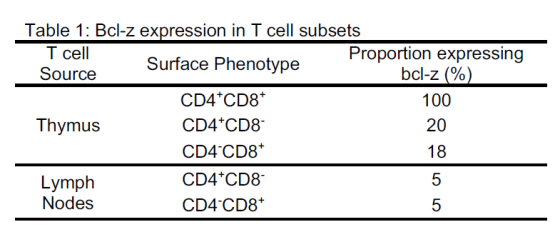
Do you think these data are most consistent with a
lifespan-promoting
or lifespan-shortening role for bcl-z among thymocytes? Explain
your
reasoning.
Outline one experiment to further probe your assertion
about bcl-z’s role
in T-cell lifespan determination.
Homework Answers


Add Answer to:
The factors that control lymphocyte lifespan are important, since lymphocytes undergo selective steps that must yield ei...
Most questions answered within 3 hours.
-
Where is the error in this code sequence?
String s1 = "Hello";
String s2 = "ello";...
asked 10 months ago -
Financial data for Joel de Paris, Inc., for last year
follow:
Joel de Paris, Inc.
Balance...
asked 10 months ago -
Consider this reaction:
Al2(SO4)3 (aq)+ BaCl3
(aq) Al2Cl6 (aq)- +
3BaSO4(s) . What is the...
asked 10 months ago -
Suppose that Savneet is considering increasing her
recent random sample from 20 car rentals to 40...
asked 10 months ago -
Trucks arrive at an unloading terminal at an average rate of 120
per hour.
Trucks arrive...
asked 10 months ago -
Why are methanol and ethanol completely soluble in water while
octanol is not very little soluble....
asked 10 months ago -
A facilities manager at a university reads in a research report
that the mean amount of...
asked 10 months ago -
When the CuSO4 is rehydrated by adding water to the anhydrous
compound, is this an endothermic...
asked 10 months ago -
A ray of sunlight is passing from diamond into crown glass; the
angle of incidence is...
asked 10 months ago -
A block of mass 0.249 kg is placed on top of a light, vertical
spring of...
asked 10 months ago -
how do the kidneys compensate in the presences of acidosis
a) trigger hyperventilate
b) reserve acid...
asked 10 months ago -
Question 501 pts
The rental rate of capital to the firm increases. Which of the
following...
asked 10 months ago