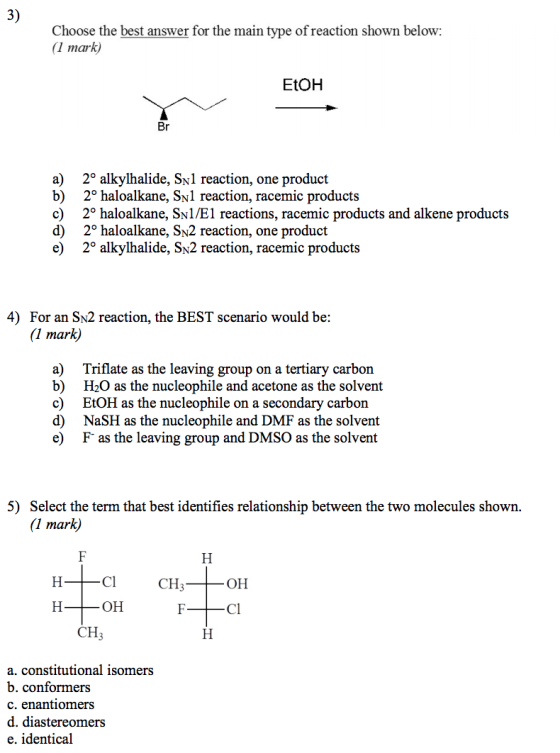
Choose the best answer for the main type of reaction shown below:
For an SN2 reaction, the BEST scenario would be:
Select the term that best identifies relationship between the two molecules shown.
Homework Answers
Add Answer to:
Choose the best answer for the main type of reaction shown below: For an SN2 reaction, the BEST scenario would be: Selec...
Choose the best answer for the main type of reaction shown below: (1 mark) EtOH Br...
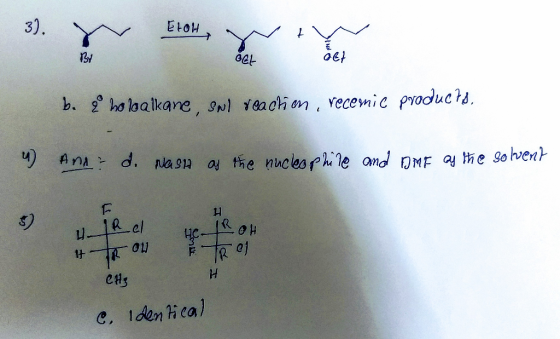
 Choose the best answer for the main type of reaction shown below: (1 mark) EtOH Br a) > b) c) d) e) 2° alkylhalide, Snl reaction, one product 2º haloalkane, Snl reaction, racemic products 2º haloalkane, SN1/E1 reactions, racemic products and alkene products 2° haloalkane, SN2 reaction, one product 2° alkylhalide, Sn2 reaction, racemic products
Which statement or set of conditions listed below is not consistent with an Syl reaction pathway?...
 Which statement or set of conditions listed below is not consistent with an Syl reaction pathway? O a. Neutral nucleophile work just fine. b. The leaving group is typically the conjugate base of a strong acid. O c. The rate is not dependent upon the concentration of the nucleophile. d. The temperature is relatively "cooler" to reduce competing elimination products. e. The solvent is polar and aprotic. Of. The substrate has a leaving group that is typically on a 30,...
Chem 2010 Substitution Problem Set Name 1. Choose the appropriate answer for each of the following...
 Chem 2010 Substitution Problem Set Name 1. Choose the appropriate answer for each of the following (circle your answer): the strongest base: i c F the strongest acid: CHOH H20 NH3 the worst nucleophile in protic, polar solvents: 1 F the slowest in an SN2 reaction: (CH3)2CHCH2Br CHI CH3CH2CH2Br the best solvent for an Snl reaction: acetone water pentane the worst nucleophile: OH "Сн, NH the strongest base NH H20 F the best nucleophile: OH CH3 NH the best solvent...
Consider the two lines shown on the energy diagram below. Energy Reaction progress In an Sn2...
 Consider the two lines shown on the energy diagram below. Energy Reaction progress In an Sn2 reaction, these compare the effect of the: a. substrate. b.nucleophile. c. leaving group. d. solvent e, nucleophile or solvent f. substrate or leaving group What is the major product formed upon treatment of ( R) 1-bromo-4-methylhexane with sodium cyanide? a. (S) 1-cyano-4-methylhexane b.(R) 1-cyano-4-methylhexane C. (R) 4-methyl-1-hexene d. (S) 4-methyl-1-hexetle
For the first six blanks, please choose only options from the dropdown menus provided below the...
 For the first six blanks, please choose only options from the
dropdown menus provided below the pictures.
Dropdown Menus:
1. methyl, primary (unhindered), primary (hindered), secondary,
tertiary
2. poor, weakly basic, strongly basic (hindered), strongly basic
(unhindered)
3. protic, aprotic
4. SN2, SN1, E1, E2, SN2 AND E2, SN1 AND E1, No Reaction
5. randomized, inverted, predictable but not inverted,
unchanged
6. a planar carbocation intermediate, backside attack transition
state, anti-periplanar transition state, other
CH3OH ~ ??? Br - în...
For the first six blanks, please choose only options from the
dropdown menus provided below the pictures.
Dropdown Menus:
1. methyl, primary (unhindered), primary (hindered), secondary,
tertiary
2. poor, weakly basic, strongly basic (hindered), strongly basic
(unhindered)
3. protic, aprotic
4. SN2, SN1, E1, E2, SN2 AND E2, SN1 AND E1, No Reaction
5. randomized, inverted, predictable but not inverted,
unchanged
6. a planar carbocation intermediate, backside attack transition
state, anti-periplanar transition state, other
CH3OH ~ ??? Br - în...
PLEASE ANSWER ALL QUESTIONS Question 5 The reaction below occurs via SN2 and E2 reaction mechanisms....
 PLEASE ANSWER ALL QUESTIONS
Question 5 The reaction below occurs via SN2 and E2 reaction mechanisms. The question only requires you to address the E2 reaction only. For the E2 reaction: Use Newman projections to show the relationship between the leaving group and the beta-hydrogen on the carbon labeled with the asterisk ("). 1. If the leaving group and the beta-hydrogen on the carbon labeled with the asterisk (1) are not in the correct orientation, show the result of the...
PLEASE ANSWER ALL QUESTIONS
Question 5 The reaction below occurs via SN2 and E2 reaction mechanisms. The question only requires you to address the E2 reaction only. For the E2 reaction: Use Newman projections to show the relationship between the leaving group and the beta-hydrogen on the carbon labeled with the asterisk ("). 1. If the leaving group and the beta-hydrogen on the carbon labeled with the asterisk (1) are not in the correct orientation, show the result of the...
Consider the SN2 reaction of butyl bromide with hydroxide ion , Assuming no other changes, what...
Consider the SN2 reaction of butyl bromide with hydroxide ion , Assuming no other changes, what effect on the reaction rate would result from simultaneously doubling the concentrations of both butyl bromide and hydroxyl ion No effect (B)It would double the rate (C)it would increase the rate six times (D) It would increase the rate four times. 2. Which alky halide would you expect to undergo SN1 hydrolysis most rapidly? (A) (CH3)3C-I (B) (CH3)3C-Br (C) (CH3)3C-Cl (D) (CH3)3C-F 3....
Which attacking species shown below would be the best choice to enforce an E2 pathway over...
 Which attacking species shown below would be the best choice to enforce an E2 pathway over an SN2 pathway for the reaction below? Attacking Species? BI CH; H -¢-o CH,MgB HC-0-0 CH; (a) H (b) (c) NH OH (d) SH (1) e Which solvent(s) listed below would be satisfactory in Sn2 reactions? HzC CH DMSO CH3CH,OH o HzC. Н.С DMF I II III a. I only b. II only c. III only d. I and II e. I and III...
Part 2 Multiple Choice. Select the best answer for each of the questions below: 1. Which...
 Part 2 Multiple Choice. Select the best answer for each of the questions below: 1. Which of these molecules is not an electrophile? a) CH4 b) CH3+ c) H* d) BF3 2. Which of these molecules is not a nucleophile ? a) NH3 b) OH c) CN d) H* 3. Water behaves as: a) a nucleophile b) an electrophile c) both d) neither 4. The SN2 reaction has how many steps? a) 1 b) 2 c) 3 d) 4 5....
1. Consider the SN2 reaction shown below and answer the following questions.nobl 8 acetone no t...
 1. Consider the SN2 reaction shown below and answer the following questions.nobl 8 acetone no t iNaSCH SCH, + NaBr worl s1918. A. Write the rate law for the reaction. ebiler vil ar to nollurunoonoo oli nison. B. Identify the nucleophile and the electrophile in the reaction. HOCH lo noiden nog orgnismanl.d C. State how each of the following factors would affect the rate of the reaction. CHOW CHOOH glasa a. Increasing the concentration of 1-bromopropane. b. Decreasing the concentration...
 Choose the best answer for the main type of reaction shown below: (1 mark) EtOH Br a) > b) c) d) e) 2° alkylhalide, Snl reaction, one product 2º haloalkane, Snl reaction, racemic products 2º haloalkane, SN1/E1 reactions, racemic products and alkene products 2° haloalkane, SN2 reaction, one product 2° alkylhalide, Sn2 reaction, racemic products
 Which statement or set of conditions listed below is not consistent with an Syl reaction pathway? O a. Neutral nucleophile work just fine. b. The leaving group is typically the conjugate base of a strong acid. O c. The rate is not dependent upon the concentration of the nucleophile. d. The temperature is relatively "cooler" to reduce competing elimination products. e. The solvent is polar and aprotic. Of. The substrate has a leaving group that is typically on a 30,...
 Chem 2010 Substitution Problem Set Name 1. Choose the appropriate answer for each of the following (circle your answer): the strongest base: i c F the strongest acid: CHOH H20 NH3 the worst nucleophile in protic, polar solvents: 1 F the slowest in an SN2 reaction: (CH3)2CHCH2Br CHI CH3CH2CH2Br the best solvent for an Snl reaction: acetone water pentane the worst nucleophile: OH "Сн, NH the strongest base NH H20 F the best nucleophile: OH CH3 NH the best solvent...
 Consider the two lines shown on the energy diagram below. Energy Reaction progress In an Sn2 reaction, these compare the effect of the: a. substrate. b.nucleophile. c. leaving group. d. solvent e, nucleophile or solvent f. substrate or leaving group What is the major product formed upon treatment of ( R) 1-bromo-4-methylhexane with sodium cyanide? a. (S) 1-cyano-4-methylhexane b.(R) 1-cyano-4-methylhexane C. (R) 4-methyl-1-hexene d. (S) 4-methyl-1-hexetle
 For the first six blanks, please choose only options from the
dropdown menus provided below the pictures.
Dropdown Menus:
1. methyl, primary (unhindered), primary (hindered), secondary,
tertiary
2. poor, weakly basic, strongly basic (hindered), strongly basic
(unhindered)
3. protic, aprotic
4. SN2, SN1, E1, E2, SN2 AND E2, SN1 AND E1, No Reaction
5. randomized, inverted, predictable but not inverted,
unchanged
6. a planar carbocation intermediate, backside attack transition
state, anti-periplanar transition state, other
CH3OH ~ ??? Br - în...
For the first six blanks, please choose only options from the
dropdown menus provided below the pictures.
Dropdown Menus:
1. methyl, primary (unhindered), primary (hindered), secondary,
tertiary
2. poor, weakly basic, strongly basic (hindered), strongly basic
(unhindered)
3. protic, aprotic
4. SN2, SN1, E1, E2, SN2 AND E2, SN1 AND E1, No Reaction
5. randomized, inverted, predictable but not inverted,
unchanged
6. a planar carbocation intermediate, backside attack transition
state, anti-periplanar transition state, other
CH3OH ~ ??? Br - în...
 PLEASE ANSWER ALL QUESTIONS
Question 5 The reaction below occurs via SN2 and E2 reaction mechanisms. The question only requires you to address the E2 reaction only. For the E2 reaction: Use Newman projections to show the relationship between the leaving group and the beta-hydrogen on the carbon labeled with the asterisk ("). 1. If the leaving group and the beta-hydrogen on the carbon labeled with the asterisk (1) are not in the correct orientation, show the result of the...
PLEASE ANSWER ALL QUESTIONS
Question 5 The reaction below occurs via SN2 and E2 reaction mechanisms. The question only requires you to address the E2 reaction only. For the E2 reaction: Use Newman projections to show the relationship between the leaving group and the beta-hydrogen on the carbon labeled with the asterisk ("). 1. If the leaving group and the beta-hydrogen on the carbon labeled with the asterisk (1) are not in the correct orientation, show the result of the...
 Which attacking species shown below would be the best choice to enforce an E2 pathway over an SN2 pathway for the reaction below? Attacking Species? BI CH; H -¢-o CH,MgB HC-0-0 CH; (a) H (b) (c) NH OH (d) SH (1) e Which solvent(s) listed below would be satisfactory in Sn2 reactions? HzC CH DMSO CH3CH,OH o HzC. Н.С DMF I II III a. I only b. II only c. III only d. I and II e. I and III...
 Part 2 Multiple Choice. Select the best answer for each of the questions below: 1. Which of these molecules is not an electrophile? a) CH4 b) CH3+ c) H* d) BF3 2. Which of these molecules is not a nucleophile ? a) NH3 b) OH c) CN d) H* 3. Water behaves as: a) a nucleophile b) an electrophile c) both d) neither 4. The SN2 reaction has how many steps? a) 1 b) 2 c) 3 d) 4 5....
 1. Consider the SN2 reaction shown below and answer the following questions.nobl 8 acetone no t iNaSCH SCH, + NaBr worl s1918. A. Write the rate law for the reaction. ebiler vil ar to nollurunoonoo oli nison. B. Identify the nucleophile and the electrophile in the reaction. HOCH lo noiden nog orgnismanl.d C. State how each of the following factors would affect the rate of the reaction. CHOW CHOOH glasa a. Increasing the concentration of 1-bromopropane. b. Decreasing the concentration...
Most questions answered within 3 hours.
-
Where is the error in this code sequence?
String s1 = "Hello";
String s2 = "ello";...
asked 10 months ago -
Financial data for Joel de Paris, Inc., for last year
follow:
Joel de Paris, Inc.
Balance...
asked 10 months ago -
Consider this reaction:
Al2(SO4)3 (aq)+ BaCl3
(aq) Al2Cl6 (aq)- +
3BaSO4(s) . What is the...
asked 10 months ago -
Suppose that Savneet is considering increasing her
recent random sample from 20 car rentals to 40...
asked 10 months ago -
Trucks arrive at an unloading terminal at an average rate of 120
per hour.
Trucks arrive...
asked 10 months ago -
Why are methanol and ethanol completely soluble in water while
octanol is not very little soluble....
asked 10 months ago -
A facilities manager at a university reads in a research report
that the mean amount of...
asked 10 months ago -
When the CuSO4 is rehydrated by adding water to the anhydrous
compound, is this an endothermic...
asked 10 months ago -
A ray of sunlight is passing from diamond into crown glass; the
angle of incidence is...
asked 10 months ago -
A block of mass 0.249 kg is placed on top of a light, vertical
spring of...
asked 10 months ago -
how do the kidneys compensate in the presences of acidosis
a) trigger hyperventilate
b) reserve acid...
asked 10 months ago -
Question 501 pts
The rental rate of capital to the firm increases. Which of the
following...
asked 10 months ago