
Homework Answers
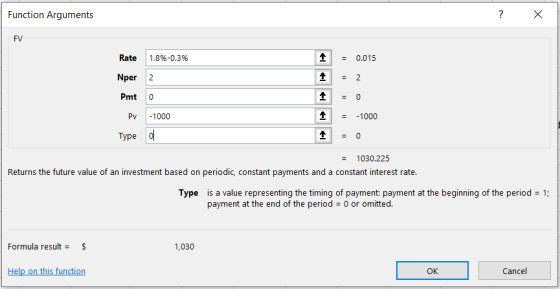
Hence, correct option is C. $1030
Please rate thumbs up
Add Answer to:
please use financial calculator 24. You deposited $1000 in a savings account two years ago. Inflation has been 1.8% per...
You opened a savings account seven years ago and deposited $1,500 at that time. Five years...
 You opened a savings account seven years ago and deposited $1,500 at that time. Five years ago, you added another $1,200 to the account. Today, you deposited an additional $600. The rate of return is 6 percent compounded annually. How much was your account worth at the close of business today? a. $4,416.14 b. $4,461.32 c. $4,497.32 d. $4,961.98
Answer the question. $100,000 was deposited in a savings account 8 years ago, and the account...
 Answer the question. $100,000 was deposited in a savings account 8 years ago, and the account earned interest at the rate of 10% per year. Assuming the end-of-the-year convention, what is the amount of equal annual withdrawals that can be made to completely deplete the fund 15 years from now if the first withdrawal will be made one year from today?
Pete Frost made a deposit into his savings account 3 years ago and earned interest at...
 Pete Frost made a deposit into his savings account 3 years ago and earned interest at an annual rate of 8%. The deposit accumulated to $20,500. How much was initially deposited assuming that the interest was compounded (a) annually, (b) semiannually, and (c) quarterly? terly? Use Excel or a financial calculator for computation. Round your answer to nearest dollar. (a) Annually (b) Semiannually (c) Quarterly
Answer the question. $100,000 was deposited in a savings account 8 years ago, and the account earned interest at th...
 Answer the question. $100,000 was deposited in a savings account 8 years ago, and the account earned interest at the rate of 10% per year. Assuming the end-of-the-year convention, what is the amount of equal annual withdrawals that can be made to ompletely deplete the fund 15 years from now if the first withdrawal will be made one year from today? B I * Fr
Present Value Computation Pete Frost made a deposit into his savings account three years ago, and...
 Present Value Computation Pete Frost made a deposit into his savings account three years ago, and earned interest at an annual rate of 8%. The deposit accumulated to $25,000. How much was initially deposited assuming that the interest was compounded (a) annually, (b) semiannually, and (c) quarterly? Use Excel or a financial calculator for computation. Round answers to the nearest dollar. (a) Annually $ (b) Semiannually $ (c) Quarterly $ 0 0
Suppose you deposited $10 at 5% interest into a savings account 20 years ago. How much...
Suppose you deposited $10 at 5% interest into a savings account 20 years ago. How much is the investment worth today with simple interest? With compound interest? What is the difference? continue to identify the critical values, draw a time line, write the appropriate formula, and then solve the problem
Thirteen years ago, you deposited $2,400 into an account. Eight years ago, you added an additional...
Thirteen years ago, you deposited $2,400 into an account. Eight years ago, you added an additional $1,000 to this account. You earned 8 percent, compounded annually, for the first 5 years and 5.5 percent, compounded annually, for the last 8 years. How much money do you have in your account today?
Suppose that, in March 2018, you had deposited $1000 in a savings account with an interest...
Suppose that, in March 2018, you had deposited $1000 in a savings account with an interest rate of 2.2% (and left it there until March of this year) and the bank paid an interest rate of 2% on that savings. What nominal interest rate did you earn? What real interest rate did you earn? Was it a good decision on your part, why or why not?
You deposited $5,000 four years ago into a bank account. Two years ago, you deposited an...
You deposited $5,000 four years ago into a bank account. Two years ago, you deposited an additional $4,000. Assume an annual interest rate of 6%. How much will be in the account in ten years from now? Use a $ symbol and zero decimal places. (i.e. $5,432)
Assume you opened and deposited $1000.00 into a savings account that pays 4% per annum. If the bank compounds interest...
Assume you opened and deposited $1000.00 into a savings account that pays 4% per annum. If the bank compounds interest annually, how much will you have in your account at the end of 3 years (assuming no deposits or withdrawals are made for 3 years)? Find the balance if the bank compounds interest quarterly under the same conditions. Find the balance if the bank compounds interest continuously under the same conditions.
 You opened a savings account seven years ago and deposited $1,500 at that time. Five years ago, you added another $1,200 to the account. Today, you deposited an additional $600. The rate of return is 6 percent compounded annually. How much was your account worth at the close of business today? a. $4,416.14 b. $4,461.32 c. $4,497.32 d. $4,961.98
 Answer the question. $100,000 was deposited in a savings account 8 years ago, and the account earned interest at the rate of 10% per year. Assuming the end-of-the-year convention, what is the amount of equal annual withdrawals that can be made to completely deplete the fund 15 years from now if the first withdrawal will be made one year from today?
 Pete Frost made a deposit into his savings account 3 years ago and earned interest at an annual rate of 8%. The deposit accumulated to $20,500. How much was initially deposited assuming that the interest was compounded (a) annually, (b) semiannually, and (c) quarterly? terly? Use Excel or a financial calculator for computation. Round your answer to nearest dollar. (a) Annually (b) Semiannually (c) Quarterly
 Answer the question. $100,000 was deposited in a savings account 8 years ago, and the account earned interest at the rate of 10% per year. Assuming the end-of-the-year convention, what is the amount of equal annual withdrawals that can be made to ompletely deplete the fund 15 years from now if the first withdrawal will be made one year from today? B I * Fr
 Present Value Computation Pete Frost made a deposit into his savings account three years ago, and earned interest at an annual rate of 8%. The deposit accumulated to $25,000. How much was initially deposited assuming that the interest was compounded (a) annually, (b) semiannually, and (c) quarterly? Use Excel or a financial calculator for computation. Round answers to the nearest dollar. (a) Annually $ (b) Semiannually $ (c) Quarterly $ 0 0
Most questions answered within 3 hours.
-
Where is the error in this code sequence?
String s1 = "Hello";
String s2 = "ello";...
asked 10 months ago -
Financial data for Joel de Paris, Inc., for last year
follow:
Joel de Paris, Inc.
Balance...
asked 10 months ago -
Consider this reaction:
Al2(SO4)3 (aq)+ BaCl3
(aq) Al2Cl6 (aq)- +
3BaSO4(s) . What is the...
asked 10 months ago -
Suppose that Savneet is considering increasing her
recent random sample from 20 car rentals to 40...
asked 10 months ago -
Trucks arrive at an unloading terminal at an average rate of 120
per hour.
Trucks arrive...
asked 10 months ago -
Why are methanol and ethanol completely soluble in water while
octanol is not very little soluble....
asked 10 months ago -
A facilities manager at a university reads in a research report
that the mean amount of...
asked 10 months ago -
When the CuSO4 is rehydrated by adding water to the anhydrous
compound, is this an endothermic...
asked 10 months ago -
A ray of sunlight is passing from diamond into crown glass; the
angle of incidence is...
asked 10 months ago -
A block of mass 0.249 kg is placed on top of a light, vertical
spring of...
asked 10 months ago -
how do the kidneys compensate in the presences of acidosis
a) trigger hyperventilate
b) reserve acid...
asked 10 months ago -
Question 501 pts
The rental rate of capital to the firm increases. Which of the
following...
asked 10 months ago