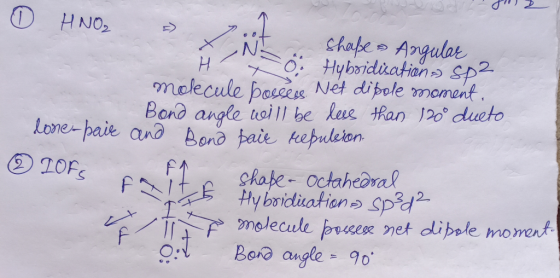
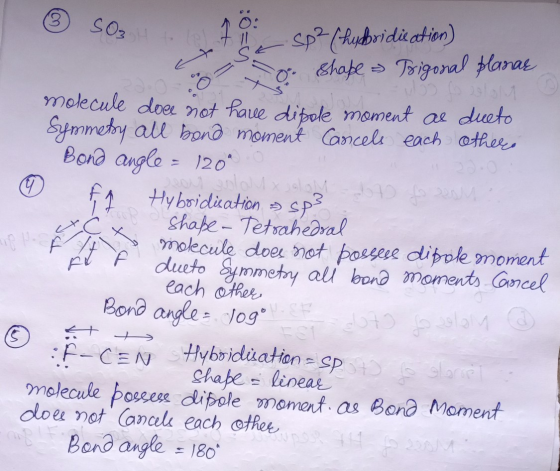
For the following three questions, determine the shapes of the following molecules (assume there is one central atom): 1...
For the following three questions, determine the shapes of the following molecules (assume there is one central atom):
1)HNO 2) IOF5 3) SO3 4)CF4 5)FCN
a) Which structures have hybridizations that involve d orbitals?
b) Which ones have bond angles of 120o?
c) Which ones have a molecular dipole?
Homework Answers
Add Answer to:
For the following three questions, determine the shapes of the following molecules (assume there is one central atom): 1...
5. Determine the molecular shapes of the following molecules/ions and the hybridization on the central atom...
 5. Determine the molecular shapes of the following molecules/ions and the hybridization on the central atom of each molecule/ion. (a) 13"; (b) AsFs; (c) ,2; (d) ClO2; (e) IFs (f) HCOOH 6. Draw three resonance structures of carbon dioxide, and use formal charges to determine which of them is most important contributor to the Lewis structure. 7. Which of the following has the stronger nitrogen-to-nitrogen bond? The longer nitrogen-to-nitrogen bond? N2H2 N2H4
Draw Louis structures for the following molecules.each molecule has more than one central atom. use supplied...
 Draw Louis structures for the following molecules.each molecule has
more than one central atom. use supplied hints to arrange atoms
into molecular framework then fill in the blank. for bond
polarities, indicate the polar bonds on your Lewis structures using
the S+ and S- notation.
Experiment 8 Part 2: Molecules and lons with More Than One Central Atom Molecular geometries (indicate which atom): N₂F4 Ideal bond angles (indicate which atom): Are polar bonds present? (Indicate on Lewis dot structure.) Is...
Draw Louis structures for the following molecules.each molecule has
more than one central atom. use supplied hints to arrange atoms
into molecular framework then fill in the blank. for bond
polarities, indicate the polar bonds on your Lewis structures using
the S+ and S- notation.
Experiment 8 Part 2: Molecules and lons with More Than One Central Atom Molecular geometries (indicate which atom): N₂F4 Ideal bond angles (indicate which atom): Are polar bonds present? (Indicate on Lewis dot structure.) Is...
Questions 1, 2, and 5: If there are 3 elements in the molecule, the first atom...
 Questions 1, 2, and 5: If there are 3 elements in the molecule, the first atom is the central atom and the others are bonded to it. 1. Draw the Lewis structures for each of the following ions or molecules. For each, give (i) the molecular shape, (ii) the electron pair geometry at the central atom, and (iii) the hybridization of the central atom. (a) SOF2 (b) PCI, (c) BrOF (d) IFS (e) IO, 2. Consider the following molecules or...
Consider each of the following molecules and/or ions. Give the hybridization for the central atom in...
 Consider each of the following molecules and/or ions. Give the hybridization for the central atom in each case, and also give the molecular geometry. Ignore any distortions in the geometry due to non-equivalent terminal atoms. molecule or ion central atom hybridization for central atom molecular geometry CIO; (b) Seot (c) coza CO2 Cl2 Answer the following questions about the hybrid orbitals on the phosphorus atom in the POCl; and PClz molecules. What are the expected geometries of these molecules? Ignore...
Part 2: Molecules and lons with More than One Central Atom. Answer each of the following...
 Part 2: Molecules and lons with More than One Central Atom. Answer each of the following for the stated molecule or ion Molecule: N204 Molecular geometry (1*N) Ideal bond angles (1* N) Molecular geometry (204N) Ideal bond angles (2nd N) Are polar bonds present? Is there an overall dipole? Octet rule violator and how? Molecule: H,SO Molecular geometry (5) Ideal bond angles (5) Molecular geometry (10) Ideal bond angles (10) Molecular geometry (2010) Ideal bond angles ( 20) Are polar...
2. Use the VSEPR theory to predict the shapes of the following molecules or ions. First,...
 2. Use the VSEPR theory to predict the shapes of the following molecules or ions. First, draw the Lewis structures for each species. Next, use the modeling kit to build the molecule and confirm that it matches your Lewis structure. For structures 2a e, show your models to your instructor. Finally, report the molecular geometry and bond angles for each of the central atoms. H bol H с с с CN H Central Atom Molecular Geometry Bond Angles Carbon (left)...
For each of the following molecules, draw 1. the Lewis structure 2. indicate the molecular shapes...
 For each of the following
molecules, draw 1. the Lewis structure 2. indicate the molecular
shapes 3. bond angles 4. hybridization on the central atom 5. for
the problems with a *, calculate the formal charge of the element
in bold.
Lewis structure Molecular Shape bond angles hybridization or formal charge for on central atom element in Bold 16.) BF3 7.) NF3 *N 8.) H30* 9.) PF3 10.) [CH₂F2 *F
For each of the following
molecules, draw 1. the Lewis structure 2. indicate the molecular
shapes 3. bond angles 4. hybridization on the central atom 5. for
the problems with a *, calculate the formal charge of the element
in bold.
Lewis structure Molecular Shape bond angles hybridization or formal charge for on central atom element in Bold 16.) BF3 7.) NF3 *N 8.) H30* 9.) PF3 10.) [CH₂F2 *F
Assignment 10, version 129 Questions 1, 2, and 5: If there are 3 elements in the...
 Assignment 10, version 129 Questions 1, 2, and 5: If there are 3 elements in the molecule, the first atom is the central atom and the others are bonded to it. 1. Draw the Lewis structures for each of the following ions or molecules. For each, give (i) the molecular shape, (ii) the electron pair geometry at the central atom, and (iii) the hybridization of the central atom. (a) CIF (b) AsCl4 (C) PCI (d) AsCl3 (e) OF 2. Consider...
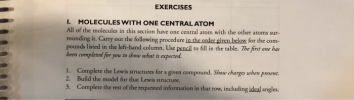
How does one complete the chart? EXERCISES I. MOLECULES WITH ONE CENTRAL ATOM All of the...
 How does one complete the chart?
EXERCISES I. MOLECULES WITH ONE CENTRAL ATOM All of the molecules in this section have one central atom with the other atoms sur- rounding it. Carry out the following procedure in the order given below for the com- pounds listed in the left-hand column. Use pencil to fill in the table. The first one has been completed for you to show what is expected. 1. Complete the Lewis structures for a given compound. Show...
How does one complete the chart?
EXERCISES I. MOLECULES WITH ONE CENTRAL ATOM All of the molecules in this section have one central atom with the other atoms sur- rounding it. Carry out the following procedure in the order given below for the com- pounds listed in the left-hand column. Use pencil to fill in the table. The first one has been completed for you to show what is expected. 1. Complete the Lewis structures for a given compound. Show...
(1) Which one of the following molecules where the central atom does not have an octet?...
 (1) Which one of the following molecules where the central atom does not have an octet? (2) Which one of the following molecules where the central atom has more than 8 valence electrons around the central atom? Весі SO HBrO PFS SO3 CHO НАРО SCH BCI, IOCIS IF, XeCl2 Bн, нсіо. (3) Which of the following elements has the largest difference between the first and second ionization energy? A. chlorine B. argon C. potassium D. calcium E.scandium HIO (4) How...
 5. Determine the molecular shapes of the following molecules/ions and the hybridization on the central atom of each molecule/ion. (a) 13"; (b) AsFs; (c) ,2; (d) ClO2; (e) IFs (f) HCOOH 6. Draw three resonance structures of carbon dioxide, and use formal charges to determine which of them is most important contributor to the Lewis structure. 7. Which of the following has the stronger nitrogen-to-nitrogen bond? The longer nitrogen-to-nitrogen bond? N2H2 N2H4
 Draw Louis structures for the following molecules.each molecule has
more than one central atom. use supplied hints to arrange atoms
into molecular framework then fill in the blank. for bond
polarities, indicate the polar bonds on your Lewis structures using
the S+ and S- notation.
Experiment 8 Part 2: Molecules and lons with More Than One Central Atom Molecular geometries (indicate which atom): N₂F4 Ideal bond angles (indicate which atom): Are polar bonds present? (Indicate on Lewis dot structure.) Is...
Draw Louis structures for the following molecules.each molecule has
more than one central atom. use supplied hints to arrange atoms
into molecular framework then fill in the blank. for bond
polarities, indicate the polar bonds on your Lewis structures using
the S+ and S- notation.
Experiment 8 Part 2: Molecules and lons with More Than One Central Atom Molecular geometries (indicate which atom): N₂F4 Ideal bond angles (indicate which atom): Are polar bonds present? (Indicate on Lewis dot structure.) Is...
 Questions 1, 2, and 5: If there are 3 elements in the molecule, the first atom is the central atom and the others are bonded to it. 1. Draw the Lewis structures for each of the following ions or molecules. For each, give (i) the molecular shape, (ii) the electron pair geometry at the central atom, and (iii) the hybridization of the central atom. (a) SOF2 (b) PCI, (c) BrOF (d) IFS (e) IO, 2. Consider the following molecules or...
 Consider each of the following molecules and/or ions. Give the hybridization for the central atom in each case, and also give the molecular geometry. Ignore any distortions in the geometry due to non-equivalent terminal atoms. molecule or ion central atom hybridization for central atom molecular geometry CIO; (b) Seot (c) coza CO2 Cl2 Answer the following questions about the hybrid orbitals on the phosphorus atom in the POCl; and PClz molecules. What are the expected geometries of these molecules? Ignore...
 Part 2: Molecules and lons with More than One Central Atom. Answer each of the following for the stated molecule or ion Molecule: N204 Molecular geometry (1*N) Ideal bond angles (1* N) Molecular geometry (204N) Ideal bond angles (2nd N) Are polar bonds present? Is there an overall dipole? Octet rule violator and how? Molecule: H,SO Molecular geometry (5) Ideal bond angles (5) Molecular geometry (10) Ideal bond angles (10) Molecular geometry (2010) Ideal bond angles ( 20) Are polar...
 2. Use the VSEPR theory to predict the shapes of the following molecules or ions. First, draw the Lewis structures for each species. Next, use the modeling kit to build the molecule and confirm that it matches your Lewis structure. For structures 2a e, show your models to your instructor. Finally, report the molecular geometry and bond angles for each of the central atoms. H bol H с с с CN H Central Atom Molecular Geometry Bond Angles Carbon (left)...
 For each of the following
molecules, draw 1. the Lewis structure 2. indicate the molecular
shapes 3. bond angles 4. hybridization on the central atom 5. for
the problems with a *, calculate the formal charge of the element
in bold.
Lewis structure Molecular Shape bond angles hybridization or formal charge for on central atom element in Bold 16.) BF3 7.) NF3 *N 8.) H30* 9.) PF3 10.) [CH₂F2 *F
For each of the following
molecules, draw 1. the Lewis structure 2. indicate the molecular
shapes 3. bond angles 4. hybridization on the central atom 5. for
the problems with a *, calculate the formal charge of the element
in bold.
Lewis structure Molecular Shape bond angles hybridization or formal charge for on central atom element in Bold 16.) BF3 7.) NF3 *N 8.) H30* 9.) PF3 10.) [CH₂F2 *F
 Assignment 10, version 129 Questions 1, 2, and 5: If there are 3 elements in the molecule, the first atom is the central atom and the others are bonded to it. 1. Draw the Lewis structures for each of the following ions or molecules. For each, give (i) the molecular shape, (ii) the electron pair geometry at the central atom, and (iii) the hybridization of the central atom. (a) CIF (b) AsCl4 (C) PCI (d) AsCl3 (e) OF 2. Consider...
 How does one complete the chart?
EXERCISES I. MOLECULES WITH ONE CENTRAL ATOM All of the molecules in this section have one central atom with the other atoms sur- rounding it. Carry out the following procedure in the order given below for the com- pounds listed in the left-hand column. Use pencil to fill in the table. The first one has been completed for you to show what is expected. 1. Complete the Lewis structures for a given compound. Show...
How does one complete the chart?
EXERCISES I. MOLECULES WITH ONE CENTRAL ATOM All of the molecules in this section have one central atom with the other atoms sur- rounding it. Carry out the following procedure in the order given below for the com- pounds listed in the left-hand column. Use pencil to fill in the table. The first one has been completed for you to show what is expected. 1. Complete the Lewis structures for a given compound. Show...
 (1) Which one of the following molecules where the central atom does not have an octet? (2) Which one of the following molecules where the central atom has more than 8 valence electrons around the central atom? Весі SO HBrO PFS SO3 CHO НАРО SCH BCI, IOCIS IF, XeCl2 Bн, нсіо. (3) Which of the following elements has the largest difference between the first and second ionization energy? A. chlorine B. argon C. potassium D. calcium E.scandium HIO (4) How...
Most questions answered within 3 hours.
-
Where is the error in this code sequence?
String s1 = "Hello";
String s2 = "ello";...
asked 10 months ago -
Financial data for Joel de Paris, Inc., for last year
follow:
Joel de Paris, Inc.
Balance...
asked 10 months ago -
Consider this reaction:
Al2(SO4)3 (aq)+ BaCl3
(aq) Al2Cl6 (aq)- +
3BaSO4(s) . What is the...
asked 10 months ago -
Suppose that Savneet is considering increasing her
recent random sample from 20 car rentals to 40...
asked 10 months ago -
Trucks arrive at an unloading terminal at an average rate of 120
per hour.
Trucks arrive...
asked 10 months ago -
Why are methanol and ethanol completely soluble in water while
octanol is not very little soluble....
asked 10 months ago -
A facilities manager at a university reads in a research report
that the mean amount of...
asked 10 months ago -
When the CuSO4 is rehydrated by adding water to the anhydrous
compound, is this an endothermic...
asked 10 months ago -
A ray of sunlight is passing from diamond into crown glass; the
angle of incidence is...
asked 10 months ago -
A block of mass 0.249 kg is placed on top of a light, vertical
spring of...
asked 10 months ago -
how do the kidneys compensate in the presences of acidosis
a) trigger hyperventilate
b) reserve acid...
asked 10 months ago -
Question 501 pts
The rental rate of capital to the firm increases. Which of the
following...
asked 10 months ago