
Homework Answers

Add Answer to:
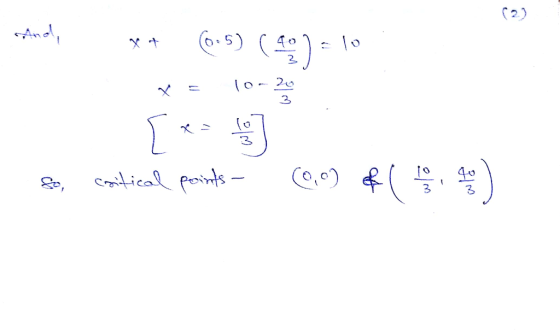
3 Consider the following Lotka-Volterra model which describes some competitive inter action: r' = 0.3r(10 - r - 0.5...
• (Problem 2) Consider the second version of the Lotka-Volterra model: F(a – bF – cS)...
 • (Problem 2) Consider the second version of the Lotka-Volterra model: F(a – bF – cS) dF dt ds dt S(-k + \F). (1) Explain the model; i.e. what are the terms in the equation signify? How is this model different from equations (1)? (2) Find the equilibrium point(s). (3) Linearize (2) about the equilibrium point(s). (4) Classify if the equilibrium points are stable or unstable. (5) Pick some values for a, b, c, k, 1. Plot the solutions of...
Consider the second version of the Lotka-Volterra model: dF F(a - 6F - cS) dt ds...
 Consider the second version of the Lotka-Volterra model: dF F(a - 6F - cS) dt ds = S(-k + XF). dt (1) Explain the model; i.e. what are the terms in the equation signify? How is this model different from equations (1)? (2) Find the equilibrium point(s). (3) Linearize (2) about the equilibrium point(s). (4) Classify if the equilibrium points are stable or unstable. (5) Pick some values for a, b,c,k, X. Plot the solutions of the model and the...
1. Consider the Lotka-Volterra model for the interaction between a predator population (wolves W(t)) and a...
 1. Consider the Lotka-Volterra model for the interaction between a predator population (wolves W(t)) and a prey population (moose M(t)), À = aM - bmw W = -cW+dMW with the four constants all positive. (a) Explain the meaning of the terms. (b) Non-dimensionalize the equations in the form dx/dt = *(1 - y) and dy/dt = xy(x - 1). (c) Find the fixed points, linearize, classify their stability and draw a phase diagram for various initial conditions (again, using a...
Exercise 3, Section 9.5. Modified Lotka- Volterra Predator-Prey model Consider two species (rabbits and foxes) such that the population R (rabbits) and F (foxrs) obey the system of equations dR d...
 Exercise 3, Section 9.5. Modified Lotka- Volterra Predator-Prey model Consider two species (rabbits and foxes) such that the population R (rabbits) and F (foxrs) obey the system of equations dR dt dF dt R2-R)-12RF . What happens to the population of rabbits if the number of foxes is arro? (Use the phase line analysis from Chapter 2) What happens to the population of foxes if the number of rabbits is zero? 3. Using the method of nullclines, draw an approximate...
5. Consider the nonlinear two dimensional Lotka-Volterra (predator-prey) system z'(t) = z(t)[2-2(...
 5. Consider the nonlinear two dimensional Lotka-Volterra (predator-prey) system z'(t) = z(t)[2-2(t)-2y(t)l, y'(t) = y(t)12-y(t)--2(t)] (a) Find all critical points of this system, and at each determine whether or not the system is locally stable or unstable. (b) We proved in class, using the Bendixson-Dulac theorem, that this system has no periodic solution with trajectory in the first quadrant of the plane. Assuming this, use the Poincare-Bendixson theorem to prove that all trajectories (z(t),y(t)) of the system (2) with initial...
5. Consider the nonlinear two dimensional Lotka-Volterra (predator-prey) system z'(t) = z(t)[2-2(t)-2y(t)l, y'(t) = y(t)12-y(t)--2(t)] (a)...
 5. Consider the nonlinear two dimensional Lotka-Volterra (predator-prey) system z'(t) = z(t)[2-2(t)-2y(t)l, y'(t) = y(t)12-y(t)--2(t)] (a) Find all critical points of this system, and at each determine whether or not the system is locally stable or unstable. (b) We proved in class, using the Bendixson-Dulac theorem, that this system has no periodic solution with trajectory in the first quadrant of the plane. Assuming this, use the Poincare-Bendixson theorem to prove that all trajectories (z(t),y(t)) of the system (2) with initial...
Q1. The following nonlinear system of DE's can be interpreted as describing the inter- action of ...
 please give specific steps of
all the questions, thanks
Q1. The following nonlinear system of DE's can be interpreted as describing the inter- action of two species with population densities r and y, respectively. 1dy1 2dt 2 dt (a) Write the given system in the form where A is a matrix with constant enteries. Also, show that the system is locally linear. (b) This system has three equilibrium or critical points. Determine those critical points and give a physical interpretation...
please give specific steps of
all the questions, thanks
Q1. The following nonlinear system of DE's can be interpreted as describing the inter- action of two species with population densities r and y, respectively. 1dy1 2dt 2 dt (a) Write the given system in the form where A is a matrix with constant enteries. Also, show that the system is locally linear. (b) This system has three equilibrium or critical points. Determine those critical points and give a physical interpretation...
Consider the nonlinear second-order differential equation x4 3(x')2 + k2x2 - 1 = 0, _ where k > 0 is a constant....
 Consider the nonlinear second-order differential equation x4 3(x')2 + k2x2 - 1 = 0, _ where k > 0 is a constant. Answer to the following questions. (a) Derive a plane autonomous system from the given equation and find all the critical points (b) Classify(discriminate/categorize) all the critical points into one of the three cat- egories: stable / saddle unstable(not saddle)} (c) Show that there is no periodic solution in a simply connected region {(r, y) R2< 0} R =...
Problem 3. Consider the following system of two equations, in terms of the parameter 7, which...
 Problem 3. Consider the following system of two equations, in terms of the parameter 7, which describes the respective populations of two species: 1 = *(- zv- ) yz ( +x). y' 2 (a.) List all critical points and discuss the stability at the points in relation to the parameter 7. (b.) What values of the parameter y will allow a stable solution in which both species have positive populations.
Consider the following model of the economy Production function: Y = A·K·N – N2/2 Marginal produ...
Consider the following model of the economy Production function: Y = A·K·N – N2/2 Marginal product of labor: MPN = A·K – N. where the initial values of A = 10 and K = 10. The initial labor supply curve is given as: NS = 50 + 4w Initial conditions in the goods market Cd = 790 + .50(Y-T) – 500r Id = 1000 – 500r G = 800 T = 100 Md/P = 110 + 0.5Y- 1000(r + πe) ...
 • (Problem 2) Consider the second version of the Lotka-Volterra model: F(a – bF – cS) dF dt ds dt S(-k + \F). (1) Explain the model; i.e. what are the terms in the equation signify? How is this model different from equations (1)? (2) Find the equilibrium point(s). (3) Linearize (2) about the equilibrium point(s). (4) Classify if the equilibrium points are stable or unstable. (5) Pick some values for a, b, c, k, 1. Plot the solutions of...
 Consider the second version of the Lotka-Volterra model: dF F(a - 6F - cS) dt ds = S(-k + XF). dt (1) Explain the model; i.e. what are the terms in the equation signify? How is this model different from equations (1)? (2) Find the equilibrium point(s). (3) Linearize (2) about the equilibrium point(s). (4) Classify if the equilibrium points are stable or unstable. (5) Pick some values for a, b,c,k, X. Plot the solutions of the model and the...
 1. Consider the Lotka-Volterra model for the interaction between a predator population (wolves W(t)) and a prey population (moose M(t)), À = aM - bmw W = -cW+dMW with the four constants all positive. (a) Explain the meaning of the terms. (b) Non-dimensionalize the equations in the form dx/dt = *(1 - y) and dy/dt = xy(x - 1). (c) Find the fixed points, linearize, classify their stability and draw a phase diagram for various initial conditions (again, using a...
 Exercise 3, Section 9.5. Modified Lotka- Volterra Predator-Prey model Consider two species (rabbits and foxes) such that the population R (rabbits) and F (foxrs) obey the system of equations dR dt dF dt R2-R)-12RF . What happens to the population of rabbits if the number of foxes is arro? (Use the phase line analysis from Chapter 2) What happens to the population of foxes if the number of rabbits is zero? 3. Using the method of nullclines, draw an approximate...
 5. Consider the nonlinear two dimensional Lotka-Volterra (predator-prey) system z'(t) = z(t)[2-2(t)-2y(t)l, y'(t) = y(t)12-y(t)--2(t)] (a) Find all critical points of this system, and at each determine whether or not the system is locally stable or unstable. (b) We proved in class, using the Bendixson-Dulac theorem, that this system has no periodic solution with trajectory in the first quadrant of the plane. Assuming this, use the Poincare-Bendixson theorem to prove that all trajectories (z(t),y(t)) of the system (2) with initial...
 5. Consider the nonlinear two dimensional Lotka-Volterra (predator-prey) system z'(t) = z(t)[2-2(t)-2y(t)l, y'(t) = y(t)12-y(t)--2(t)] (a) Find all critical points of this system, and at each determine whether or not the system is locally stable or unstable. (b) We proved in class, using the Bendixson-Dulac theorem, that this system has no periodic solution with trajectory in the first quadrant of the plane. Assuming this, use the Poincare-Bendixson theorem to prove that all trajectories (z(t),y(t)) of the system (2) with initial...
 please give specific steps of
all the questions, thanks
Q1. The following nonlinear system of DE's can be interpreted as describing the inter- action of two species with population densities r and y, respectively. 1dy1 2dt 2 dt (a) Write the given system in the form where A is a matrix with constant enteries. Also, show that the system is locally linear. (b) This system has three equilibrium or critical points. Determine those critical points and give a physical interpretation...
please give specific steps of
all the questions, thanks
Q1. The following nonlinear system of DE's can be interpreted as describing the inter- action of two species with population densities r and y, respectively. 1dy1 2dt 2 dt (a) Write the given system in the form where A is a matrix with constant enteries. Also, show that the system is locally linear. (b) This system has three equilibrium or critical points. Determine those critical points and give a physical interpretation...
 Consider the nonlinear second-order differential equation x4 3(x')2 + k2x2 - 1 = 0, _ where k > 0 is a constant. Answer to the following questions. (a) Derive a plane autonomous system from the given equation and find all the critical points (b) Classify(discriminate/categorize) all the critical points into one of the three cat- egories: stable / saddle unstable(not saddle)} (c) Show that there is no periodic solution in a simply connected region {(r, y) R2< 0} R =...
 Problem 3. Consider the following system of two equations, in terms of the parameter 7, which describes the respective populations of two species: 1 = *(- zv- ) yz ( +x). y' 2 (a.) List all critical points and discuss the stability at the points in relation to the parameter 7. (b.) What values of the parameter y will allow a stable solution in which both species have positive populations.
Most questions answered within 3 hours.
-
Where is the error in this code sequence?
String s1 = "Hello";
String s2 = "ello";...
asked 11 months ago -
Financial data for Joel de Paris, Inc., for last year
follow:
Joel de Paris, Inc.
Balance...
asked 11 months ago -
Consider this reaction:
Al2(SO4)3 (aq)+ BaCl3
(aq) Al2Cl6 (aq)- +
3BaSO4(s) . What is the...
asked 11 months ago -
Suppose that Savneet is considering increasing her
recent random sample from 20 car rentals to 40...
asked 11 months ago -
Trucks arrive at an unloading terminal at an average rate of 120
per hour.
Trucks arrive...
asked 11 months ago -
Why are methanol and ethanol completely soluble in water while
octanol is not very little soluble....
asked 11 months ago -
A facilities manager at a university reads in a research report
that the mean amount of...
asked 11 months ago -
When the CuSO4 is rehydrated by adding water to the anhydrous
compound, is this an endothermic...
asked 11 months ago -
A ray of sunlight is passing from diamond into crown glass; the
angle of incidence is...
asked 11 months ago -
A block of mass 0.249 kg is placed on top of a light, vertical
spring of...
asked 11 months ago -
how do the kidneys compensate in the presences of acidosis
a) trigger hyperventilate
b) reserve acid...
asked 11 months ago -
Question 501 pts
The rental rate of capital to the firm increases. Which of the
following...
asked 11 months ago