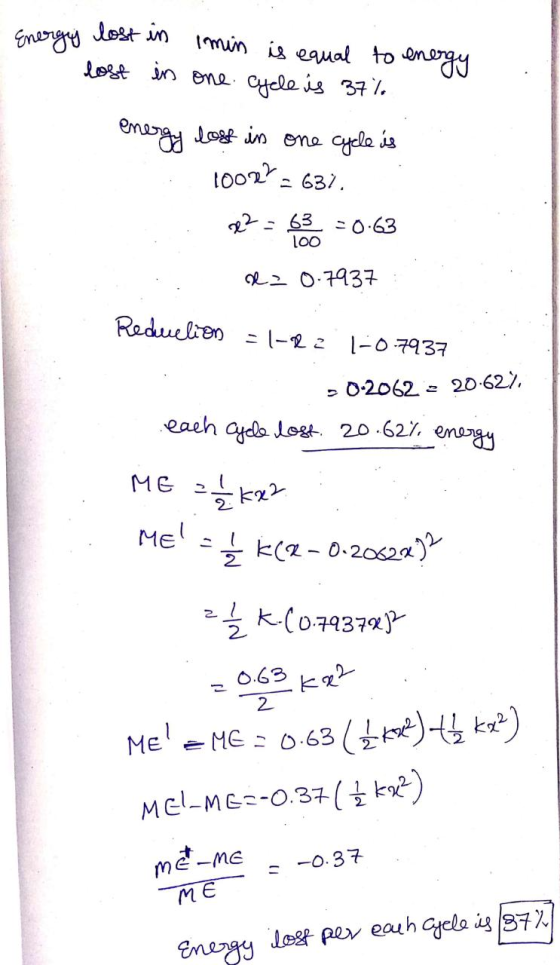
A damped oscillator with a period of 30 s shows a reduction of 37% in amplitude after 1.0 min. 1)Calculate the percent l...
A damped oscillator with a period of 30 s shows a reduction of 37% in amplitude after 1.0 min.
1)Calculate the percent loss in mechanical energy per cycle.
Homework Answers
Add Answer to:
A damped oscillator with a period of 30 s shows a reduction of 37% in amplitude after 1.0 min. 1)Calculate the percent l...
2. The amplitude of a damped harmonic oscillator drops to 1/e of its initial value after...
 2. The amplitude of a damped harmonic oscillator drops to 1/e of its initial value after n complete cycles. Show that the ratio of the period of oscillator to the period of the same oscillator with no damping is given by Td To when n is large.
A damped harmonic oscillator loses 8 percent of its mechanical energy per cycle. (a) By what...
A damped harmonic oscillator loses 8 percent of its mechanical energy per cycle. (a) By what percentage does its frequency differ from the natural frequency f0 = (1/2?)?k/m?
Damped SHM motion A mass M is suspended from a spring and oscillates with a period...
 Damped SHM motion A mass M is suspended from a spring and oscillates with a period of 0.980 s. Each complete oscillation results in an amplitude reduction of a factor of 0.985 due to a small velocity dependent frictional effect. Calculate the time it takes for the total energy of the oscillator to decrease to 45% of its initial value. Submit Answer Incorrect. Tries 3/6 Previous Tries
An oscillator has a period of 2.5 s. Its amplitude decreases by 7% during each cycle....
An oscillator has a period of 2.5 s. Its amplitude decreases by 7% during each cycle. (a) By how much does its energy decrease during each cycle? % (b) What is the time constant τ? (c) What is the Q factor?
An oscillator has a period of 2.4 s. Its amplitude decreases by 3% during each cycle....
An oscillator has a period of 2.4 s. Its amplitude decreases by 3% during each cycle. (a) By how much does its energy decrease during each cycle? (b) What is the time constant τ? (c) What is the Q factor?
Damped SHM motion A mass M is suspended from a spring and oscillates with a period...
 Damped SHM motion A mass M is suspended from a spring and oscillates with a period of 0.840 s. Each complete oscillation results in an amplitude reduction of a factor of 0.965 due to a small velocity dependent frictional effect. Calculate the time it takes for the total energy of the oscillator to decrease to 69% of its initial value. The amplitude after N oscillations- (initial amplitude) x(damping factor)N Submit wIncorrect. Tries 2/6 Previous Tries 1998-2018 by Florida State University....
Oscillator Energies 50 40 30 Energy [J] 20 B 10 X 0.2 0.4 0.8 1 1.2...
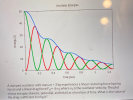 Oscillator Energies 50 40 30 Energy [J] 20 B 10 X 0.2 0.4 0.8 1 1.2 0.6 Time (sec) A damped oscillator with mass m = 3 kg experiences a linear restoring force (spring force) and a linear drag force Fa = -b Vy where vx is the oscillator velocity. The plot shows energies (kinetic, potential, and total) as a function of time. What is the value of the drag coefficient b in kg/s?
help with 1-3 1) A simple harmonic oscillator consists of a 0.100 kg mass attached to...
 help with 1-3
1) A simple harmonic oscillator consists of a 0.100 kg mass attached to a spring whose force constant is 10.0 N/m. The mass is displaced 3.00 cm and released from rest. Calculate (a) the natural frequency fo and period T (b) the total energy , and (c) the maximum speed 2) Allow the motion in problem 1 to take place in a resisting medium. After oscillating for 10 seconds, the maximum amplitude decreases to half the initial...
help with 1-3
1) A simple harmonic oscillator consists of a 0.100 kg mass attached to a spring whose force constant is 10.0 N/m. The mass is displaced 3.00 cm and released from rest. Calculate (a) the natural frequency fo and period T (b) the total energy , and (c) the maximum speed 2) Allow the motion in problem 1 to take place in a resisting medium. After oscillating for 10 seconds, the maximum amplitude decreases to half the initial...
PROBLEMS 89 3-30. A system composed of a mass of S kg and an elastic member having a modulus of 4...
 Please answer 3-34 and 3-35. Please provide all steps so I can
follow along.
PROBLEMS 89 3-30. A system composed of a mass of S kg and an elastic member having a modulus of 45 N/m is less than critically damped. When the mass is givén an initial displacement and released from rest, the overshoot (the displacement attained past the equilibrium position) is 25% Determine the dam ping factor and the damping constant. 3-31. A mass-spring system is critically damped....
Please answer 3-34 and 3-35. Please provide all steps so I can
follow along.
PROBLEMS 89 3-30. A system composed of a mass of S kg and an elastic member having a modulus of 45 N/m is less than critically damped. When the mass is givén an initial displacement and released from rest, the overshoot (the displacement attained past the equilibrium position) is 25% Determine the dam ping factor and the damping constant. 3-31. A mass-spring system is critically damped....
Temperature Co Rate Constant (s-1) 37 3.2 x 10⁻¹¹ 52 1.0 x 10⁻⁹ 49 3.0 x...
Temperature Co Rate Constant (s-1) 37 3.2 x 10⁻¹¹ 52 1.0 x 10⁻⁹ 49 3.0 x 10⁻⁸ 72 2.4 x 10⁻⁷ Use the table to calculate the activation energy in kJ/mol for a first order reaction.
 2. The amplitude of a damped harmonic oscillator drops to 1/e of its initial value after n complete cycles. Show that the ratio of the period of oscillator to the period of the same oscillator with no damping is given by Td To when n is large.
 Damped SHM motion A mass M is suspended from a spring and oscillates with a period of 0.980 s. Each complete oscillation results in an amplitude reduction of a factor of 0.985 due to a small velocity dependent frictional effect. Calculate the time it takes for the total energy of the oscillator to decrease to 45% of its initial value. Submit Answer Incorrect. Tries 3/6 Previous Tries
 Damped SHM motion A mass M is suspended from a spring and oscillates with a period of 0.840 s. Each complete oscillation results in an amplitude reduction of a factor of 0.965 due to a small velocity dependent frictional effect. Calculate the time it takes for the total energy of the oscillator to decrease to 69% of its initial value. The amplitude after N oscillations- (initial amplitude) x(damping factor)N Submit wIncorrect. Tries 2/6 Previous Tries 1998-2018 by Florida State University....
 Oscillator Energies 50 40 30 Energy [J] 20 B 10 X 0.2 0.4 0.8 1 1.2 0.6 Time (sec) A damped oscillator with mass m = 3 kg experiences a linear restoring force (spring force) and a linear drag force Fa = -b Vy where vx is the oscillator velocity. The plot shows energies (kinetic, potential, and total) as a function of time. What is the value of the drag coefficient b in kg/s?
 help with 1-3
1) A simple harmonic oscillator consists of a 0.100 kg mass attached to a spring whose force constant is 10.0 N/m. The mass is displaced 3.00 cm and released from rest. Calculate (a) the natural frequency fo and period T (b) the total energy , and (c) the maximum speed 2) Allow the motion in problem 1 to take place in a resisting medium. After oscillating for 10 seconds, the maximum amplitude decreases to half the initial...
help with 1-3
1) A simple harmonic oscillator consists of a 0.100 kg mass attached to a spring whose force constant is 10.0 N/m. The mass is displaced 3.00 cm and released from rest. Calculate (a) the natural frequency fo and period T (b) the total energy , and (c) the maximum speed 2) Allow the motion in problem 1 to take place in a resisting medium. After oscillating for 10 seconds, the maximum amplitude decreases to half the initial...
 Please answer 3-34 and 3-35. Please provide all steps so I can
follow along.
PROBLEMS 89 3-30. A system composed of a mass of S kg and an elastic member having a modulus of 45 N/m is less than critically damped. When the mass is givén an initial displacement and released from rest, the overshoot (the displacement attained past the equilibrium position) is 25% Determine the dam ping factor and the damping constant. 3-31. A mass-spring system is critically damped....
Please answer 3-34 and 3-35. Please provide all steps so I can
follow along.
PROBLEMS 89 3-30. A system composed of a mass of S kg and an elastic member having a modulus of 45 N/m is less than critically damped. When the mass is givén an initial displacement and released from rest, the overshoot (the displacement attained past the equilibrium position) is 25% Determine the dam ping factor and the damping constant. 3-31. A mass-spring system is critically damped....
Most questions answered within 3 hours.
-
Where is the error in this code sequence?
String s1 = "Hello";
String s2 = "ello";...
asked 11 months ago -
Financial data for Joel de Paris, Inc., for last year
follow:
Joel de Paris, Inc.
Balance...
asked 11 months ago -
Consider this reaction:
Al2(SO4)3 (aq)+ BaCl3
(aq) Al2Cl6 (aq)- +
3BaSO4(s) . What is the...
asked 11 months ago -
Suppose that Savneet is considering increasing her
recent random sample from 20 car rentals to 40...
asked 11 months ago -
Trucks arrive at an unloading terminal at an average rate of 120
per hour.
Trucks arrive...
asked 11 months ago -
Why are methanol and ethanol completely soluble in water while
octanol is not very little soluble....
asked 11 months ago -
A facilities manager at a university reads in a research report
that the mean amount of...
asked 11 months ago -
When the CuSO4 is rehydrated by adding water to the anhydrous
compound, is this an endothermic...
asked 11 months ago -
A ray of sunlight is passing from diamond into crown glass; the
angle of incidence is...
asked 11 months ago -
A block of mass 0.249 kg is placed on top of a light, vertical
spring of...
asked 11 months ago -
how do the kidneys compensate in the presences of acidosis
a) trigger hyperventilate
b) reserve acid...
asked 11 months ago -
Question 501 pts
The rental rate of capital to the firm increases. Which of the
following...
asked 11 months ago