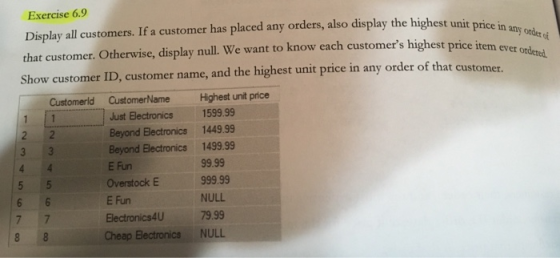
Display all customers. If a customer has placed any orders, also display the highest.....
Tables:
CREATE TABLE Sales.Customers
(
CustomerId INT NOT NULL IDENTITY,
CustomerName NVARCHAR(50) NOT NULL,
StreetAddress NVARCHAR(50) NULL,
City NVARCHAR(20) NULL,
[State] NVARCHAR(20) NULL,
PostalCode NVARCHAR(10) NULL,
Country NVARCHAR(20) NULL,
Contact NVARCHAR(50) NULL,
Email NVARCHAR(50) NULL,
CONSTRAINT PK_Customers PRIMARY KEY(CustomerId)
);
CREATE TABLE HR.Employees
(
EmployeeId INT NOT NULL IDENTITY,
FirstName NVARCHAR(50) NOT NULL,
LastName NVARCHAR(50) NOT NULL,
BirthDate DATE NOT NULL,
HireDate DATE NOT NULL,
HomeAddress NVARCHAR(50) NULL,
City NVARCHAR(20) NULL,
[State] NVARCHAR(20) NULL,
PostalCode NVARCHAR(10) NULL,
Phone NVARCHAR(20) NULL,
ManagerId INT NULL,
CONSTRAINT PK_Employees PRIMARY KEY(EmployeeId),
CONSTRAINT FK_Employees_Employees FOREIGN KEY(ManagerId)
REFERENCES HR.Employees(EmployeeId),
CONSTRAINT CHK_BirthDate CHECK(BirthDate <= CAST(SYSDATETIME() AS DATE)),
CONSTRAINT CHK_HireDate CHECK(BirthDate < HireDate)
);
CREATE TABLE Purchasing.Suppliers
(
SupplierId INT NOT NULL IDENTITY,
SupplierName NVARCHAR(50) NOT NULL,
StreetAddress NVARCHAR(50) NULL,
City NVARCHAR(20) NULL,
[State] NVARCHAR(20) NULL,
PostalCode NVARCHAR(10) NULL,
Country NVARCHAR(20) NULL,
CONSTRAINT PK_Supplier PRIMARY KEY(SupplierId)
);
CREATE TABLE Purchasing.Products
(
ProductId INT NOT NULL IDENTITY,
ProductName NVARCHAR(40) NOT NULL,
supplierid INT NOT NULL,
CONSTRAINT PK_Products PRIMARY KEY(ProductId),
CONSTRAINT FK_Products_Suppliers FOREIGN KEY(SupplierId)
REFERENCES Purchasing.Suppliers(SupplierId)
);
CREATE TABLE Purchasing.Deliveries
(
DeliveryId INT NOT NULL IDENTITY,
ProductId INT NOT NULL,
Quantity INT NOT NULL,
Price MONEY NOT NULL
CONSTRAINT DF_Deliveries_price DEFAULT(0),
DeliveryDate DateTime2 NOT NULL
CONSTRAINT DF_Deliveries_DeliveryDate DEFAULT(SYSDATETIME()),
CONSTRAINT PK_Deliveries PRIMARY KEY (DeliveryId),
CONSTRAINT FK_Deliveries_Products FOREIGN KEY(ProductId)
REFERENCES Purchasing.Products(ProductId),
CONSTRAINT CHK_Deliveries_Price CHECK (Price >= 0)
);
CREATE TABLE Sales.Orders
(
OrderId INT NOT NULL IDENTITY,
CustomerId INT NOT NULL,
EmployeeId INT NOT NULL,
OrderDate DATE NOT NULL,
CONSTRAINT PK_Orders PRIMARY KEY(OrderId),
CONSTRAINT FK_Orders_Customers FOREIGN KEY(CustomerId)
REFERENCES Sales.Customers(CustomerId),
CONSTRAINT FK_Orders_Employees FOREIGN KEY(EmployeeId)
REFERENCES HR.Employees(EmployeeId)
);
CREATE TABLE Sales.OrderDetails
(
OrderId INT NOT NULL,
ProductId INT NOT NULL,
Price MONEY NOT NULL
CONSTRAINT DF_OrderDetails_price DEFAULT(0),
quantity SMALLINT NOT NULL
CONSTRAINT DF_OrderDetails_qty DEFAULT(1),
CONSTRAINT PK_OrderDetails PRIMARY KEY(Orderid, Productid),
CONSTRAINT FK_OrderDetails_Orders FOREIGN KEY(OrderId)
REFERENCES Sales.Orders(OrderId),
CONSTRAINT FK_OrderDetails_Products FOREIGN KEY(ProductId)
REFERENCES Purchasing.Products(ProductId),
CONSTRAINT CHK_quantity CHECK (quantity > 0),
CONSTRAINT CHK_price CHECK (price >= 0)
);
Homework Answers
Please find the SQL query below.
SELECT c.CustomerId, c.CustomerName, max(od.Price) FROM Customer c LEFT JOIN Orders o ON c.CustomerId = o.CustomerId JOIN OrderDetails od ON o.OrderId = od.OrderId GROUP BY o.CustomerId;
Add Answer to:
Display all customers. If a customer has placed any orders, also display the highest..... Tables: CREATE TABLE Sales.Cu...
Create a new database and execute the code below in SQL Server’s query window to create...
Create a new database and execute the code below in SQL Server’s query window to create the database tables. CREATE TABLE PhysicianSpecialties (SpecialtyID integer, SpecialtyName varchar(50), CONSTRAINT PK_PhysicianSpecialties PRIMARY KEY (SpecialtyID)) go CREATE TABLE ZipCodes (ZipCode varchar(10), City varchar(50), State varchar(2), CONSTRAINT PK_ZipCodes PRIMARY KEY (ZipCode)) go CREATE TABLE PhysicianPractices (PracticeID integer, PracticeName varchar(50), Address_Line1 varchar(50), Address_Line2 varchar(50), ZipCode varchar(10), Phone varchar(14), Fax varchar(14), WebsiteURL varchar(50), CONSTRAINT PK_PhysicianPractices PRIMARY KEY (PracticeID), CONSTRAINT FK_PhysicianPractices_ZipCodes FOREIGN KEY (ZipCode) REFERENCES Zipcodes) go CREATE...
Hello, Does anyone have any input on how to fragment this table in visual studio? CREATE...
Hello, Does anyone have any input on how to fragment this table in visual studio? CREATE TABLE [dbo].[Stock] ( [itemNo] INT NOT NULL , [store] VARCHAR(50) NOT NULL, [qtyOnHand] INT NULL, [qtyHand] INT NULL, [qtyOnOrder] INT NULL, [reorderPoint] INT NULL, CONSTRAINT [FK_Stock_Item] FOREIGN KEY ([itemNo]) REFERENCES [Item]([itemNo]), CONSTRAINT [FK_Stock_Store] FOREIGN KEY ([store]) REFERENCES [Store]([storeName]), CONSTRAINT [PK_Stock] PRIMARY KEY ([itemNo], [store]), The other tables are: CREATE TABLE [dbo].[Item] ( [itemNo] INT NOT NULL PRIMARY KEY, [itemName] VARCHAR(50) NULL, [supplier] VARCHAR(50) NULL,...
Based on the CREATE TABLE statements, make an ER model of the database. Give suitable names...
 Based on the CREATE TABLE
statements, make an ER model of the database. Give suitable names
to the relationships. (Remember cardinality and participation
constraints.) The diagram must use either the notation used in the
textbook (and the lectures) or the crow’s foot notation. To save
you some time: There are a few tables that include the following
address fields: Address, City, State, Country and PostalCode (and
the same fields with the prefix Billing-). You are allowed to
replace these attributes...
Based on the CREATE TABLE
statements, make an ER model of the database. Give suitable names
to the relationships. (Remember cardinality and participation
constraints.) The diagram must use either the notation used in the
textbook (and the lectures) or the crow’s foot notation. To save
you some time: There are a few tables that include the following
address fields: Address, City, State, Country and PostalCode (and
the same fields with the prefix Billing-). You are allowed to
replace these attributes...
SQL CHECK CONSTRAINT AND TEST CASE... SQL Query Here are the tables: CREATE TABLE Movies( movieID...
SQL CHECK CONSTRAINT AND TEST CASE... SQL Query Here are the tables: CREATE TABLE Movies( movieID INT, name VARCHAR(30) NOT NULL, year INT, rating CHAR(1), length INT, totalEarned NUMERIC(7,2), PRIMARY KEY(movieID), UNIQUE(name, year) ); CREATE TABLE Showings( theaterID INT, showingDate DATE, startTime TIME, movieID INT, priceCode CHAR(1), PRIMARY KEY(theaterID, showingDate, startTime), FOREIGN KEY(theaterID) REFERENCES Theaters, FOREIGN KEY(movieID) REFERENCES Movies ); CREATE TABLE Tickets( theaterID INT, seatNum INT, showingDate DATE, startTime TIME, customerID INT, ticketPrice NUMERIC(4,2), PRIMARY KEY(theaterID, seatNum, showingDate, startTime)...
-- Schema definition create table Customer ( cid smallint not null, name varchar(20), ...
 -- Schema definition
create table Customer (
cid smallint not null,
name varchar(20),
city varchar(15),
constraint customer_pk
primary key (cid)
);
create table Club (
club varchar(15) not null,
desc varchar(50),
constraint club_pk
primary key
(club)
);
create table Member (
club varchar(15) not null,
cid
smallint not null,
constraint member_pk
primary key (club,
cid),
constraint mem_fk_club
foreign key (club)
references Club,
constraint mem_fk_cust...
-- Schema definition
create table Customer (
cid smallint not null,
name varchar(20),
city varchar(15),
constraint customer_pk
primary key (cid)
);
create table Club (
club varchar(15) not null,
desc varchar(50),
constraint club_pk
primary key
(club)
);
create table Member (
club varchar(15) not null,
cid
smallint not null,
constraint member_pk
primary key (club,
cid),
constraint mem_fk_club
foreign key (club)
references Club,
constraint mem_fk_cust...
The Northwind database created by Microsoft contains the sales data for a fictitious company called Northwind...
The Northwind database created by Microsoft contains the sales data for a fictitious company called Northwind Traders, which imports and exports specialty foods from around the world. Here is the schema of the database: Products (ProductID, ProductName, SupplierID, CategoryID, QuantityPerUnit, UnitPrice, UnitsInStock, UnitsOnOrder, ReorderLevel, Discontinued); Suppliers (SupplierID, CompanyName, ContactName , ContactTitle, Address, City, Region, PostalCode, Country, Phone, Fax, HomePage); Categories (CategoryID, CategoryName, Description, Picture); Orders (OrderID, CustomerID, EmployeeID, OrderDate, RequiredDate, ShippedDate, ShipVia, Freight, ShipName,ShipAddress, ShipCity, ShipRegion, ShipPostalCode, ShipCountry); Order_details (ID, OrderID,...
An online company sells hundreds of office supply products on its e-Commerce store. It has asked...
 An online company sells hundreds of office supply products on
its e-Commerce store. It has asked you to design and implement a
sales order processing system which will be used by users in our
Operations department to process sales orders. Here is an overview
of the sales order process. Customers make purchases by placing
orders. Each customer has a customer number and profile (such as
name, shipping address). To simplify the matter, each time an order
is placed, only one...
An online company sells hundreds of office supply products on
its e-Commerce store. It has asked you to design and implement a
sales order processing system which will be used by users in our
Operations department to process sales orders. Here is an overview
of the sales order process. Customers make purchases by placing
orders. Each customer has a customer number and profile (such as
name, shipping address). To simplify the matter, each time an order
is placed, only one...
-- drop tables DROP TABLE REQUEST CASCADE CONSTRAINTS; DROP TABLE FULLORDER CASCADE CONSTRAINTS; DROP TABLE PRODUCT...
-- drop tables DROP TABLE REQUEST CASCADE CONSTRAINTS; DROP TABLE FULLORDER CASCADE CONSTRAINTS; DROP TABLE PRODUCT CASCADE CONSTRAINTS; DROP TABLE CUSTOMER CASCADE CONSTRAINTS; -- create and link tables CREATE TABLE CUSTOMER ( CustomerID INTEGER, Name VARCHAR2(40), City VARCHAR2(20), State CHAR(2), Zip CHAR(5), CONSTRAINT PK_CUSTOMER PRIMARY KEY (CustomerID) ); CREATE TABLE PRODUCT ( ProductID INTEGER, Description VARCHAR2(30), Material VARCHAR2(20), Price NUMBER(5,2), CONSTRAINT PK_PRODUCT...
WRITING POSTGRESQL QUERIES RELATIONS: CREATE TABLE Movies( movieID INT, year INT UNIQUE, rating...
WRITING POSTGRESQL QUERIES RELATIONS: CREATE TABLE Movies( movieID INT, year INT UNIQUE, rating CHAR(1), length INT, totalEarned NUMERIC(7,2), PRIMARY KEY(movieID) ); CREATE TABLE Theaters( theaterID INT, address VARCHAR(40) UNIQUE, numSeats INT NOT NULL, PRIMARY KEY(theaterID) ); CREATE TABLE TheaterSeats( theaterID INT, seatNum INT, brokenSeat BOOLEAN NOT NULL, PRIMARY KEY(theaterID, seatNum), FOREIGN KEY(theaterID) REFERENCES Theaters ); CREATE TABLE Showings( theaterID INT, showingDate DATE, ...
For each city, list number of customers from the city, who have placed order(s). Cities are...
For each city, list number of customers from the city, who have placed order(s). Cities are listed in ascending alphabetical order. Use equal join for this query. CREATE TABLE customer ( cust_id number(11,0) not null, cust_name varchar2(25) not null, street varchar2(30), city varchar2(20), state varchar2(2), zipcode varchar2(5), CONSTRAINT customer_pk PRIMARY KEY (cust_id) ); CREATE TABLE ordertable ( order_id number(11,0) not null, order_date date, cust_id number(11,0), CONSTRAINT order_pk PRIMARY KEY (order_id), CONSTRAINT order_fk FOREIGN KEY (cust_id) REFERENCES customer (cust_id)); CREATE TABLE...
 Based on the CREATE TABLE
statements, make an ER model of the database. Give suitable names
to the relationships. (Remember cardinality and participation
constraints.) The diagram must use either the notation used in the
textbook (and the lectures) or the crow’s foot notation. To save
you some time: There are a few tables that include the following
address fields: Address, City, State, Country and PostalCode (and
the same fields with the prefix Billing-). You are allowed to
replace these attributes...
Based on the CREATE TABLE
statements, make an ER model of the database. Give suitable names
to the relationships. (Remember cardinality and participation
constraints.) The diagram must use either the notation used in the
textbook (and the lectures) or the crow’s foot notation. To save
you some time: There are a few tables that include the following
address fields: Address, City, State, Country and PostalCode (and
the same fields with the prefix Billing-). You are allowed to
replace these attributes...
 -- Schema definition
create table Customer (
cid smallint not null,
name varchar(20),
city varchar(15),
constraint customer_pk
primary key (cid)
);
create table Club (
club varchar(15) not null,
desc varchar(50),
constraint club_pk
primary key
(club)
);
create table Member (
club varchar(15) not null,
cid
smallint not null,
constraint member_pk
primary key (club,
cid),
constraint mem_fk_club
foreign key (club)
references Club,
constraint mem_fk_cust...
-- Schema definition
create table Customer (
cid smallint not null,
name varchar(20),
city varchar(15),
constraint customer_pk
primary key (cid)
);
create table Club (
club varchar(15) not null,
desc varchar(50),
constraint club_pk
primary key
(club)
);
create table Member (
club varchar(15) not null,
cid
smallint not null,
constraint member_pk
primary key (club,
cid),
constraint mem_fk_club
foreign key (club)
references Club,
constraint mem_fk_cust...
 An online company sells hundreds of office supply products on
its e-Commerce store. It has asked you to design and implement a
sales order processing system which will be used by users in our
Operations department to process sales orders. Here is an overview
of the sales order process. Customers make purchases by placing
orders. Each customer has a customer number and profile (such as
name, shipping address). To simplify the matter, each time an order
is placed, only one...
An online company sells hundreds of office supply products on
its e-Commerce store. It has asked you to design and implement a
sales order processing system which will be used by users in our
Operations department to process sales orders. Here is an overview
of the sales order process. Customers make purchases by placing
orders. Each customer has a customer number and profile (such as
name, shipping address). To simplify the matter, each time an order
is placed, only one...
Most questions answered within 3 hours.
-
Where is the error in this code sequence?
String s1 = "Hello";
String s2 = "ello";...
asked 11 months ago -
Financial data for Joel de Paris, Inc., for last year
follow:
Joel de Paris, Inc.
Balance...
asked 11 months ago -
Consider this reaction:
Al2(SO4)3 (aq)+ BaCl3
(aq) Al2Cl6 (aq)- +
3BaSO4(s) . What is the...
asked 11 months ago -
Suppose that Savneet is considering increasing her
recent random sample from 20 car rentals to 40...
asked 11 months ago -
Trucks arrive at an unloading terminal at an average rate of 120
per hour.
Trucks arrive...
asked 11 months ago -
Why are methanol and ethanol completely soluble in water while
octanol is not very little soluble....
asked 11 months ago -
A facilities manager at a university reads in a research report
that the mean amount of...
asked 11 months ago -
When the CuSO4 is rehydrated by adding water to the anhydrous
compound, is this an endothermic...
asked 11 months ago -
A ray of sunlight is passing from diamond into crown glass; the
angle of incidence is...
asked 11 months ago -
A block of mass 0.249 kg is placed on top of a light, vertical
spring of...
asked 11 months ago -
how do the kidneys compensate in the presences of acidosis
a) trigger hyperventilate
b) reserve acid...
asked 11 months ago -
Question 501 pts
The rental rate of capital to the firm increases. Which of the
following...
asked 11 months ago