
Homework Answers
Add Answer to:
(9 pts 3 pts each) For each of the following languages, name the least powerful type of machine that will accept it, an...
(9 pts 3 pts each) For each of the following languages, name the least powerful type of machine that will accept it...
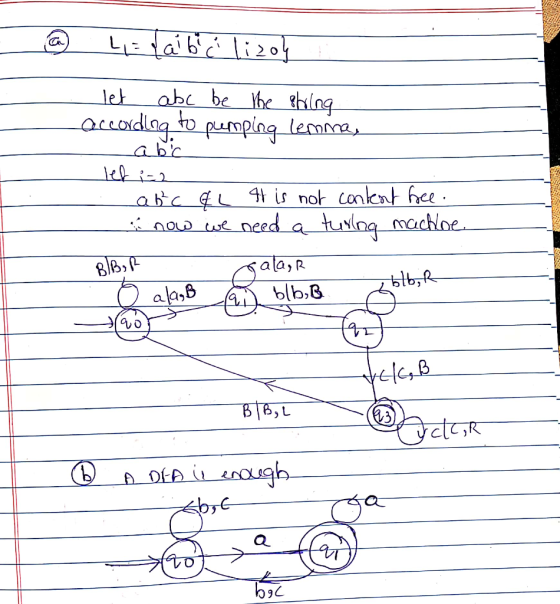
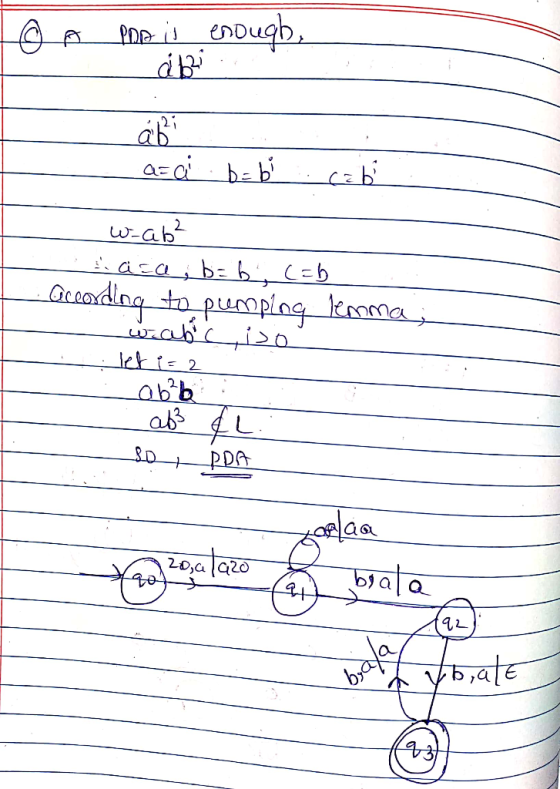
 (9 pts 3 pts each) For each of the following languages, name the least powerful type of machine that will accept it, and prove your answer. (Hint: a finite state automata is less powerful than a pushdown automata, which in turn is less powerful than a Turing Machine.) For example, to prove a language needs a PDA to accept it, you would use the Pumping Lemma to show it is not regular, and then build the PDA or CFG that...
determine if the language is regular, context-free, Turing-decidable, or undecidable. For languages that are regular, give...
 determine if the language is regular, context-free, Turing-decidable, or undecidable. For languages that are regular, give a DFA that accepts the language, a regular expression that generates the language, and a maximal list of strings that are pairwise distinguishable with respect to the language. For languages that are context-free but not regular, prove that the language is not regular and either give a context- free grammar that generates the language or a pushdown automaton that accepts the language. You need...
determine if the language is regular, context-free, Turing-decidable, or undecidable. For languages that are regular, give...
 determine if the language is regular, context-free, Turing-decidable, or undecidable. For languages that are regular, give a DFA that accepts the language, a regular expression that generates the language, and a maximal list of strings that arc pairwise distinguishable with respect to the language. For languages that are context-free but not regular, prove that the language is not regular and either give a context- free grammar that generates the language or a pushdown automaton that accepts the language. You need...
6. Consider a Pushdown Automata with TWO STACKS. Show that this machine is more powerful than...
 6. Consider a Pushdown Automata with TWO STACKS. Show that this machine is more powerful than a single stack PDA. (Use the language L = {a"\"c"which is not a CFL. Explain bow a two stack automata can accept this language.) HINT : Give a table representation of the 2PDA - it should have 7 columns : state, input, stack 1, stack 2, new state, stack 1 operation, stack 2 operation.
what is the minimal corresponding maching (Finite Automata, Pushdown Automata, or Turing Machine) for each of the following languages? State which method is being used P3) What is the minimal corr...
 what is the minimal corresponding maching (Finite Automata,
Pushdown Automata, or Turing Machine) for each of the following
languages? State which method is being used
P3) What is the minimal corresponding machine (FA, PDA or TM) for each of the following languages? (You must provide proper explanations or proofs for your answer.) (30 points) o) L1 (every strings consist with a and b 0, 00,000), 0). (b) L2 balanced parenthesises , For example L2- (a) Ls ab" al n 20)...
what is the minimal corresponding maching (Finite Automata,
Pushdown Automata, or Turing Machine) for each of the following
languages? State which method is being used
P3) What is the minimal corresponding machine (FA, PDA or TM) for each of the following languages? (You must provide proper explanations or proofs for your answer.) (30 points) o) L1 (every strings consist with a and b 0, 00,000), 0). (b) L2 balanced parenthesises , For example L2- (a) Ls ab" al n 20)...
3. These languages are not regular. For each, list three strings that would work in a...
3. These languages are not regular. For each, list three strings that would work in a Pumping Lemma proof. Then, use one of them to show the language is not regular. But not a. a. L = {ww | w Î {a, b}*} b. L = {anba2n | n >= 0} c. {w Î S* | w contains more a’s than b’s}.
If L1 and L2 are Regular Languages, then L1 ∪ L2 is a CFL. Group of answer choices...
If L1 and L2 are Regular Languages, then L1 ∪ L2 is a CFL. Group of answer choices True False Flag this Question Question 61 pts If L1 and L2 are CFLs, then L1 ∩ L2 and L1 ∪ L2 are CFLs. Group of answer choices True False Flag this Question Question 71 pts The regular expression ((ac*)a*)* = ((aa*)c*)*. Group of answer choices True False Flag this Question Question 81 pts Some context free languages are regular. Group of answer choices True...
UueSLIORS! 1. Find the error in logic in the following statement: We know that a b'...
 UueSLIORS! 1. Find the error in logic in the following statement: We know that a b' is a context-free, not regular language. The class of context-free languages are not closed under complement, so its complement is not context free. But we know that its complement is context-free. 2. We have proved that the regular languages are closed under string reversal. Prove here that the context-free languages are closed under string reversal. 3. Part 1: Find an NFA with 3 states...
 (9 pts 3 pts each) For each of the following languages, name the least powerful type of machine that will accept it, and prove your answer. (Hint: a finite state automata is less powerful than a pushdown automata, which in turn is less powerful than a Turing Machine.) For example, to prove a language needs a PDA to accept it, you would use the Pumping Lemma to show it is not regular, and then build the PDA or CFG that...
 determine if the language is regular, context-free, Turing-decidable, or undecidable. For languages that are regular, give a DFA that accepts the language, a regular expression that generates the language, and a maximal list of strings that are pairwise distinguishable with respect to the language. For languages that are context-free but not regular, prove that the language is not regular and either give a context- free grammar that generates the language or a pushdown automaton that accepts the language. You need...
 determine if the language is regular, context-free, Turing-decidable, or undecidable. For languages that are regular, give a DFA that accepts the language, a regular expression that generates the language, and a maximal list of strings that arc pairwise distinguishable with respect to the language. For languages that are context-free but not regular, prove that the language is not regular and either give a context- free grammar that generates the language or a pushdown automaton that accepts the language. You need...
 6. Consider a Pushdown Automata with TWO STACKS. Show that this machine is more powerful than a single stack PDA. (Use the language L = {a"\"c"which is not a CFL. Explain bow a two stack automata can accept this language.) HINT : Give a table representation of the 2PDA - it should have 7 columns : state, input, stack 1, stack 2, new state, stack 1 operation, stack 2 operation.
 what is the minimal corresponding maching (Finite Automata,
Pushdown Automata, or Turing Machine) for each of the following
languages? State which method is being used
P3) What is the minimal corresponding machine (FA, PDA or TM) for each of the following languages? (You must provide proper explanations or proofs for your answer.) (30 points) o) L1 (every strings consist with a and b 0, 00,000), 0). (b) L2 balanced parenthesises , For example L2- (a) Ls ab" al n 20)...
what is the minimal corresponding maching (Finite Automata,
Pushdown Automata, or Turing Machine) for each of the following
languages? State which method is being used
P3) What is the minimal corresponding machine (FA, PDA or TM) for each of the following languages? (You must provide proper explanations or proofs for your answer.) (30 points) o) L1 (every strings consist with a and b 0, 00,000), 0). (b) L2 balanced parenthesises , For example L2- (a) Ls ab" al n 20)...
 UueSLIORS! 1. Find the error in logic in the following statement: We know that a b' is a context-free, not regular language. The class of context-free languages are not closed under complement, so its complement is not context free. But we know that its complement is context-free. 2. We have proved that the regular languages are closed under string reversal. Prove here that the context-free languages are closed under string reversal. 3. Part 1: Find an NFA with 3 states...
Most questions answered within 3 hours.
-
Where is the error in this code sequence?
String s1 = "Hello";
String s2 = "ello";...
asked 11 months ago -
Financial data for Joel de Paris, Inc., for last year
follow:
Joel de Paris, Inc.
Balance...
asked 11 months ago -
Consider this reaction:
Al2(SO4)3 (aq)+ BaCl3
(aq) Al2Cl6 (aq)- +
3BaSO4(s) . What is the...
asked 11 months ago -
Suppose that Savneet is considering increasing her
recent random sample from 20 car rentals to 40...
asked 11 months ago -
Trucks arrive at an unloading terminal at an average rate of 120
per hour.
Trucks arrive...
asked 11 months ago -
Why are methanol and ethanol completely soluble in water while
octanol is not very little soluble....
asked 11 months ago -
A facilities manager at a university reads in a research report
that the mean amount of...
asked 11 months ago -
When the CuSO4 is rehydrated by adding water to the anhydrous
compound, is this an endothermic...
asked 11 months ago -
A ray of sunlight is passing from diamond into crown glass; the
angle of incidence is...
asked 11 months ago -
A block of mass 0.249 kg is placed on top of a light, vertical
spring of...
asked 11 months ago -
how do the kidneys compensate in the presences of acidosis
a) trigger hyperventilate
b) reserve acid...
asked 11 months ago -
Question 501 pts
The rental rate of capital to the firm increases. Which of the
following...
asked 11 months ago