
Homework Answers
Answer:
Given reaction is
UO2(NO3)2(aq) -----> UO3(s) + 2NO2(g) + 1/2O2(g)
Zero-order rate law is
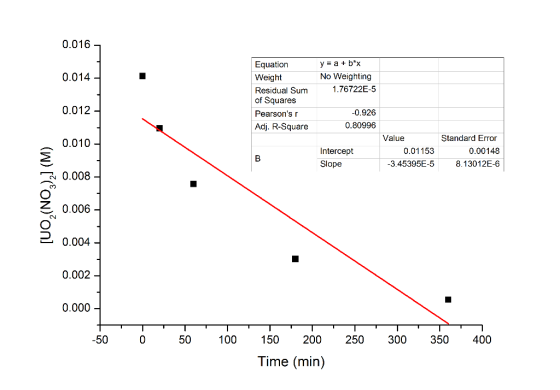
[UO2(NO3)2]=-kt+[UO2(NO3)2]0 and the plot of [UO2(NO3)2] vs t gives a straight line with slope=-k.
The first-order rate law is
ln[UO2(NO3)2]=-kt+ln[UO2(NO3)2]0 and the plot of ln[UO2(NO3)2] vs t gives a straight line with slope=-k.
The second-order rate law is
1/[UO2(NO3)2]=kt+1/[UO2(NO3)2]0 and the plot of 1/[UO2(NO3)2] vs t gives a straight line with slope=k.
Where k=rate constant, [UO2(NO3)2]0=Initial concentration at t=0 min
[UO2(NO3)2]=concentration of UO2(NO3)2 at time t.
The calculated values are tabulated below
| Time(s) | [UO2(NO3)2] (M) | ln[UO2(NO3)2] | 1/[UO2(NO3)2] |
| 0 | 1.41E-02 | -4.259455082 | 70.77140835 |
| 20 | 1.10E-02 | -4.513502997 | 91.24087591 |
| 60 | 7.58E-03 | -4.882242079 | 131.9261214 |
| 180 | 3.02E-03 | -5.802498448 | 331.1258278 |
| 360 | 5.50E-04 | -7.50559228 | 1818.181818 |
[UO2(NO3)2] vs t plot is
ln[UO2(NO3)2] vs t plot is
 1/[UO2(NO3)2] vs
t plot is
1/[UO2(NO3)2] vs
t plot is
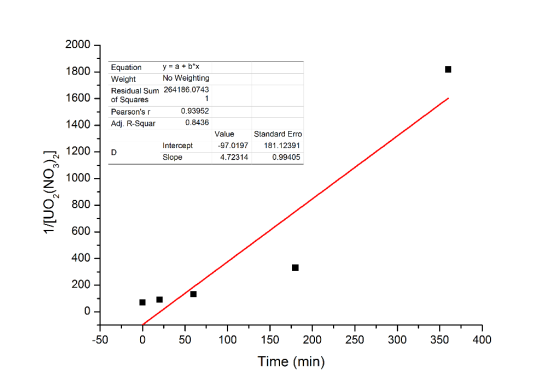
From the above plots, the plot of ln[UO2(NO3)2] vs t gives a straight line with R2=0.997.
Therefore the order of the reaction is first order.
The slope of the line=-k=-0.00882 min-1
Therefore rate constant, k=0.00882 min-1.
Add Answer to:
Uranyl nitrate decomposes according to UO2(NO3)2(aq) -> UO3(s) +2 NO 2 (g)+ 1/2 O2(g) The following data were record...
A 3.10-g sample of lead nitrate, Pb(NO3)2, molar mass = 331 g/mol, is heated in an...
A 3.10-g sample of lead nitrate, Pb(NO3)2, molar mass = 331 g/mol, is heated in an evacuated cylinder with a volume of 2.00 L. The salt decomposes when heated, the unbalanced equation for the decomposition reaction is shown below: Pb(NO3)2(s) → PbO(s) + NO2(g) + O2(g) Assuming complete decomposition, what is the pressure in the cylinder after decomposition and cooling to a temperature of 303 K? Assume the PbO(s) takes up negligible volume.
Ammonium nitrate decomposes explosively upon heating according to the following balanced equation: 2NH4NO3(s)→2N2(g)+O2(g)+4H2O(g) Calculate the total...
Ammonium nitrate decomposes explosively upon heating according to the following balanced equation: 2NH4NO3(s)→2N2(g)+O2(g)+4H2O(g) Calculate the total volume of gas (at 122 ∘C and 730 mmHg ) produced by the complete decomposition of 1.37 kg of ammonium nitrate.
Ammonium nitrate decomposes explosively upon heating according to the following balanced equation: 2NH4NO3(s)→2N2(g)+O2(g)+4H2O(g) Calculate the total...
Ammonium nitrate decomposes explosively upon heating according to the following balanced equation: 2NH4NO3(s)→2N2(g)+O2(g)+4H2O(g) Calculate the total volume of gas (at 119 ∘C and 761 mmHg ) produced by the complete decomposition of 1.71 kg of ammonium nitrate.
12) Ammonium nitrate decomposes explosively upon heating according to the following balanced equation: 2NH4NO3(s)→2N2(g)+O2(g)+4H2O(g) Calculate the...
12) Ammonium nitrate decomposes explosively upon heating according to the following balanced equation: 2NH4NO3(s)→2N2(g)+O2(g)+4H2O(g) Calculate the total volume of gas (at 127 ∘C and 733 mmHg ) produced by the complete decomposition of 1.54 kg of ammonium nitrate.
5. (12 points) For the following oxidation reduction reaction: Zn(s)+NO3 (aq) > Zn2*(aq) + N2(g) +...
 5. (12 points) For the following oxidation reduction reaction: Zn(s)+NO3 (aq) > Zn2*(aq) + N2(g) + H20 a. What are the oxidation numbers of the reactants and products? Oxidation Number in products Element Oxidation Number in reactants Zn N b. Write the balanced oxidation half-reaction and the reduction half-reaction. (in acid medium) Balanced oxidation half-reaction: Balanced reduction half-reaction: Write the balanced full reaction c.
N2O3(g) decomposes to NO2 (g) and O2(g) according to the following balanced equation: N20 (2) $...
 N2O3(g) decomposes to NO2 (g) and O2(g) according to the following balanced equation: N20 (2) $ NO2(g) + O2(g) The decomposition of N2O(g) was found to be first order at 30 °C. The half-life for the reaction was found to be 3000 s. A rigid reactor was initially filled with N2O5 to a pressure of 400 psi at 30°C. What is the total pressure (in psi) in the reactor at 30 °C after 6000 s? ANS: 850 psi
1.Potassium nitrate decomposes to potassium nitrite and oxygen. 2KNO3(s)→2KNO2(s)+O2(g) What volume, in liters, of O2 can...
1.Potassium nitrate decomposes to potassium nitrite and oxygen. 2KNO3(s)→2KNO2(s)+O2(g) What volume, in liters, of O2 can be produced from the decomposition of 54.0 g of KNO3 at 33 ∘C and 1.11 atm ? Express your answer with the appropriate units. 2,On a climb up Mt. Whitney, the atmospheric pressure drops to 507 mmHg . A.What is the pressure in atmospheres?Express the pressure in atmospheres to three significant figures. B.What is the pressure in torrs? Express the pressure in torrs to...
MgCl2(aq)+H2(g)→ C4H10(g)+O2(g)Δ ⟶ Al(s)+O2(g)→ HCl(aq)+Pb(NO3)2(aq)→ complete and balance the following equations
MgCl2(aq)+H2(g)→ C4H10(g)+O2(g)Δ ⟶ Al(s)+O2(g)→ HCl(aq)+Pb(NO3)2(aq)→ complete and balance the following equations
Which of the following is an acid-base reaction? C(s) + O2(g) → CO2(g) 2 HBrO4(aq) +...
Which of the following is an acid-base reaction? C(s) + O2(g) → CO2(g) 2 HBrO4(aq) + Ba(OH)2(aq) → 2 H2O(l) + Ba( BrO4)2(aq) Cu(s) + 2 AgNO3(aq) → 2 Ag(s) + Cu(NO3)2(aq) MgSO4(aq) + Ba (NO3)2(aq) → Mg(NO3)2(aq) + BaSO4(s) None of the above is an acid-base reaction.
Balance each of the following skeletal equations: (a) Mg(s)+ O2(g) (b) Zn(s)+ AgNO3(aq) Zn(NO3)2(aq) + Ag(s)...
 Balance each of the following skeletal equations: (a) Mg(s)+ O2(g) (b) Zn(s)+ AgNO3(aq) Zn(NO3)2(aq) + Ag(s) (c) C2H2(g)+O2(g) CO2(g) + H20(g) 5.38 MgO(s) odm(d) C12H22O11(s) +KCIO3(I) Constder the foll CO2(g) +H20(g) + KCI(s)
 5. (12 points) For the following oxidation reduction reaction: Zn(s)+NO3 (aq) > Zn2*(aq) + N2(g) + H20 a. What are the oxidation numbers of the reactants and products? Oxidation Number in products Element Oxidation Number in reactants Zn N b. Write the balanced oxidation half-reaction and the reduction half-reaction. (in acid medium) Balanced oxidation half-reaction: Balanced reduction half-reaction: Write the balanced full reaction c.
 N2O3(g) decomposes to NO2 (g) and O2(g) according to the following balanced equation: N20 (2) $ NO2(g) + O2(g) The decomposition of N2O(g) was found to be first order at 30 °C. The half-life for the reaction was found to be 3000 s. A rigid reactor was initially filled with N2O5 to a pressure of 400 psi at 30°C. What is the total pressure (in psi) in the reactor at 30 °C after 6000 s? ANS: 850 psi
 Balance each of the following skeletal equations: (a) Mg(s)+ O2(g) (b) Zn(s)+ AgNO3(aq) Zn(NO3)2(aq) + Ag(s) (c) C2H2(g)+O2(g) CO2(g) + H20(g) 5.38 MgO(s) odm(d) C12H22O11(s) +KCIO3(I) Constder the foll CO2(g) +H20(g) + KCI(s)
Most questions answered within 3 hours.
-
Where is the error in this code sequence?
String s1 = "Hello";
String s2 = "ello";...
asked 10 months ago -
Financial data for Joel de Paris, Inc., for last year
follow:
Joel de Paris, Inc.
Balance...
asked 10 months ago -
Consider this reaction:
Al2(SO4)3 (aq)+ BaCl3
(aq) Al2Cl6 (aq)- +
3BaSO4(s) . What is the...
asked 10 months ago -
Suppose that Savneet is considering increasing her
recent random sample from 20 car rentals to 40...
asked 10 months ago -
Trucks arrive at an unloading terminal at an average rate of 120
per hour.
Trucks arrive...
asked 10 months ago -
Why are methanol and ethanol completely soluble in water while
octanol is not very little soluble....
asked 10 months ago -
A facilities manager at a university reads in a research report
that the mean amount of...
asked 10 months ago -
When the CuSO4 is rehydrated by adding water to the anhydrous
compound, is this an endothermic...
asked 10 months ago -
A ray of sunlight is passing from diamond into crown glass; the
angle of incidence is...
asked 10 months ago -
A block of mass 0.249 kg is placed on top of a light, vertical
spring of...
asked 10 months ago -
how do the kidneys compensate in the presences of acidosis
a) trigger hyperventilate
b) reserve acid...
asked 10 months ago -
Question 501 pts
The rental rate of capital to the firm increases. Which of the
following...
asked 10 months ago