
Homework Answers
The irregularities in the trend of reduction potentials is because of the irregularity in ionisation enthalpies and hydration energies of these ions. The Mn(II) and Zn(II) ions have half filled (d5) and fully filled configurations (d10), so they have anomolous reduction potentials.
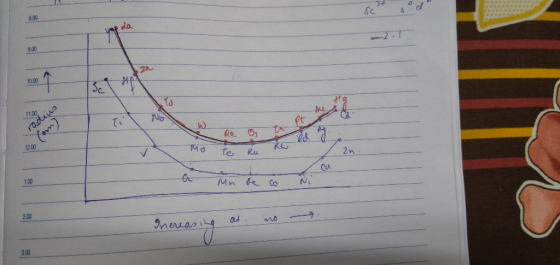
Trend in atomic or ionic radii: The radii of the transition elements should decrease with the increase in atomic no. because of increasing nuclear charge but this trend has a few anomalies. It decreases rapidly from group 3-6 (ex: Sc to Cr), then remains constant for from group 7-10 (Mn, Fe, Co and Ni) and again increases for group 11-12 (Cu,Zn). The first decrease is due to general trend i.e. increase in nuclear charge and poor shielding of d-orbitals. Then this increasing effective nuclear charge is balancd by the repulsion from increasing d electrons. And hence their reduction potentials also deviate.
While moving from 3d to 4d series, there is increase in atomic
radii due to increase in no. Of shells. But while going from 4d to
5d, there is no significant change in atomic radii due to
lanthanide contraction. Below is the graph showing this trend.
Trend in ionisation enthalpy:
There is an increase in the ionisation enthalpies on moving from left to right because of decreasing ionic radii but there are some variations. Although the increase in second and third ionisation energies while moving along the group is much higher as compared to the increase in first ionisation energy. The irregular trend in FIRST IONSIATION ENTHALPIES(removal of one electron) is due to the alteration of relative energies of 3d and 4s orbitals with the removal of electrons. The ionisation enthalpy increases to some extent due to increase in nuclear charge. But the value of Cr is lower due to stable half filled (d5) configuration after the removal of one electron and the value for Zn is higher due to filled stable configurations(4s2 3d10).
To form M(II) ions, the sum of first and second I.E. is required. The second I.E. terms are very high for Cr and Cu where d5 and d10 configurations are stable, hence have less negative reduction potentials i.e. can easily be oxidised. This value for Zn is lower because loss of a second electron from 4s is easy.
The trend in third ionisation enthalpies is almost regular but the Mn(d5) and Zn(d10) shows difficulty in ionisation.
Add Answer to:
1. Consider the table of reduction potentials for several transition metals (values refer to the reaction M +xe M, w...
Select the most reactive organometallic compound. Electronegativity values can be found in the table below: He...
 Select the most reactive organometallic compound. Electronegativity values can be found in the table below: He H 2.1 Ne Li 1.0 Be 1.5 B 2.0 с 2.5 N 3.0 O 3.5 4.0 Na 0.9 Mg 1.2 ΑΙ 1.5 Si 1.8 P 2.2 S 2.5 CI 3.0 Ar K 0.8 Ca 1.0 Sc 1.3 Ti 1.5 V 1.6 Cr 1.6 Mn 1.5 Fe 1.8 Co 1.8 Ni 1.8 Cu 1.9 Zn 1.6 Ga 1.6 Ge 1.8 As 2.0 Se 2.4 Br...
Select the most reactive organometallic compound. Electronegativity values can be found in the table below: He...
 Select the most reactive organometallic compound. Electronegativity values can be found in the table below: He H 21 F Ne L 10 Be 15 B 2.0 с 2.5 N 3.0 0 3.5 4.0 Na 0.9 At Mg Al 15 Si 1.8 P 2.2 S 2.5 a 3.0 TI K 0.8 Sc 1.3 V 1.6 Cr 1.6 Mn 1.5 Co 1.8 Fe 1.8 Ni 1.8 Cu 1.9 Zn 1.6 Ga 1.6 Ge 1.8 1.0 As 20 Se 24 1.5 Br 2.8...
 Select the most reactive organometallic compound. Electronegativity values can be found in the table below: He H 2.1 Ne Li 1.0 Be 1.5 B 2.0 с 2.5 N 3.0 O 3.5 4.0 Na 0.9 Mg 1.2 ΑΙ 1.5 Si 1.8 P 2.2 S 2.5 CI 3.0 Ar K 0.8 Ca 1.0 Sc 1.3 Ti 1.5 V 1.6 Cr 1.6 Mn 1.5 Fe 1.8 Co 1.8 Ni 1.8 Cu 1.9 Zn 1.6 Ga 1.6 Ge 1.8 As 2.0 Se 2.4 Br...
 Select the most reactive organometallic compound. Electronegativity values can be found in the table below: He H 21 F Ne L 10 Be 15 B 2.0 с 2.5 N 3.0 0 3.5 4.0 Na 0.9 At Mg Al 15 Si 1.8 P 2.2 S 2.5 a 3.0 TI K 0.8 Sc 1.3 V 1.6 Cr 1.6 Mn 1.5 Co 1.8 Fe 1.8 Ni 1.8 Cu 1.9 Zn 1.6 Ga 1.6 Ge 1.8 1.0 As 20 Se 24 1.5 Br 2.8...
Most questions answered within 3 hours.
-
Where is the error in this code sequence?
String s1 = "Hello";
String s2 = "ello";...
asked 10 months ago -
Financial data for Joel de Paris, Inc., for last year
follow:
Joel de Paris, Inc.
Balance...
asked 10 months ago -
Consider this reaction:
Al2(SO4)3 (aq)+ BaCl3
(aq) Al2Cl6 (aq)- +
3BaSO4(s) . What is the...
asked 10 months ago -
Suppose that Savneet is considering increasing her
recent random sample from 20 car rentals to 40...
asked 10 months ago -
Trucks arrive at an unloading terminal at an average rate of 120
per hour.
Trucks arrive...
asked 10 months ago -
Why are methanol and ethanol completely soluble in water while
octanol is not very little soluble....
asked 10 months ago -
A facilities manager at a university reads in a research report
that the mean amount of...
asked 10 months ago -
When the CuSO4 is rehydrated by adding water to the anhydrous
compound, is this an endothermic...
asked 10 months ago -
A ray of sunlight is passing from diamond into crown glass; the
angle of incidence is...
asked 10 months ago -
A block of mass 0.249 kg is placed on top of a light, vertical
spring of...
asked 10 months ago -
how do the kidneys compensate in the presences of acidosis
a) trigger hyperventilate
b) reserve acid...
asked 10 months ago -
Question 501 pts
The rental rate of capital to the firm increases. Which of the
following...
asked 10 months ago