Consider the following TM’s. Identify the language recognized by these machines?
Homework Answers
2)
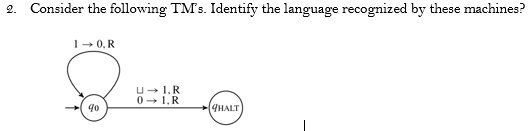
The language recognized is : zero or more 1's followed by
(ending with) zero or one 0
L={1^n(0+e)|0<=n}//here e is empty string
explanation:
on state q0 if 1 comes then it makes it 0,moves head
right and stay on same state
on state q0 if 0 or empty string comes then it makes
it 1,moves head right, and moves to halting state
Add Answer to:
Consider the following TM’s. Identify the language recognized by these machines? Consider the following TMs. Identify t...
Consider the following TM’s. Identify the language recognized by these machines? Consider the following TMs. Identify...
 Consider the following TM’s. Identify the language recognized by
these machines?
Consider the following TMs. Identify the language recognized by these machines? 2. 10, R U1,R 0 ,R qHALT
Consider the following TM’s. Identify the language recognized by
these machines?
Consider the following TMs. Identify the language recognized by these machines? 2. 10, R U1,R 0 ,R qHALT
7.(10%) Give the Turing machine as shown below. 1) Examine the following strings are recognized or...
 7.(10%) Give the Turing machine as shown below. 1) Examine the following strings are recognized or not. a) 01100110 b) 11001011 2) In general, what language does this Turing machine recognize? Obr. 0, b, R 1 R 1,1R
(10pts)Use the subset construction to build a DFA that recognizes the language recognized by the following...
 (10pts)Use the subset construction to build a DFA that recognizes the language recognized by the following NFA. Clearly show your steps so that it is clear that you used the subset construction. 2 90
Question 3. (5 points) What is the language recognized by the following grammar? You can either...
 Question 3. (5 points) What is the language recognized by the following grammar? You can either give the set representation of the language or describe the set in English. The starting symbol is S.
Find a regular description for the language recognized by the NFA with set of states {0,1,2,3,4,5},...
Find a regular description for the language recognized by the NFA with set of states {0,1,2,3,4,5}, initial state 0, accepting state 4, and transitions δ(0,a)={1,3}, δ(0,b)=4, δ(1,a)=4, δ(1,b)={2,3}, δ(2,b)=5, δ(3,a)=2, δ(4,a)={0,5}, δ(4,b)={0,2}, δ(5,a)=4
Give transition diagrams for Standard Turing Machines that accept the following language L = {ww :...
Give transition diagrams for Standard Turing Machines that accept the following language L = {ww : w ∈ {a, b} ∗}
10. Consider the following CFG: Is the language generated by this CFG a regular language? If so, give a regular expression denoting it. If not, prove it. 10. Consider the following CFG: Is the l...
 10. Consider the following CFG: Is the language generated by this CFG a regular language? If so, give a regular expression denoting it. If not, prove it.
10. Consider the following CFG: Is the language generated by this CFG a regular language? If so, give a regular expression denoting it. If not, prove it.
10. Consider the following CFG: Is the language generated by this CFG a regular language? If so, give a regular expression denoting it. If not, prove it.
Question 9. Consider the language {a"b" : n >0}. (i) Is this a regular language? Why...
 Question 9. Consider the language {a"b" : n >0}. (i) Is this a regular language? Why or why not? (ii) Is this a recursively enumerable language? Why or why not? Question 10. Consider the function defined by f(n) = 2 where n is a positive integer. (i) Can this function be computed by a Turing machine? Why or why not? (ii) Is this function primitive recursive? Why or why not?
Consider the following regular expression r. 1(0+1)*0(0+1)*1 1.In words, describe the language L(r). Please explain
Consider the following regular expression r. 1(0+1)*0(0+1)*1 1.In words, describe the language L(r). Please explain
Turing Machines - Models of Language and Computation 8. (7 points) Consider the deterministic Turing machine M (s, t, h), includes fa, b, u) and possibly other symbols, H following rules, along with...
 Turing Machines - Models of Language and Computation
8. (7 points) Consider the deterministic Turing machine M (s, t, h), includes fa, b, u) and possibly other symbols, H following rules, along with possibly other rules: (K, Σ, δ, s,H), where K (h), and includes the 6(s,凵) = (t,-) δ(t, a) = (t,-) 6(r,L) = (h, a) Here凵represents a blank. Suppose M is started in the configuration 凵aababaa in the start state with the read write head scanning the blank...
Turing Machines - Models of Language and Computation
8. (7 points) Consider the deterministic Turing machine M (s, t, h), includes fa, b, u) and possibly other symbols, H following rules, along with possibly other rules: (K, Σ, δ, s,H), where K (h), and includes the 6(s,凵) = (t,-) δ(t, a) = (t,-) 6(r,L) = (h, a) Here凵represents a blank. Suppose M is started in the configuration 凵aababaa in the start state with the read write head scanning the blank...
 Consider the following TM’s. Identify the language recognized by
these machines?
Consider the following TMs. Identify the language recognized by these machines? 2. 10, R U1,R 0 ,R qHALT
Consider the following TM’s. Identify the language recognized by
these machines?
Consider the following TMs. Identify the language recognized by these machines? 2. 10, R U1,R 0 ,R qHALT
 7.(10%) Give the Turing machine as shown below. 1) Examine the following strings are recognized or not. a) 01100110 b) 11001011 2) In general, what language does this Turing machine recognize? Obr. 0, b, R 1 R 1,1R
 (10pts)Use the subset construction to build a DFA that recognizes the language recognized by the following NFA. Clearly show your steps so that it is clear that you used the subset construction. 2 90
 Question 3. (5 points) What is the language recognized by the following grammar? You can either give the set representation of the language or describe the set in English. The starting symbol is S.
 10. Consider the following CFG: Is the language generated by this CFG a regular language? If so, give a regular expression denoting it. If not, prove it.
10. Consider the following CFG: Is the language generated by this CFG a regular language? If so, give a regular expression denoting it. If not, prove it.
10. Consider the following CFG: Is the language generated by this CFG a regular language? If so, give a regular expression denoting it. If not, prove it.
 Question 9. Consider the language {a"b" : n >0}. (i) Is this a regular language? Why or why not? (ii) Is this a recursively enumerable language? Why or why not? Question 10. Consider the function defined by f(n) = 2 where n is a positive integer. (i) Can this function be computed by a Turing machine? Why or why not? (ii) Is this function primitive recursive? Why or why not?
 Turing Machines - Models of Language and Computation
8. (7 points) Consider the deterministic Turing machine M (s, t, h), includes fa, b, u) and possibly other symbols, H following rules, along with possibly other rules: (K, Σ, δ, s,H), where K (h), and includes the 6(s,凵) = (t,-) δ(t, a) = (t,-) 6(r,L) = (h, a) Here凵represents a blank. Suppose M is started in the configuration 凵aababaa in the start state with the read write head scanning the blank...
Turing Machines - Models of Language and Computation
8. (7 points) Consider the deterministic Turing machine M (s, t, h), includes fa, b, u) and possibly other symbols, H following rules, along with possibly other rules: (K, Σ, δ, s,H), where K (h), and includes the 6(s,凵) = (t,-) δ(t, a) = (t,-) 6(r,L) = (h, a) Here凵represents a blank. Suppose M is started in the configuration 凵aababaa in the start state with the read write head scanning the blank...
Most questions answered within 3 hours.
-
Where is the error in this code sequence?
String s1 = "Hello";
String s2 = "ello";...
asked 10 months ago -
Financial data for Joel de Paris, Inc., for last year
follow:
Joel de Paris, Inc.
Balance...
asked 10 months ago -
Consider this reaction:
Al2(SO4)3 (aq)+ BaCl3
(aq) Al2Cl6 (aq)- +
3BaSO4(s) . What is the...
asked 10 months ago -
Suppose that Savneet is considering increasing her
recent random sample from 20 car rentals to 40...
asked 10 months ago -
Trucks arrive at an unloading terminal at an average rate of 120
per hour.
Trucks arrive...
asked 10 months ago -
Why are methanol and ethanol completely soluble in water while
octanol is not very little soluble....
asked 10 months ago -
A facilities manager at a university reads in a research report
that the mean amount of...
asked 10 months ago -
When the CuSO4 is rehydrated by adding water to the anhydrous
compound, is this an endothermic...
asked 10 months ago -
A ray of sunlight is passing from diamond into crown glass; the
angle of incidence is...
asked 10 months ago -
A block of mass 0.249 kg is placed on top of a light, vertical
spring of...
asked 10 months ago -
how do the kidneys compensate in the presences of acidosis
a) trigger hyperventilate
b) reserve acid...
asked 10 months ago -
Question 501 pts
The rental rate of capital to the firm increases. Which of the
following...
asked 10 months ago