
Homework Answers
Add Answer to:
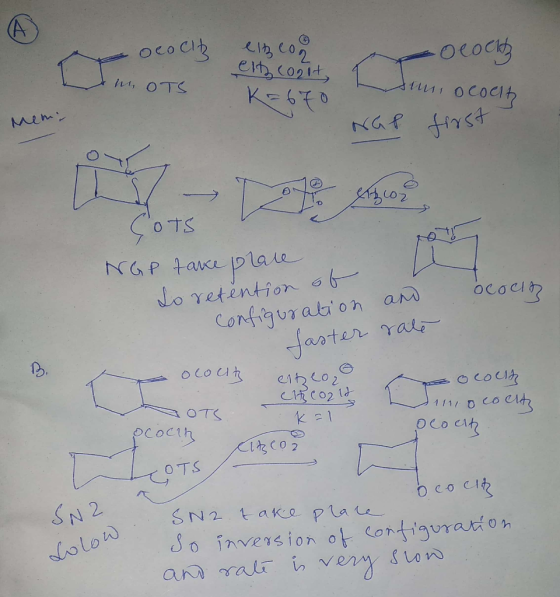
Using appropriate mechanisms, explain formation of given products in the following reactions and discuss why reaction (...
Draw the major products of the following reactions. Clearly explain the formation of the major products using appropria...
 Draw the major products of the following reactions. Clearly explain the formation of the major products using appropriate mechanisms/models. i) Ph D) MeMgBr ii) H30* NaOH
Draw the mechanisms that explain the formation of the two products below from the one starting...
 Draw the mechanisms that explain the formation of the two products below from the one starting material. Show all steps and arrows (6 pts) H-SO4 heat H3C он CH3 CH3 Diels-Alder reactions involve some further stereochemical considerations that we did not talk about. Mainly, these are the formation of the endo and the exo products (starting page 361 of the book). Using the example below, explain the difference between the endo and the exo products. (5 pts) Draw mechanisms and...
Dehydration Experiment: 1. Show all appropriate electron-pushing arrows to explain the formation of each of the...
 Dehydration Experiment: 1. Show all appropriate electron-pushing arrows to explain the formation of each of the observed products in the following reaction. Because intermediates have been provided for you, all arrows must be perfect and must be clear to get credit. 9M H,SO 20- s-d-o g- 2. "Rearrangements" like you see above are fairly common in Snl (and El) reactions, but are never seen in Sy2 or E2 reactions. Why don't those latter mechanisms ever allow rearrangement to occur?
S. Using arrow-pushing mechanisms, write the expected products from the following reactions and i...
 s. Using arrow-pushing mechanisms, write the expected products from the following reactions and indicate whether the equilibrium lies to the "right or to the "left". Very briefly explain your reasoning. If resonance is important, show this. If given pKa values calculate Keq. (X pts) d.
s. Using arrow-pushing mechanisms, write the expected products from the following reactions and indicate whether the equilibrium lies to the "right or to the "left". Very briefly explain your reasoning. If resonance is important, show...
s. Using arrow-pushing mechanisms, write the expected products from the following reactions and indicate whether the equilibrium lies to the "right or to the "left". Very briefly explain your reasoning. If resonance is important, show this. If given pKa values calculate Keq. (X pts) d.
s. Using arrow-pushing mechanisms, write the expected products from the following reactions and indicate whether the equilibrium lies to the "right or to the "left". Very briefly explain your reasoning. If resonance is important, show...
поyy ouppocetter Classify each of the following reactions using appropriate name tags/descriptions of the organic reaction...
 поyy ouppocetter Classify each of the following reactions using appropriate name tags/descriptions of the organic reaction type нс Н ( ан, сенн Ф) ГН (c) H₂CH₂ нс——сн, HBr HECH (а) нс 1сн, Br H (0) Ph-сис + сн,-Br -- Ph-oc-cн, О... . . . . acid catalyst
Model 3: Reactions of Bromine Radical with Various Alkanes For each reaction below, the most likely products are sh...
 Model 3: Reactions of Bromine Radical with Various Alkanes For each reaction below, the most likely products are shown. H H H H Rxn I : Br -H H H H H H H H Br H Rxn IV C- H H CHy сн, H,C нC Rxn V BrH н.с CH -сн Critical Thinking Questions 5. Label the carbon radicals in Model 3 as methyl. primary, secondary, tertiary, allyl or benzyl. a) Which carbon radical in Model 3 is closest...
Complete the following with the correct products, label Zaitsev and Hofmann, and explain why the reaction...
 Complete the following with the correct products, label Zaitsev and Hofmann, and explain why the reaction is either regioselective or stereoselective. (6 pts.) D -Br Nahi Complete each of the following reactions by adding the starting material, reaction conditions, or all possible product(s) - label major/minor - Sx2. Sx1, E2 or E1. (33 pts.) (CH3),COK DMF C(CH3) NaOH DMSO CH OH heat Ph H+Br NaOCH, H+CHE Ph DMF SK DMF o (only product)
asap 7. Base your answers to the following questions on the reactions or schemes below 0-0. +HO- For this reaction, equilibrium favors the products over the reactants. Explain why a. b. For the pr...
 asap
7. Base your answers to the following questions on the reactions or schemes below 0-0. +HO- For this reaction, equilibrium favors the products over the reactants. Explain why a. b. For the propagation step, this is a "guided" mechanism. I gave you all the reagents and products, just add in the arrows where appropriate! ONR2O-NR2 The termination step is also incredibly strange here. The following occurs either radically or ionically, but we aren't sure yet. At the very least,...
asap
7. Base your answers to the following questions on the reactions or schemes below 0-0. +HO- For this reaction, equilibrium favors the products over the reactants. Explain why a. b. For the propagation step, this is a "guided" mechanism. I gave you all the reagents and products, just add in the arrows where appropriate! ONR2O-NR2 The termination step is also incredibly strange here. The following occurs either radically or ionically, but we aren't sure yet. At the very least,...
1)Explain using drawings why acetaldehyde reacts faster than acetone to nucleophilic acyl addition. 2) 3)What is...
 1)Explain using drawings why acetaldehyde
reacts faster than acetone to nucleophilic acyl addition.
2)
3)What is the major purpose of pyridine in nucleophile acyl
substitution reactions (for example, a reaction including an acid
chloride with pyridine)?
i. What is the purpose of the cyclic acetal in the following reaction? ii. Draw the product formed if the original starting material was treated with 1. LiAlH4 & 2. H20 (i.e. what would happen if the 1st and 3rd reactions were not performed?)...
1)Explain using drawings why acetaldehyde
reacts faster than acetone to nucleophilic acyl addition.
2)
3)What is the major purpose of pyridine in nucleophile acyl
substitution reactions (for example, a reaction including an acid
chloride with pyridine)?
i. What is the purpose of the cyclic acetal in the following reaction? ii. Draw the product formed if the original starting material was treated with 1. LiAlH4 & 2. H20 (i.e. what would happen if the 1st and 3rd reactions were not performed?)...
 Draw the major products of the following reactions. Clearly explain the formation of the major products using appropriate mechanisms/models. i) Ph D) MeMgBr ii) H30* NaOH
 Draw the mechanisms that explain the formation of the two products below from the one starting material. Show all steps and arrows (6 pts) H-SO4 heat H3C он CH3 CH3 Diels-Alder reactions involve some further stereochemical considerations that we did not talk about. Mainly, these are the formation of the endo and the exo products (starting page 361 of the book). Using the example below, explain the difference between the endo and the exo products. (5 pts) Draw mechanisms and...
 Dehydration Experiment: 1. Show all appropriate electron-pushing arrows to explain the formation of each of the observed products in the following reaction. Because intermediates have been provided for you, all arrows must be perfect and must be clear to get credit. 9M H,SO 20- s-d-o g- 2. "Rearrangements" like you see above are fairly common in Snl (and El) reactions, but are never seen in Sy2 or E2 reactions. Why don't those latter mechanisms ever allow rearrangement to occur?
 s. Using arrow-pushing mechanisms, write the expected products from the following reactions and indicate whether the equilibrium lies to the "right or to the "left". Very briefly explain your reasoning. If resonance is important, show this. If given pKa values calculate Keq. (X pts) d.
s. Using arrow-pushing mechanisms, write the expected products from the following reactions and indicate whether the equilibrium lies to the "right or to the "left". Very briefly explain your reasoning. If resonance is important, show...
s. Using arrow-pushing mechanisms, write the expected products from the following reactions and indicate whether the equilibrium lies to the "right or to the "left". Very briefly explain your reasoning. If resonance is important, show this. If given pKa values calculate Keq. (X pts) d.
s. Using arrow-pushing mechanisms, write the expected products from the following reactions and indicate whether the equilibrium lies to the "right or to the "left". Very briefly explain your reasoning. If resonance is important, show...
 поyy ouppocetter Classify each of the following reactions using appropriate name tags/descriptions of the organic reaction type нс Н ( ан, сенн Ф) ГН (c) H₂CH₂ нс——сн, HBr HECH (а) нс 1сн, Br H (0) Ph-сис + сн,-Br -- Ph-oc-cн, О... . . . . acid catalyst
 Model 3: Reactions of Bromine Radical with Various Alkanes For each reaction below, the most likely products are shown. H H H H Rxn I : Br -H H H H H H H H Br H Rxn IV C- H H CHy сн, H,C нC Rxn V BrH н.с CH -сн Critical Thinking Questions 5. Label the carbon radicals in Model 3 as methyl. primary, secondary, tertiary, allyl or benzyl. a) Which carbon radical in Model 3 is closest...
 Complete the following with the correct products, label Zaitsev and Hofmann, and explain why the reaction is either regioselective or stereoselective. (6 pts.) D -Br Nahi Complete each of the following reactions by adding the starting material, reaction conditions, or all possible product(s) - label major/minor - Sx2. Sx1, E2 or E1. (33 pts.) (CH3),COK DMF C(CH3) NaOH DMSO CH OH heat Ph H+Br NaOCH, H+CHE Ph DMF SK DMF o (only product)
 asap
7. Base your answers to the following questions on the reactions or schemes below 0-0. +HO- For this reaction, equilibrium favors the products over the reactants. Explain why a. b. For the propagation step, this is a "guided" mechanism. I gave you all the reagents and products, just add in the arrows where appropriate! ONR2O-NR2 The termination step is also incredibly strange here. The following occurs either radically or ionically, but we aren't sure yet. At the very least,...
asap
7. Base your answers to the following questions on the reactions or schemes below 0-0. +HO- For this reaction, equilibrium favors the products over the reactants. Explain why a. b. For the propagation step, this is a "guided" mechanism. I gave you all the reagents and products, just add in the arrows where appropriate! ONR2O-NR2 The termination step is also incredibly strange here. The following occurs either radically or ionically, but we aren't sure yet. At the very least,...
 1)Explain using drawings why acetaldehyde
reacts faster than acetone to nucleophilic acyl addition.
2)
3)What is the major purpose of pyridine in nucleophile acyl
substitution reactions (for example, a reaction including an acid
chloride with pyridine)?
i. What is the purpose of the cyclic acetal in the following reaction? ii. Draw the product formed if the original starting material was treated with 1. LiAlH4 & 2. H20 (i.e. what would happen if the 1st and 3rd reactions were not performed?)...
1)Explain using drawings why acetaldehyde
reacts faster than acetone to nucleophilic acyl addition.
2)
3)What is the major purpose of pyridine in nucleophile acyl
substitution reactions (for example, a reaction including an acid
chloride with pyridine)?
i. What is the purpose of the cyclic acetal in the following reaction? ii. Draw the product formed if the original starting material was treated with 1. LiAlH4 & 2. H20 (i.e. what would happen if the 1st and 3rd reactions were not performed?)...
Most questions answered within 3 hours.
-
Where is the error in this code sequence?
String s1 = "Hello";
String s2 = "ello";...
asked 10 months ago -
Financial data for Joel de Paris, Inc., for last year
follow:
Joel de Paris, Inc.
Balance...
asked 10 months ago -
Consider this reaction:
Al2(SO4)3 (aq)+ BaCl3
(aq) Al2Cl6 (aq)- +
3BaSO4(s) . What is the...
asked 10 months ago -
Suppose that Savneet is considering increasing her
recent random sample from 20 car rentals to 40...
asked 10 months ago -
Trucks arrive at an unloading terminal at an average rate of 120
per hour.
Trucks arrive...
asked 10 months ago -
Why are methanol and ethanol completely soluble in water while
octanol is not very little soluble....
asked 10 months ago -
A facilities manager at a university reads in a research report
that the mean amount of...
asked 10 months ago -
When the CuSO4 is rehydrated by adding water to the anhydrous
compound, is this an endothermic...
asked 10 months ago -
A ray of sunlight is passing from diamond into crown glass; the
angle of incidence is...
asked 10 months ago -
A block of mass 0.249 kg is placed on top of a light, vertical
spring of...
asked 10 months ago -
how do the kidneys compensate in the presences of acidosis
a) trigger hyperventilate
b) reserve acid...
asked 10 months ago -
Question 501 pts
The rental rate of capital to the firm increases. Which of the
following...
asked 10 months ago