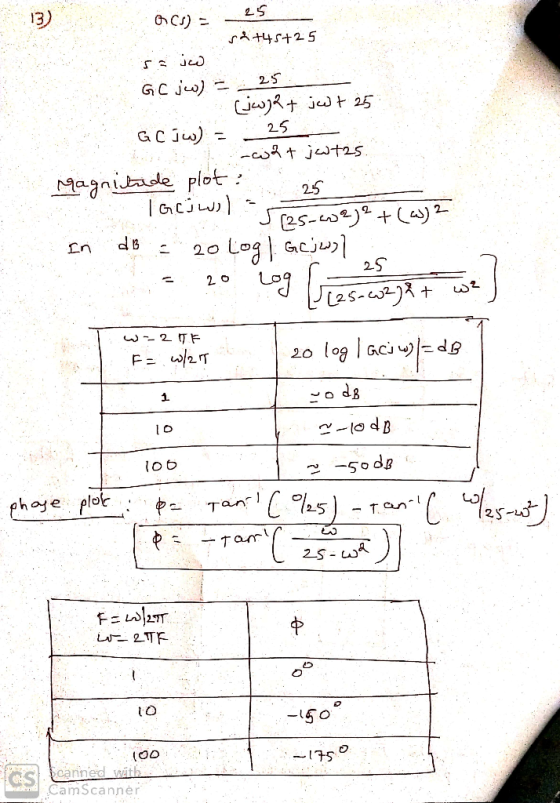
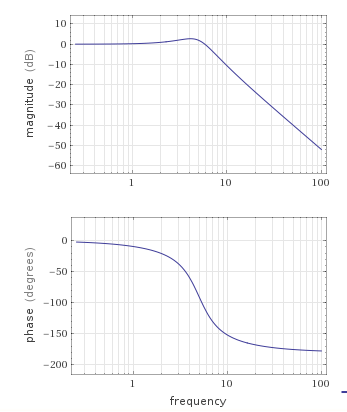
![25 For the system with transfer function G(S) [13] draw the bode (magnitude and s2+4s+25 phase) plot on the semi-log paper. [](http://img.homeworklib.com/images/56ff606a-af0d-4f28-a017-10c8db58b31f.png?x-oss-process=image/resize,w_560)
Homework Answers
1)
Add Answer to:
Q13,Q14 please. 25 For the system with transfer function G(S) [13] draw the bode (magnitude and s2+4s+25 phase)...
25 G(s) draw the bode (magnitude and [13] For the system with transfer function s2+4s+25 phase) plot on the semi-log pa...
 25 G(s) draw the bode (magnitude and [13] For the system with transfer function s2+4s+25 phase) plot on the semi-log paper
25 G(s) draw the bode (magnitude and [13] For the system with transfer function s2+4s+25 phase) plot on the semi-log paper
25 G(s) draw the bode (magnitude and [13] For the system with transfer function s2+4s+25 phase) plot on the semi-log paper
[14] The frequency response test on a system yielded the following data: db 900 610 450 00 0.1 -14 0.5 1 5 10 -450 -136...
 [14] The frequency response test on a system yielded the following data: db 900 610 450 00 0.1 -14 0.5 1 5 10 -450 -1360 -1800 7.5 10 50 -19 100 -31 Plot the data on a semi-log graph sheet. And, also determine the system transfer function in a frequency domain.
[14] The frequency response test on a system yielded the following data: db 900 610 450 00 0.1 -14 0.5 1 5 10 -450 -1360 -1800 7.5 10 50...
[14] The frequency response test on a system yielded the following data: db 900 610 450 00 0.1 -14 0.5 1 5 10 -450 -1360 -1800 7.5 10 50 -19 100 -31 Plot the data on a semi-log graph sheet. And, also determine the system transfer function in a frequency domain.
[14] The frequency response test on a system yielded the following data: db 900 610 450 00 0.1 -14 0.5 1 5 10 -450 -1360 -1800 7.5 10 50...
For the transfer function, construct the bode plots for magnitude and phase. Use copies of the...
 For the transfer function, construct the bode plots for
magnitude and phase. Use copies of the semi-log paper on the second
page of this assignment. Also, a printable copy of the semi-log
paper can be found below. Use one sheet per problem. Indicate the
contributions from the factors of the transfer function with light
lines in pencil. These are called “guidelines”. Indicate the
graphical sum of the guidelines (the final bode plot) with heavier
lines in ink. You will find...
For the transfer function, construct the bode plots for
magnitude and phase. Use copies of the semi-log paper on the second
page of this assignment. Also, a printable copy of the semi-log
paper can be found below. Use one sheet per problem. Indicate the
contributions from the factors of the transfer function with light
lines in pencil. These are called “guidelines”. Indicate the
graphical sum of the guidelines (the final bode plot) with heavier
lines in ink. You will find...
A bode plot of the transfer function, GS = - 25 $2+45+25, is shown as below....
 A bode plot of the transfer function, GS = - 25 $2+45+25, is shown as below. Bode Diagram System sys Frequency (rad/s): 7 Magnitude (dB): -3.4 Magnitude (dB) Phase (deg) Systemt sys Frequency (rad/s): 7 Phase (deg): - 130 - 135 - 180 10 Frequency (rad/s) Determine the frequency response y(t) when a sinusoidal function, X(t) = 10 sin (7t +30) is applied to the transfer function as an input signal. (20 points)
2. The transfer function of a CT LTI system is given by H(s) (s2 +6s +10) (s2 -4s +8) a) Draw the...
 2. The transfer function of a CT LTI system is given by H(s) (s2 +6s +10) (s2 -4s +8) a) Draw the pole-zero plot of the transfer function. b) Show all possible ROC's associated with this transfer function. c) Obtain the impulse response h(t) associated with each ROC of the transfer function. d) Which one (if any) of the impulse responses of part c) is stable?
2. The transfer function of a CT LTI system is given by H(s) (s2...
2. The transfer function of a CT LTI system is given by H(s) (s2 +6s +10) (s2 -4s +8) a) Draw the pole-zero plot of the transfer function. b) Show all possible ROC's associated with this transfer function. c) Obtain the impulse response h(t) associated with each ROC of the transfer function. d) Which one (if any) of the impulse responses of part c) is stable?
2. The transfer function of a CT LTI system is given by H(s) (s2...
Sketch the bode plot of a signal conditioner with the transfer function G(s) in the provided...
 Sketch the bode plot of a signal conditioner with the transfer function G(s) in the provided graph and calculate the bandwidth of this signal conditioner. GO 10s +1 S2 + 10s + 24 Table 2 Components in G(S) Asymptotes for Magnitude Asymptotes for Phase 20 log,0 1G(jw) Frequency-rad/sec Phase - degrees Frequency - rad/sec
Consider the system shown as below. Draw a Bode diagram of the open-loop transfer function G(s).
 1 Consider the system shown as below. Draw a Bode diagram of the open-loop transfer function G(s). Determine the phase margin, gain-crossover frequency, gain margin and phase-crossover frequency, (Sketch the bode diagram by hand) 2 Consider the system shown as below. Use MATLAB to draw a bode diagram of the open-loop transfer function G(s). Show the gain-crossover frequency and phase-crossover frequency in the Bode diagram and determine the phase margin and gain margin. 3. Consider the system shown as below. Design a...
The transfer function of the given physical system is 2500 Gp(s)-T-1000 Part 3 1. Frequency response (a) Draw the bode...
 The transfer function of the given physical system is 2500 Gp(s)-T-1000 Part 3 1. Frequency response (a) Draw the bode plot of open-loop transfer function when K (b) Use bode plot of open-loop transfer function to determine the type of system (do not use transfer function) (c) For what input the system will have constant steady-state error (d) for the unit input in item (c) calculate the constant steady-state error.(Use bode plot to calculate the error.) (e) Design a lead...
7 11. If a particular network is described by transfer function H(s), use MATLAB to plot the magnitude and phase Bode plot for H(s) equal to (a) 300 (s2 7s +7 s(5s +8s(2s + 4) 7 11. If a particu...
 7 11. If a particular network is described by transfer function H(s), use MATLAB to plot the magnitude and phase Bode plot for H(s) equal to (a) 300 (s2 7s +7 s(5s +8s(2s + 4)
7 11. If a particular network is described by transfer function H(s), use MATLAB to plot the magnitude and phase Bode plot for H(s) equal to (a) 300 (s2 7s +7 s(5s +8s(2s + 4)
7 11. If a particular network is described by transfer function H(s), use MATLAB to plot the magnitude and phase Bode plot for H(s) equal to (a) 300 (s2 7s +7 s(5s +8s(2s + 4)
For all problems -given a transfer function G(s) sketch the magnitude and phase characteristics in the...
 For all problems -given a transfer function G(s) sketch the magnitude and phase characteristics in the logarithmic scale (i.e. Bode-plots) of the system using the following rules-of-thumb: i. "Normalize" the G(s) by extracting poles/zeros, substituting s-jw and writing the TF using DC-gain KO and time-constants i. Arange break-points (poles, zeros or on for complex-conjugate poles) in ascending order ii Based on the term Ko(ju)Fk, determine: initial slope of the magnitude-response asymptote for low frequencies as F k 20 dB/dec (e.g....
 25 G(s) draw the bode (magnitude and [13] For the system with transfer function s2+4s+25 phase) plot on the semi-log paper
25 G(s) draw the bode (magnitude and [13] For the system with transfer function s2+4s+25 phase) plot on the semi-log paper
25 G(s) draw the bode (magnitude and [13] For the system with transfer function s2+4s+25 phase) plot on the semi-log paper
 [14] The frequency response test on a system yielded the following data: db 900 610 450 00 0.1 -14 0.5 1 5 10 -450 -1360 -1800 7.5 10 50 -19 100 -31 Plot the data on a semi-log graph sheet. And, also determine the system transfer function in a frequency domain.
[14] The frequency response test on a system yielded the following data: db 900 610 450 00 0.1 -14 0.5 1 5 10 -450 -1360 -1800 7.5 10 50...
[14] The frequency response test on a system yielded the following data: db 900 610 450 00 0.1 -14 0.5 1 5 10 -450 -1360 -1800 7.5 10 50 -19 100 -31 Plot the data on a semi-log graph sheet. And, also determine the system transfer function in a frequency domain.
[14] The frequency response test on a system yielded the following data: db 900 610 450 00 0.1 -14 0.5 1 5 10 -450 -1360 -1800 7.5 10 50...
 For the transfer function, construct the bode plots for
magnitude and phase. Use copies of the semi-log paper on the second
page of this assignment. Also, a printable copy of the semi-log
paper can be found below. Use one sheet per problem. Indicate the
contributions from the factors of the transfer function with light
lines in pencil. These are called “guidelines”. Indicate the
graphical sum of the guidelines (the final bode plot) with heavier
lines in ink. You will find...
For the transfer function, construct the bode plots for
magnitude and phase. Use copies of the semi-log paper on the second
page of this assignment. Also, a printable copy of the semi-log
paper can be found below. Use one sheet per problem. Indicate the
contributions from the factors of the transfer function with light
lines in pencil. These are called “guidelines”. Indicate the
graphical sum of the guidelines (the final bode plot) with heavier
lines in ink. You will find...
 A bode plot of the transfer function, GS = - 25 $2+45+25, is shown as below. Bode Diagram System sys Frequency (rad/s): 7 Magnitude (dB): -3.4 Magnitude (dB) Phase (deg) Systemt sys Frequency (rad/s): 7 Phase (deg): - 130 - 135 - 180 10 Frequency (rad/s) Determine the frequency response y(t) when a sinusoidal function, X(t) = 10 sin (7t +30) is applied to the transfer function as an input signal. (20 points)
 2. The transfer function of a CT LTI system is given by H(s) (s2 +6s +10) (s2 -4s +8) a) Draw the pole-zero plot of the transfer function. b) Show all possible ROC's associated with this transfer function. c) Obtain the impulse response h(t) associated with each ROC of the transfer function. d) Which one (if any) of the impulse responses of part c) is stable?
2. The transfer function of a CT LTI system is given by H(s) (s2...
2. The transfer function of a CT LTI system is given by H(s) (s2 +6s +10) (s2 -4s +8) a) Draw the pole-zero plot of the transfer function. b) Show all possible ROC's associated with this transfer function. c) Obtain the impulse response h(t) associated with each ROC of the transfer function. d) Which one (if any) of the impulse responses of part c) is stable?
2. The transfer function of a CT LTI system is given by H(s) (s2...
 Sketch the bode plot of a signal conditioner with the transfer function G(s) in the provided graph and calculate the bandwidth of this signal conditioner. GO 10s +1 S2 + 10s + 24 Table 2 Components in G(S) Asymptotes for Magnitude Asymptotes for Phase 20 log,0 1G(jw) Frequency-rad/sec Phase - degrees Frequency - rad/sec
 The transfer function of the given physical system is 2500 Gp(s)-T-1000 Part 3 1. Frequency response (a) Draw the bode plot of open-loop transfer function when K (b) Use bode plot of open-loop transfer function to determine the type of system (do not use transfer function) (c) For what input the system will have constant steady-state error (d) for the unit input in item (c) calculate the constant steady-state error.(Use bode plot to calculate the error.) (e) Design a lead...
 7 11. If a particular network is described by transfer function H(s), use MATLAB to plot the magnitude and phase Bode plot for H(s) equal to (a) 300 (s2 7s +7 s(5s +8s(2s + 4)
7 11. If a particular network is described by transfer function H(s), use MATLAB to plot the magnitude and phase Bode plot for H(s) equal to (a) 300 (s2 7s +7 s(5s +8s(2s + 4)
7 11. If a particular network is described by transfer function H(s), use MATLAB to plot the magnitude and phase Bode plot for H(s) equal to (a) 300 (s2 7s +7 s(5s +8s(2s + 4)
 For all problems -given a transfer function G(s) sketch the magnitude and phase characteristics in the logarithmic scale (i.e. Bode-plots) of the system using the following rules-of-thumb: i. "Normalize" the G(s) by extracting poles/zeros, substituting s-jw and writing the TF using DC-gain KO and time-constants i. Arange break-points (poles, zeros or on for complex-conjugate poles) in ascending order ii Based on the term Ko(ju)Fk, determine: initial slope of the magnitude-response asymptote for low frequencies as F k 20 dB/dec (e.g....
Most questions answered within 3 hours.
-
Where is the error in this code sequence?
String s1 = "Hello";
String s2 = "ello";...
asked 10 months ago -
Financial data for Joel de Paris, Inc., for last year
follow:
Joel de Paris, Inc.
Balance...
asked 10 months ago -
Consider this reaction:
Al2(SO4)3 (aq)+ BaCl3
(aq) Al2Cl6 (aq)- +
3BaSO4(s) . What is the...
asked 10 months ago -
Suppose that Savneet is considering increasing her
recent random sample from 20 car rentals to 40...
asked 10 months ago -
Trucks arrive at an unloading terminal at an average rate of 120
per hour.
Trucks arrive...
asked 10 months ago -
Why are methanol and ethanol completely soluble in water while
octanol is not very little soluble....
asked 10 months ago -
A facilities manager at a university reads in a research report
that the mean amount of...
asked 10 months ago -
When the CuSO4 is rehydrated by adding water to the anhydrous
compound, is this an endothermic...
asked 10 months ago -
A ray of sunlight is passing from diamond into crown glass; the
angle of incidence is...
asked 10 months ago -
A block of mass 0.249 kg is placed on top of a light, vertical
spring of...
asked 10 months ago -
how do the kidneys compensate in the presences of acidosis
a) trigger hyperventilate
b) reserve acid...
asked 10 months ago -
Question 501 pts
The rental rate of capital to the firm increases. Which of the
following...
asked 10 months ago