
Homework Answers
Add Answer to:
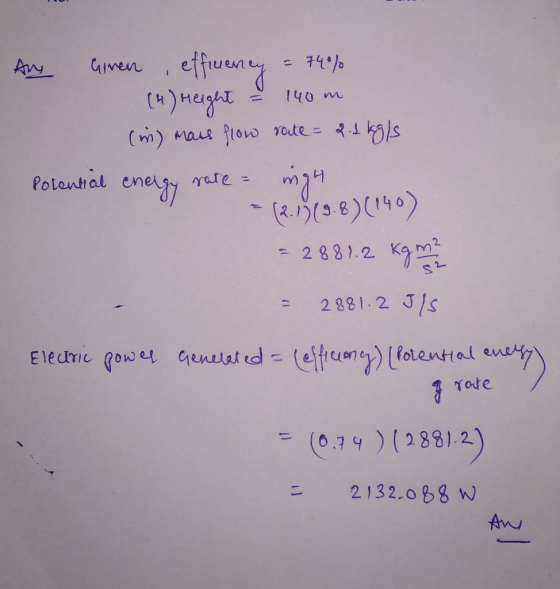
The turbines ina hydroelectric plant kg/s. Assuming 74% efficiency for conversion of potential to electrical energy...
The vertical drop of water in a hydroelectric power plant is 155m (See figure below). Water...
 The vertical drop of water in a hydroelectric power plant is 155m (See figure below). Water flows through the plant and into the lower river at the rate of 425m/s. Assume the overall efficiency of the plant as 80%. Density of water d is equal to 1000kg/m3 Acceleration due to gravity g is equal to 9.81m/s2. Ignore the viscous losses in the flowing water. Dam Water Reservoir Hm Turbine Generator River Figure: Schematic diagram of the hydroelectric power plant (a)...
Please help me thanks. The vertical drop of water in a hydroelectric power plant is 125m...
 Please help me thanks.
The vertical drop of water in a hydroelectric power plant is 125m (See figure below). Water flows through the plant and into the lower river at the rate of 325m/s. Assume the overall efficiency n of the plant as 80%. Density of water d is equal to 1000kg/mº. Acceleration due to gravity g is equal to 9.81m/s2. Ignore the viscous losses in the flowing water. Dam Water Reservoir Hm Turbine Generator River Figure: Schematic diagram of...
Please help me thanks.
The vertical drop of water in a hydroelectric power plant is 125m (See figure below). Water flows through the plant and into the lower river at the rate of 325m/s. Assume the overall efficiency n of the plant as 80%. Density of water d is equal to 1000kg/mº. Acceleration due to gravity g is equal to 9.81m/s2. Ignore the viscous losses in the flowing water. Dam Water Reservoir Hm Turbine Generator River Figure: Schematic diagram of...
A hydroelectric power plant has a dam 100 ft high, and water can flow through the...
A hydroelectric power plant has a dam 100 ft high, and water can flow through the dam and water turbines at 1 million lbm per minute over a 60-ft drop. If the turbines can convert the loss in potential energy of the water into electric power at an efficiency of 70%, how much power can the facility produce in megawatts? (Note: 550 ft ·lbf/s = 1 hp = 0.746 kW)
20.64 Electric Power and Energy Assuming 91.0% efficiency for the conversion of electrical power by the...
 20.64 Electric Power and Energy Assuming 91.0% efficiency for the conversion of electrical power by the motor, what current must the 84.0-V batteries of a 690-kg electric car be able to supply: To accelerate from rest to 22.0 m/s in 1.00 min? Figure caption: This REVAi, an electric car, gets recharged on a street in London. (credit: Frank Hebbert) Submit Answer Tries 0/10 To climb a 190-m-high hill in 2.00 min at a constant 22.0-m/s speed while exerting 410 N...
You are designing a hydroelectric plant. The turbine has an efficiency of 88% and the generator...
You are designing a hydroelectric plant. The turbine has an efficiency of 88% and the generator has an efficiency of 92%. You design the water flow rate to be 110 m3/s. The water elevation drop is 120 m. Disregarding frictional loss in the piping, what do you expect the electric power output to be in MW?
A pumped-storage hydroelectric plant generates high value electricity during peak demand times, b...
 A pumped-storage hydroelectric plant generates high value electricity during peak demand times, by allowing water (density 1,000 kg/m3) to run through a pipe from an elevated reservoir through a bank of turbines and then into a lower level reservoir. It then uses low-cost, off-peak electricity to pump the water back up into the upper reservoir The water surface in the very large upper reservoir (A) is 600 m above datum whilst that in the very large lower reservoir (B) is...
A hydroelectric generator converts kinetic energy of water into electrical energy. Each second 2915 m3 of...
 A hydroelectric generator converts kinetic energy of water into electrical energy. Each second 2915 m3 of water passes over a waterfall 300 m high and the generator is only 84% efficient: (The mass of 1 m3 of water is 1000 kg.) a) What is the total energy available? b) What is the power generated? W
ENGR 320 Exam2 Name 1: (15+5 pts) A hydroelectric power plant takes in 25 m's of water through it...
 ENGR 320 Exam2 Name 1: (15+5 pts) A hydroelectric power plant takes in 25 m's of water through its turbine and discharges it to the atmosphere at V2-I m/s. The head loss in the turbine and penstock system is 10 m. Assuming turbulent flow, a -1.12, (a) What it the power in MW extracted by the turbine? () If the efficiency of the turbine and electrical generator is 85% what is the net power (in MW) generated by this plant?...
Assuming 95.0% efficiency for the conversion of electrical power by the motor, what current must the...
Assuming 95.0% efficiency for the conversion of electrical power by the motor, what current must the 12.0-V batteries of a 728-kg electric car be able to supply to do the following? (a) accelerate from rest to 25.0 m/s in 1.00 min A (b) climb a 200-m high hill in 2.00 min at a constant 25.0 m/s speed while exerting 443 N of force to overcome air resistance and friction A
Assuming 95.0% efficiency for the conversion of electrical power by the motor, what current must the...
Assuming 95.0% efficiency for the conversion of electrical power by the motor, what current must the 12.0-V batteries of a 692-kg electric car be able to supply to climb a 359-m high hill in 2.00 min at a constant 11.3 m/s speed while exerting 569 N of force to overcome air resistance and friction
 The vertical drop of water in a hydroelectric power plant is 155m (See figure below). Water flows through the plant and into the lower river at the rate of 425m/s. Assume the overall efficiency of the plant as 80%. Density of water d is equal to 1000kg/m3 Acceleration due to gravity g is equal to 9.81m/s2. Ignore the viscous losses in the flowing water. Dam Water Reservoir Hm Turbine Generator River Figure: Schematic diagram of the hydroelectric power plant (a)...
 Please help me thanks.
The vertical drop of water in a hydroelectric power plant is 125m (See figure below). Water flows through the plant and into the lower river at the rate of 325m/s. Assume the overall efficiency n of the plant as 80%. Density of water d is equal to 1000kg/mº. Acceleration due to gravity g is equal to 9.81m/s2. Ignore the viscous losses in the flowing water. Dam Water Reservoir Hm Turbine Generator River Figure: Schematic diagram of...
Please help me thanks.
The vertical drop of water in a hydroelectric power plant is 125m (See figure below). Water flows through the plant and into the lower river at the rate of 325m/s. Assume the overall efficiency n of the plant as 80%. Density of water d is equal to 1000kg/mº. Acceleration due to gravity g is equal to 9.81m/s2. Ignore the viscous losses in the flowing water. Dam Water Reservoir Hm Turbine Generator River Figure: Schematic diagram of...
 20.64 Electric Power and Energy Assuming 91.0% efficiency for the conversion of electrical power by the motor, what current must the 84.0-V batteries of a 690-kg electric car be able to supply: To accelerate from rest to 22.0 m/s in 1.00 min? Figure caption: This REVAi, an electric car, gets recharged on a street in London. (credit: Frank Hebbert) Submit Answer Tries 0/10 To climb a 190-m-high hill in 2.00 min at a constant 22.0-m/s speed while exerting 410 N...
 A pumped-storage hydroelectric plant generates high value electricity during peak demand times, by allowing water (density 1,000 kg/m3) to run through a pipe from an elevated reservoir through a bank of turbines and then into a lower level reservoir. It then uses low-cost, off-peak electricity to pump the water back up into the upper reservoir The water surface in the very large upper reservoir (A) is 600 m above datum whilst that in the very large lower reservoir (B) is...
 A hydroelectric generator converts kinetic energy of water into electrical energy. Each second 2915 m3 of water passes over a waterfall 300 m high and the generator is only 84% efficient: (The mass of 1 m3 of water is 1000 kg.) a) What is the total energy available? b) What is the power generated? W
 ENGR 320 Exam2 Name 1: (15+5 pts) A hydroelectric power plant takes in 25 m's of water through its turbine and discharges it to the atmosphere at V2-I m/s. The head loss in the turbine and penstock system is 10 m. Assuming turbulent flow, a -1.12, (a) What it the power in MW extracted by the turbine? () If the efficiency of the turbine and electrical generator is 85% what is the net power (in MW) generated by this plant?...
Most questions answered within 3 hours.
-
Where is the error in this code sequence?
String s1 = "Hello";
String s2 = "ello";...
asked 11 months ago -
Financial data for Joel de Paris, Inc., for last year
follow:
Joel de Paris, Inc.
Balance...
asked 11 months ago -
Consider this reaction:
Al2(SO4)3 (aq)+ BaCl3
(aq) Al2Cl6 (aq)- +
3BaSO4(s) . What is the...
asked 11 months ago -
Suppose that Savneet is considering increasing her
recent random sample from 20 car rentals to 40...
asked 11 months ago -
Trucks arrive at an unloading terminal at an average rate of 120
per hour.
Trucks arrive...
asked 11 months ago -
Why are methanol and ethanol completely soluble in water while
octanol is not very little soluble....
asked 11 months ago -
A facilities manager at a university reads in a research report
that the mean amount of...
asked 11 months ago -
When the CuSO4 is rehydrated by adding water to the anhydrous
compound, is this an endothermic...
asked 11 months ago -
A ray of sunlight is passing from diamond into crown glass; the
angle of incidence is...
asked 11 months ago -
A block of mass 0.249 kg is placed on top of a light, vertical
spring of...
asked 11 months ago -
how do the kidneys compensate in the presences of acidosis
a) trigger hyperventilate
b) reserve acid...
asked 11 months ago -
Question 501 pts
The rental rate of capital to the firm increases. Which of the
following...
asked 11 months ago