Arrange the alkyl halides in order of reactivity (from most to least reactive) under both SN1 (silver nitrate/ethanol)...
Homework Answers
Add Answer to:
Arrange the alkyl halides in order of reactivity (from most to least reactive) under both SN1 (silver nitrate/ethanol)...
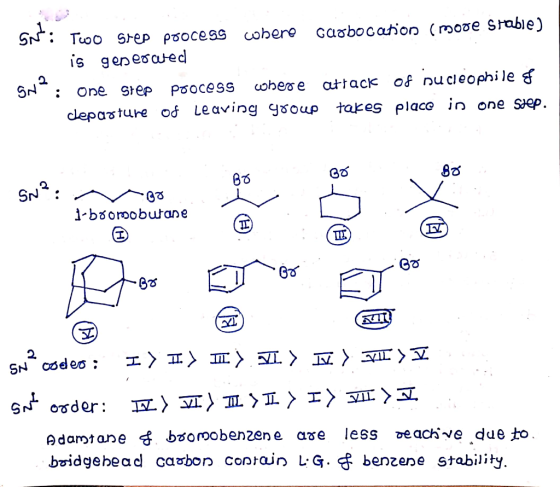
To test the reactivity of halides in sodium iodide (Sn2). arrange in decreasing reactivity Bromobenzene 1-bromobutane...
To test the reactivity of halides in sodium iodide (Sn2). arrange in decreasing reactivity Bromobenzene 1-bromobutane 2-bromo-2-methyl propane Benzyl bromide Allyl bromide 2-bromobutane
Nucleophilic substitutions, mainly just need the arrangements, and the drawn out reaction equations CHEM 220L Laboratory...
 Nucleophilic substitutions, mainly just need the arrangements,
and the drawn out reaction equations
CHEM 220L Laboratory Manual (S.A. Cummings & J.K. Mahoney) CHEM 220L Data Sheet: Nucleophilic Substitutions (SN1 and SN2) (6 points) Part 1. Enter the results of each test into the table below: Alkyl Halides 10, 2 or 3? SN2 (Nal/acetone) 1-chlorobutane 1-bromobutane 2-chlorobutane 2-bromobutane bromocyclohexane 2-chloro-2-methylpropane (t-butyl chloride) Crotyl chloride Benzyl chloride (a-chlorotoluene) Arrange the alkyl halides in order of reactivity (from most to least reactive) with...
Nucleophilic substitutions, mainly just need the arrangements,
and the drawn out reaction equations
CHEM 220L Laboratory Manual (S.A. Cummings & J.K. Mahoney) CHEM 220L Data Sheet: Nucleophilic Substitutions (SN1 and SN2) (6 points) Part 1. Enter the results of each test into the table below: Alkyl Halides 10, 2 or 3? SN2 (Nal/acetone) 1-chlorobutane 1-bromobutane 2-chlorobutane 2-bromobutane bromocyclohexane 2-chloro-2-methylpropane (t-butyl chloride) Crotyl chloride Benzyl chloride (a-chlorotoluene) Arrange the alkyl halides in order of reactivity (from most to least reactive) with...
For the Reactions that formed precipitates, what are the drawn out reaction equations with stereochemistry if...
 For the Reactions that formed precipitates, what are the drawn
out reaction equations with stereochemistry if applicable?
Part 1. Enter the results of each test into the table below: 1°, 2° or 3°? Alkyl Halides 1-chlorobutane Sn2 (Nal/acetone) Precipitate formed 1-bromobutane Precipitate formed 2-chlorobutane No precipitate formed 2-bromobutane No precipitate formed bromocyclohexane No precipitate formed 2-chloro-2-methylpropane (t-butyl chloride) No precipitate formed Crotyl chloride No precipitate formed Benzyl chloride (a-chlorotoluene) No precipitate formed Arrange the alkyl halides in order of reactivity...
For the Reactions that formed precipitates, what are the drawn
out reaction equations with stereochemistry if applicable?
Part 1. Enter the results of each test into the table below: 1°, 2° or 3°? Alkyl Halides 1-chlorobutane Sn2 (Nal/acetone) Precipitate formed 1-bromobutane Precipitate formed 2-chlorobutane No precipitate formed 2-bromobutane No precipitate formed bromocyclohexane No precipitate formed 2-chloro-2-methylpropane (t-butyl chloride) No precipitate formed Crotyl chloride No precipitate formed Benzyl chloride (a-chlorotoluene) No precipitate formed Arrange the alkyl halides in order of reactivity...
1. arrange Alkyl chlorides in theoretical order of reactivity in SN1 reaction 2. arrange Alkyl chlorides in theoretica...
 1. arrange Alkyl chlorides in theoretical order of reactivity
in SN1 reaction
2. arrange Alkyl chlorides in theoretical order of reactivity
in SN2 reaction
a HC 1-Chlorobutane AgNO3+ Ethanol (SN1) Nal + Acetone SN2 CH3 H3C 2-Chlorobutane Br CH3 H3C 2-Bromobutane CH3 H2C- a CH3 t-butylchloride Benzylchloride Br Bromobenzene
1. arrange Alkyl chlorides in theoretical order of reactivity
in SN1 reaction
2. arrange Alkyl chlorides in theoretical order of reactivity
in SN2 reaction
a HC 1-Chlorobutane AgNO3+ Ethanol (SN1) Nal + Acetone SN2 CH3 H3C 2-Chlorobutane Br CH3 H3C 2-Bromobutane CH3 H2C- a CH3 t-butylchloride Benzylchloride Br Bromobenzene
2.Data Table. Arrange the alkyl halides from Figure 3 in the order of expected reactivity (most reactive first) in...
 2.Data Table. Arrange the alkyl halides from Figure 3 in the order of expected reactivity (most reactive first) in EtOH/AgNO. Repeat the process for acetone/NaI. In both rankings, represent the molecules with both skeletal structures and name. Don't forget to include non-bonded electrons. D.OUTLA n-butyl chloride sec-butyl chloride tert-butyl chloride isobutyl chloride Вг. Br crotyl chloride n-butyl bromide ethyl iodide sec-butyl bromide
1. arrange Alkyl bromides in theoretical order of reactivity in SN1 reaction 2. arrange Alkyl bromides in theoretical o...
 1.
arrange Alkyl bromides in theoretical order of reactivity in SN1
reaction
2. arrange Alkyl bromides in theoretical order of reactivity
in SN2 reaction
AgNO3+ Ethanol Yal H₂C (SN 1) 1-Chlorobutane Nal + Acetone SN2 CH3 H3C 2-Chlorobutane Br CH3 H3C 2-Bromobutane CH3 H2C- a CH3 t-butylchloride Benzylchloride Br Bromobenzene
1.
arrange Alkyl bromides in theoretical order of reactivity in SN1
reaction
2. arrange Alkyl bromides in theoretical order of reactivity
in SN2 reaction
AgNO3+ Ethanol Yal H₂C (SN 1) 1-Chlorobutane Nal + Acetone SN2 CH3 H3C 2-Chlorobutane Br CH3 H3C 2-Bromobutane CH3 H2C- a CH3 t-butylchloride Benzylchloride Br Bromobenzene
1. Compare the reactivity of primary alkyl halides in part 1 (SN2) of this experiment to...
1. Compare the reactivity of primary alkyl halides in part 1 (SN2) of this experiment to the reactivity of primary alkyl halides today. What conclusions, if any, can you make about the reactivity of these molecules under these different conditions? Use specific data to make your point. 2. Compare the reactivity of secondary alkyl halides in part 1 (SN2) of this experiment to the reactivity of secondary alkyl halides today. What conclusions, if any, can you make about the reactivity...
1. arrange the halides in order of reactivity under the two sets of conditions Part 2:...
 1. arrange the halides in order of reactivity under the two
sets of conditions
Part 2: A Comparison of the Reactivity of Alkyl Halides 2% ethanolic silver nitrate 15 Nal in acetone 1. n-butyl chloride Clear Milky precipitate 2. sec-butyl chloride After heating, some precipitation 3. t-butyl chloride White precipitate After heating, precipitate Clear No precipitate Milk precipitate 4. n-butyl bromide Clear 5. allyl chloride White precipitate Brown color precipitate 6. chlorobenzene Clear Clear 1. Arrange the halides in order...
1. arrange the halides in order of reactivity under the two
sets of conditions
Part 2: A Comparison of the Reactivity of Alkyl Halides 2% ethanolic silver nitrate 15 Nal in acetone 1. n-butyl chloride Clear Milky precipitate 2. sec-butyl chloride After heating, some precipitation 3. t-butyl chloride White precipitate After heating, precipitate Clear No precipitate Milk precipitate 4. n-butyl bromide Clear 5. allyl chloride White precipitate Brown color precipitate 6. chlorobenzene Clear Clear 1. Arrange the halides in order...
Rank the compounds from most reactive to least reactive under conditions of both SN1 and SN2. Experiment CI Br 1-chl...
 Rank the compounds from most reactive to least
reactive under conditions of both SN1 and SN2.
Experiment CI Br 1-chlorobutane 1-bromobutane 1-chloro-2-methylpropane B ta Br 2-bromobutane 2-chloro-2-methylpropane 1-chloro-2-butene 2-chlorobutane
Rank the compounds from most reactive to least
reactive under conditions of both SN1 and SN2.
Experiment CI Br 1-chlorobutane 1-bromobutane 1-chloro-2-methylpropane B ta Br 2-bromobutane 2-chloro-2-methylpropane 1-chloro-2-butene 2-chlorobutane
In this exercise, you will use two reagent mixtures to test a variety of organic halides....
In this exercise, you will use two reagent mixtures to test a variety of organic halides. The distinct differences in the factors affecting the SN2 and SN1 mechanisms make it possible to determine which mechanism is favored by a given compound. One reagent and solvent favors SN2 reactivity, the other SN1 reactivity. From the results of your tests, you will determine which mechanism, if either, is favored by a given compound. In your post-lab assignment, you will be required to...
 Nucleophilic substitutions, mainly just need the arrangements,
and the drawn out reaction equations
CHEM 220L Laboratory Manual (S.A. Cummings & J.K. Mahoney) CHEM 220L Data Sheet: Nucleophilic Substitutions (SN1 and SN2) (6 points) Part 1. Enter the results of each test into the table below: Alkyl Halides 10, 2 or 3? SN2 (Nal/acetone) 1-chlorobutane 1-bromobutane 2-chlorobutane 2-bromobutane bromocyclohexane 2-chloro-2-methylpropane (t-butyl chloride) Crotyl chloride Benzyl chloride (a-chlorotoluene) Arrange the alkyl halides in order of reactivity (from most to least reactive) with...
Nucleophilic substitutions, mainly just need the arrangements,
and the drawn out reaction equations
CHEM 220L Laboratory Manual (S.A. Cummings & J.K. Mahoney) CHEM 220L Data Sheet: Nucleophilic Substitutions (SN1 and SN2) (6 points) Part 1. Enter the results of each test into the table below: Alkyl Halides 10, 2 or 3? SN2 (Nal/acetone) 1-chlorobutane 1-bromobutane 2-chlorobutane 2-bromobutane bromocyclohexane 2-chloro-2-methylpropane (t-butyl chloride) Crotyl chloride Benzyl chloride (a-chlorotoluene) Arrange the alkyl halides in order of reactivity (from most to least reactive) with...
 For the Reactions that formed precipitates, what are the drawn
out reaction equations with stereochemistry if applicable?
Part 1. Enter the results of each test into the table below: 1°, 2° or 3°? Alkyl Halides 1-chlorobutane Sn2 (Nal/acetone) Precipitate formed 1-bromobutane Precipitate formed 2-chlorobutane No precipitate formed 2-bromobutane No precipitate formed bromocyclohexane No precipitate formed 2-chloro-2-methylpropane (t-butyl chloride) No precipitate formed Crotyl chloride No precipitate formed Benzyl chloride (a-chlorotoluene) No precipitate formed Arrange the alkyl halides in order of reactivity...
For the Reactions that formed precipitates, what are the drawn
out reaction equations with stereochemistry if applicable?
Part 1. Enter the results of each test into the table below: 1°, 2° or 3°? Alkyl Halides 1-chlorobutane Sn2 (Nal/acetone) Precipitate formed 1-bromobutane Precipitate formed 2-chlorobutane No precipitate formed 2-bromobutane No precipitate formed bromocyclohexane No precipitate formed 2-chloro-2-methylpropane (t-butyl chloride) No precipitate formed Crotyl chloride No precipitate formed Benzyl chloride (a-chlorotoluene) No precipitate formed Arrange the alkyl halides in order of reactivity...
 1. arrange Alkyl chlorides in theoretical order of reactivity
in SN1 reaction
2. arrange Alkyl chlorides in theoretical order of reactivity
in SN2 reaction
a HC 1-Chlorobutane AgNO3+ Ethanol (SN1) Nal + Acetone SN2 CH3 H3C 2-Chlorobutane Br CH3 H3C 2-Bromobutane CH3 H2C- a CH3 t-butylchloride Benzylchloride Br Bromobenzene
1. arrange Alkyl chlorides in theoretical order of reactivity
in SN1 reaction
2. arrange Alkyl chlorides in theoretical order of reactivity
in SN2 reaction
a HC 1-Chlorobutane AgNO3+ Ethanol (SN1) Nal + Acetone SN2 CH3 H3C 2-Chlorobutane Br CH3 H3C 2-Bromobutane CH3 H2C- a CH3 t-butylchloride Benzylchloride Br Bromobenzene
 2.Data Table. Arrange the alkyl halides from Figure 3 in the order of expected reactivity (most reactive first) in EtOH/AgNO. Repeat the process for acetone/NaI. In both rankings, represent the molecules with both skeletal structures and name. Don't forget to include non-bonded electrons. D.OUTLA n-butyl chloride sec-butyl chloride tert-butyl chloride isobutyl chloride Вг. Br crotyl chloride n-butyl bromide ethyl iodide sec-butyl bromide
 1.
arrange Alkyl bromides in theoretical order of reactivity in SN1
reaction
2. arrange Alkyl bromides in theoretical order of reactivity
in SN2 reaction
AgNO3+ Ethanol Yal H₂C (SN 1) 1-Chlorobutane Nal + Acetone SN2 CH3 H3C 2-Chlorobutane Br CH3 H3C 2-Bromobutane CH3 H2C- a CH3 t-butylchloride Benzylchloride Br Bromobenzene
1.
arrange Alkyl bromides in theoretical order of reactivity in SN1
reaction
2. arrange Alkyl bromides in theoretical order of reactivity
in SN2 reaction
AgNO3+ Ethanol Yal H₂C (SN 1) 1-Chlorobutane Nal + Acetone SN2 CH3 H3C 2-Chlorobutane Br CH3 H3C 2-Bromobutane CH3 H2C- a CH3 t-butylchloride Benzylchloride Br Bromobenzene
 1. arrange the halides in order of reactivity under the two
sets of conditions
Part 2: A Comparison of the Reactivity of Alkyl Halides 2% ethanolic silver nitrate 15 Nal in acetone 1. n-butyl chloride Clear Milky precipitate 2. sec-butyl chloride After heating, some precipitation 3. t-butyl chloride White precipitate After heating, precipitate Clear No precipitate Milk precipitate 4. n-butyl bromide Clear 5. allyl chloride White precipitate Brown color precipitate 6. chlorobenzene Clear Clear 1. Arrange the halides in order...
1. arrange the halides in order of reactivity under the two
sets of conditions
Part 2: A Comparison of the Reactivity of Alkyl Halides 2% ethanolic silver nitrate 15 Nal in acetone 1. n-butyl chloride Clear Milky precipitate 2. sec-butyl chloride After heating, some precipitation 3. t-butyl chloride White precipitate After heating, precipitate Clear No precipitate Milk precipitate 4. n-butyl bromide Clear 5. allyl chloride White precipitate Brown color precipitate 6. chlorobenzene Clear Clear 1. Arrange the halides in order...
 Rank the compounds from most reactive to least
reactive under conditions of both SN1 and SN2.
Experiment CI Br 1-chlorobutane 1-bromobutane 1-chloro-2-methylpropane B ta Br 2-bromobutane 2-chloro-2-methylpropane 1-chloro-2-butene 2-chlorobutane
Rank the compounds from most reactive to least
reactive under conditions of both SN1 and SN2.
Experiment CI Br 1-chlorobutane 1-bromobutane 1-chloro-2-methylpropane B ta Br 2-bromobutane 2-chloro-2-methylpropane 1-chloro-2-butene 2-chlorobutane
Most questions answered within 3 hours.
-
Where is the error in this code sequence?
String s1 = "Hello";
String s2 = "ello";...
asked 11 months ago -
Financial data for Joel de Paris, Inc., for last year
follow:
Joel de Paris, Inc.
Balance...
asked 11 months ago -
Consider this reaction:
Al2(SO4)3 (aq)+ BaCl3
(aq) Al2Cl6 (aq)- +
3BaSO4(s) . What is the...
asked 11 months ago -
Suppose that Savneet is considering increasing her
recent random sample from 20 car rentals to 40...
asked 11 months ago -
Trucks arrive at an unloading terminal at an average rate of 120
per hour.
Trucks arrive...
asked 11 months ago -
Why are methanol and ethanol completely soluble in water while
octanol is not very little soluble....
asked 11 months ago -
A facilities manager at a university reads in a research report
that the mean amount of...
asked 11 months ago -
When the CuSO4 is rehydrated by adding water to the anhydrous
compound, is this an endothermic...
asked 11 months ago -
A ray of sunlight is passing from diamond into crown glass; the
angle of incidence is...
asked 11 months ago -
A block of mass 0.249 kg is placed on top of a light, vertical
spring of...
asked 11 months ago -
how do the kidneys compensate in the presences of acidosis
a) trigger hyperventilate
b) reserve acid...
asked 11 months ago -
Question 501 pts
The rental rate of capital to the firm increases. Which of the
following...
asked 11 months ago