
Homework Answers
Add Answer to:
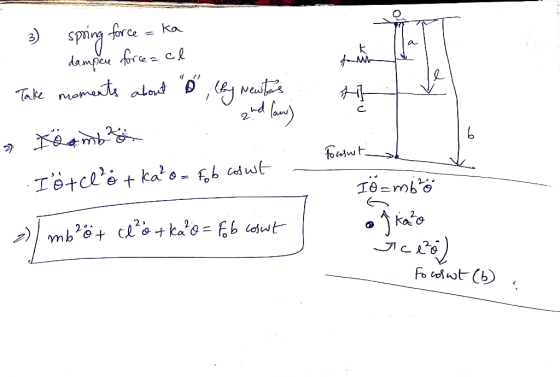
3. The rigid uniform pendulum of mass m is initially at rest at 0 0. Using Newton's 2nd law, derive the equation of...
A compound pendulum is made up of a rod of length L, with mass M and...
 A compound pendulum is made up of a rod of length L, with mass M and a solid sphere of radius r, with mass m (see figure below). The pendulum is pivoted about one end and released from rest from and angle of 0, (angle with the vertical). (a) Find the distance, dom, of center of mass of this pendulum from its pivot. (b) Draw a free body diagram and write down Newton's 2nd Law (for rotation) for the pendulum...
Applying Newton's 2nd law, Fnet=ma, then to this system, along the direction of motion (parallel...
 Applying Newton's 2nd law,
Fnet=ma, then to this system, along the direction of motion
(parallel to the swinging bob), we find
−mgsinθ=ma. (Note, the negative sign is required since the
acceleration in our picture, which is to the right at this moment,
is opposite to the angular displacement from the vertical, which is
to the left.)
This equation is extremely difficult to solve, so let us
simplify it by assuming that the pendulum's swings only through a
very small angle,...
Applying Newton's 2nd law,
Fnet=ma, then to this system, along the direction of motion
(parallel to the swinging bob), we find
−mgsinθ=ma. (Note, the negative sign is required since the
acceleration in our picture, which is to the right at this moment,
is opposite to the angular displacement from the vertical, which is
to the left.)
This equation is extremely difficult to solve, so let us
simplify it by assuming that the pendulum's swings only through a
very small angle,...
this picture shows the question and ask to derive differential equation based on the law QUESTION...
 this picture shows the question and ask to derive differential
equation based on the law
QUESTION 1 a) Consider a flexible spring is suspended vertically from a rigid support and a mass m is attached to its free end. s and x are the amount of elongation and displacement respectively. The two parameters involved are constant of proportionality, k and acceleration of gravity, g. Derive the differential equation of free undamped motion using the appropriate physical laws. {Hint: Hooke's law...
this picture shows the question and ask to derive differential
equation based on the law
QUESTION 1 a) Consider a flexible spring is suspended vertically from a rigid support and a mass m is attached to its free end. s and x are the amount of elongation and displacement respectively. The two parameters involved are constant of proportionality, k and acceleration of gravity, g. Derive the differential equation of free undamped motion using the appropriate physical laws. {Hint: Hooke's law...
Problen /) Derive equations of motion of the system shown below in x and 0 by using Lagrange's method. The thin rigid rod of length is supported as a pendulum at end A, and has a mass m. The rod...
 Problen /) Derive equations of motion of the system shown below in x and 0 by using Lagrange's method. The thin rigid rod of length is supported as a pendulum at end A, and has a mass m. The rod is also pinned to a roller and held in place by two elastic springs with constants k .
Problen /) Derive equations of motion of the system shown below in x and 0 by using Lagrange's method. The thin rigid...
Problen /) Derive equations of motion of the system shown below in x and 0 by using Lagrange's method. The thin rigid rod of length is supported as a pendulum at end A, and has a mass m. The rod is also pinned to a roller and held in place by two elastic springs with constants k .
Problen /) Derive equations of motion of the system shown below in x and 0 by using Lagrange's method. The thin rigid...
Q3. For the rotational system subjected to an applied torque Mocosout shown in Figure 3, the...
 Q3. For the rotational system subjected to an applied torque Mocosout shown in Figure 3, the rotary inertia of the rigid bar about the hinge O can be calculated by Jo =7ml /48. Given k = 5,000N/m, 1 - 1m, m = 20 kg, Mo = 100 Nm, c = 130 rpm. Assume rotation angle is very small, (i) Draw the free body diagram; (ii) Use Newton's 2nd law to derive the equation of motion of the system; and (iii)...
1) Consider a pendulum of constant length L to which a bob of mass m is attached. The Q6. pendulum moves only in a two-dimensional plane (see figure below). The polar frame of reference attached to t...
 1) Consider a pendulum of constant length L to which a bob of mass m is attached. The Q6. pendulum moves only in a two-dimensional plane (see figure below). The polar frame of reference attached to the bob is defined by er,ce where er is the unit vector orientecd away from the origin and e completes the direct orthonormal basis. The pendulum makes an angle 0(t) between the radial direction and the vertical direction e(t) The position vector beinge ind...
#2. [Swinging Disk] A uniform circular disk of mass M and radius R is set swinging...
 #2. [Swinging Disk] A uniform circular disk of mass M and radius R is set swinging side-to-side about a frictionless pivot P at its edge (a) What is the disk's moment of inertia about the pivot? (b) Write an expression for the net torque acting on the disk about the pivot when the disk is displaced to the right by angle θ CM (c) Write Newton's 2nd Law for Rotation for the disk when it is displaced as shown. Be...
Xosin(ot) Shown in the figure below is a rigid pendulum bar of I= 1 m and...
 Xosin(ot) Shown in the figure below is a rigid pendulum bar of I= 1 m and mass m, 1 kg attached to a roller, of mass m, = 0.2 kg, whose motion is described by X, sin(@t), Xo = 1 [m]. Model the pendulum bar as a uniform slender rod which has a moment of inertia with respect to its mass centre Ig given by m1/12. Use tangential-normal coordinate system to analyze the dynamics of the pendulum bar and use...
An object of mass m is connected to a light spring with a force constant of...
An object of mass m is connected to a light spring with a force constant of kH N/meter which oscillates on a frictionless horizontal surface with Simple Harmonic Motion. At t = 0 the spring was at rest but is compressed x = A meter maximum during oscillation. Write the equation of motion from Newton's 2nd law FH = m·a and Hook's Law FH = -kH·x. Because of the starting position assume a solution is x = A sin(ωt) a...
Problem 36 bclow presents a model describing the drag of a fluid medium that is released from rest at time t 0 (same in...
 Problem 36 bclow presents a model describing the drag of a fluid medium that is released from rest at time t 0 (same initial conditions). Using Newton's Second Law, you build a model of the form particle moving through a (governing equation (initial velocity) mi mg-F drag '0 (0)(0)a (t) is the particle's position, m is the mass of the particle, g is the acceleration due to gravity, and Fa is the magnitude of the drag force. You account for...
 A compound pendulum is made up of a rod of length L, with mass M and a solid sphere of radius r, with mass m (see figure below). The pendulum is pivoted about one end and released from rest from and angle of 0, (angle with the vertical). (a) Find the distance, dom, of center of mass of this pendulum from its pivot. (b) Draw a free body diagram and write down Newton's 2nd Law (for rotation) for the pendulum...
 Applying Newton's 2nd law,
Fnet=ma, then to this system, along the direction of motion
(parallel to the swinging bob), we find
−mgsinθ=ma. (Note, the negative sign is required since the
acceleration in our picture, which is to the right at this moment,
is opposite to the angular displacement from the vertical, which is
to the left.)
This equation is extremely difficult to solve, so let us
simplify it by assuming that the pendulum's swings only through a
very small angle,...
Applying Newton's 2nd law,
Fnet=ma, then to this system, along the direction of motion
(parallel to the swinging bob), we find
−mgsinθ=ma. (Note, the negative sign is required since the
acceleration in our picture, which is to the right at this moment,
is opposite to the angular displacement from the vertical, which is
to the left.)
This equation is extremely difficult to solve, so let us
simplify it by assuming that the pendulum's swings only through a
very small angle,...
 this picture shows the question and ask to derive differential
equation based on the law
QUESTION 1 a) Consider a flexible spring is suspended vertically from a rigid support and a mass m is attached to its free end. s and x are the amount of elongation and displacement respectively. The two parameters involved are constant of proportionality, k and acceleration of gravity, g. Derive the differential equation of free undamped motion using the appropriate physical laws. {Hint: Hooke's law...
this picture shows the question and ask to derive differential
equation based on the law
QUESTION 1 a) Consider a flexible spring is suspended vertically from a rigid support and a mass m is attached to its free end. s and x are the amount of elongation and displacement respectively. The two parameters involved are constant of proportionality, k and acceleration of gravity, g. Derive the differential equation of free undamped motion using the appropriate physical laws. {Hint: Hooke's law...
 Problen /) Derive equations of motion of the system shown below in x and 0 by using Lagrange's method. The thin rigid rod of length is supported as a pendulum at end A, and has a mass m. The rod is also pinned to a roller and held in place by two elastic springs with constants k .
Problen /) Derive equations of motion of the system shown below in x and 0 by using Lagrange's method. The thin rigid...
Problen /) Derive equations of motion of the system shown below in x and 0 by using Lagrange's method. The thin rigid rod of length is supported as a pendulum at end A, and has a mass m. The rod is also pinned to a roller and held in place by two elastic springs with constants k .
Problen /) Derive equations of motion of the system shown below in x and 0 by using Lagrange's method. The thin rigid...
 Q3. For the rotational system subjected to an applied torque Mocosout shown in Figure 3, the rotary inertia of the rigid bar about the hinge O can be calculated by Jo =7ml /48. Given k = 5,000N/m, 1 - 1m, m = 20 kg, Mo = 100 Nm, c = 130 rpm. Assume rotation angle is very small, (i) Draw the free body diagram; (ii) Use Newton's 2nd law to derive the equation of motion of the system; and (iii)...
 1) Consider a pendulum of constant length L to which a bob of mass m is attached. The Q6. pendulum moves only in a two-dimensional plane (see figure below). The polar frame of reference attached to the bob is defined by er,ce where er is the unit vector orientecd away from the origin and e completes the direct orthonormal basis. The pendulum makes an angle 0(t) between the radial direction and the vertical direction e(t) The position vector beinge ind...
 #2. [Swinging Disk] A uniform circular disk of mass M and radius R is set swinging side-to-side about a frictionless pivot P at its edge (a) What is the disk's moment of inertia about the pivot? (b) Write an expression for the net torque acting on the disk about the pivot when the disk is displaced to the right by angle θ CM (c) Write Newton's 2nd Law for Rotation for the disk when it is displaced as shown. Be...
 Xosin(ot) Shown in the figure below is a rigid pendulum bar of I= 1 m and mass m, 1 kg attached to a roller, of mass m, = 0.2 kg, whose motion is described by X, sin(@t), Xo = 1 [m]. Model the pendulum bar as a uniform slender rod which has a moment of inertia with respect to its mass centre Ig given by m1/12. Use tangential-normal coordinate system to analyze the dynamics of the pendulum bar and use...
 Problem 36 bclow presents a model describing the drag of a fluid medium that is released from rest at time t 0 (same initial conditions). Using Newton's Second Law, you build a model of the form particle moving through a (governing equation (initial velocity) mi mg-F drag '0 (0)(0)a (t) is the particle's position, m is the mass of the particle, g is the acceleration due to gravity, and Fa is the magnitude of the drag force. You account for...
Most questions answered within 3 hours.
-
Where is the error in this code sequence?
String s1 = "Hello";
String s2 = "ello";...
asked 11 months ago -
Financial data for Joel de Paris, Inc., for last year
follow:
Joel de Paris, Inc.
Balance...
asked 11 months ago -
Consider this reaction:
Al2(SO4)3 (aq)+ BaCl3
(aq) Al2Cl6 (aq)- +
3BaSO4(s) . What is the...
asked 11 months ago -
Suppose that Savneet is considering increasing her
recent random sample from 20 car rentals to 40...
asked 11 months ago -
Trucks arrive at an unloading terminal at an average rate of 120
per hour.
Trucks arrive...
asked 11 months ago -
Why are methanol and ethanol completely soluble in water while
octanol is not very little soluble....
asked 11 months ago -
A facilities manager at a university reads in a research report
that the mean amount of...
asked 11 months ago -
When the CuSO4 is rehydrated by adding water to the anhydrous
compound, is this an endothermic...
asked 11 months ago -
A ray of sunlight is passing from diamond into crown glass; the
angle of incidence is...
asked 11 months ago -
A block of mass 0.249 kg is placed on top of a light, vertical
spring of...
asked 11 months ago -
how do the kidneys compensate in the presences of acidosis
a) trigger hyperventilate
b) reserve acid...
asked 11 months ago -
Question 501 pts
The rental rate of capital to the firm increases. Which of the
following...
asked 11 months ago