
Homework Answers
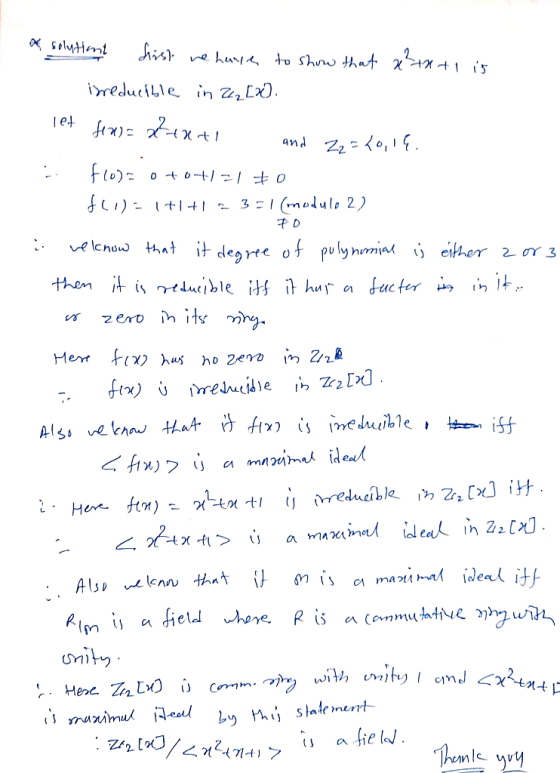
Here I'm using theorems .
1.Degree of polynomial is either 2 or 3 the it is reducible iff it has a factor or zero in ring.
2.if f(x) is irreducible polynomial iff (f(x)) is a maximal ideal.
3. In a commutative ring R with unity 1 M is a maximal ideal iff R/M is a field. To show that given example. Answer is below thank you.
Add Answer to:
prove. please write it i can recognize. is ueducile in Z (rxe) maximal idea fn Z is a is a field (with 2 elaments)...
prove that the only idea Paragraph Prove that the only ideals of a field F are...
 prove that the only idea
Paragraph Prove that the only ideals of a field F are {0} and F itself. Please write clearly and include any theorems or definitions used and don't skip steps please.
prove that the only idea
Paragraph Prove that the only ideals of a field F are {0} and F itself. Please write clearly and include any theorems or definitions used and don't skip steps please.
(3) Prove that the sequence fn (x(max10,z - n))2 does not converge uniformly on IR, but converges...
 (3) Prove that the sequence fn (x(max10,z - n))2 does not converge uniformly on IR, but converges uniformly on compact subsets of R
(3) Prove that the sequence fn (x(max10,z - n))2 does not converge uniformly on IR, but converges uniformly on compact subsets of R
(3) Prove that the sequence fn (x(max10,z - n))2 does not converge uniformly on IR, but converges uniformly on compact subsets of R
Prove procedure to compute Fibinocci(n) where F0 = 0, F1 = 1, Fn = Fn-2 +...
Prove procedure to compute Fibinocci(n) where F0 = 0, F1 = 1, Fn = Fn-2 + Fn-1. Prove by establishing and proving loop invariant then using induction to prove soundness and termination. 1: Procedure Fib(n) 2: i←0,j←1,k←1,m←n 3: while m ≥ 3 do 4: m←m−3 5: i←j+k 6: j←i+k 7: k←i+j 8: if m = 0 then 9: return i 10: else if m = 1 then 11: return j 12: else 13. return k
Prove procedure to compute Fibinocci(n) where F0 = 0, F1 = 1, Fn = Fn-2 +...
Prove procedure to compute Fibinocci(n) where F0 = 0, F1 = 1, Fn = Fn-2 + Fn-1. Prove by establishing and proving loop invariant then using induction to prove soundness and termination. 1: Procedure Fib(n) 2: i←0,j←1,k←1,m←n 3: while m ≥ 3 do 4: m←m−3 5: i←j+k 6: j←i+k 7: k←i+j 8: if m = 0 then 9: return i 10: else if m = 1 then 11: return j 12: else 13. return k
need help with discrete math HW, please try write clearly and i will give a thumb up thanks!! (i) Prove that every comp...
 need help with discrete math HW, please try write clearly and i
will give a thumb up thanks!!
(i) Prove that every complete lattice has a unique maximal element. (ii) Give an example of an infinite chain complete poset with no unique maximal 1 element (iii) Prove that any closed interval on R ([a, b) with the usual order (<) is a complete lattice (you may assume the properties of R that you assume in Calculus class) (iv) Say that...
need help with discrete math HW, please try write clearly and i
will give a thumb up thanks!!
(i) Prove that every complete lattice has a unique maximal element. (ii) Give an example of an infinite chain complete poset with no unique maximal 1 element (iii) Prove that any closed interval on R ([a, b) with the usual order (<) is a complete lattice (you may assume the properties of R that you assume in Calculus class) (iv) Say that...
Please Solove only (a)and (b) Please, Write so that I can recognize 4.20 Consider the system...
 Please Solove only (a)and (b)
Please, Write so that I can recognize
4.20 Consider the system depicted in Fig. P4.20(a). The of the input signal is depicted in Fig. P4.20(b). I FT FT z(t) Z(jw) and y(t) Z(ja) and Y(jo) for the following cases: -» Y(j»). Sket (a) w(t) cos(5 mt) and h(t) sin 6 (b) w(t) cos(5mt) and h(t) sin 5 (c) w(t) depicted in Fig. P4.20(c) and h(t) sin2r cos (5 rt X(jw) z(t) x)X hit) w(t) cos...
Please Solove only (a)and (b)
Please, Write so that I can recognize
4.20 Consider the system depicted in Fig. P4.20(a). The of the input signal is depicted in Fig. P4.20(b). I FT FT z(t) Z(jw) and y(t) Z(ja) and Y(jo) for the following cases: -» Y(j»). Sket (a) w(t) cos(5 mt) and h(t) sin 6 (b) w(t) cos(5mt) and h(t) sin 5 (c) w(t) depicted in Fig. P4.20(c) and h(t) sin2r cos (5 rt X(jw) z(t) x)X hit) w(t) cos...
Please use strong introduction to prove it :) Prove each of the following statements using strong...
 Please use strong introduction
to prove it :)
Prove each of the following statements using strong induction. (a) The Fibonacci sequence is defined as follows: · fo=0 . fn = fn-1+fn-2. for n 2 Prove that for n z 0, 1-V5 TL
Please use strong introduction
to prove it :)
Prove each of the following statements using strong induction. (a) The Fibonacci sequence is defined as follows: · fo=0 . fn = fn-1+fn-2. for n 2 Prove that for n z 0, 1-V5 TL
Log(2 - 2) Consider the function f(x, y,z) (a) What is the maximal domain off? (Write your answer...
 log(2 - 2) Consider the function f(x, y,z) (a) What is the maximal domain off? (Write your answer in set notation.) Find ▽f. (b) Find the tangent hyperplanes Ta2.1,f(r, y, 2) and To-ef(r, y, 2). Find the intersection (c) On (z, y, z)-axes, draw arrows representing the vector field F = Vf at the points (1,0,1), (d) Find the level set of f which has value ("height") wo 0, and describe it in words and of these two hyperplanes, and...
Consider the ring Z[i] = {a + bil ab € Z} where i is the imaginary...
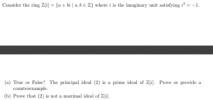 Consider the ring Z[i] = {a + bil ab € Z} where i is the imaginary unit satisfying 12 = -1. (a) True or False? The principal ideal (2) is a prime ideal of Z[i). Prove or provide a counterexample. (b) Prove that (2) is not a maximal ideal of Z[i].
6. Let f(2) be an entire function such that (1 +lzl) fm (z) is bounded for some k and m. Prove that fn) (2) is identically zero for sufficiently large n. How large must n be in terms of k and m?...
 6. Let f(2) be an entire function such that (1 +lzl) fm (z) is bounded for some k and m. Prove that fn) (2) is identically zero for sufficiently large n. How large must n be in terms of k and m?
6. Let f(2) be an entire function such that (1 +lzl) fm (z) is bounded for some k and m. Prove that fn) (2) is identically zero for sufficiently large n. How large must n be in terms...
6. Let f(2) be an entire function such that (1 +lzl) fm (z) is bounded for some k and m. Prove that fn) (2) is identically zero for sufficiently large n. How large must n be in terms of k and m?
6. Let f(2) be an entire function such that (1 +lzl) fm (z) is bounded for some k and m. Prove that fn) (2) is identically zero for sufficiently large n. How large must n be in terms...
 prove that the only idea
Paragraph Prove that the only ideals of a field F are {0} and F itself. Please write clearly and include any theorems or definitions used and don't skip steps please.
prove that the only idea
Paragraph Prove that the only ideals of a field F are {0} and F itself. Please write clearly and include any theorems or definitions used and don't skip steps please.
 (3) Prove that the sequence fn (x(max10,z - n))2 does not converge uniformly on IR, but converges uniformly on compact subsets of R
(3) Prove that the sequence fn (x(max10,z - n))2 does not converge uniformly on IR, but converges uniformly on compact subsets of R
(3) Prove that the sequence fn (x(max10,z - n))2 does not converge uniformly on IR, but converges uniformly on compact subsets of R
 need help with discrete math HW, please try write clearly and i
will give a thumb up thanks!!
(i) Prove that every complete lattice has a unique maximal element. (ii) Give an example of an infinite chain complete poset with no unique maximal 1 element (iii) Prove that any closed interval on R ([a, b) with the usual order (<) is a complete lattice (you may assume the properties of R that you assume in Calculus class) (iv) Say that...
need help with discrete math HW, please try write clearly and i
will give a thumb up thanks!!
(i) Prove that every complete lattice has a unique maximal element. (ii) Give an example of an infinite chain complete poset with no unique maximal 1 element (iii) Prove that any closed interval on R ([a, b) with the usual order (<) is a complete lattice (you may assume the properties of R that you assume in Calculus class) (iv) Say that...
 Please Solove only (a)and (b)
Please, Write so that I can recognize
4.20 Consider the system depicted in Fig. P4.20(a). The of the input signal is depicted in Fig. P4.20(b). I FT FT z(t) Z(jw) and y(t) Z(ja) and Y(jo) for the following cases: -» Y(j»). Sket (a) w(t) cos(5 mt) and h(t) sin 6 (b) w(t) cos(5mt) and h(t) sin 5 (c) w(t) depicted in Fig. P4.20(c) and h(t) sin2r cos (5 rt X(jw) z(t) x)X hit) w(t) cos...
Please Solove only (a)and (b)
Please, Write so that I can recognize
4.20 Consider the system depicted in Fig. P4.20(a). The of the input signal is depicted in Fig. P4.20(b). I FT FT z(t) Z(jw) and y(t) Z(ja) and Y(jo) for the following cases: -» Y(j»). Sket (a) w(t) cos(5 mt) and h(t) sin 6 (b) w(t) cos(5mt) and h(t) sin 5 (c) w(t) depicted in Fig. P4.20(c) and h(t) sin2r cos (5 rt X(jw) z(t) x)X hit) w(t) cos...
 Please use strong introduction
to prove it :)
Prove each of the following statements using strong induction. (a) The Fibonacci sequence is defined as follows: · fo=0 . fn = fn-1+fn-2. for n 2 Prove that for n z 0, 1-V5 TL
Please use strong introduction
to prove it :)
Prove each of the following statements using strong induction. (a) The Fibonacci sequence is defined as follows: · fo=0 . fn = fn-1+fn-2. for n 2 Prove that for n z 0, 1-V5 TL
 log(2 - 2) Consider the function f(x, y,z) (a) What is the maximal domain off? (Write your answer in set notation.) Find ▽f. (b) Find the tangent hyperplanes Ta2.1,f(r, y, 2) and To-ef(r, y, 2). Find the intersection (c) On (z, y, z)-axes, draw arrows representing the vector field F = Vf at the points (1,0,1), (d) Find the level set of f which has value ("height") wo 0, and describe it in words and of these two hyperplanes, and...
 Consider the ring Z[i] = {a + bil ab € Z} where i is the imaginary unit satisfying 12 = -1. (a) True or False? The principal ideal (2) is a prime ideal of Z[i). Prove or provide a counterexample. (b) Prove that (2) is not a maximal ideal of Z[i].
 6. Let f(2) be an entire function such that (1 +lzl) fm (z) is bounded for some k and m. Prove that fn) (2) is identically zero for sufficiently large n. How large must n be in terms of k and m?
6. Let f(2) be an entire function such that (1 +lzl) fm (z) is bounded for some k and m. Prove that fn) (2) is identically zero for sufficiently large n. How large must n be in terms...
6. Let f(2) be an entire function such that (1 +lzl) fm (z) is bounded for some k and m. Prove that fn) (2) is identically zero for sufficiently large n. How large must n be in terms of k and m?
6. Let f(2) be an entire function such that (1 +lzl) fm (z) is bounded for some k and m. Prove that fn) (2) is identically zero for sufficiently large n. How large must n be in terms...
Most questions answered within 3 hours.
-
Where is the error in this code sequence?
String s1 = "Hello";
String s2 = "ello";...
asked 10 months ago -
Financial data for Joel de Paris, Inc., for last year
follow:
Joel de Paris, Inc.
Balance...
asked 10 months ago -
Consider this reaction:
Al2(SO4)3 (aq)+ BaCl3
(aq) Al2Cl6 (aq)- +
3BaSO4(s) . What is the...
asked 10 months ago -
Suppose that Savneet is considering increasing her
recent random sample from 20 car rentals to 40...
asked 10 months ago -
Trucks arrive at an unloading terminal at an average rate of 120
per hour.
Trucks arrive...
asked 10 months ago -
Why are methanol and ethanol completely soluble in water while
octanol is not very little soluble....
asked 10 months ago -
A facilities manager at a university reads in a research report
that the mean amount of...
asked 10 months ago -
When the CuSO4 is rehydrated by adding water to the anhydrous
compound, is this an endothermic...
asked 10 months ago -
A ray of sunlight is passing from diamond into crown glass; the
angle of incidence is...
asked 10 months ago -
A block of mass 0.249 kg is placed on top of a light, vertical
spring of...
asked 10 months ago -
how do the kidneys compensate in the presences of acidosis
a) trigger hyperventilate
b) reserve acid...
asked 10 months ago -
Question 501 pts
The rental rate of capital to the firm increases. Which of the
following...
asked 10 months ago