
Homework Answers


Add Answer to:
5. (20 pts) Consider the following reaction OF2(g) + H2O(g) ---> 2 HF(g) + O2(g) AH.(kJ/mole)=-318 kJ/mole (a) U...
5. (20 pts) Consider the following reaction OF2(g) + H2O(g) ---> 2 HF(g) + O2(g) AH.(kJ/mole) -318 kJ/mole (a) U...
 5. (20 pts) Consider the following reaction OF2(g) + H2O(g) ---> 2 HF(g) + O2(g) AH.(kJ/mole) -318 kJ/mole (a) Using this information along with data in the appendix of your textbook, calculate AH;(OF,(8)) in kJ/mole at 25°C. (b) If 15.0 g of OF2(g) and 10.0 g of H2Og) react, how much heat, expressed in kJ is released? Hint: First calculate the limiting reagent. 6.(20 pts) Consider two Styrofoam coffee cups. If cup #1 contains 102.0 mL of water at 81.8°C...
 ...
Consider the following reaction OF2(g) + H2O(g) --- > 2 HF(g) + O2(g) ∆Hºrxn(kJ/mole)= -318 kJ/mole Using this information along with data in the appendix of your textbook, calculate ∆Hºf(OF2(g)) in kJ/mole at 25oC. (b) If 15.0 g of OF2(g) and 10.0 g of H2Og) react, how much heat, expressed in kJ is released? Hint: First calculate the limiting reagent.
5. (20 pts) Consider the following reaction OF:(g)+ H20(g) (a) Using this information along with data...
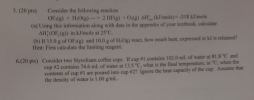 5. (20 pts) Consider the following reaction OF:(g)+ H20(g) (a) Using this information along with data in the appendix of your textbook, calculate AH(OF, (g)) in kJ/mole at 25 C. (b) If 15.0 g of OF (g) and 10.0 g of H2Og) react, how much heat, expressed in kJ is released? Hint: First calculate the limiting reagent. 2 HF(g) + O(g) AH (kJ/mole)--318 kJ/mole Consider two Styrofoam coffee cups. If cup # 1 contains 102.0 mL of water at 81.8...
Information from the appendix is attached: 5. (20 pts) Consider the following reaction OF2(g) + H2O(g)...
 Information from the appendix is attached:
5. (20 pts) Consider the following reaction OF2(g) + H2O(g) ---> 2 HF(g) + O2(g) AH (kJ/mole) = -318 kJ/mole (a) Using this information along with data in the appendix of your textbook, calculate AH (OF, (g)) in kJ/mole at 25°C. (b) If 15.0 g of OF2(g) and 10.0 g of H2Og) react, how much heat, expressed in kJ is released? Hint: First calculate the limiting reagent. 6.(20 pts) Consider two Styrofoam coffee cups....
Information from the appendix is attached:
5. (20 pts) Consider the following reaction OF2(g) + H2O(g) ---> 2 HF(g) + O2(g) AH (kJ/mole) = -318 kJ/mole (a) Using this information along with data in the appendix of your textbook, calculate AH (OF, (g)) in kJ/mole at 25°C. (b) If 15.0 g of OF2(g) and 10.0 g of H2Og) react, how much heat, expressed in kJ is released? Hint: First calculate the limiting reagent. 6.(20 pts) Consider two Styrofoam coffee cups....
The enthalpy change for the following reaction is -318 kJ. OF2(g) + H2O(g) --> O2(g) + 2HF(g) a) To analyze the react...
The enthalpy change for the following reaction is -318 kJ. OF2(g) + H2O(g) --> O2(g) + 2HF(g) a) To analyze the reaction, first draw Lewis structures for all reactant and product molecules. b) Estimate the O-F bond energy in OF2(g) , using tabulated bond energies (linked above) for the remaining bonds. Bond data for question two can be found in a references chart by googling bond energy (will not allow photo upload) H - O = 463kJ O=O = 498kJ...
#4.(25pts) Consider the reaction AH (kJ/mole) 5 CO2(g) + SizN() ----> 3 SiO(g) + 2 N2O(s)...
 #4.(25pts) Consider the reaction AH (kJ/mole) 5 CO2(g) + SizN() ----> 3 SiO(g) + 2 N2O(s) + 5 CO(g) AH = 2023.75 kJ/mole (1) Use the above information as well as heat of formation data in the appendix of your textbook to calculate AH (Si,N.(s)) in kJ/mole. Additional information: AH (SiO(g)) = 1.94 x 10⁹ kJ/mole 6) How many kJ of heat are absorbed when 1.2 lbs of Si N.(s) react according to the above equation? 1 lb = 453.6...
Given that H2(g) + F,() 2 HF(g) AH = -546.6 kJ 2 H,() + O2(g) →...
 Given that H2(g) + F,() 2 HF(g) AH = -546.6 kJ 2 H,() + O2(g) → 2H,O(1) AH x = -571.6 kJ calculate the value of AHixn for 2F2(g) + 2 H2O(1) 4 HF(g) + O2(8) AH = KJ
UIVLII Lidl H, (g)+F2(g) → 2 HF(g) 2 H2(g) + O2(g) — 2 H2O(1) AH;xn = -546.6 kJ AHixn = -571.6 kJ calculate the value o...
 UIVLII Lidl H, (g)+F2(g) → 2 HF(g) 2 H2(g) + O2(g) — 2 H2O(1) AH;xn = -546.6 kJ AHixn = -571.6 kJ calculate the value of AHixn for 2F2(g) + 2 H2O(l) — 4 HF(g) + O2(8)
4. (14 pts) Calculate AHr (kJ/mole) for the reaction CaHlg)+ 6 F2(g) >2 CFg) + 4...
 4. (14 pts) Calculate AHr (kJ/mole) for the reaction CaHlg)+ 6 F2(g) >2 CFg) + 4 HF(g) AH (kJ/mole) ? Using only the following data AH (kJ/mole) H2(g)+ F2(g) C(s) + 2 F2(g) 2 C(s)+ 2 H2(g) 2 HF(g) -537.0 -680,0 CF4(g) C2H4(g) + 52.3
Given that H2(g) + F2(g) → 2 HF(g) AH;xn = -546.6 kJ 2 H2(g) + O2(g)...
 Given that H2(g) + F2(g) → 2 HF(g) AH;xn = -546.6 kJ 2 H2(g) + O2(g) + 2H,0(1) AH;x= -571.6 kJ calculate the value of AHEX for 2F2(g) + 2 H20(1) + 4HF(g) + O2(8) AH
 5. (20 pts) Consider the following reaction OF2(g) + H2O(g) ---> 2 HF(g) + O2(g) AH.(kJ/mole) -318 kJ/mole (a) Using this information along with data in the appendix of your textbook, calculate AH;(OF,(8)) in kJ/mole at 25°C. (b) If 15.0 g of OF2(g) and 10.0 g of H2Og) react, how much heat, expressed in kJ is released? Hint: First calculate the limiting reagent. 6.(20 pts) Consider two Styrofoam coffee cups. If cup #1 contains 102.0 mL of water at 81.8°C...
 5. (20 pts) Consider the following reaction OF:(g)+ H20(g) (a) Using this information along with data in the appendix of your textbook, calculate AH(OF, (g)) in kJ/mole at 25 C. (b) If 15.0 g of OF (g) and 10.0 g of H2Og) react, how much heat, expressed in kJ is released? Hint: First calculate the limiting reagent. 2 HF(g) + O(g) AH (kJ/mole)--318 kJ/mole Consider two Styrofoam coffee cups. If cup # 1 contains 102.0 mL of water at 81.8...
 Information from the appendix is attached:
5. (20 pts) Consider the following reaction OF2(g) + H2O(g) ---> 2 HF(g) + O2(g) AH (kJ/mole) = -318 kJ/mole (a) Using this information along with data in the appendix of your textbook, calculate AH (OF, (g)) in kJ/mole at 25°C. (b) If 15.0 g of OF2(g) and 10.0 g of H2Og) react, how much heat, expressed in kJ is released? Hint: First calculate the limiting reagent. 6.(20 pts) Consider two Styrofoam coffee cups....
Information from the appendix is attached:
5. (20 pts) Consider the following reaction OF2(g) + H2O(g) ---> 2 HF(g) + O2(g) AH (kJ/mole) = -318 kJ/mole (a) Using this information along with data in the appendix of your textbook, calculate AH (OF, (g)) in kJ/mole at 25°C. (b) If 15.0 g of OF2(g) and 10.0 g of H2Og) react, how much heat, expressed in kJ is released? Hint: First calculate the limiting reagent. 6.(20 pts) Consider two Styrofoam coffee cups....
 #4.(25pts) Consider the reaction AH (kJ/mole) 5 CO2(g) + SizN() ----> 3 SiO(g) + 2 N2O(s) + 5 CO(g) AH = 2023.75 kJ/mole (1) Use the above information as well as heat of formation data in the appendix of your textbook to calculate AH (Si,N.(s)) in kJ/mole. Additional information: AH (SiO(g)) = 1.94 x 10⁹ kJ/mole 6) How many kJ of heat are absorbed when 1.2 lbs of Si N.(s) react according to the above equation? 1 lb = 453.6...
 Given that H2(g) + F,() 2 HF(g) AH = -546.6 kJ 2 H,() + O2(g) → 2H,O(1) AH x = -571.6 kJ calculate the value of AHixn for 2F2(g) + 2 H2O(1) 4 HF(g) + O2(8) AH = KJ
 UIVLII Lidl H, (g)+F2(g) → 2 HF(g) 2 H2(g) + O2(g) — 2 H2O(1) AH;xn = -546.6 kJ AHixn = -571.6 kJ calculate the value of AHixn for 2F2(g) + 2 H2O(l) — 4 HF(g) + O2(8)
 4. (14 pts) Calculate AHr (kJ/mole) for the reaction CaHlg)+ 6 F2(g) >2 CFg) + 4 HF(g) AH (kJ/mole) ? Using only the following data AH (kJ/mole) H2(g)+ F2(g) C(s) + 2 F2(g) 2 C(s)+ 2 H2(g) 2 HF(g) -537.0 -680,0 CF4(g) C2H4(g) + 52.3
 Given that H2(g) + F2(g) → 2 HF(g) AH;xn = -546.6 kJ 2 H2(g) + O2(g) + 2H,0(1) AH;x= -571.6 kJ calculate the value of AHEX for 2F2(g) + 2 H20(1) + 4HF(g) + O2(8) AH
Most questions answered within 3 hours.
-
Where is the error in this code sequence?
String s1 = "Hello";
String s2 = "ello";...
asked 10 months ago -
Financial data for Joel de Paris, Inc., for last year
follow:
Joel de Paris, Inc.
Balance...
asked 10 months ago -
Consider this reaction:
Al2(SO4)3 (aq)+ BaCl3
(aq) Al2Cl6 (aq)- +
3BaSO4(s) . What is the...
asked 10 months ago -
Suppose that Savneet is considering increasing her
recent random sample from 20 car rentals to 40...
asked 11 months ago -
Trucks arrive at an unloading terminal at an average rate of 120
per hour.
Trucks arrive...
asked 11 months ago -
Why are methanol and ethanol completely soluble in water while
octanol is not very little soluble....
asked 11 months ago -
A facilities manager at a university reads in a research report
that the mean amount of...
asked 11 months ago -
When the CuSO4 is rehydrated by adding water to the anhydrous
compound, is this an endothermic...
asked 11 months ago -
A ray of sunlight is passing from diamond into crown glass; the
angle of incidence is...
asked 11 months ago -
A block of mass 0.249 kg is placed on top of a light, vertical
spring of...
asked 11 months ago -
how do the kidneys compensate in the presences of acidosis
a) trigger hyperventilate
b) reserve acid...
asked 11 months ago -
Question 501 pts
The rental rate of capital to the firm increases. Which of the
following...
asked 11 months ago