

Homework Answers
Add Answer to:
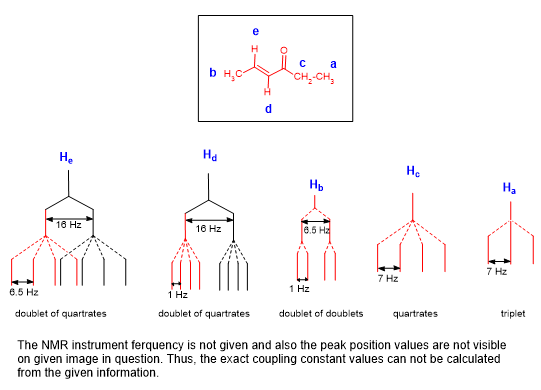
GB-unsaturated ketone is given below (with expansions of each 4.) Proton NMR spectral data for an a.ß-unsaturated...
Q1 The proton NMR spectrum shown in this problem is for Expansions are shown for each...
 Q1 The proton NMR spectrum shown in this problem is for Expansions are shown for each of the five unique types of protons in this compound. Determine the coupling constants. Draw tree diagrams for each of the protons shown in the expansions and label them with the appreciate. MUMU MMMWWW (ppm) (udd) www
1.Identify the compound whose spectral data are shown. 2. Describe the coupling observed and show the...
 1.Identify the compound whose spectral data are shown.
2. Describe the coupling observed and show the splitting diagram
for each hydrogen.
3. Determine the value of each coupling constants.
4. Label and assign each 1 H and 13 C signal to your answer.
100 3 % of Base Peak 90 80 100 120 m/z 5 SA % Transmittance --1689 -3047 --14197 --1273 -957 E9EE- -702 3000 1000 4000 'H NMR 300 MHz 2000 Wavenumber (cm-1) 2720 2700 Hz 2600 2580...
1.Identify the compound whose spectral data are shown.
2. Describe the coupling observed and show the splitting diagram
for each hydrogen.
3. Determine the value of each coupling constants.
4. Label and assign each 1 H and 13 C signal to your answer.
100 3 % of Base Peak 90 80 100 120 m/z 5 SA % Transmittance --1689 -3047 --14197 --1273 -957 E9EE- -702 3000 1000 4000 'H NMR 300 MHz 2000 Wavenumber (cm-1) 2720 2700 Hz 2600 2580...
b) Consider the proton NMR spectrum of the following ketone: O b H C=C C. d...
 b) Consider the proton NMR spectrum of the following ketone: O b H C=C C. d CH H с CH: i) ii) Predict the chemical shifts of each type of proton. Predict the multiplicity of NMR signals for each type of protons. Draw a tree diagram to show the splitting predicted for Hy and indicate the number of lines obtain (given Joc = 15 Hz, Jab = 7 Hz). (7 marks)
Identify each compound in the following questions and make assignments in the 1H NMR a) First...
 Identify each compound in the following questions and make
assignments in the 1H NMR
a) First spectra: Compound 1, 1H NMR given, and has a strong
absorbance in the IR at 1715 cm-1
b) Second spectra: Compound 2, a carboxylic acid of formula
C8H6O3Cl2 with 1H NMR given
c) Third spectra: Compound 3 with molecular formula of
C6H9ClO2, with 1H NMR given (the four signal from highest to lowest
chemical shift are quartet, quartet, double, and triplet)
d) Compound 4,...
Identify each compound in the following questions and make
assignments in the 1H NMR
a) First spectra: Compound 1, 1H NMR given, and has a strong
absorbance in the IR at 1715 cm-1
b) Second spectra: Compound 2, a carboxylic acid of formula
C8H6O3Cl2 with 1H NMR given
c) Third spectra: Compound 3 with molecular formula of
C6H9ClO2, with 1H NMR given (the four signal from highest to lowest
chemical shift are quartet, quartet, double, and triplet)
d) Compound 4,...
3. Find the structure of a compound given the MS, IR, and NMR data below. When...
 3. Find the structure of a compound given the MS, IR, and NMR data below. When you have the solution, use it to determine the correct multiplicity of the signal at 5.1 ppm and explain the coupling pattern. A correct answer with no explanation will receive no credit. MASS 951 FL 100 128 1107 677 r69 r45 50 557 811 130 120 100 110 90 80 70 60 50 mt IR 100 50 2000 Wavenumber (cm-1) 1000 3000 4000 'H...
Draw the structure of the compound C3H4Cl2O from its proton NMR spectrum below. Please explain. Draw...
 Draw the structure of the compound C3H4Cl2O from its proton NMR
spectrum below. Please explain.
Draw the structure of the compound CH CI O from its proton (1) NMR spectrum below. Fust-order spin-spin splitting rules and equal coupling constants can be assumed. (Detailed analysis of any non-first order portions of the spectrum will not be required) Integral ratios to the nearest whole number are left to right) 1:3 Flash Installation and Troubleshooting Used with from At Checa Co Inc (purty...
Draw the structure of the compound C3H4Cl2O from its proton NMR
spectrum below. Please explain.
Draw the structure of the compound CH CI O from its proton (1) NMR spectrum below. Fust-order spin-spin splitting rules and equal coupling constants can be assumed. (Detailed analysis of any non-first order portions of the spectrum will not be required) Integral ratios to the nearest whole number are left to right) 1:3 Flash Installation and Troubleshooting Used with from At Checa Co Inc (purty...
7. Which compound below be H-1 NMR 0.9 ppm (quartet fits the following spectral data? (6...
 7. Which compound below be H-1 NMR 0.9 ppm (quartet fits the following spectral data? (6 points) 1.2 ppm (sextet 2 hydrogens), 2.1 ppm (triplet, hydrogens), 4.3 ppm (singlet 3 hydrogens) C-13 NMR 5 signals 25 ppr ppm (CH2); 61 ppm: (CH3) 198 Ppm (C). IR strong peak 1735 cm Ignals 25 ppm (CH): 35 ppm (CH2), 46 ppm (CH2); 61 ppm: em Mass Spee parent M+ = 102 Mass Spec paren ou 0 H2 CH3 HjC Holo H3C- CC...
NMR Aa7 If you can, please provide the answer in this sheet. Otherwise, do draw the...
 NMR Aa7 If you can, please provide the answer in this sheet. Otherwise, do draw the structure and schematic analysis carefully and clearly, in a plain sheet. DONT USE PENCIL Aal: The full spectrum of an unknown compound is displayed in bottom. The spectrum is also blown up to afford the dose-up of peaks. There are numerical values in red beneath some of peak sets. They are proton integration number. With the detailed spectral information and the molecular structures provided....
I've zoomed in and taken more pictures of the 4 H NMR spectrum. I would appreciate...
 I've zoomed in and taken more pictures of the 4 H NMR
spectrum. I would appreciate any explaination or work. Thank you so
much!!
6. (Bpts) For each example below, draw a structure that is consistent with the formula and 'H NMR spectrum provided. In some cases, additional IR spectral information is provided. Assign each peak to the appropriate hydrogen atoms in the structure by using the labeling convention discussed in class. Ciottie interes 40 - 5.0 S&= 6.2 Adjusted...
I've zoomed in and taken more pictures of the 4 H NMR
spectrum. I would appreciate any explaination or work. Thank you so
much!!
6. (Bpts) For each example below, draw a structure that is consistent with the formula and 'H NMR spectrum provided. In some cases, additional IR spectral information is provided. Assign each peak to the appropriate hydrogen atoms in the structure by using the labeling convention discussed in class. Ciottie interes 40 - 5.0 S&= 6.2 Adjusted...
Use IR, proton NMR and MS data to deduce the correct structure. Draw the structure and...
 Use IR, proton NMR and MS data to deduce the correct structure. Draw the structure and circle it. Indicate on the IR, NMR and MS spectra the information you got from each to deduce the structure. 14, IR Spectrum 4000 3000 2000 V (cm 16001200800 ) Mass Spectrum 121/123 % of base peak M+-- 200202/204 X X or C₂ H₂ Brz 240 280 40 80 120 160 m/e 200 'H NMR Spectrum (400 MHz, CDCI, solution) triplet expansions carbon Carbon...
 Q1 The proton NMR spectrum shown in this problem is for Expansions are shown for each of the five unique types of protons in this compound. Determine the coupling constants. Draw tree diagrams for each of the protons shown in the expansions and label them with the appreciate. MUMU MMMWWW (ppm) (udd) www
 1.Identify the compound whose spectral data are shown.
2. Describe the coupling observed and show the splitting diagram
for each hydrogen.
3. Determine the value of each coupling constants.
4. Label and assign each 1 H and 13 C signal to your answer.
100 3 % of Base Peak 90 80 100 120 m/z 5 SA % Transmittance --1689 -3047 --14197 --1273 -957 E9EE- -702 3000 1000 4000 'H NMR 300 MHz 2000 Wavenumber (cm-1) 2720 2700 Hz 2600 2580...
1.Identify the compound whose spectral data are shown.
2. Describe the coupling observed and show the splitting diagram
for each hydrogen.
3. Determine the value of each coupling constants.
4. Label and assign each 1 H and 13 C signal to your answer.
100 3 % of Base Peak 90 80 100 120 m/z 5 SA % Transmittance --1689 -3047 --14197 --1273 -957 E9EE- -702 3000 1000 4000 'H NMR 300 MHz 2000 Wavenumber (cm-1) 2720 2700 Hz 2600 2580...
 b) Consider the proton NMR spectrum of the following ketone: O b H C=C C. d CH H с CH: i) ii) Predict the chemical shifts of each type of proton. Predict the multiplicity of NMR signals for each type of protons. Draw a tree diagram to show the splitting predicted for Hy and indicate the number of lines obtain (given Joc = 15 Hz, Jab = 7 Hz). (7 marks)
 Identify each compound in the following questions and make
assignments in the 1H NMR
a) First spectra: Compound 1, 1H NMR given, and has a strong
absorbance in the IR at 1715 cm-1
b) Second spectra: Compound 2, a carboxylic acid of formula
C8H6O3Cl2 with 1H NMR given
c) Third spectra: Compound 3 with molecular formula of
C6H9ClO2, with 1H NMR given (the four signal from highest to lowest
chemical shift are quartet, quartet, double, and triplet)
d) Compound 4,...
Identify each compound in the following questions and make
assignments in the 1H NMR
a) First spectra: Compound 1, 1H NMR given, and has a strong
absorbance in the IR at 1715 cm-1
b) Second spectra: Compound 2, a carboxylic acid of formula
C8H6O3Cl2 with 1H NMR given
c) Third spectra: Compound 3 with molecular formula of
C6H9ClO2, with 1H NMR given (the four signal from highest to lowest
chemical shift are quartet, quartet, double, and triplet)
d) Compound 4,...
 3. Find the structure of a compound given the MS, IR, and NMR data below. When you have the solution, use it to determine the correct multiplicity of the signal at 5.1 ppm and explain the coupling pattern. A correct answer with no explanation will receive no credit. MASS 951 FL 100 128 1107 677 r69 r45 50 557 811 130 120 100 110 90 80 70 60 50 mt IR 100 50 2000 Wavenumber (cm-1) 1000 3000 4000 'H...
 Draw the structure of the compound C3H4Cl2O from its proton NMR
spectrum below. Please explain.
Draw the structure of the compound CH CI O from its proton (1) NMR spectrum below. Fust-order spin-spin splitting rules and equal coupling constants can be assumed. (Detailed analysis of any non-first order portions of the spectrum will not be required) Integral ratios to the nearest whole number are left to right) 1:3 Flash Installation and Troubleshooting Used with from At Checa Co Inc (purty...
Draw the structure of the compound C3H4Cl2O from its proton NMR
spectrum below. Please explain.
Draw the structure of the compound CH CI O from its proton (1) NMR spectrum below. Fust-order spin-spin splitting rules and equal coupling constants can be assumed. (Detailed analysis of any non-first order portions of the spectrum will not be required) Integral ratios to the nearest whole number are left to right) 1:3 Flash Installation and Troubleshooting Used with from At Checa Co Inc (purty...
 7. Which compound below be H-1 NMR 0.9 ppm (quartet fits the following spectral data? (6 points) 1.2 ppm (sextet 2 hydrogens), 2.1 ppm (triplet, hydrogens), 4.3 ppm (singlet 3 hydrogens) C-13 NMR 5 signals 25 ppr ppm (CH2); 61 ppm: (CH3) 198 Ppm (C). IR strong peak 1735 cm Ignals 25 ppm (CH): 35 ppm (CH2), 46 ppm (CH2); 61 ppm: em Mass Spee parent M+ = 102 Mass Spec paren ou 0 H2 CH3 HjC Holo H3C- CC...
 NMR Aa7 If you can, please provide the answer in this sheet. Otherwise, do draw the structure and schematic analysis carefully and clearly, in a plain sheet. DONT USE PENCIL Aal: The full spectrum of an unknown compound is displayed in bottom. The spectrum is also blown up to afford the dose-up of peaks. There are numerical values in red beneath some of peak sets. They are proton integration number. With the detailed spectral information and the molecular structures provided....
 I've zoomed in and taken more pictures of the 4 H NMR
spectrum. I would appreciate any explaination or work. Thank you so
much!!
6. (Bpts) For each example below, draw a structure that is consistent with the formula and 'H NMR spectrum provided. In some cases, additional IR spectral information is provided. Assign each peak to the appropriate hydrogen atoms in the structure by using the labeling convention discussed in class. Ciottie interes 40 - 5.0 S&= 6.2 Adjusted...
I've zoomed in and taken more pictures of the 4 H NMR
spectrum. I would appreciate any explaination or work. Thank you so
much!!
6. (Bpts) For each example below, draw a structure that is consistent with the formula and 'H NMR spectrum provided. In some cases, additional IR spectral information is provided. Assign each peak to the appropriate hydrogen atoms in the structure by using the labeling convention discussed in class. Ciottie interes 40 - 5.0 S&= 6.2 Adjusted...
 Use IR, proton NMR and MS data to deduce the correct structure. Draw the structure and circle it. Indicate on the IR, NMR and MS spectra the information you got from each to deduce the structure. 14, IR Spectrum 4000 3000 2000 V (cm 16001200800 ) Mass Spectrum 121/123 % of base peak M+-- 200202/204 X X or C₂ H₂ Brz 240 280 40 80 120 160 m/e 200 'H NMR Spectrum (400 MHz, CDCI, solution) triplet expansions carbon Carbon...
Most questions answered within 3 hours.
-
Where is the error in this code sequence?
String s1 = "Hello";
String s2 = "ello";...
asked 10 months ago -
Financial data for Joel de Paris, Inc., for last year
follow:
Joel de Paris, Inc.
Balance...
asked 10 months ago -
Consider this reaction:
Al2(SO4)3 (aq)+ BaCl3
(aq) Al2Cl6 (aq)- +
3BaSO4(s) . What is the...
asked 10 months ago -
Suppose that Savneet is considering increasing her
recent random sample from 20 car rentals to 40...
asked 10 months ago -
Trucks arrive at an unloading terminal at an average rate of 120
per hour.
Trucks arrive...
asked 10 months ago -
Why are methanol and ethanol completely soluble in water while
octanol is not very little soluble....
asked 10 months ago -
A facilities manager at a university reads in a research report
that the mean amount of...
asked 10 months ago -
When the CuSO4 is rehydrated by adding water to the anhydrous
compound, is this an endothermic...
asked 10 months ago -
A ray of sunlight is passing from diamond into crown glass; the
angle of incidence is...
asked 10 months ago -
A block of mass 0.249 kg is placed on top of a light, vertical
spring of...
asked 10 months ago -
how do the kidneys compensate in the presences of acidosis
a) trigger hyperventilate
b) reserve acid...
asked 10 months ago -
Question 501 pts
The rental rate of capital to the firm increases. Which of the
following...
asked 10 months ago