


Question 5:
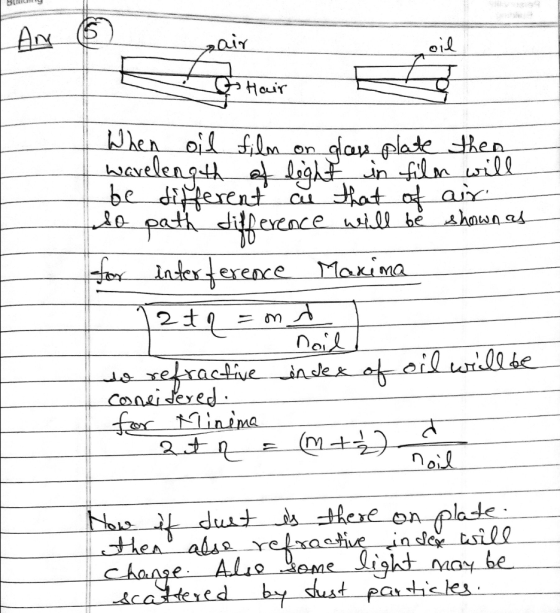
How would dust and oil on the glass plates affect the results?
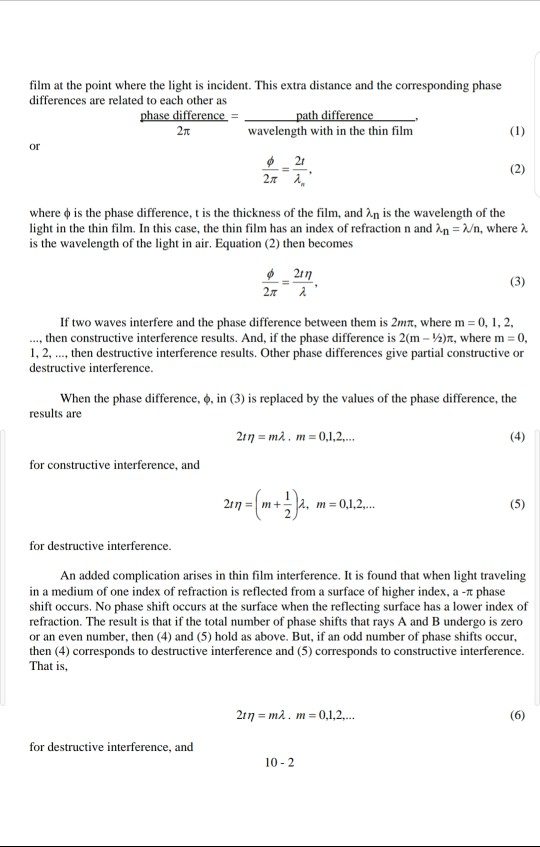
film at the point where the light is incident. This extra distance and the corresponding phase differences are related to each other as path difference wavelength with in the thin film phase difference 2T (1) or 2t (2) where is the phase difference, t is the thickness of the film, and An is the wavelength of the light in the thin film. In this case, the thin film has an index of refraction n and An /n, where is the wavelength of the light in air. Equation (2) then becomes 2n (3) 2T If two waves interfere and the phase difference between them is 2mm, where m 0, 1, 2 , then constructive interference results. And, if the phase difference is 2(m - %)r, where m 0 1,2, then destructive interference results. Other phase differences give partial constructive or destructive interference. When the phase difference, , in (3) is replaced by the values of the phase difference, the results are 2tn m. m= 0,1,2,. (4) for constructive interference, and 2m 2, m 0,1,2.. (5) m+ for destructive interference. An added complication arises in thin film interference. It is found that when light traveling in a medium of one index of refraction is reflected from a surface of higher index, a -r phase shift occurs. No phase shift occurs at the surface when the reflecting surface has a lower index of refraction. The result is that if the total number of phase shifts that rays A and B undergo is zero or an even number, then (4) and (5) hold as above. But, if an odd number of phase shifts occur then (4) corresponds to destructive interference and (5) corresponds to constructive interference. That is 21η- mA. m= 0,1,2 . (6) for destructive interference, and 10-2
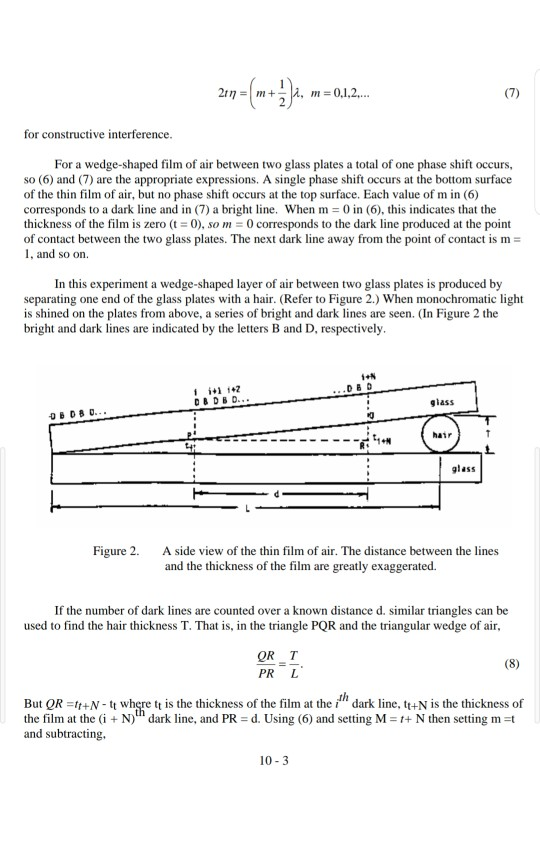
2rm 0,1,2. A. m= (7) m+ for constructive interference. For a wedge-shaped film of air between two glass plates a total of one phase shift occurs, so (6) and (7) are the appropriate expressions. A single phase shift occurs at the bottom surface of the thin film of air, but no phase shift occurs at the top surface. Each value of m in (6) corresponds to a dark line and in (7) a bright line. When m= 0 in (6), this indicates that the thickness of the film is zero (t 0), so m= 0 corresponds to the dark line produced at the point of contact between the two glass plates. The next dark line away from the point of contact is m 1, and so on. In this experiment a wedge-shaped layer of air between two glass plates is produced by separating one end of the glass plates with a hair. (Refer to Figure 2.) When monochromatic light is shined on the plates from above, a series of bright and dark lines are seen. (In Figure 2 the bright and dark lines are indicated by the letters B and D, respectively .DB D CB DB D... giass 0BD8 0... hair glass Figure 2. A side view of the thin film of air. The distance between the lines and the thickness of the film are greatly exaggerated. If the number of dark lines are counted over a known distance d. similar triangles can be used to find the hair thickness T. That is, in the triangle PQR and the triangular wedge of air, QR T (8) PR But QR t+N- where t is the thickness of the film at the " dark line, t+N is the thickness of the film at the (i + N)t" dark line, and PR = d. Using (6) and setting M 1+ N then setting m-t and subtracting. 10-3
h) Use the 10 cm focal length lens as a magnifying glass and count the number of dark lines between the one centimeter marks on the notebook paper. Record the number of lines, N, and the uncertainty in the count, ON Have each person in the group repeat steps (d) and (h) for his or her own data. ANALYSIS The uncertainty in the thickness of the hair due to uncertainties in measurements is =T + + d (11) where the wavelength of the sodium light is assumed to be exactly 589 nm and the index of refraction of air is 1,000. Calculate the thickness of the hair from (10) and its uncertainty from (11). Report these values and the value obtained from the micrometer reading in a table. Also graph these values on a one-dimensional graph QUESTION 1. It is hard to get the bars to be parallel in this experiment. Explain why the bars tend to be wiggly So 2. Explain why it is necessary to use a special sodium vapor lamp for this experiment rather than an ordinary white lamp 3. Explain how the number of bars to be counted would be affected if the lamp were changed to a different source producing red light. Would this make the uncertainty in the experiment smaller or greater? 4. Explain why it is better to place the hair as far as possible from the contact point of the glass plates S 5. How would dust and oil on the glass plates affect the results? 6. What percentage error would result from miscounting the bars by one? 7. How would the data and results of the experiment be affected ff instead of glass we had used a different transparent material for the plates? 10-5
Homework Answers
Here we apply thin film interference concept.
Add Answer to:
Question 5: How would dust and oil on the glass plates affect the results? EXPERIMENT 10 THIN FILM I...
Question 6: What percentage error would result from miscounting the bars by one? EXPERIMENT 10 THIN...
 Question 6:
What percentage error would result from miscounting
the bars by one?
EXPERIMENT 10 THIN FILM INTERFERENCE Light from a monochromatic source is shined downward on two glass plates that are separated at one end by a hair. Light that is reflected from the top and bottom surfaces of the wedge-shaped thin film of air undergoes interference, and a series of dark and light lines are seen. By counting the number of dark or light lines over a known...
Question 6:
What percentage error would result from miscounting
the bars by one?
EXPERIMENT 10 THIN FILM INTERFERENCE Light from a monochromatic source is shined downward on two glass plates that are separated at one end by a hair. Light that is reflected from the top and bottom surfaces of the wedge-shaped thin film of air undergoes interference, and a series of dark and light lines are seen. By counting the number of dark or light lines over a known...
Monochromatic light of wavelength X-89.1um is shone at normal incidence through a thin film of thickness...
 Monochromatic light of wavelength X-89.1um is shone at normal incidence through a thin film of thickness t resting atop a fully reflective surface. The film has an index of refraction of n film 1.5 What is the smallest thickness t (in ?m) the film could have to get constructive interference?
N-1.00 n-1.33 n=1 50 3. A thin film of thickness t and index of refraction 1.33 coats a glass wit...
 I dont understand thin film interference. Thanks in
advance
n-1.00 n-1.33 n=1 50 3. A thin film of thickness t and index of refraction 1.33 coats a glass with index of refraction 1.50 as shown above. Which of the following thicknesses t will not reflect light with wavelength 640 nm in air? (A) 160 nm (8) 240 nm (C) 360 nm (D) 480 nm 4. Lenses in fine quality cameras are coated to reduce the reflection from the lenses. If...
I dont understand thin film interference. Thanks in
advance
n-1.00 n-1.33 n=1 50 3. A thin film of thickness t and index of refraction 1.33 coats a glass with index of refraction 1.50 as shown above. Which of the following thicknesses t will not reflect light with wavelength 640 nm in air? (A) 160 nm (8) 240 nm (C) 360 nm (D) 480 nm 4. Lenses in fine quality cameras are coated to reduce the reflection from the lenses. If...
A thin film, with a thickness of 277.1 nm and with air on both sides, is...
A thin film, with a thickness of 277.1 nm and with air on both sides, is illuminated with a beam of white light. The beam is perpendicular to the film and consists of the full range of wavelengths for the visible spectrum. In the light reflected by the film, light with a wavelength of 632.3 nm undergoes fully constructive interference. At what wavelength does the reflected light undergo fully destructive interference? (Hint: You must make a reasonable assumption about the...
The default setting is a thin film of glass(n = 1.5) with air (n = 1)on...
 The default setting is a thin film of glass(n = 1.5) with air (n
= 1)on both sides.The starting wavelength is 652 nm and the
starting thickness is 544 nm. Use these starting values for this
next set of questions.
1. Is there a phase shift on the front (left) interface? On the
back (right) interface in the simulation?Justify why there is/isn’t
a phase shift at each interface.
2. How does the wavelength in the film (glass) compare to the...
The default setting is a thin film of glass(n = 1.5) with air (n
= 1)on both sides.The starting wavelength is 652 nm and the
starting thickness is 544 nm. Use these starting values for this
next set of questions.
1. Is there a phase shift on the front (left) interface? On the
back (right) interface in the simulation?Justify why there is/isn’t
a phase shift at each interface.
2. How does the wavelength in the film (glass) compare to the...
The surface of a flat piece of glass is covered by a thin plastic that has...
 The surface of a flat piece of glass is covered by a thin plastic that has thickness 180 nm. There is air above the plastic film. The refractive index of the glass is 1.40 and the refractive index of the plastic film is 1.80. Light of wavelength lambda_air in air shines at normal incidence on the plastic film. What is the largest value of lambda_air for which there will be constructive interference between the light reflected at the top and...
The answer is C, but how? Object Lens Point A near f ar a. Between the...
 The answer is C, but how?
Object Lens Point A near f ar a. Between the object and the near focal point. Between the near focal point and point A. c. Between point A and the lens. d. Between lens and the far focal point. rFurther from the lens than the far focal point. 8. Three experiments involving thin soap film (in air) are shown below. Which of these three experiments will produce constructive interference as seen by the observer...
The answer is C, but how?
Object Lens Point A near f ar a. Between the object and the near focal point. Between the near focal point and point A. c. Between point A and the lens. d. Between lens and the far focal point. rFurther from the lens than the far focal point. 8. Three experiments involving thin soap film (in air) are shown below. Which of these three experiments will produce constructive interference as seen by the observer...
1) A thin film suspended in air is 0.410 µm thick and is illuminated with white...
1) A thin film suspended in air is 0.410 µm thick and is illuminated with white light incident perpendicularly on its surface. The index of refraction of the film is 1.54. At what wavelength will visible light that is reflected from the two surfaces of the film undergo fully constructive interference? 2) Monochromatic green light, of wavelength 550 nm, illuminates two parallel narrow slits 7.70 μm apart. Calculate the angular deviation (θ) of the third-order (m = 3) bright fringe...
Thin film examples Suppose the two glass plates in the figure are two microscope slides 10...
 Thin film examples Suppose the two glass plates in the figure are two microscope slides 10 cm long. They are in contact at one end and are separated by a piece of paper 0.020 mm thick at the other end. What is the spacing of the interference fringes seen by reflection? Is the fringe at the line of contact bright or dark? Assume monochromatic light with λ-500 nm. λο 500 nm h - 0.020 mm 1 10.0 cm
the formula for reflected light form thin film layer 2 m m 0,1,2..where t is the...
 the formula for reflected light form thin film layer 2 m m 0,1,2..where t is the film thickness the wavelength of the light and n is the index of refraction, can be used to determine a) constructive interference only b) b) destructive interference c) c) both destructive and constructive interference. The following picture shows wave fronts of a wave propagating in the transparent materials A and B. What can you tell about the speeds V, Vs of the wave and...
 Question 6:
What percentage error would result from miscounting
the bars by one?
EXPERIMENT 10 THIN FILM INTERFERENCE Light from a monochromatic source is shined downward on two glass plates that are separated at one end by a hair. Light that is reflected from the top and bottom surfaces of the wedge-shaped thin film of air undergoes interference, and a series of dark and light lines are seen. By counting the number of dark or light lines over a known...
Question 6:
What percentage error would result from miscounting
the bars by one?
EXPERIMENT 10 THIN FILM INTERFERENCE Light from a monochromatic source is shined downward on two glass plates that are separated at one end by a hair. Light that is reflected from the top and bottom surfaces of the wedge-shaped thin film of air undergoes interference, and a series of dark and light lines are seen. By counting the number of dark or light lines over a known...
 Monochromatic light of wavelength X-89.1um is shone at normal incidence through a thin film of thickness t resting atop a fully reflective surface. The film has an index of refraction of n film 1.5 What is the smallest thickness t (in ?m) the film could have to get constructive interference?
 I dont understand thin film interference. Thanks in
advance
n-1.00 n-1.33 n=1 50 3. A thin film of thickness t and index of refraction 1.33 coats a glass with index of refraction 1.50 as shown above. Which of the following thicknesses t will not reflect light with wavelength 640 nm in air? (A) 160 nm (8) 240 nm (C) 360 nm (D) 480 nm 4. Lenses in fine quality cameras are coated to reduce the reflection from the lenses. If...
I dont understand thin film interference. Thanks in
advance
n-1.00 n-1.33 n=1 50 3. A thin film of thickness t and index of refraction 1.33 coats a glass with index of refraction 1.50 as shown above. Which of the following thicknesses t will not reflect light with wavelength 640 nm in air? (A) 160 nm (8) 240 nm (C) 360 nm (D) 480 nm 4. Lenses in fine quality cameras are coated to reduce the reflection from the lenses. If...
 The default setting is a thin film of glass(n = 1.5) with air (n
= 1)on both sides.The starting wavelength is 652 nm and the
starting thickness is 544 nm. Use these starting values for this
next set of questions.
1. Is there a phase shift on the front (left) interface? On the
back (right) interface in the simulation?Justify why there is/isn’t
a phase shift at each interface.
2. How does the wavelength in the film (glass) compare to the...
The default setting is a thin film of glass(n = 1.5) with air (n
= 1)on both sides.The starting wavelength is 652 nm and the
starting thickness is 544 nm. Use these starting values for this
next set of questions.
1. Is there a phase shift on the front (left) interface? On the
back (right) interface in the simulation?Justify why there is/isn’t
a phase shift at each interface.
2. How does the wavelength in the film (glass) compare to the...
 The surface of a flat piece of glass is covered by a thin plastic that has thickness 180 nm. There is air above the plastic film. The refractive index of the glass is 1.40 and the refractive index of the plastic film is 1.80. Light of wavelength lambda_air in air shines at normal incidence on the plastic film. What is the largest value of lambda_air for which there will be constructive interference between the light reflected at the top and...
 The answer is C, but how?
Object Lens Point A near f ar a. Between the object and the near focal point. Between the near focal point and point A. c. Between point A and the lens. d. Between lens and the far focal point. rFurther from the lens than the far focal point. 8. Three experiments involving thin soap film (in air) are shown below. Which of these three experiments will produce constructive interference as seen by the observer...
The answer is C, but how?
Object Lens Point A near f ar a. Between the object and the near focal point. Between the near focal point and point A. c. Between point A and the lens. d. Between lens and the far focal point. rFurther from the lens than the far focal point. 8. Three experiments involving thin soap film (in air) are shown below. Which of these three experiments will produce constructive interference as seen by the observer...
 Thin film examples Suppose the two glass plates in the figure are two microscope slides 10 cm long. They are in contact at one end and are separated by a piece of paper 0.020 mm thick at the other end. What is the spacing of the interference fringes seen by reflection? Is the fringe at the line of contact bright or dark? Assume monochromatic light with λ-500 nm. λο 500 nm h - 0.020 mm 1 10.0 cm
 the formula for reflected light form thin film layer 2 m m 0,1,2..where t is the film thickness the wavelength of the light and n is the index of refraction, can be used to determine a) constructive interference only b) b) destructive interference c) c) both destructive and constructive interference. The following picture shows wave fronts of a wave propagating in the transparent materials A and B. What can you tell about the speeds V, Vs of the wave and...
Most questions answered within 3 hours.
-
Where is the error in this code sequence?
String s1 = "Hello";
String s2 = "ello";...
asked 11 months ago -
Financial data for Joel de Paris, Inc., for last year
follow:
Joel de Paris, Inc.
Balance...
asked 11 months ago -
Consider this reaction:
Al2(SO4)3 (aq)+ BaCl3
(aq) Al2Cl6 (aq)- +
3BaSO4(s) . What is the...
asked 11 months ago -
Suppose that Savneet is considering increasing her
recent random sample from 20 car rentals to 40...
asked 11 months ago -
Trucks arrive at an unloading terminal at an average rate of 120
per hour.
Trucks arrive...
asked 11 months ago -
Why are methanol and ethanol completely soluble in water while
octanol is not very little soluble....
asked 11 months ago -
A facilities manager at a university reads in a research report
that the mean amount of...
asked 11 months ago -
When the CuSO4 is rehydrated by adding water to the anhydrous
compound, is this an endothermic...
asked 11 months ago -
A ray of sunlight is passing from diamond into crown glass; the
angle of incidence is...
asked 11 months ago -
A block of mass 0.249 kg is placed on top of a light, vertical
spring of...
asked 11 months ago -
how do the kidneys compensate in the presences of acidosis
a) trigger hyperventilate
b) reserve acid...
asked 11 months ago -
Question 501 pts
The rental rate of capital to the firm increases. Which of the
following...
asked 11 months ago