
Homework Answers
Add Answer to:
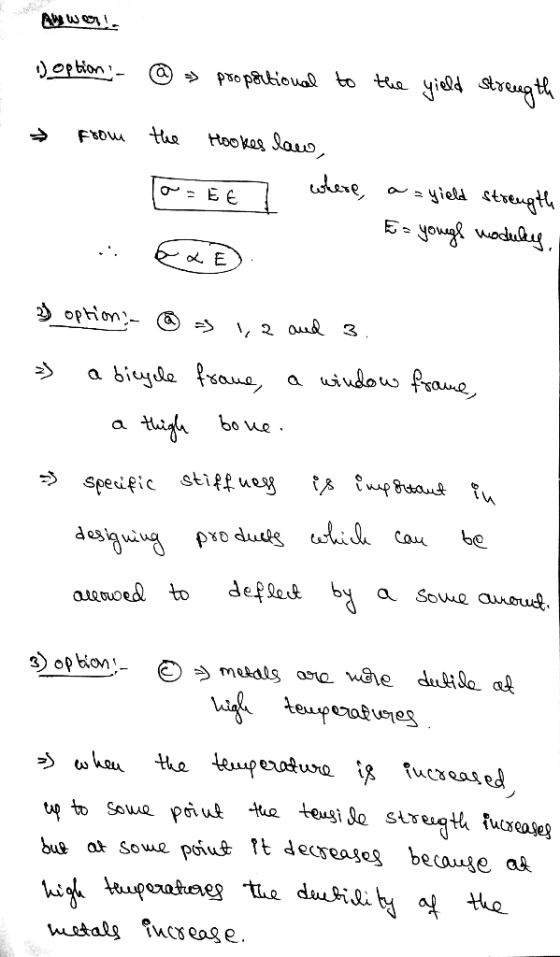
The modulus of a material is (a) proportional to the yield strength (b) the stiffness at the onset of plastic flow (c)...
QUESTION 1 A semi-crystalline nylon with a degree of crystallinity of 25% has a density of 1.5 g/cm^3. Nylon has a crystalline density of 1.8 g/cm^3. What is its amorphous density in grams per centi...
QUESTION 1 A semi-crystalline nylon with a degree of crystallinity of 25% has a density of 1.5 g/cm^3. Nylon has a crystalline density of 1.8 g/cm^3. What is its amorphous density in grams per centimeters cubed? 1 points QUESTION 2 Which defect is NOT common between metals and polymers? tie molecules vacancies screw dislocations interstitial defects 0.5 points QUESTION 3 Which one is not a characteristic of a plastic polymer? a. Low stress but very large strains b. Tensile strength...
hep with question 3 please A material may fail in many ways; in a ductile or...
 hep with question 3 please
A material may fail in many ways; in a ductile or brittle mode; by creep or fatigue; by corrosion or stress corrosion; by hydrogen or liquid metal embrittlement; by slow tensile overload or by impact. An examination of the failure may tell you a lot about the material and the failure mode. In this course, you have learned (we trust) the correlations between structure-properties, - applications. This leads to material selection. However, the engineer has...
hep with question 3 please
A material may fail in many ways; in a ductile or brittle mode; by creep or fatigue; by corrosion or stress corrosion; by hydrogen or liquid metal embrittlement; by slow tensile overload or by impact. An examination of the failure may tell you a lot about the material and the failure mode. In this course, you have learned (we trust) the correlations between structure-properties, - applications. This leads to material selection. However, the engineer has...
answer question 2 please A material may fail in many ways; in a ductile or brittle...
 answer question 2 please
A material may fail in many ways; in a ductile or brittle mode; by creep or fatigue; by corrosion or stress corrosion; by hydrogen or liquid metal embrittlement; by slow tensile overload or by impact. An examination of the failure may tell you a lot about the material and the failure mode. In this course, you have learned (we trust) the correlations between structure-properties, - applications. This leads to material selection. However, the engineer has to...
answer question 2 please
A material may fail in many ways; in a ductile or brittle mode; by creep or fatigue; by corrosion or stress corrosion; by hydrogen or liquid metal embrittlement; by slow tensile overload or by impact. An examination of the failure may tell you a lot about the material and the failure mode. In this course, you have learned (we trust) the correlations between structure-properties, - applications. This leads to material selection. However, the engineer has to...
Material science 1) Polypropylene (PP) has a glass-transition temperature of -15 oC and a melting...
Material science 1) Polypropylene (PP) has a glass-transition temperature of -15 oC and a melting temperature of 175 oC. This means that at a temperature of -40 oC that PP is ________, and at temperature 0 oC PP is _________ . (A) brittle, brittle (B) ductile, brittle (C) brittle, ductile (D) ductile, ductile (E) low in thermal conductivity, high in thermal conductivity. .2) Galvanized steel corrodes slowly in air because: (A) the...
Identify the material. that fits the stress-strain curve. A) MILD STEEL Yield Strength: 30 kN, Ultimate...
 Identify the material. that fits the stress-strain
curve.
A)
MILD STEEL
Yield Strength: 30 kN, Ultimate Strength: 40 kN, Young Modulus:
30/0.7 kN/mm = 43 kN/mm
B)
ALUMINUM
Yield Strength: 20 kN, Ultimate Strength: 26 kN, Young Modulus:
20 kN/mm
C)
CAST IRON
Yield Strength: N/A, Ultimate Strength: 20 kN, Young Modulus:
20/0.4 kN/mm = 50 kN/mm
D)
COPPER
Yield Strength: 30 kN, Ultimate Strength: 35 kN, Young Modulus:
30 kN/mm
Instructions CLI Tesile TesTeR Test Specimens Material - Mild...
Identify the material. that fits the stress-strain
curve.
A)
MILD STEEL
Yield Strength: 30 kN, Ultimate Strength: 40 kN, Young Modulus:
30/0.7 kN/mm = 43 kN/mm
B)
ALUMINUM
Yield Strength: 20 kN, Ultimate Strength: 26 kN, Young Modulus:
20 kN/mm
C)
CAST IRON
Yield Strength: N/A, Ultimate Strength: 20 kN, Young Modulus:
20/0.4 kN/mm = 50 kN/mm
D)
COPPER
Yield Strength: 30 kN, Ultimate Strength: 35 kN, Young Modulus:
30 kN/mm
Instructions CLI Tesile TesTeR Test Specimens Material - Mild...
help with question 4 please. there are two samples given with two different pictures of each...
 help with question 4 please.
there are two samples given with two different pictures of
each
A material may fail in many ways; in a ductile or brittle mode; by creep or fatigue; by corrosion or stress corrosion; by hydrogen or liquid metal embrittlement; by slow tensile overload or by impact. An examination of the failure may tell you a lot about the material and the failure mode. In this course, you have learned (we trust) the correlations between structure-properties,...
help with question 4 please.
there are two samples given with two different pictures of
each
A material may fail in many ways; in a ductile or brittle mode; by creep or fatigue; by corrosion or stress corrosion; by hydrogen or liquid metal embrittlement; by slow tensile overload or by impact. An examination of the failure may tell you a lot about the material and the failure mode. In this course, you have learned (we trust) the correlations between structure-properties,...
help with question 5 please. there are two samples given with two different pictures of each....
 help with question 5 please.
there are two samples given with two different pictures of
each.
all
of the information to solve is given
A material may fail in many ways; in a ductile or brittle mode; by creep or fatigue; by corrosion or stress corrosion; by hydrogen or liquid metal embrittlement; by slow tensile overload or by impact. An examination of the failure may tell you a lot about the material and the failure mode. In this course, you...
help with question 5 please.
there are two samples given with two different pictures of
each.
all
of the information to solve is given
A material may fail in many ways; in a ductile or brittle mode; by creep or fatigue; by corrosion or stress corrosion; by hydrogen or liquid metal embrittlement; by slow tensile overload or by impact. An examination of the failure may tell you a lot about the material and the failure mode. In this course, you...
Materials selection for light springs is shown in Figure 3. A family of lines of slope 2 link mat...
 Materials selection for light springs is shown in Figure 3. A family of lines of slope 2 link materials with equal values of Specific modulus specific strength Technical ceramics Melals and polymers yield sirength, ey Ceramics. glasses: modulus of rupture, MOR Elastomers: tensile tear strength, Composites: tensile failure, o Diamond 8,c SigN Al203 10-1 Composites Yield before 10 Siica glass Soda gass CFRP bucking Nontechnical ceramics Stone Brick Ti alloy CD 10-2 nMetals Wood ng alloys Search area Yield strein...
(1) (b) concrete, (c) polyethylene, or (d) water? 1.14 Copper is generally considered easy to weld...
 (1) (b) concrete, (c) polyethylene, or (d) water? 1.14 Copper is generally considered easy to weld because of its high thermal conductivity: (a) true or (b) false? (1) 1,15 Which of the following properties or characteristics do not apply to metals (two correct answers): (a) good thermal conductivity, (b) high strength, (c) high electrical resistivity, (d) high stiffness, and (e) ionic bonding? 1.16 An alloy is a metal composed of two or more elements, at least one of which is...
polymer physics yes otherwise? 1. To determine the Tg of polymers, which method is NOT applicable?...
 polymer physics
yes
otherwise?
1. To determine the Tg of polymers, which method is NOT applicable? (a) dilatometry, (b) OM, (e) DSC. (d) HDT. o d ) T0 sho dai n0 nar onom (o) itivo bos ed do o lT ed 2. To determine the Tm of polymers, which method is NOT applicable? (a) POM, (b) WAXD, (c) SEM, (d) DSC. MGT0 2lsbom tods bne M001 To ulubom oY ed mlog 3. To determine the crystallinity, which method is NOT...
polymer physics
yes
otherwise?
1. To determine the Tg of polymers, which method is NOT applicable? (a) dilatometry, (b) OM, (e) DSC. (d) HDT. o d ) T0 sho dai n0 nar onom (o) itivo bos ed do o lT ed 2. To determine the Tm of polymers, which method is NOT applicable? (a) POM, (b) WAXD, (c) SEM, (d) DSC. MGT0 2lsbom tods bne M001 To ulubom oY ed mlog 3. To determine the crystallinity, which method is NOT...
 hep with question 3 please
A material may fail in many ways; in a ductile or brittle mode; by creep or fatigue; by corrosion or stress corrosion; by hydrogen or liquid metal embrittlement; by slow tensile overload or by impact. An examination of the failure may tell you a lot about the material and the failure mode. In this course, you have learned (we trust) the correlations between structure-properties, - applications. This leads to material selection. However, the engineer has...
hep with question 3 please
A material may fail in many ways; in a ductile or brittle mode; by creep or fatigue; by corrosion or stress corrosion; by hydrogen or liquid metal embrittlement; by slow tensile overload or by impact. An examination of the failure may tell you a lot about the material and the failure mode. In this course, you have learned (we trust) the correlations between structure-properties, - applications. This leads to material selection. However, the engineer has...
 answer question 2 please
A material may fail in many ways; in a ductile or brittle mode; by creep or fatigue; by corrosion or stress corrosion; by hydrogen or liquid metal embrittlement; by slow tensile overload or by impact. An examination of the failure may tell you a lot about the material and the failure mode. In this course, you have learned (we trust) the correlations between structure-properties, - applications. This leads to material selection. However, the engineer has to...
answer question 2 please
A material may fail in many ways; in a ductile or brittle mode; by creep or fatigue; by corrosion or stress corrosion; by hydrogen or liquid metal embrittlement; by slow tensile overload or by impact. An examination of the failure may tell you a lot about the material and the failure mode. In this course, you have learned (we trust) the correlations between structure-properties, - applications. This leads to material selection. However, the engineer has to...
 Identify the material. that fits the stress-strain
curve.
A)
MILD STEEL
Yield Strength: 30 kN, Ultimate Strength: 40 kN, Young Modulus:
30/0.7 kN/mm = 43 kN/mm
B)
ALUMINUM
Yield Strength: 20 kN, Ultimate Strength: 26 kN, Young Modulus:
20 kN/mm
C)
CAST IRON
Yield Strength: N/A, Ultimate Strength: 20 kN, Young Modulus:
20/0.4 kN/mm = 50 kN/mm
D)
COPPER
Yield Strength: 30 kN, Ultimate Strength: 35 kN, Young Modulus:
30 kN/mm
Instructions CLI Tesile TesTeR Test Specimens Material - Mild...
Identify the material. that fits the stress-strain
curve.
A)
MILD STEEL
Yield Strength: 30 kN, Ultimate Strength: 40 kN, Young Modulus:
30/0.7 kN/mm = 43 kN/mm
B)
ALUMINUM
Yield Strength: 20 kN, Ultimate Strength: 26 kN, Young Modulus:
20 kN/mm
C)
CAST IRON
Yield Strength: N/A, Ultimate Strength: 20 kN, Young Modulus:
20/0.4 kN/mm = 50 kN/mm
D)
COPPER
Yield Strength: 30 kN, Ultimate Strength: 35 kN, Young Modulus:
30 kN/mm
Instructions CLI Tesile TesTeR Test Specimens Material - Mild...
 help with question 4 please.
there are two samples given with two different pictures of
each
A material may fail in many ways; in a ductile or brittle mode; by creep or fatigue; by corrosion or stress corrosion; by hydrogen or liquid metal embrittlement; by slow tensile overload or by impact. An examination of the failure may tell you a lot about the material and the failure mode. In this course, you have learned (we trust) the correlations between structure-properties,...
help with question 4 please.
there are two samples given with two different pictures of
each
A material may fail in many ways; in a ductile or brittle mode; by creep or fatigue; by corrosion or stress corrosion; by hydrogen or liquid metal embrittlement; by slow tensile overload or by impact. An examination of the failure may tell you a lot about the material and the failure mode. In this course, you have learned (we trust) the correlations between structure-properties,...
 help with question 5 please.
there are two samples given with two different pictures of
each.
all
of the information to solve is given
A material may fail in many ways; in a ductile or brittle mode; by creep or fatigue; by corrosion or stress corrosion; by hydrogen or liquid metal embrittlement; by slow tensile overload or by impact. An examination of the failure may tell you a lot about the material and the failure mode. In this course, you...
help with question 5 please.
there are two samples given with two different pictures of
each.
all
of the information to solve is given
A material may fail in many ways; in a ductile or brittle mode; by creep or fatigue; by corrosion or stress corrosion; by hydrogen or liquid metal embrittlement; by slow tensile overload or by impact. An examination of the failure may tell you a lot about the material and the failure mode. In this course, you...
 Materials selection for light springs is shown in Figure 3. A family of lines of slope 2 link materials with equal values of Specific modulus specific strength Technical ceramics Melals and polymers yield sirength, ey Ceramics. glasses: modulus of rupture, MOR Elastomers: tensile tear strength, Composites: tensile failure, o Diamond 8,c SigN Al203 10-1 Composites Yield before 10 Siica glass Soda gass CFRP bucking Nontechnical ceramics Stone Brick Ti alloy CD 10-2 nMetals Wood ng alloys Search area Yield strein...
 (1) (b) concrete, (c) polyethylene, or (d) water? 1.14 Copper is generally considered easy to weld because of its high thermal conductivity: (a) true or (b) false? (1) 1,15 Which of the following properties or characteristics do not apply to metals (two correct answers): (a) good thermal conductivity, (b) high strength, (c) high electrical resistivity, (d) high stiffness, and (e) ionic bonding? 1.16 An alloy is a metal composed of two or more elements, at least one of which is...
 polymer physics
yes
otherwise?
1. To determine the Tg of polymers, which method is NOT applicable? (a) dilatometry, (b) OM, (e) DSC. (d) HDT. o d ) T0 sho dai n0 nar onom (o) itivo bos ed do o lT ed 2. To determine the Tm of polymers, which method is NOT applicable? (a) POM, (b) WAXD, (c) SEM, (d) DSC. MGT0 2lsbom tods bne M001 To ulubom oY ed mlog 3. To determine the crystallinity, which method is NOT...
polymer physics
yes
otherwise?
1. To determine the Tg of polymers, which method is NOT applicable? (a) dilatometry, (b) OM, (e) DSC. (d) HDT. o d ) T0 sho dai n0 nar onom (o) itivo bos ed do o lT ed 2. To determine the Tm of polymers, which method is NOT applicable? (a) POM, (b) WAXD, (c) SEM, (d) DSC. MGT0 2lsbom tods bne M001 To ulubom oY ed mlog 3. To determine the crystallinity, which method is NOT...
Most questions answered within 3 hours.
-
Where is the error in this code sequence?
String s1 = "Hello";
String s2 = "ello";...
asked 10 months ago -
Financial data for Joel de Paris, Inc., for last year
follow:
Joel de Paris, Inc.
Balance...
asked 10 months ago -
Consider this reaction:
Al2(SO4)3 (aq)+ BaCl3
(aq) Al2Cl6 (aq)- +
3BaSO4(s) . What is the...
asked 10 months ago -
Suppose that Savneet is considering increasing her
recent random sample from 20 car rentals to 40...
asked 10 months ago -
Trucks arrive at an unloading terminal at an average rate of 120
per hour.
Trucks arrive...
asked 10 months ago -
Why are methanol and ethanol completely soluble in water while
octanol is not very little soluble....
asked 10 months ago -
A facilities manager at a university reads in a research report
that the mean amount of...
asked 10 months ago -
When the CuSO4 is rehydrated by adding water to the anhydrous
compound, is this an endothermic...
asked 10 months ago -
A ray of sunlight is passing from diamond into crown glass; the
angle of incidence is...
asked 10 months ago -
A block of mass 0.249 kg is placed on top of a light, vertical
spring of...
asked 10 months ago -
how do the kidneys compensate in the presences of acidosis
a) trigger hyperventilate
b) reserve acid...
asked 10 months ago -
Question 501 pts
The rental rate of capital to the firm increases. Which of the
following...
asked 10 months ago