
Homework Answers
Answer
Add Answer to:
Kinetic data are normally presented as graphs. The following questions test your knowledge about labeling and interpret...
Kinetic data are normally presented as graphs. The following questions test your knowledge about labeling and...
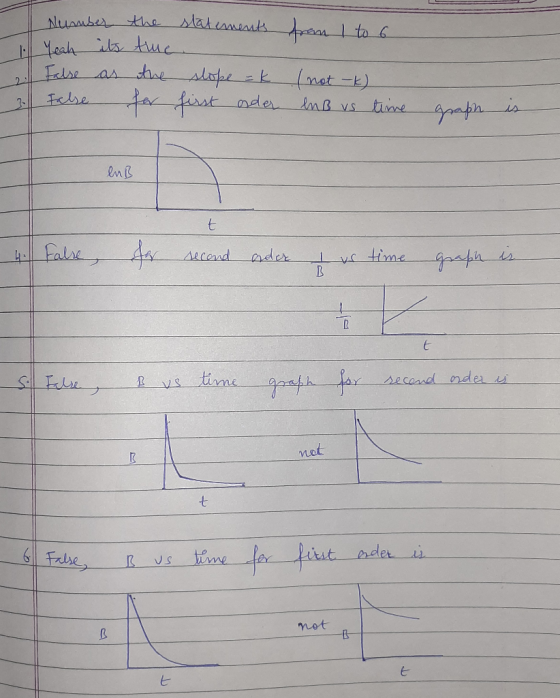
 Kinetic data are normally presented as graphs. The following questions test your knowledge about labeling and interpreting graphs correctly. [B] is used to represent the concentration of a react reaction. FYRĘ Decide if each of the following statements is True or False. False False True False False True Consider graph C: if y = 1/[B] and x = time, the graph could represent a second order reaction. Consider graph A: if y = [B] and x = time, the graph...
I am not sure how to answer this question. Kinetic data are normally presented as graphs. The following questions test...
 I am not sure how to answer this question.
Kinetic data are normally presented as graphs. The following questions test your knowledge about labeling and interpreting graphs correctly. [B] is used to represent the concentration of a reactant B in a reaction. Decide if each of the following statements is True or False. True True False False True True Consider graph D: if y = In[B] and x = time, the graph could represent a first order reaction. Consider graph...
I am not sure how to answer this question.
Kinetic data are normally presented as graphs. The following questions test your knowledge about labeling and interpreting graphs correctly. [B] is used to represent the concentration of a reactant B in a reaction. Decide if each of the following statements is True or False. True True False False True True Consider graph D: if y = In[B] and x = time, the graph could represent a first order reaction. Consider graph...
el Joe Lvaluate eeubela FILMU Kinetic data are normally presented as graphs. The following questions test...
 el Joe Lvaluate eeubela FILMU Kinetic data are normally presented as graphs. The following questions test your knowledge about labeling and interpreting graphs correctly. [B] is used to represent the concentration of a reactant B in a reaction. Decide if each of the following statements is True or False. A Consider aranh . if y = 1/Bland y = time the aranh could False Consider graph C: if y = 1/[B] and x = time, the graph could represent a...
could you help with this? help is much appreciated:) CHEMISTRY 206 Experiment 4: A KINETIC STUDY:...
 could you help with this? help is much
appreciated:)
CHEMISTRY 206 Experiment 4: A KINETIC STUDY: THE REACTION OF CRYSTAL VIOLET WITH SODIUM HYDROXIDE Prelaboratory Questions This lab is the most complicated of the experiments in Chem 206. The questions in this prelaboratory exercise illustrate the calculations you will be doing with the results you will obtain, and should help you understand the reason for steps you will follow in the lab. For this reason we are not asking you...
could you help with this? help is much
appreciated:)
CHEMISTRY 206 Experiment 4: A KINETIC STUDY: THE REACTION OF CRYSTAL VIOLET WITH SODIUM HYDROXIDE Prelaboratory Questions This lab is the most complicated of the experiments in Chem 206. The questions in this prelaboratory exercise illustrate the calculations you will be doing with the results you will obtain, and should help you understand the reason for steps you will follow in the lab. For this reason we are not asking you...
Most of the time, the rate of a reaction depends on the concentration of the reactant....
 Most of the time, the rate of a reaction depends on the
concentration of the reactant. In the case of second-order
reactions, the rate is proportional to the square of the
concentration of the reactant.
Select the image to explore the simulation, which will help you
to understand how second-order reactions are identified by the
nature of their plots. You can also observe the rate law for
different reactions.
In the simulation, you can select one of the three different...
Most of the time, the rate of a reaction depends on the
concentration of the reactant. In the case of second-order
reactions, the rate is proportional to the square of the
concentration of the reactant.
Select the image to explore the simulation, which will help you
to understand how second-order reactions are identified by the
nature of their plots. You can also observe the rate law for
different reactions.
In the simulation, you can select one of the three different...
Which of the following graphs best represents of penicillin, if the reaction is second order with...
 Which of the following graphs best represents of penicillin, if the reaction is second order with respect to penicillin? For the reaction X_2 + Y + Z rightarrow XY + XZ, it is found that doubling the concentration of X_2 doubled the reaction rate, tripling the concentration of Y triples the rate, and doubling the concentration of Z has no effect. What is the rate law for this reaction? What is the unit for the rate constant for this reaction?...
+ Using Integrated Rate Laws The integrated rate laws for zero-, first-, and second-order reaction may be arrang...
 + Using Integrated Rate Laws The integrated rate laws for zero-, first-, and second-order reaction may be arranged such that they resemble the equation for a straight line, y = mx + b. Slope Order O 1 2 Integrated Rate Law Graph [A] = - kt + [A] [A] vs. t In[A] = -kt + In[A], In[A] vs. t LÀ=kt + TA LÀ vs. t -k Review Constants Periodic Table Part A The reactant concentration in a zero-order reaction was...
+ Using Integrated Rate Laws The integrated rate laws for zero-, first-, and second-order reaction may...
 + Using Integrated Rate Laws The integrated rate laws for zero-, first-, and second-order reaction may be arranged such that they resemble the equation for a straight line, y = mx + b. Slope Order O 1 2 Integrated Rate Law Graph [A] = - kt + [A] [A] vs. t In[A] = -kt + In[A], In[A] vs. t LÀ=kt + TA LÀ vs. t -k Review Constants Periodic Table Part A The reactant concentration in a zero-order reaction was...
graph all 3 tables on excel The tabulated data show the concentrations of A versus time...
 graph all 3 tables on excel
The tabulated data show the concentrations of A versus time for this reaction A products Time (s) (A] (M) 1.000 0 25 0.914 50 0.829 75 0.744 100 0.659 125 0.573 0.488 150 0.403 175 0.318 200 *do all 3 graphs *trendline 1. Determine the order of the reaction. Do this by graphing: zero order: time vs. [A] first order: time vs. In [A] second order: time vs. 1/[A Slope rate constant 2. Determine...
graph all 3 tables on excel
The tabulated data show the concentrations of A versus time for this reaction A products Time (s) (A] (M) 1.000 0 25 0.914 50 0.829 75 0.744 100 0.659 125 0.573 0.488 150 0.403 175 0.318 200 *do all 3 graphs *trendline 1. Determine the order of the reaction. Do this by graphing: zero order: time vs. [A] first order: time vs. In [A] second order: time vs. 1/[A Slope rate constant 2. Determine...
will work with up to 3 partners (similar to a lab group) to prepare a written report which analyzes kinetic data that has been provided to you. All student groups will receive data for the hy...
 will work with up to 3 partners (similar to a lab group) to prepare a written report which analyzes kinetic data that has been provided to you. All student groups will receive data for the hypothetical reaction aAlE) products where a is a numeric variable and A is a chemical variable. The reaction therefore has the form of a decomposition reaction, in which a single substance forms one or more new substances. For consistency, all concentrations start out at 1.000...
 Kinetic data are normally presented as graphs. The following questions test your knowledge about labeling and interpreting graphs correctly. [B] is used to represent the concentration of a react reaction. FYRĘ Decide if each of the following statements is True or False. False False True False False True Consider graph C: if y = 1/[B] and x = time, the graph could represent a second order reaction. Consider graph A: if y = [B] and x = time, the graph...
 I am not sure how to answer this question.
Kinetic data are normally presented as graphs. The following questions test your knowledge about labeling and interpreting graphs correctly. [B] is used to represent the concentration of a reactant B in a reaction. Decide if each of the following statements is True or False. True True False False True True Consider graph D: if y = In[B] and x = time, the graph could represent a first order reaction. Consider graph...
I am not sure how to answer this question.
Kinetic data are normally presented as graphs. The following questions test your knowledge about labeling and interpreting graphs correctly. [B] is used to represent the concentration of a reactant B in a reaction. Decide if each of the following statements is True or False. True True False False True True Consider graph D: if y = In[B] and x = time, the graph could represent a first order reaction. Consider graph...
 el Joe Lvaluate eeubela FILMU Kinetic data are normally presented as graphs. The following questions test your knowledge about labeling and interpreting graphs correctly. [B] is used to represent the concentration of a reactant B in a reaction. Decide if each of the following statements is True or False. A Consider aranh . if y = 1/Bland y = time the aranh could False Consider graph C: if y = 1/[B] and x = time, the graph could represent a...
 could you help with this? help is much
appreciated:)
CHEMISTRY 206 Experiment 4: A KINETIC STUDY: THE REACTION OF CRYSTAL VIOLET WITH SODIUM HYDROXIDE Prelaboratory Questions This lab is the most complicated of the experiments in Chem 206. The questions in this prelaboratory exercise illustrate the calculations you will be doing with the results you will obtain, and should help you understand the reason for steps you will follow in the lab. For this reason we are not asking you...
could you help with this? help is much
appreciated:)
CHEMISTRY 206 Experiment 4: A KINETIC STUDY: THE REACTION OF CRYSTAL VIOLET WITH SODIUM HYDROXIDE Prelaboratory Questions This lab is the most complicated of the experiments in Chem 206. The questions in this prelaboratory exercise illustrate the calculations you will be doing with the results you will obtain, and should help you understand the reason for steps you will follow in the lab. For this reason we are not asking you...
 Most of the time, the rate of a reaction depends on the
concentration of the reactant. In the case of second-order
reactions, the rate is proportional to the square of the
concentration of the reactant.
Select the image to explore the simulation, which will help you
to understand how second-order reactions are identified by the
nature of their plots. You can also observe the rate law for
different reactions.
In the simulation, you can select one of the three different...
Most of the time, the rate of a reaction depends on the
concentration of the reactant. In the case of second-order
reactions, the rate is proportional to the square of the
concentration of the reactant.
Select the image to explore the simulation, which will help you
to understand how second-order reactions are identified by the
nature of their plots. You can also observe the rate law for
different reactions.
In the simulation, you can select one of the three different...
 Which of the following graphs best represents of penicillin, if the reaction is second order with respect to penicillin? For the reaction X_2 + Y + Z rightarrow XY + XZ, it is found that doubling the concentration of X_2 doubled the reaction rate, tripling the concentration of Y triples the rate, and doubling the concentration of Z has no effect. What is the rate law for this reaction? What is the unit for the rate constant for this reaction?...
 + Using Integrated Rate Laws The integrated rate laws for zero-, first-, and second-order reaction may be arranged such that they resemble the equation for a straight line, y = mx + b. Slope Order O 1 2 Integrated Rate Law Graph [A] = - kt + [A] [A] vs. t In[A] = -kt + In[A], In[A] vs. t LÀ=kt + TA LÀ vs. t -k Review Constants Periodic Table Part A The reactant concentration in a zero-order reaction was...
 + Using Integrated Rate Laws The integrated rate laws for zero-, first-, and second-order reaction may be arranged such that they resemble the equation for a straight line, y = mx + b. Slope Order O 1 2 Integrated Rate Law Graph [A] = - kt + [A] [A] vs. t In[A] = -kt + In[A], In[A] vs. t LÀ=kt + TA LÀ vs. t -k Review Constants Periodic Table Part A The reactant concentration in a zero-order reaction was...
 graph all 3 tables on excel
The tabulated data show the concentrations of A versus time for this reaction A products Time (s) (A] (M) 1.000 0 25 0.914 50 0.829 75 0.744 100 0.659 125 0.573 0.488 150 0.403 175 0.318 200 *do all 3 graphs *trendline 1. Determine the order of the reaction. Do this by graphing: zero order: time vs. [A] first order: time vs. In [A] second order: time vs. 1/[A Slope rate constant 2. Determine...
graph all 3 tables on excel
The tabulated data show the concentrations of A versus time for this reaction A products Time (s) (A] (M) 1.000 0 25 0.914 50 0.829 75 0.744 100 0.659 125 0.573 0.488 150 0.403 175 0.318 200 *do all 3 graphs *trendline 1. Determine the order of the reaction. Do this by graphing: zero order: time vs. [A] first order: time vs. In [A] second order: time vs. 1/[A Slope rate constant 2. Determine...
 will work with up to 3 partners (similar to a lab group) to prepare a written report which analyzes kinetic data that has been provided to you. All student groups will receive data for the hypothetical reaction aAlE) products where a is a numeric variable and A is a chemical variable. The reaction therefore has the form of a decomposition reaction, in which a single substance forms one or more new substances. For consistency, all concentrations start out at 1.000...
Most questions answered within 3 hours.
-
Where is the error in this code sequence?
String s1 = "Hello";
String s2 = "ello";...
asked 11 months ago -
Financial data for Joel de Paris, Inc., for last year
follow:
Joel de Paris, Inc.
Balance...
asked 11 months ago -
Consider this reaction:
Al2(SO4)3 (aq)+ BaCl3
(aq) Al2Cl6 (aq)- +
3BaSO4(s) . What is the...
asked 11 months ago -
Suppose that Savneet is considering increasing her
recent random sample from 20 car rentals to 40...
asked 11 months ago -
Trucks arrive at an unloading terminal at an average rate of 120
per hour.
Trucks arrive...
asked 11 months ago -
Why are methanol and ethanol completely soluble in water while
octanol is not very little soluble....
asked 11 months ago -
A facilities manager at a university reads in a research report
that the mean amount of...
asked 11 months ago -
When the CuSO4 is rehydrated by adding water to the anhydrous
compound, is this an endothermic...
asked 11 months ago -
A ray of sunlight is passing from diamond into crown glass; the
angle of incidence is...
asked 11 months ago -
A block of mass 0.249 kg is placed on top of a light, vertical
spring of...
asked 11 months ago -
how do the kidneys compensate in the presences of acidosis
a) trigger hyperventilate
b) reserve acid...
asked 11 months ago -
Question 501 pts
The rental rate of capital to the firm increases. Which of the
following...
asked 11 months ago