Given the following electrolytic cell:
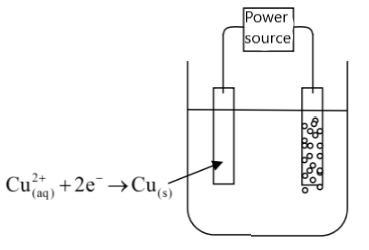
The current is discharged into the electrolytic cell containing the solution CuSO4(aq) 1.0M at 25 oC. During the operation of the cell, copper Cu(s) is deposited on one electrode and oxygen O2(g) gas is released, near the second electrode.
O2(g) + 4H3O+(aq) +
4e-
Cu2+(aq) + 2e-
A. The current in the cell is 1.5 amperes. The current is
streamed in 40 minutes.
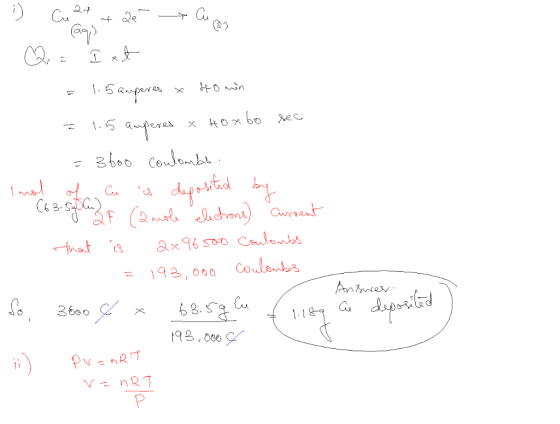
i. Calculate the mass of copper in grams that have sunk. Show
calculations.
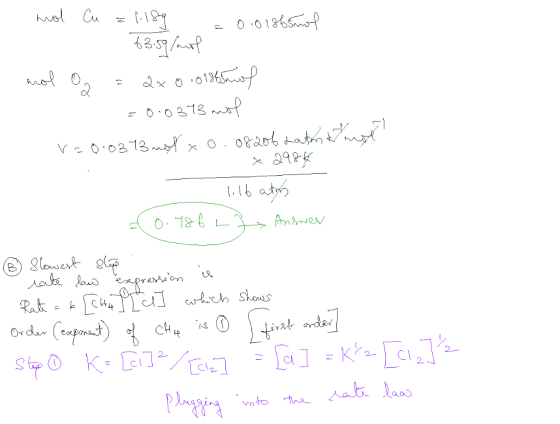
ii. What is the volume in liters of oxygen gas released on 25
oC under pressure of 1.16 atm. Show calculations.
B. Methane gas reacts with chlorine gas according to the reaction given below:
CH4(g) + 2Cl2(g) → CH2Cl2(g) + 2HCl(g)
The following mechanism is proposed for the reaction (all substances in the gaseous state):
Step 1: Cl2 ⇄ 2Cl equilibrium is fast
Step 2: CH4 + Cl → CH3 + HCl Slow step
Step 3: CH3 + Cl2 → CH3Cl + Cl
Quick step
Step 4: CH3Cl + Cl → CH2Cl2 + H
Quick step
Step 5: H + Cl → HCl Quick step
i. Does CH3Cl function as a catalyst or as an
intermediate in the proposed mechanism? Explain.
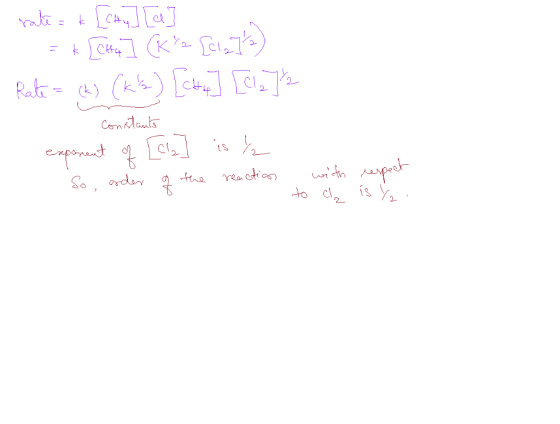
ii. What is the order of response to Cl2(g) and CH4(g) according to the proposed mechanism? Explain.
Thanks!
Homework Answers
Add Answer to:
Given the following electrolytic cell: The current is discharged into the electrolytic cell containing the solution CuS...
Given the following electrolytic cell: The current is discharged into the electrolytic cell containing the solution CuSO4(aq) 1.0M at 25 oC. During the operation of the cell, copper Cu(s) is deposite...
 Given the following electrolytic cell:
The current is discharged into the electrolytic cell containing
the solution CuSO4(aq) 1.0M at 25 oC. During
the operation of the cell, copper Cu(s) is deposited on
one electrode and oxygen O2(g) gas is released, near the
second electrode.
O2(g) + 4H3O+(aq) +
4e-
6H2O(l) Eo= 1.23V
Cu2+(aq) + 2e- Cu(s)
Eo= 0.34V
A. Write the direction of the flow of electrons in the
cell.
B. Write the electrolysis equation that occurs in the cell....
Given the following electrolytic cell:
The current is discharged into the electrolytic cell containing
the solution CuSO4(aq) 1.0M at 25 oC. During
the operation of the cell, copper Cu(s) is deposited on
one electrode and oxygen O2(g) gas is released, near the
second electrode.
O2(g) + 4H3O+(aq) +
4e-
6H2O(l) Eo= 1.23V
Cu2+(aq) + 2e- Cu(s)
Eo= 0.34V
A. Write the direction of the flow of electrons in the
cell.
B. Write the electrolysis equation that occurs in the cell....
Calculate the cell potential for the following reaction as written at 25.00 °C, given that [Mg2...
Calculate the cell potential for the following reaction as written at 25.00 °C, given that [Mg2 ] = 0.774 M and [Sn2 ] = 0.0190 M. Standard reduction potentials can be found here. Reduction Half-Reaction Standard Potential Ered° (V) F2(g) + 2e– → 2F–(aq) +2.87 O3(g) + 2H3O+(aq) + 2e– → O2(g) + 3H2O(l) +2.076 Co3+(aq) + e– → Co2+(aq) +1.92 H2O2(aq) + 2H3O+(aq) + 2e– → 2H2O(l) +1.776 N2O(g) + 2H3O+(aq) + 2e– → N2(g) + 3H2O(l) +1.766 Ce4+(aq) + e– → Ce3+(aq)...
need help for half cell potentials pls calculate step by step (NOTE - Remember that the...
 need help for half cell potentials pls calculate step by step
(NOTE - Remember that the positive electrode is attached to the red wire and the negative electrode is attached to the black wire.) Electrode Systems Used Anode (oxidation) Negative Cathode (reduction) Positive Measured Potential (V) Positive (Ecu) Copper and silver Cu() - Cu2+ + 2e" Ag+ +1e Ag) 0.432 V Zinc + Silver Zn cs + 2n**+ Zé dat + leº nAg (s) 1.484 V Copper & Zinc Zn(s)...
need help for half cell potentials pls calculate step by step
(NOTE - Remember that the positive electrode is attached to the red wire and the negative electrode is attached to the black wire.) Electrode Systems Used Anode (oxidation) Negative Cathode (reduction) Positive Measured Potential (V) Positive (Ecu) Copper and silver Cu() - Cu2+ + 2e" Ag+ +1e Ag) 0.432 V Zinc + Silver Zn cs + 2n**+ Zé dat + leº nAg (s) 1.484 V Copper & Zinc Zn(s)...
1.) An aqueous solution containing 5.66 g of lead(II) nitrate is added to an aqueous solution...
1.) An aqueous solution containing 5.66 g of lead(II) nitrate is added to an aqueous solution containing 6.30 g of potassium chloride. Enter the balanced chemical equation for this reaction. Be sure to include all physical states. balanced chemical equation What is the limiting reactant? The percent yield for the reaction is 79.2 % . How many grams of precipitate is recovered? precipitate recovered: How many grams of the excess reactant remain? excess reactant remaining: 2.) Chlorine gas can be...
Exam Name MULTIPLE CHOICE. Choose the one alternative that best completes the statement or answers the...
 Exam Name MULTIPLE CHOICE. Choose the one alternative that best completes the statement or answers the question. 1) 1) One mole of any substance contains Avogadro's number of particles of that substance. What is the numerical value of Avogadro's number? A) 12.01 23 Avagrans t Male aton 6022 x1o atums B) 6.022 x 10²³ C) 6.022 x 10⁻²³ D) 1.661 x10⁻²⁴ E) 1.00 x10⁻¹⁴ 2) What is the mass of 4.00 moles of helium, the gas commonly used to fill...
 Given the following electrolytic cell:
The current is discharged into the electrolytic cell containing
the solution CuSO4(aq) 1.0M at 25 oC. During
the operation of the cell, copper Cu(s) is deposited on
one electrode and oxygen O2(g) gas is released, near the
second electrode.
O2(g) + 4H3O+(aq) +
4e-
6H2O(l) Eo= 1.23V
Cu2+(aq) + 2e- Cu(s)
Eo= 0.34V
A. Write the direction of the flow of electrons in the
cell.
B. Write the electrolysis equation that occurs in the cell....
Given the following electrolytic cell:
The current is discharged into the electrolytic cell containing
the solution CuSO4(aq) 1.0M at 25 oC. During
the operation of the cell, copper Cu(s) is deposited on
one electrode and oxygen O2(g) gas is released, near the
second electrode.
O2(g) + 4H3O+(aq) +
4e-
6H2O(l) Eo= 1.23V
Cu2+(aq) + 2e- Cu(s)
Eo= 0.34V
A. Write the direction of the flow of electrons in the
cell.
B. Write the electrolysis equation that occurs in the cell....
 need help for half cell potentials pls calculate step by step
(NOTE - Remember that the positive electrode is attached to the red wire and the negative electrode is attached to the black wire.) Electrode Systems Used Anode (oxidation) Negative Cathode (reduction) Positive Measured Potential (V) Positive (Ecu) Copper and silver Cu() - Cu2+ + 2e" Ag+ +1e Ag) 0.432 V Zinc + Silver Zn cs + 2n**+ Zé dat + leº nAg (s) 1.484 V Copper & Zinc Zn(s)...
need help for half cell potentials pls calculate step by step
(NOTE - Remember that the positive electrode is attached to the red wire and the negative electrode is attached to the black wire.) Electrode Systems Used Anode (oxidation) Negative Cathode (reduction) Positive Measured Potential (V) Positive (Ecu) Copper and silver Cu() - Cu2+ + 2e" Ag+ +1e Ag) 0.432 V Zinc + Silver Zn cs + 2n**+ Zé dat + leº nAg (s) 1.484 V Copper & Zinc Zn(s)...
 Exam Name MULTIPLE CHOICE. Choose the one alternative that best completes the statement or answers the question. 1) 1) One mole of any substance contains Avogadro's number of particles of that substance. What is the numerical value of Avogadro's number? A) 12.01 23 Avagrans t Male aton 6022 x1o atums B) 6.022 x 10²³ C) 6.022 x 10⁻²³ D) 1.661 x10⁻²⁴ E) 1.00 x10⁻¹⁴ 2) What is the mass of 4.00 moles of helium, the gas commonly used to fill...
Most questions answered within 3 hours.
-
Where is the error in this code sequence?
String s1 = "Hello";
String s2 = "ello";...
asked 11 months ago -
Financial data for Joel de Paris, Inc., for last year
follow:
Joel de Paris, Inc.
Balance...
asked 11 months ago -
Consider this reaction:
Al2(SO4)3 (aq)+ BaCl3
(aq) Al2Cl6 (aq)- +
3BaSO4(s) . What is the...
asked 11 months ago -
Suppose that Savneet is considering increasing her
recent random sample from 20 car rentals to 40...
asked 11 months ago -
Trucks arrive at an unloading terminal at an average rate of 120
per hour.
Trucks arrive...
asked 11 months ago -
Why are methanol and ethanol completely soluble in water while
octanol is not very little soluble....
asked 11 months ago -
A facilities manager at a university reads in a research report
that the mean amount of...
asked 11 months ago -
When the CuSO4 is rehydrated by adding water to the anhydrous
compound, is this an endothermic...
asked 11 months ago -
A ray of sunlight is passing from diamond into crown glass; the
angle of incidence is...
asked 11 months ago -
A block of mass 0.249 kg is placed on top of a light, vertical
spring of...
asked 11 months ago -
how do the kidneys compensate in the presences of acidosis
a) trigger hyperventilate
b) reserve acid...
asked 11 months ago -
Question 501 pts
The rental rate of capital to the firm increases. Which of the
following...
asked 11 months ago