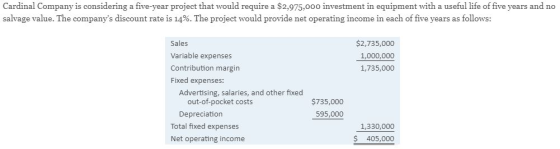
1. Which item(s) in the income statement shown above will not affect cash flows?
2. What are the project's annual net cash inflows?
3. What is the present value of the project's annual net cash inflows?
4. What is the project's net present value?
5. What is the project profitability index for this project? (Round your answer to the nearest whole per cent.)
7. What is the project's payback period?
8. What is the project's simple rate of return for each of the five years?
9. If the company's discount rate was 16% instead of 14%, would you expect the project's net present value to be higher than, lower than, or the same as your answer to requirement 4? No computations are necessary.
10. If the equipment had a salvage value of $300,000 at the end of five years, would you expect the project's payback period to be higher than, lower than, or the same as your answer to requirement 7? No computations are necessary.
11. If the equipment had a salvage value of $300,000 at the end of five years, would you expect the project's net present value to be higher than, lower than, or the same as your answer to requirement 3? No computations are necessary.
12. If the equipment had a salvage value of $300,000 at the end of five years, would you expect the project's simple rate of return to be higher than, lower than, or the same as your answer to requirement 8? No computations are necessary
Homework Answers
| 1) The depreciation expense of $595,000 is the only non-cash expense. | |||||||
| 2) | |||||||
|
Annual net cash inflows: |
|||||||
| Net operating income | $405,000 | ||||||
| Add: Noncash deduction for depreciation | $595,000 | ||||||
| Annual net cash inflow | $1,000,000 | ||||||
| 3) | |||||||
| Present value of the annual net cash inflows = $1,000,000 x PVOA(14%,5) | |||||||
| Present value of the annual net cash inflows = $1,000,000 x 3.433 | $3,433,000.000 | ||||||
| 4) | |||||||
| Year | 0 | 1 | 2 | 3 | 4 | 5 | |
| Purchase of equipment | $ (2,975,000.00) | ||||||
| Sales | $ 2,735,000.00 | $ 2,735,000.00 | $ 2,735,000.00 | $ 2,735,000.00 | $ 2,735,000.00 | ||
| Variable Expense | $ 1,000,000.00 | $ 1,000,000.00 | $ 1,000,000.00 | $ 1,000,000.00 | $ 1,000,000.00 | ||
| Out-of-pocket costs | $ 735,000.00 | $ 735,000.00 | $ 735,000.00 | $ 735,000.00 | $ 735,000.00 | ||
| Total cash flows | $ (2,975,000.00) | $ 1,000,000.00 | $ 1,000,000.00 | $ 1,000,000.00 | $ 1,000,000.00 | $ 1,000,000.00 | |
| Discount factor (b) @ 14% | 1.000 | 0.877 | 0.769 | 0.675 | 0.592 | 0.519 | |
| Present value (a)×(b) | $ (2,975,000.0000) | $ 877,000.0000 | $ 769,000.0000 | $ 675,000.0000 | $ 592,000.0000 | $519,000.0000 | |
| Net present value | $ 457,000.0000 | ||||||
| 5) | |||||||
| project profitability index = NPV/Investment Required | |||||||
| Project profitability index = 457,000/2975000 | 0.1536 | ||||||
| 6) | |||||||
| IRR (Using excel) = IRR( cashflow year 0 to cashflow year 5 | 20.24% | ||||||
| project’s internal rate of return = | |||||||
| Factor of IRR = Investment required/ Annual cash flow | 2.9750 | ||||||
| The factor computed above, 2.975, is closest to 2.991 along the five-year line in Pv table, the factor for the 20% rate of return. Therefore, to the nearest whole percent, the internal rate of return is 20%. | |||||||
| 7) | |||||||
| payback period = Investment required/ Annual cash flow | |||||||
| Payback period = 29750000/ 10000000 | 2.98 | Years | |||||
| 8) | |||||||
| Simple rate of return = Annual incremental net operating income/Initial investment | |||||||
| Simple rate of return =$405,000/2975000 | 13.61% | ||||||
| 9) | |||||||
| If the discount rate was 16%, instead of 14%, the project’s net present value would be lower because the discount factors would be smaller. | |||||||
| 10) | |||||||
| The payback period would be the same because the initial investment was recovered at the end of three years. The salvage value at the end of five years is irrelevant to the payback calculation | |||||||
| 11) | |||||||
| The net present value would be higher because a $300,000 salvage value translates into a larger cash inflow in the fifth year. Although the salvage value would need to be translated to its lesser present value, it would still increase the project’s net present value. | |||||||
| 12) | |||||||
| The simple rate of return would be higher. The salvage value would lower the annual depreciation expense by $60,000 ($300,000 ÷ 5 years), which in turn would raise the annual net operating income and the simple rate of return. |
Add Answer to:
1. Which item(s) in the income statement shown above will not affect cash flows? 2. What are the project's annual net c...
CARDINAL COMPANY IS CONSIDERING A FIVE-YEAR PROJECT THAT WOULD REQUIRE A $2,975,000 INVESTMENT IN EQUIPMENT WITH...
CARDINAL COMPANY IS CONSIDERING A FIVE-YEAR PROJECT THAT WOULD REQUIRE A $2,975,000 INVESTMENT IN EQUIPMENT WITH A USEFUL LIFE OF YEARS AND NO SALVAGE VALUE. THE COMPANY'S DISCOUNT RATE IS 14%. THE PROJECT WOULD PROVIDE NET OPERATING INCOME EACH OF THE FIVE YEARS AS FOLLOWS: SALES $2,735,000 VARIABLE EXPENSES 1,000,000 CONTRIBUTION MARGIN 1,735,000 FIXED EXPENSES: ADVERTISING, SALARIES, AND OTHER FIXED OUT OF POCKET EXPENSES $735,000 DEPRECIATION $ 95,000 TOTAL FIXED EXPENSES $1,330,000 NET OPERATING INCOME $405,000 1....
Cardinal Company is considering a five-year project that would require a $2,975,000 investment in equipment with...
Cardinal Company is considering a five-year project that would require a $2,975,000 investment in equipment with a useful life of years and no salvage value. The company's discount rate is 14%. The project would provide net operating income each of the five years as folllows: Sales $2,735,000 Variable Expenses 1,000,000 Contribution Margin $1,735,000 Fixed Expenses: Advertising , salaries, and other fixed out of pocket costs $735,000 Depreciation $995,000 Total Fixed expenses $1,330,000 Net Operating Income $405,000...
Cardinal Company is considering a five-year project that would require a $2,915,000 investment in equipment with...
 Cardinal Company is considering a five-year project that would require a $2,915,000 investment in equipment with a useful life of five years and no salvage value. The company's discount rate is 12%. The project would provide net operating income in each of five years as follows: $ 2,746, eee 1,126, eee 1,620,000 Sales Variable expenses Contribution margin Fixed expenses: Advertising, salaries, and other fixed out-of-pocket costs Depreciation Total fixed expenses Net operating income $ 615, eee 583,000 1,198,000 422,000 Click...
CARDINAL COMPANY IS CONSIDERING A FIVE-YEAR PROJECT THAT WOULD REQUIRE A $2,975,000 INVESTMENT IN EQUIPMENT WITH...
CARDINAL COMPANY IS CONSIDERING A FIVE-YEAR PROJECT THAT WOULD REQUIRE A $2,975,000 INVESTMENT IN EQUIPMENT WITH A USEFUL LIFE OF YEARS AND NO SALVAGE VALUE. THE COMPANY'S DISCOUNT RATE IS 14%. THE PROJECT WOULD PROVIDE NET OPERATING INCOME EACH OF THE 5 YEARS AS FOLLOWS: SALES $2,735,000 VARIABLE EXPENSES 1,000,000 CONTRIBUTION MARGIN $1,735,000 FIXED EXPENSES: ADVERTISING, SALARIES, AND OTHER FIXED OUT OF POCKET COSTS $735,000 DEPRECIATION $ 95,000 TOTAL FIXED EXPENSES $1,330,000 NET OPERATING EXPENSES ...
Cardinal Company is considering a five-year project that would require a $2,955,000 investment in equipment with...
Cardinal Company is considering a five-year project that would require a $2,955,000 investment in equipment with a useful life of five years and no salvage value. The company’s discount rate is 16%. The project would provide net operating income in each of five years as follows: Sales $ 2,871,000 Variable expenses 1,018,000 Contribution margin 1,853,000 Fixed expenses: Advertising, salaries, and other fixed out-of-pocket costs $ 753,000 Depreciation 591,000 Total fixed expenses 1,344,000 Net operating income $ 509,000 Click here to...
17. If the profitably index for a project exceeds 1, then the project's net present value...
 17. If the profitably index for a project exceeds 1, then the project's net present value is positive a. b. internal rate of return is less than the projects's disount rate. payback period is less than 5 years. d. c. Accounting rate of return is greater than the project's rate of return. 18. If a project's profitability index is less than 1, the project's a. discount rate is above its cost of capital. b. Internal rate of return is less...
Cardinal Company is considering a five-year project that would require a $2,975,000 investment in equipment with...
Cardinal Company is considering a five-year project that would require a $2,975,000 investment in equipment with a useful life of five years and no salvage value. The company’s discount rate is 14%. The project would provide net operating income in each of five years as follows: Sales $ 2,735,000 Variable expenses 1,000,000 Contribution margin 1,735,000 Fixed expenses: Advertising, salaries, and other fixed out-of-pocket costs $ 735,000 Depreciation 595,000 Total fixed expenses 1,330,000 Net operating income $ 405,000 2-a. What are...
NOTE: Annual cash net flow should be multiplied by PVF for annuity EXERCISE 13–7 Net Present...
 NOTE: Annual cash net flow should be multiplied by PVF for
annuity
EXERCISE 13–7 Net Present Value Analysis of Two Alternatives Perit Industries has $100,000 to invest. The company is trying to decide between two alternative uses of the funds. The alternatives are: The working capital needed for project B will be released at the end of six years for investment elsewhere. Perit Industries' discount rate is 14%. Project A Project B Cost of equipment required ............. Working capital investment...
NOTE: Annual cash net flow should be multiplied by PVF for
annuity
EXERCISE 13–7 Net Present Value Analysis of Two Alternatives Perit Industries has $100,000 to invest. The company is trying to decide between two alternative uses of the funds. The alternatives are: The working capital needed for project B will be released at the end of six years for investment elsewhere. Perit Industries' discount rate is 14%. Project A Project B Cost of equipment required ............. Working capital investment...
SHOW ALL YOUR WORKS FOR YOUR CALCULATIONS: Calculate "Initial investment and Expected annual net cash inflow"...
 SHOW ALL YOUR WORKS FOR YOUR CALCULATIONS: Calculate "Initial investment and Expected annual net cash inflow" Playmore Products is considering producing toy action figures and sandbox toys. The products require different specialized machines each costing $1 million. Each machine has a five-year life and zero residual value. The two products have different patterns of predicted net cash inflows. (Click the icon to view the data.) Calculate the toy action figure project's payback period. If the toy action figure project had...
Data Table Annual Net Cash Inflows Sandbox toy Toy action Year figure project project $ 371,500...
 Data Table Annual Net Cash Inflows Sandbox toy Toy action Year figure project project $ 371,500 $ 1.. 540,000 2.... 371,500 360,000 3. .. . 371,500 320,000 4.. .. 371,500 250,000 371,500 40,000 5.... $ 1,857,500 $ 1,510,000 Total Playland will consider making capital investments only if the payback period of the project is less than 3.5 years and the ARR exceeds 8% V S12-3 (similar to) Question Help Playland Products is considering producing toy action figures and sandbox toys....
 Cardinal Company is considering a five-year project that would require a $2,915,000 investment in equipment with a useful life of five years and no salvage value. The company's discount rate is 12%. The project would provide net operating income in each of five years as follows: $ 2,746, eee 1,126, eee 1,620,000 Sales Variable expenses Contribution margin Fixed expenses: Advertising, salaries, and other fixed out-of-pocket costs Depreciation Total fixed expenses Net operating income $ 615, eee 583,000 1,198,000 422,000 Click...
 17. If the profitably index for a project exceeds 1, then the project's net present value is positive a. b. internal rate of return is less than the projects's disount rate. payback period is less than 5 years. d. c. Accounting rate of return is greater than the project's rate of return. 18. If a project's profitability index is less than 1, the project's a. discount rate is above its cost of capital. b. Internal rate of return is less...
 NOTE: Annual cash net flow should be multiplied by PVF for
annuity
EXERCISE 13–7 Net Present Value Analysis of Two Alternatives Perit Industries has $100,000 to invest. The company is trying to decide between two alternative uses of the funds. The alternatives are: The working capital needed for project B will be released at the end of six years for investment elsewhere. Perit Industries' discount rate is 14%. Project A Project B Cost of equipment required ............. Working capital investment...
NOTE: Annual cash net flow should be multiplied by PVF for
annuity
EXERCISE 13–7 Net Present Value Analysis of Two Alternatives Perit Industries has $100,000 to invest. The company is trying to decide between two alternative uses of the funds. The alternatives are: The working capital needed for project B will be released at the end of six years for investment elsewhere. Perit Industries' discount rate is 14%. Project A Project B Cost of equipment required ............. Working capital investment...
 SHOW ALL YOUR WORKS FOR YOUR CALCULATIONS: Calculate "Initial investment and Expected annual net cash inflow" Playmore Products is considering producing toy action figures and sandbox toys. The products require different specialized machines each costing $1 million. Each machine has a five-year life and zero residual value. The two products have different patterns of predicted net cash inflows. (Click the icon to view the data.) Calculate the toy action figure project's payback period. If the toy action figure project had...
 Data Table Annual Net Cash Inflows Sandbox toy Toy action Year figure project project $ 371,500 $ 1.. 540,000 2.... 371,500 360,000 3. .. . 371,500 320,000 4.. .. 371,500 250,000 371,500 40,000 5.... $ 1,857,500 $ 1,510,000 Total Playland will consider making capital investments only if the payback period of the project is less than 3.5 years and the ARR exceeds 8% V S12-3 (similar to) Question Help Playland Products is considering producing toy action figures and sandbox toys....
Most questions answered within 3 hours.
-
Where is the error in this code sequence?
String s1 = "Hello";
String s2 = "ello";...
asked 10 months ago -
Financial data for Joel de Paris, Inc., for last year
follow:
Joel de Paris, Inc.
Balance...
asked 10 months ago -
Consider this reaction:
Al2(SO4)3 (aq)+ BaCl3
(aq) Al2Cl6 (aq)- +
3BaSO4(s) . What is the...
asked 10 months ago -
Suppose that Savneet is considering increasing her
recent random sample from 20 car rentals to 40...
asked 10 months ago -
Trucks arrive at an unloading terminal at an average rate of 120
per hour.
Trucks arrive...
asked 10 months ago -
Why are methanol and ethanol completely soluble in water while
octanol is not very little soluble....
asked 10 months ago -
A facilities manager at a university reads in a research report
that the mean amount of...
asked 10 months ago -
When the CuSO4 is rehydrated by adding water to the anhydrous
compound, is this an endothermic...
asked 10 months ago -
A ray of sunlight is passing from diamond into crown glass; the
angle of incidence is...
asked 10 months ago -
A block of mass 0.249 kg is placed on top of a light, vertical
spring of...
asked 10 months ago -
how do the kidneys compensate in the presences of acidosis
a) trigger hyperventilate
b) reserve acid...
asked 10 months ago -
Question 501 pts
The rental rate of capital to the firm increases. Which of the
following...
asked 10 months ago