
Homework Answers
Add Answer to:
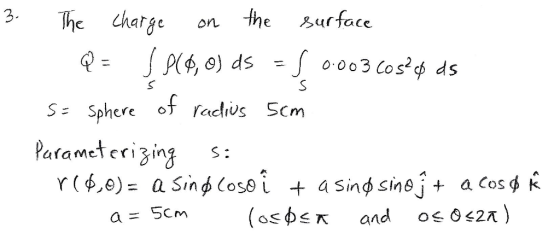
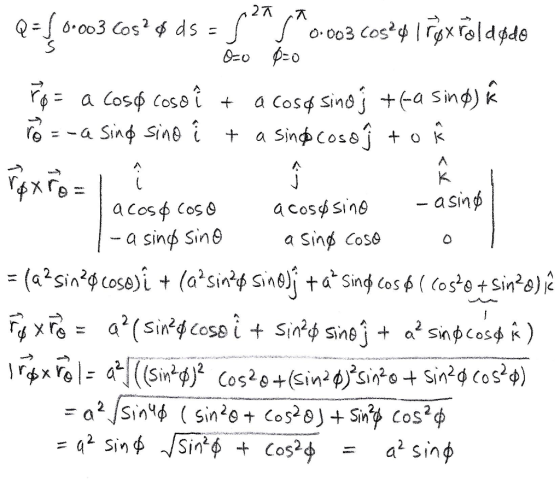
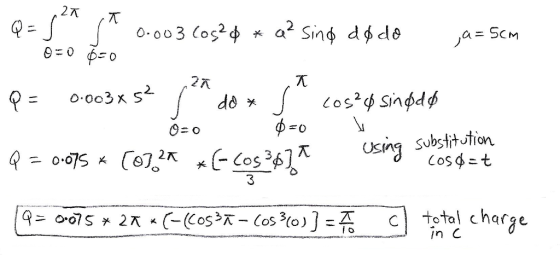
help please 3. Students were asking about applications of surface integrals in class last week. If S is a surface w...
Please solve all parts of this question clearly and neatly 1. Let S be part of the paraboloid z = 5-22-уг, z--3. Assume that the charge density of s is (x,y,2-7x +5 -z Coulombs per unit of surface ar...
 Please solve all parts of this question clearly and neatly
1. Let S be part of the paraboloid z = 5-22-уг, z--3. Assume that the charge density of s is (x,y,2-7x +5 -z Coulombs per unit of surface area. (a) Sketch S (b) Using a parametrisation based on cylindrical coordinates, determine a normal vector to S c) Using part (b), determine the total charge on S
1. Let S be part of the paraboloid z = 5-22-уг, z--3. Assume that...
Please solve all parts of this question clearly and neatly
1. Let S be part of the paraboloid z = 5-22-уг, z--3. Assume that the charge density of s is (x,y,2-7x +5 -z Coulombs per unit of surface area. (a) Sketch S (b) Using a parametrisation based on cylindrical coordinates, determine a normal vector to S c) Using part (b), determine the total charge on S
1. Let S be part of the paraboloid z = 5-22-уг, z--3. Assume that...
Help with question 2 1. what is the electric field at the centre (r = 0)...
 Help with question 2
1. what is the electric field at the centre (r = 0) of a hemisphere bounded by r = a, 0 < θ < π/2 and 0 < φ < 2m, that carries a uniform volumetric charge density P3(The charges are distributed in this hemispherical 3D space. Use spherical coordinates due to the hemispherical geometry.) Consider some charges that are lined up in a straight line. This line of charge carries a uniform linear charge density....
Help with question 2
1. what is the electric field at the centre (r = 0) of a hemisphere bounded by r = a, 0 < θ < π/2 and 0 < φ < 2m, that carries a uniform volumetric charge density P3(The charges are distributed in this hemispherical 3D space. Use spherical coordinates due to the hemispherical geometry.) Consider some charges that are lined up in a straight line. This line of charge carries a uniform linear charge density....
please check your answer x,y and z are measured in cm Let W be the solid between a hemisphere of radi us 3 and a hem...
 please check your answer
x,y and z are measured in cm
Let W be the solid between a hemisphere of radi us 3 and a hemisphere of radius 6, but not in the first octant (a) Suppose the density at a point (x, y, z) is proportional to the distance from the origin. Find a formula P(x,y, z) = (b) Use spherical coordinates to set up the integral to find the mass of W For instructor's notes only. Do not...
please check your answer
x,y and z are measured in cm
Let W be the solid between a hemisphere of radi us 3 and a hemisphere of radius 6, but not in the first octant (a) Suppose the density at a point (x, y, z) is proportional to the distance from the origin. Find a formula P(x,y, z) = (b) Use spherical coordinates to set up the integral to find the mass of W For instructor's notes only. Do not...
1. what is the electric field at the centre (r = 0) of a hemisphere bounded...
 1. what is the electric field at the centre (r = 0) of a hemisphere bounded by r = a, 0 < θ < π/2 and 0 < φ < 2m, that carries a uniform volumetric charge density P3(The charges are distributed in this hemispherical 3D space. Use spherical coordinates due to the hemispherical geometry.) Consider some charges that are lined up in a straight line. This line of charge carries a uniform linear charge density. Let's make Pl =...
Hi, I need help solving number 13. Please show all the steps, thank you. :) Consider the solid Q bounded by z-2-y2;z-tx at each point Р (x, y, z) is given by mass of Q [15 pts] 9. x-4. The density Z/...
 Hi, I need help solving number 13. Please show all the steps,
thank you. :)
Consider the solid Q bounded by z-2-y2;z-tx at each point Р (x, y, z) is given by mass of Q [15 pts] 9. x-4. The density Z/m 3 . Find the center of (x, y, z) [15 pts] 10. Evaluate the following integral: ee' dy dzdx [15 pts] 11. Use spherical coordinates to find the mass m of a solid Q that lies between the...
Hi, I need help solving number 13. Please show all the steps,
thank you. :)
Consider the solid Q bounded by z-2-y2;z-tx at each point Р (x, y, z) is given by mass of Q [15 pts] 9. x-4. The density Z/m 3 . Find the center of (x, y, z) [15 pts] 10. Evaluate the following integral: ee' dy dzdx [15 pts] 11. Use spherical coordinates to find the mass m of a solid Q that lies between the...
Need help solving this questions. I know it's a lot (I'm sorry in advance). I've solved...
 Need help solving this questions. I know it's a lot (I'm sorry
in advance). I've solved a couple but I'm not sure if I'm correct.
Please show all your work so I can follow along.
oooo Sprint 16:30 70% Done ee135-winter19-01.courses.soe MVV #1 Due: Tuesday, January 22. Q.1: Two volleyballs, mass 0.3 kg each, tethered by nylon strings and charged with an electrostatic generator, hang as shown in Fig. Q.1. What s the charge on each, assuming the charges are...
Need help solving this questions. I know it's a lot (I'm sorry
in advance). I've solved a couple but I'm not sure if I'm correct.
Please show all your work so I can follow along.
oooo Sprint 16:30 70% Done ee135-winter19-01.courses.soe MVV #1 Due: Tuesday, January 22. Q.1: Two volleyballs, mass 0.3 kg each, tethered by nylon strings and charged with an electrostatic generator, hang as shown in Fig. Q.1. What s the charge on each, assuming the charges are...
Physics 222 Name: Task 7: Electric Flux and Gauss's Law Objective: To illustrate the concept of...
 Physics 222 Name: Task 7: Electric Flux and Gauss's Law Objective: To illustrate the concept of "flux" and to avoid performing the integral in Gauss's Law for Electricity 1. A cylindrical Gaussian surface (length = 0.80 m, diameter = 0.20 m) is drawn in an area of a non-uniform electric field, directed at all points in the ex direction (i.e. horizontal to the right). The field varies with x, but does not vary with respect to y or z. The...
Consider a cylindrical capacitor like that shown in Fig. 24.6. Let d = rb − ra...
 Consider a cylindrical capacitor like that shown in Fig. 24.6. Let d = rb − ra be the spacing between the inner and outer conductors. (a) Let the radii of the two conductors be only slightly different, so that d << ra. Show that the result derived in Example 24.4 (Section 24.1) for the capacitance of a cylindrical capacitor then reduces to Eq. (24.2), the equation for the capacitance of a parallel-plate capacitor, with A being the surface area of...
Consider 1-2 Vr? + y + 3 LLL da dydar. V1-38-98 V +y + y2 +22...
 Consider 1-2 Vr? + y + 3 LLL da dydar. V1-38-98 V +y + y2 +22 +y +22-2 the origin to the point (2, y, ) makes with the z-axis is a new angle which we will label o, and we label the length of the line segment p. We can now determine the remaining side-lengths of our new triangle. Let us try to label our point (2, y, z) in only p and 6. Our labeled triangle gives us...
Work out the highlighted questions (3-6) clearly and with units, please. Thanks! 4/5 a the minimum...
 Work out the highlighted questions (3-6) clearly and with
units, please. Thanks!
4/5 a the minimum kinetic energy at the apping point? (C) Use conservation of energy to determine the minimum angular velocity of the block just after the collision, (d) then use conservation of angular momentum during the collision to find the initial speed of the bullet vo. (Hint: Ignore the mass of the bullet after the collision. The moment of inertia of the cube about its bottom-right edge...
Work out the highlighted questions (3-6) clearly and with
units, please. Thanks!
4/5 a the minimum kinetic energy at the apping point? (C) Use conservation of energy to determine the minimum angular velocity of the block just after the collision, (d) then use conservation of angular momentum during the collision to find the initial speed of the bullet vo. (Hint: Ignore the mass of the bullet after the collision. The moment of inertia of the cube about its bottom-right edge...
 Please solve all parts of this question clearly and neatly
1. Let S be part of the paraboloid z = 5-22-уг, z--3. Assume that the charge density of s is (x,y,2-7x +5 -z Coulombs per unit of surface area. (a) Sketch S (b) Using a parametrisation based on cylindrical coordinates, determine a normal vector to S c) Using part (b), determine the total charge on S
1. Let S be part of the paraboloid z = 5-22-уг, z--3. Assume that...
Please solve all parts of this question clearly and neatly
1. Let S be part of the paraboloid z = 5-22-уг, z--3. Assume that the charge density of s is (x,y,2-7x +5 -z Coulombs per unit of surface area. (a) Sketch S (b) Using a parametrisation based on cylindrical coordinates, determine a normal vector to S c) Using part (b), determine the total charge on S
1. Let S be part of the paraboloid z = 5-22-уг, z--3. Assume that...
 Help with question 2
1. what is the electric field at the centre (r = 0) of a hemisphere bounded by r = a, 0 < θ < π/2 and 0 < φ < 2m, that carries a uniform volumetric charge density P3(The charges are distributed in this hemispherical 3D space. Use spherical coordinates due to the hemispherical geometry.) Consider some charges that are lined up in a straight line. This line of charge carries a uniform linear charge density....
Help with question 2
1. what is the electric field at the centre (r = 0) of a hemisphere bounded by r = a, 0 < θ < π/2 and 0 < φ < 2m, that carries a uniform volumetric charge density P3(The charges are distributed in this hemispherical 3D space. Use spherical coordinates due to the hemispherical geometry.) Consider some charges that are lined up in a straight line. This line of charge carries a uniform linear charge density....
 please check your answer
x,y and z are measured in cm
Let W be the solid between a hemisphere of radi us 3 and a hemisphere of radius 6, but not in the first octant (a) Suppose the density at a point (x, y, z) is proportional to the distance from the origin. Find a formula P(x,y, z) = (b) Use spherical coordinates to set up the integral to find the mass of W For instructor's notes only. Do not...
please check your answer
x,y and z are measured in cm
Let W be the solid between a hemisphere of radi us 3 and a hemisphere of radius 6, but not in the first octant (a) Suppose the density at a point (x, y, z) is proportional to the distance from the origin. Find a formula P(x,y, z) = (b) Use spherical coordinates to set up the integral to find the mass of W For instructor's notes only. Do not...
 1. what is the electric field at the centre (r = 0) of a hemisphere bounded by r = a, 0 < θ < π/2 and 0 < φ < 2m, that carries a uniform volumetric charge density P3(The charges are distributed in this hemispherical 3D space. Use spherical coordinates due to the hemispherical geometry.) Consider some charges that are lined up in a straight line. This line of charge carries a uniform linear charge density. Let's make Pl =...
 Hi, I need help solving number 13. Please show all the steps,
thank you. :)
Consider the solid Q bounded by z-2-y2;z-tx at each point Р (x, y, z) is given by mass of Q [15 pts] 9. x-4. The density Z/m 3 . Find the center of (x, y, z) [15 pts] 10. Evaluate the following integral: ee' dy dzdx [15 pts] 11. Use spherical coordinates to find the mass m of a solid Q that lies between the...
Hi, I need help solving number 13. Please show all the steps,
thank you. :)
Consider the solid Q bounded by z-2-y2;z-tx at each point Р (x, y, z) is given by mass of Q [15 pts] 9. x-4. The density Z/m 3 . Find the center of (x, y, z) [15 pts] 10. Evaluate the following integral: ee' dy dzdx [15 pts] 11. Use spherical coordinates to find the mass m of a solid Q that lies between the...
 Need help solving this questions. I know it's a lot (I'm sorry
in advance). I've solved a couple but I'm not sure if I'm correct.
Please show all your work so I can follow along.
oooo Sprint 16:30 70% Done ee135-winter19-01.courses.soe MVV #1 Due: Tuesday, January 22. Q.1: Two volleyballs, mass 0.3 kg each, tethered by nylon strings and charged with an electrostatic generator, hang as shown in Fig. Q.1. What s the charge on each, assuming the charges are...
Need help solving this questions. I know it's a lot (I'm sorry
in advance). I've solved a couple but I'm not sure if I'm correct.
Please show all your work so I can follow along.
oooo Sprint 16:30 70% Done ee135-winter19-01.courses.soe MVV #1 Due: Tuesday, January 22. Q.1: Two volleyballs, mass 0.3 kg each, tethered by nylon strings and charged with an electrostatic generator, hang as shown in Fig. Q.1. What s the charge on each, assuming the charges are...
 Physics 222 Name: Task 7: Electric Flux and Gauss's Law Objective: To illustrate the concept of "flux" and to avoid performing the integral in Gauss's Law for Electricity 1. A cylindrical Gaussian surface (length = 0.80 m, diameter = 0.20 m) is drawn in an area of a non-uniform electric field, directed at all points in the ex direction (i.e. horizontal to the right). The field varies with x, but does not vary with respect to y or z. The...
 Consider a cylindrical capacitor like that shown in Fig. 24.6. Let d = rb − ra be the spacing between the inner and outer conductors. (a) Let the radii of the two conductors be only slightly different, so that d << ra. Show that the result derived in Example 24.4 (Section 24.1) for the capacitance of a cylindrical capacitor then reduces to Eq. (24.2), the equation for the capacitance of a parallel-plate capacitor, with A being the surface area of...
 Consider 1-2 Vr? + y + 3 LLL da dydar. V1-38-98 V +y + y2 +22 +y +22-2 the origin to the point (2, y, ) makes with the z-axis is a new angle which we will label o, and we label the length of the line segment p. We can now determine the remaining side-lengths of our new triangle. Let us try to label our point (2, y, z) in only p and 6. Our labeled triangle gives us...
 Work out the highlighted questions (3-6) clearly and with
units, please. Thanks!
4/5 a the minimum kinetic energy at the apping point? (C) Use conservation of energy to determine the minimum angular velocity of the block just after the collision, (d) then use conservation of angular momentum during the collision to find the initial speed of the bullet vo. (Hint: Ignore the mass of the bullet after the collision. The moment of inertia of the cube about its bottom-right edge...
Work out the highlighted questions (3-6) clearly and with
units, please. Thanks!
4/5 a the minimum kinetic energy at the apping point? (C) Use conservation of energy to determine the minimum angular velocity of the block just after the collision, (d) then use conservation of angular momentum during the collision to find the initial speed of the bullet vo. (Hint: Ignore the mass of the bullet after the collision. The moment of inertia of the cube about its bottom-right edge...
Most questions answered within 3 hours.
-
Where is the error in this code sequence?
String s1 = "Hello";
String s2 = "ello";...
asked 10 months ago -
Financial data for Joel de Paris, Inc., for last year
follow:
Joel de Paris, Inc.
Balance...
asked 10 months ago -
Consider this reaction:
Al2(SO4)3 (aq)+ BaCl3
(aq) Al2Cl6 (aq)- +
3BaSO4(s) . What is the...
asked 10 months ago -
Suppose that Savneet is considering increasing her
recent random sample from 20 car rentals to 40...
asked 10 months ago -
Trucks arrive at an unloading terminal at an average rate of 120
per hour.
Trucks arrive...
asked 10 months ago -
Why are methanol and ethanol completely soluble in water while
octanol is not very little soluble....
asked 10 months ago -
A facilities manager at a university reads in a research report
that the mean amount of...
asked 10 months ago -
When the CuSO4 is rehydrated by adding water to the anhydrous
compound, is this an endothermic...
asked 10 months ago -
A ray of sunlight is passing from diamond into crown glass; the
angle of incidence is...
asked 10 months ago -
A block of mass 0.249 kg is placed on top of a light, vertical
spring of...
asked 10 months ago -
how do the kidneys compensate in the presences of acidosis
a) trigger hyperventilate
b) reserve acid...
asked 10 months ago -
Question 501 pts
The rental rate of capital to the firm increases. Which of the
following...
asked 10 months ago