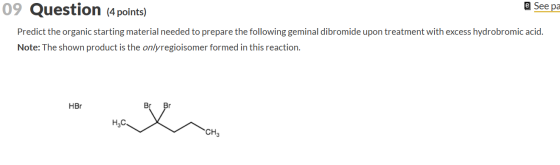
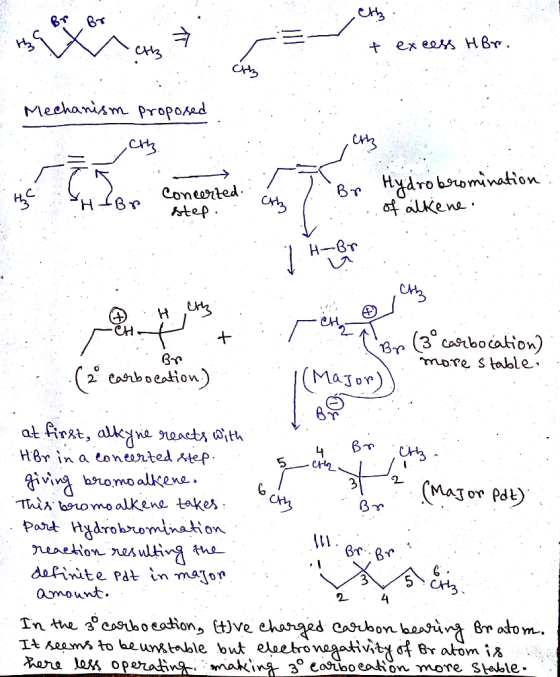
 PLEASE SHOW ALL WORK AND
PLEASE ANSWER ALL PARTS OF EACH QUESTION! Thank you!
PLEASE SHOW ALL WORK AND
PLEASE ANSWER ALL PARTS OF EACH QUESTION! Thank you!
Homework Answers
Add Answer to:
PLEASE SHOW ALL WORK AND PLEASE ANSWER ALL PARTS OF EACH QUESTION! Thank you! 06 Question (4 points) e See page 574 Comp...
please help aSee page 574 06 Question (4 points) Complete the mechanism. All necessary atoms and bonds (that is, tho...
 please help
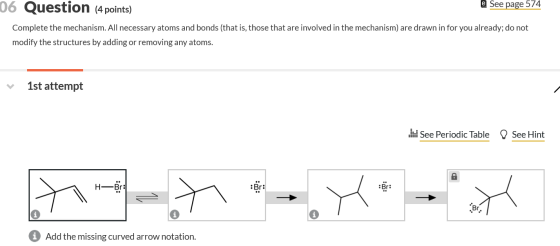
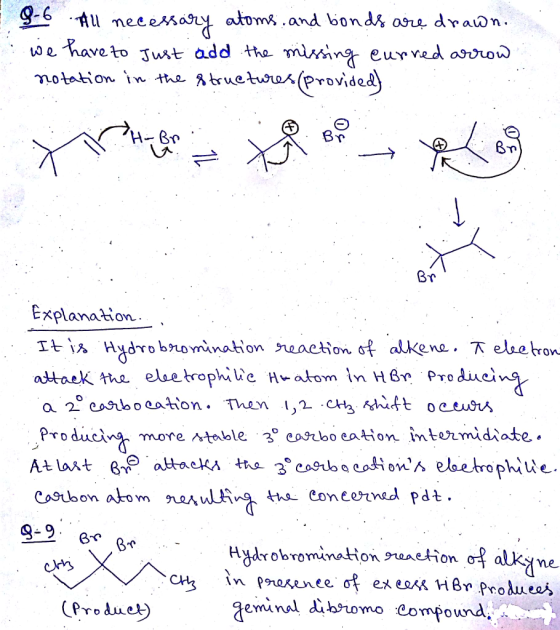
aSee page 574 06 Question (4 points) Complete the mechanism. All necessary atoms and bonds (that is, those that are involved in the mechanism) are drawn in for you already; do not modify the structures by adding or removing any atoms. 2nd attempt d See Periodic Table See Hint Feedback 1st attempt
please help
aSee page 574 06 Question (4 points) Complete the mechanism. All necessary atoms and bonds (that is, those that are involved in the mechanism) are drawn in for you already; do not modify the structures by adding or removing any atoms. 2nd attempt d See Periodic Table See Hint Feedback 1st attempt
6 Question (points) See page 574 Complete the mechanism. All necessary atoms and bonds (i.e. those...
 6 Question (points) See page 574 Complete the mechanism. All necessary atoms and bonds (i.e. those that are involved in the mechanism) are drawn in for you already; do NOT modify the structures by adding or removing any atoms. 2nd attempt See Periodic Table See Hint H CIE
e See page 574 Complete the mechanism. All necessary atoms and bonds (that is, those that...
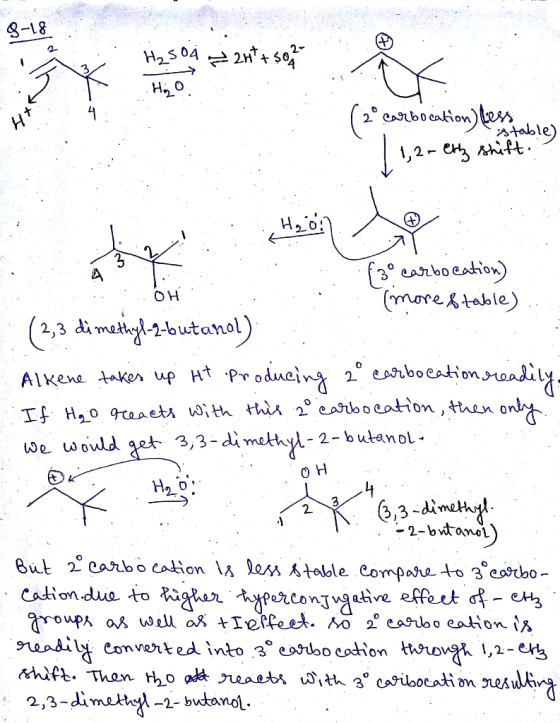
 e See page 574 Complete the mechanism. All necessary atoms and bonds (that is, those that are involved in the mechanism) are drawn in for you already: do not modify the structures by adding or removing any atoms Solution Explanation See Hint See page 569 15 Question (4points) The alkyl chloride shown could be the result of treating different alkenes with HCI. In the box below, dravw all the alkenes that, when treated with HCI, will generate the product shown....
Quickly show all steps and answers all parts of the question please thank you 3. In...
 Quickly show all steps and
answers all parts of the question please thank you
3. In the deuterium-labeled compound below predict the product(s) of the elimination reaction of the following elimination reaction and tell whether the alkene formed contains deuterium or not. (20 pts) HCCH; OH H2SO4(aq) heat н,с (ii) NaOCH.CH CH,CH,OH heat CH3 (iii) Write a detail mechanism for the formation of the product in question 3(i).
Quickly show all steps and
answers all parts of the question please thank you
3. In the deuterium-labeled compound below predict the product(s) of the elimination reaction of the following elimination reaction and tell whether the alkene formed contains deuterium or not. (20 pts) HCCH; OH H2SO4(aq) heat н,с (ii) NaOCH.CH CH,CH,OH heat CH3 (iii) Write a detail mechanism for the formation of the product in question 3(i).
Quickly show all steps and answers all parts of the question please thank you 6. For...
 Quickly show all steps and
answers all parts of the question please thank you
6. For the following reactions tell whether they will react under Syl condition (EtOH, heat), SN2 condition (Nal/acetone) or neither. Also indicate the product formed if any. (10 points) Mechanism Product (SN1 or SN2) 11. Tso H₃Ct iv. НАС HC CHE
Quickly show all steps and
answers all parts of the question please thank you
6. For the following reactions tell whether they will react under Syl condition (EtOH, heat), SN2 condition (Nal/acetone) or neither. Also indicate the product formed if any. (10 points) Mechanism Product (SN1 or SN2) 11. Tso H₃Ct iv. НАС HC CHE
please answer all parts of this question thank you 4. Consider each of the following solvents individually: i) NH2CH...
 please answer all parts of this question thank you
4. Consider each of the following solvents individually: i) NH2CH3 ii) CF3COOH iii) H2SO4. a. Give the equation for the autoionization of the pure solvent. b. Discuss what will happen if H20 is dissolved in each of the solvents, i.e., what ions will form. Give appropriate equations. Will the solution be acidic or basic with respect to the pure solvent? Will the solute act as a weak or a strong acid...
please answer all parts of this question thank you
4. Consider each of the following solvents individually: i) NH2CH3 ii) CF3COOH iii) H2SO4. a. Give the equation for the autoionization of the pure solvent. b. Discuss what will happen if H20 is dissolved in each of the solvents, i.e., what ions will form. Give appropriate equations. Will the solution be acidic or basic with respect to the pure solvent? Will the solute act as a weak or a strong acid...
Quickly show all steps and answers all parts of the question please thank you 2. Show...
 Quickly show all steps and answers all parts of the question
please thank you
2. Show the step by step mechanism to account for the following transformation. Also predict the major product formed. (20 points) CH3 OH conc. HBO CH₂ H₂CX Br CH₂ H3C CHE H₃C CH Swi condition Br L CH3 CH3 H₃C HC X X
Quickly show all steps and answers all parts of the question
please thank you
2. Show the step by step mechanism to account for the following transformation. Also predict the major product formed. (20 points) CH3 OH conc. HBO CH₂ H₂CX Br CH₂ H3C CHE H₃C CH Swi condition Br L CH3 CH3 H₃C HC X X
Quickly show all steps and answers all parts of the question please thank you 5. Predict...
 Quickly show all steps and answers
all parts of the question please thank you
5. Predict the eliminations products A and B formed (E-1 mechanism) when 4,4-dimethylhexan- 3-ol is heated with concentrated phosphoric acid. Also, identify the rate determining step and the major product using Zaitsev's Rule? (Mechanism must be shown to receive full points) (20 pts) он conc. H3PO4 CH3 Products A and B нас E-1 condition HzC CH3 4,4-dimethylhexan-3-ol
Quickly show all steps and answers
all parts of the question please thank you
5. Predict the eliminations products A and B formed (E-1 mechanism) when 4,4-dimethylhexan- 3-ol is heated with concentrated phosphoric acid. Also, identify the rate determining step and the major product using Zaitsev's Rule? (Mechanism must be shown to receive full points) (20 pts) он conc. H3PO4 CH3 Products A and B нас E-1 condition HzC CH3 4,4-dimethylhexan-3-ol
please show all work and answer both questions! 20 Question (4 points) Predict the major product...
 please show all work and answer both questions!
20 Question (4 points) Predict the major product of the following reaction. НСІ 21 Question (4 points) In the box below, draw the alkene that reacts with HCl to form 1-chlorocyclopentane. ? HCI
please show all work and answer both questions!
20 Question (4 points) Predict the major product of the following reaction. НСІ 21 Question (4 points) In the box below, draw the alkene that reacts with HCl to form 1-chlorocyclopentane. ? HCI
please show work, thank you. Question #4: (25 points total) In this problem, you are going...
 please show work, thank you.
Question #4: (25 points total) In this problem, you are going to walk you through a brief history of quantum mechanics apply the principles of quantum mechanics to a physical system (free electron) 1900 Planck's quantization of light: light with frequency v is emitted in multiples of E hv where h 6.63x10-341.s (Planck's constant), and h =hw h 1905 Einstein postulated that the quantization of light corresponded to particles, now called photons. This was the...
please show work, thank you.
Question #4: (25 points total) In this problem, you are going to walk you through a brief history of quantum mechanics apply the principles of quantum mechanics to a physical system (free electron) 1900 Planck's quantization of light: light with frequency v is emitted in multiples of E hv where h 6.63x10-341.s (Planck's constant), and h =hw h 1905 Einstein postulated that the quantization of light corresponded to particles, now called photons. This was the...
 please help
aSee page 574 06 Question (4 points) Complete the mechanism. All necessary atoms and bonds (that is, those that are involved in the mechanism) are drawn in for you already; do not modify the structures by adding or removing any atoms. 2nd attempt d See Periodic Table See Hint Feedback 1st attempt
please help
aSee page 574 06 Question (4 points) Complete the mechanism. All necessary atoms and bonds (that is, those that are involved in the mechanism) are drawn in for you already; do not modify the structures by adding or removing any atoms. 2nd attempt d See Periodic Table See Hint Feedback 1st attempt
 6 Question (points) See page 574 Complete the mechanism. All necessary atoms and bonds (i.e. those that are involved in the mechanism) are drawn in for you already; do NOT modify the structures by adding or removing any atoms. 2nd attempt See Periodic Table See Hint H CIE
 e See page 574 Complete the mechanism. All necessary atoms and bonds (that is, those that are involved in the mechanism) are drawn in for you already: do not modify the structures by adding or removing any atoms Solution Explanation See Hint See page 569 15 Question (4points) The alkyl chloride shown could be the result of treating different alkenes with HCI. In the box below, dravw all the alkenes that, when treated with HCI, will generate the product shown....
 Quickly show all steps and
answers all parts of the question please thank you
3. In the deuterium-labeled compound below predict the product(s) of the elimination reaction of the following elimination reaction and tell whether the alkene formed contains deuterium or not. (20 pts) HCCH; OH H2SO4(aq) heat н,с (ii) NaOCH.CH CH,CH,OH heat CH3 (iii) Write a detail mechanism for the formation of the product in question 3(i).
Quickly show all steps and
answers all parts of the question please thank you
3. In the deuterium-labeled compound below predict the product(s) of the elimination reaction of the following elimination reaction and tell whether the alkene formed contains deuterium or not. (20 pts) HCCH; OH H2SO4(aq) heat н,с (ii) NaOCH.CH CH,CH,OH heat CH3 (iii) Write a detail mechanism for the formation of the product in question 3(i).
 Quickly show all steps and
answers all parts of the question please thank you
6. For the following reactions tell whether they will react under Syl condition (EtOH, heat), SN2 condition (Nal/acetone) or neither. Also indicate the product formed if any. (10 points) Mechanism Product (SN1 or SN2) 11. Tso H₃Ct iv. НАС HC CHE
Quickly show all steps and
answers all parts of the question please thank you
6. For the following reactions tell whether they will react under Syl condition (EtOH, heat), SN2 condition (Nal/acetone) or neither. Also indicate the product formed if any. (10 points) Mechanism Product (SN1 or SN2) 11. Tso H₃Ct iv. НАС HC CHE
 please answer all parts of this question thank you
4. Consider each of the following solvents individually: i) NH2CH3 ii) CF3COOH iii) H2SO4. a. Give the equation for the autoionization of the pure solvent. b. Discuss what will happen if H20 is dissolved in each of the solvents, i.e., what ions will form. Give appropriate equations. Will the solution be acidic or basic with respect to the pure solvent? Will the solute act as a weak or a strong acid...
please answer all parts of this question thank you
4. Consider each of the following solvents individually: i) NH2CH3 ii) CF3COOH iii) H2SO4. a. Give the equation for the autoionization of the pure solvent. b. Discuss what will happen if H20 is dissolved in each of the solvents, i.e., what ions will form. Give appropriate equations. Will the solution be acidic or basic with respect to the pure solvent? Will the solute act as a weak or a strong acid...
 Quickly show all steps and answers all parts of the question
please thank you
2. Show the step by step mechanism to account for the following transformation. Also predict the major product formed. (20 points) CH3 OH conc. HBO CH₂ H₂CX Br CH₂ H3C CHE H₃C CH Swi condition Br L CH3 CH3 H₃C HC X X
Quickly show all steps and answers all parts of the question
please thank you
2. Show the step by step mechanism to account for the following transformation. Also predict the major product formed. (20 points) CH3 OH conc. HBO CH₂ H₂CX Br CH₂ H3C CHE H₃C CH Swi condition Br L CH3 CH3 H₃C HC X X
 Quickly show all steps and answers
all parts of the question please thank you
5. Predict the eliminations products A and B formed (E-1 mechanism) when 4,4-dimethylhexan- 3-ol is heated with concentrated phosphoric acid. Also, identify the rate determining step and the major product using Zaitsev's Rule? (Mechanism must be shown to receive full points) (20 pts) он conc. H3PO4 CH3 Products A and B нас E-1 condition HzC CH3 4,4-dimethylhexan-3-ol
Quickly show all steps and answers
all parts of the question please thank you
5. Predict the eliminations products A and B formed (E-1 mechanism) when 4,4-dimethylhexan- 3-ol is heated with concentrated phosphoric acid. Also, identify the rate determining step and the major product using Zaitsev's Rule? (Mechanism must be shown to receive full points) (20 pts) он conc. H3PO4 CH3 Products A and B нас E-1 condition HzC CH3 4,4-dimethylhexan-3-ol
 please show all work and answer both questions!
20 Question (4 points) Predict the major product of the following reaction. НСІ 21 Question (4 points) In the box below, draw the alkene that reacts with HCl to form 1-chlorocyclopentane. ? HCI
please show all work and answer both questions!
20 Question (4 points) Predict the major product of the following reaction. НСІ 21 Question (4 points) In the box below, draw the alkene that reacts with HCl to form 1-chlorocyclopentane. ? HCI
 please show work, thank you.
Question #4: (25 points total) In this problem, you are going to walk you through a brief history of quantum mechanics apply the principles of quantum mechanics to a physical system (free electron) 1900 Planck's quantization of light: light with frequency v is emitted in multiples of E hv where h 6.63x10-341.s (Planck's constant), and h =hw h 1905 Einstein postulated that the quantization of light corresponded to particles, now called photons. This was the...
please show work, thank you.
Question #4: (25 points total) In this problem, you are going to walk you through a brief history of quantum mechanics apply the principles of quantum mechanics to a physical system (free electron) 1900 Planck's quantization of light: light with frequency v is emitted in multiples of E hv where h 6.63x10-341.s (Planck's constant), and h =hw h 1905 Einstein postulated that the quantization of light corresponded to particles, now called photons. This was the...
Most questions answered within 3 hours.
-
Where is the error in this code sequence?
String s1 = "Hello";
String s2 = "ello";...
asked 10 months ago -
Financial data for Joel de Paris, Inc., for last year
follow:
Joel de Paris, Inc.
Balance...
asked 10 months ago -
Consider this reaction:
Al2(SO4)3 (aq)+ BaCl3
(aq) Al2Cl6 (aq)- +
3BaSO4(s) . What is the...
asked 10 months ago -
Suppose that Savneet is considering increasing her
recent random sample from 20 car rentals to 40...
asked 10 months ago -
Trucks arrive at an unloading terminal at an average rate of 120
per hour.
Trucks arrive...
asked 10 months ago -
Why are methanol and ethanol completely soluble in water while
octanol is not very little soluble....
asked 10 months ago -
A facilities manager at a university reads in a research report
that the mean amount of...
asked 10 months ago -
When the CuSO4 is rehydrated by adding water to the anhydrous
compound, is this an endothermic...
asked 10 months ago -
A ray of sunlight is passing from diamond into crown glass; the
angle of incidence is...
asked 10 months ago -
A block of mass 0.249 kg is placed on top of a light, vertical
spring of...
asked 10 months ago -
how do the kidneys compensate in the presences of acidosis
a) trigger hyperventilate
b) reserve acid...
asked 10 months ago -
Question 501 pts
The rental rate of capital to the firm increases. Which of the
following...
asked 10 months ago