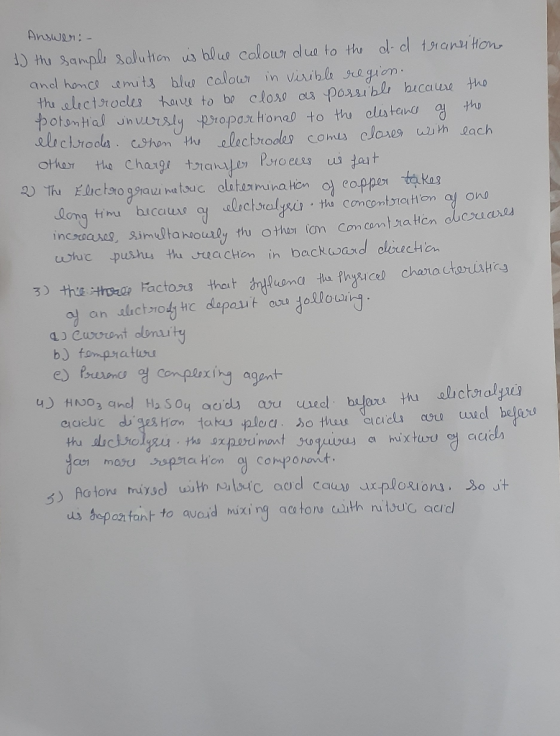
Electrogravimetric determination of Copper: 1. Why the sample solution is blue colored? Why do the electrodes have t...
Homework Answers
Add Answer to:
Electrogravimetric determination of Copper: 1. Why the sample solution is blue colored? Why do the electrodes have t...
PRELABORATORY EXCERSICE 1. Using the available texts, describe three mechanisms responsible for the transport of dissolved...
 PRELABORATORY EXCERSICE 1. Using the available texts, describe three mechanisms responsible for the transport of dissolved species to and from an electrode surface. 2. What experimental variables affect concentration polarization in an electrochemical cell? 3. Identify three experimental factors that influence the physical characteristics of an electrolytic deposit. What is an acidic digestion and what it models? Why it is important in this experiment? 5. Why is important to rinse the Cu-coated electrodes with acetone and what precautions are needed...
1 Reaction C: Copper(II) Hydroxide to Copper(IT) Oxide Observations: The solntich goes from a light blue...
 1 Reaction C: Copper(II) Hydroxide to Copper(IT) Oxide Observations: The solntich goes from a light blue to a dark blue. when heated the solution turns to a green/black color. Balanced Molecular Equation: Balanced Net lonie Equation: Reaction D: Copper(IT) Oxide to Copper(II) Sulfate Observations: "The back sond is dissolved in the acid. This creates a light blue / Clear solurich Balanced Molecular Equation: Balanced Net Ionic Equation: Reaction E: Copper(II) Sulfate to Copper Metal (and Dissolution of excess Mg) Observations:...
 PRELABORATORY EXCERSICE 1. Using the available texts, describe three mechanisms responsible for the transport of dissolved species to and from an electrode surface. 2. What experimental variables affect concentration polarization in an electrochemical cell? 3. Identify three experimental factors that influence the physical characteristics of an electrolytic deposit. What is an acidic digestion and what it models? Why it is important in this experiment? 5. Why is important to rinse the Cu-coated electrodes with acetone and what precautions are needed...
 1 Reaction C: Copper(II) Hydroxide to Copper(IT) Oxide Observations: The solntich goes from a light blue to a dark blue. when heated the solution turns to a green/black color. Balanced Molecular Equation: Balanced Net lonie Equation: Reaction D: Copper(IT) Oxide to Copper(II) Sulfate Observations: "The back sond is dissolved in the acid. This creates a light blue / Clear solurich Balanced Molecular Equation: Balanced Net Ionic Equation: Reaction E: Copper(II) Sulfate to Copper Metal (and Dissolution of excess Mg) Observations:...
Most questions answered within 3 hours.
-
Where is the error in this code sequence?
String s1 = "Hello";
String s2 = "ello";...
asked 10 months ago -
Financial data for Joel de Paris, Inc., for last year
follow:
Joel de Paris, Inc.
Balance...
asked 10 months ago -
Consider this reaction:
Al2(SO4)3 (aq)+ BaCl3
(aq) Al2Cl6 (aq)- +
3BaSO4(s) . What is the...
asked 10 months ago -
Suppose that Savneet is considering increasing her
recent random sample from 20 car rentals to 40...
asked 10 months ago -
Trucks arrive at an unloading terminal at an average rate of 120
per hour.
Trucks arrive...
asked 10 months ago -
Why are methanol and ethanol completely soluble in water while
octanol is not very little soluble....
asked 10 months ago -
A facilities manager at a university reads in a research report
that the mean amount of...
asked 10 months ago -
When the CuSO4 is rehydrated by adding water to the anhydrous
compound, is this an endothermic...
asked 10 months ago -
A ray of sunlight is passing from diamond into crown glass; the
angle of incidence is...
asked 10 months ago -
A block of mass 0.249 kg is placed on top of a light, vertical
spring of...
asked 10 months ago -
how do the kidneys compensate in the presences of acidosis
a) trigger hyperventilate
b) reserve acid...
asked 10 months ago -
Question 501 pts
The rental rate of capital to the firm increases. Which of the
following...
asked 10 months ago