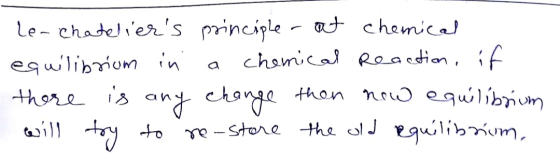
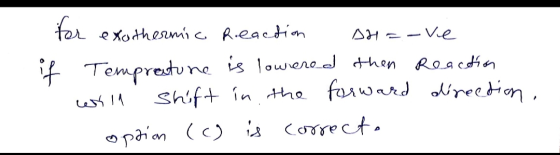
11. When the temperature is lowered to an equilibrium reaction: a. the reaction moves to the side where there are the gr...
11. When the temperature is lowered to an equilibrium reaction:
a. the reaction moves to the side where there are the greatest number of moles
b. the reaction will shift to the side of the products
c. the reaction will shift to the side of the exothermic reaction
d. the reaction will shift to the side of the endothermic reaction
Homework Answers
Add Answer to:
11. When the temperature is lowered to an equilibrium reaction: a. the reaction moves to the side where there are the gr...
A reaction at equilibrium is observed to shift left towards reactants when the temperature is increased....
A reaction at equilibrium is observed to shift left towards reactants when the temperature is increased. Based on this observation, is the reaction exothermic or endothermic? Briefly explain.
17. By increasing the temperature at an equilibrium reaction: a. the reaction will move towards the...
17. By increasing the temperature at an equilibrium reaction: a. the reaction will move towards the endothermic reaction b. the reaction speed constant is reduced c. the reaction is accelerated as the number of sites where the reaction can occur increases d. the exothermic reaction is favored
Q(22) Kp=Kc when? A) The reaction is at equilibrium B) The reaction is exothermic C) The reaction is endothermic D)...
 Q(22) Kp=Kc when? A) The reaction is at equilibrium B) The reaction is exothermic C) The reaction is endothermic D) all of the gasses present are at the same temperature E) the number of moles of gas on both sides of the balanced equation is the same. Q(23) HAH +A at the equilibrium (HA) = 1.65* 10-2 M and [H") = (A-) = 5.44*10-4 M at equilibrium. Kc = A) 1.7 X 10⁻¹ C) 1.7 X 10³ D) 1.7 X...
Name: 1. An exothermic reaction is allowed to reach equilibrium. If the temperature of the reaction...
 Name: 1. An exothermic reaction is allowed to reach equilibrium. If the temperature of the reaction mixture is decreased, the equilibrium will shift towards the product side: True False [1pt] 2. For the reaction C(s) + H2O(g) CO(g) + H2(g) a decrease in concentration of C(s) will cause the reaction to shift to the left oTrue False [1pt] 3. Define the following terms: [1.5pts] a. Activation Energy b. Exothermic Reaction c. Equilibrium [1p) 4. Determine the equilibrium constant K C(s)...
The equilibrium constant for a given reaction a. always increases with temperature. b. increases with temperature...
 The equilibrium constant for a given reaction a. always increases with temperature. b. increases with temperature for endothermic reactions only. c. increases with temperature for exothermic reactions only. d. does not change with temperature. e. always decreases with temperature.
Chemistry 202 Worksheet -Equilibrium Worksheet Grade: Name: K,= POP" Key concepts 1. Equilibrium is the state...
 Chemistry 202 Worksheet -Equilibrium Worksheet Grade: Name: K,= POP" Key concepts 1. Equilibrium is the state at which the concentrations of the reactants and products remain constant over time. Equilibrium is often defined in terms of Ke or Kp, the equilibrium constants in terms of concentration or partial pressure, respectively. For aA + bB - C + dD: [C]*[D]" [A]"[B]" The two constants are related to each other for a given reaction by: K = K (RT).. (Use R =...
Q(18) NI(CO)49) - Ni(s) + 4 CO(g)Adding nickel (solid) to this reaction will cause the equilibrium...
 Q(18) NI(CO)49) - Ni(s) + 4 CO(g)Adding nickel (solid) to this reaction will cause the equilibrium to A) Shift toward the products B) Shift toward the reactants C) remain unchanged D) increase the temperature E) it depends on the amount added Q(19) CO2 + H2 -CO + H2O Adding a catalyst to this reaction will cause the COD at equilibrium to A) Shift toward the products B) Shift toward the reactants C) remain unchanged D) increase the temperature E) it...
20. If K =(0.92) at a (150°C) for the equilibrium reaction: CO(g) + 3H2(g) CH(g) +...
 20. If K =(0.92) at a (150°C) for the equilibrium reaction: CO(g) + 3H2(g) CH(g) + H2O(g) The K of the reaction is : A) 5.63x 10⁴ B) 2.32 x10+ C) 4.20 x10⁵ D ) 3.29 x 10⁹. Putor (*): 1. Reaction in which entire amount of the reactants is not converted into products is termed as reversible reaction ( ). 2. For exothermic reactions raising the temperature causes a shift to the right (X). 3. If the number of...
3. If the equilibrium constant for a chemical reaction decreases as the temperature is increases from...
 3. If the equilibrium constant for a chemical reaction decreases as the temperature is increases from room temperature to 100 degrees C, would the reaction be exothermic of endothermic? Why?
All questions are true or false A catalyst changes both the equilibrium constant and the rate...
 All
questions are true or false
A catalyst changes both the equilibrium constant and the rate of a chemical equilibrium. j. Ifthe temperature of a chemical equilibrium is increased, the reaction will shift in a direction that will lead to the consumption of some of the extra heat. An increase in temperature favors an endothermic reaction over an exothermic reaction. k. nundifis Is ined If a chemical equilibrium is exothermic in the forward direction, it is also exothermic in the...
All
questions are true or false
A catalyst changes both the equilibrium constant and the rate of a chemical equilibrium. j. Ifthe temperature of a chemical equilibrium is increased, the reaction will shift in a direction that will lead to the consumption of some of the extra heat. An increase in temperature favors an endothermic reaction over an exothermic reaction. k. nundifis Is ined If a chemical equilibrium is exothermic in the forward direction, it is also exothermic in the...
 Q(22) Kp=Kc when? A) The reaction is at equilibrium B) The reaction is exothermic C) The reaction is endothermic D) all of the gasses present are at the same temperature E) the number of moles of gas on both sides of the balanced equation is the same. Q(23) HAH +A at the equilibrium (HA) = 1.65* 10-2 M and [H") = (A-) = 5.44*10-4 M at equilibrium. Kc = A) 1.7 X 10⁻¹ C) 1.7 X 10³ D) 1.7 X...
 Name: 1. An exothermic reaction is allowed to reach equilibrium. If the temperature of the reaction mixture is decreased, the equilibrium will shift towards the product side: True False [1pt] 2. For the reaction C(s) + H2O(g) CO(g) + H2(g) a decrease in concentration of C(s) will cause the reaction to shift to the left oTrue False [1pt] 3. Define the following terms: [1.5pts] a. Activation Energy b. Exothermic Reaction c. Equilibrium [1p) 4. Determine the equilibrium constant K C(s)...
 The equilibrium constant for a given reaction a. always increases with temperature. b. increases with temperature for endothermic reactions only. c. increases with temperature for exothermic reactions only. d. does not change with temperature. e. always decreases with temperature.
 Chemistry 202 Worksheet -Equilibrium Worksheet Grade: Name: K,= POP" Key concepts 1. Equilibrium is the state at which the concentrations of the reactants and products remain constant over time. Equilibrium is often defined in terms of Ke or Kp, the equilibrium constants in terms of concentration or partial pressure, respectively. For aA + bB - C + dD: [C]*[D]" [A]"[B]" The two constants are related to each other for a given reaction by: K = K (RT).. (Use R =...
 Q(18) NI(CO)49) - Ni(s) + 4 CO(g)Adding nickel (solid) to this reaction will cause the equilibrium to A) Shift toward the products B) Shift toward the reactants C) remain unchanged D) increase the temperature E) it depends on the amount added Q(19) CO2 + H2 -CO + H2O Adding a catalyst to this reaction will cause the COD at equilibrium to A) Shift toward the products B) Shift toward the reactants C) remain unchanged D) increase the temperature E) it...
 20. If K =(0.92) at a (150°C) for the equilibrium reaction: CO(g) + 3H2(g) CH(g) + H2O(g) The K of the reaction is : A) 5.63x 10⁴ B) 2.32 x10+ C) 4.20 x10⁵ D ) 3.29 x 10⁹. Putor (*): 1. Reaction in which entire amount of the reactants is not converted into products is termed as reversible reaction ( ). 2. For exothermic reactions raising the temperature causes a shift to the right (X). 3. If the number of...
 3. If the equilibrium constant for a chemical reaction decreases as the temperature is increases from room temperature to 100 degrees C, would the reaction be exothermic of endothermic? Why?
 All
questions are true or false
A catalyst changes both the equilibrium constant and the rate of a chemical equilibrium. j. Ifthe temperature of a chemical equilibrium is increased, the reaction will shift in a direction that will lead to the consumption of some of the extra heat. An increase in temperature favors an endothermic reaction over an exothermic reaction. k. nundifis Is ined If a chemical equilibrium is exothermic in the forward direction, it is also exothermic in the...
All
questions are true or false
A catalyst changes both the equilibrium constant and the rate of a chemical equilibrium. j. Ifthe temperature of a chemical equilibrium is increased, the reaction will shift in a direction that will lead to the consumption of some of the extra heat. An increase in temperature favors an endothermic reaction over an exothermic reaction. k. nundifis Is ined If a chemical equilibrium is exothermic in the forward direction, it is also exothermic in the...
Most questions answered within 3 hours.
-
Where is the error in this code sequence?
String s1 = "Hello";
String s2 = "ello";...
asked 10 months ago -
Financial data for Joel de Paris, Inc., for last year
follow:
Joel de Paris, Inc.
Balance...
asked 10 months ago -
Consider this reaction:
Al2(SO4)3 (aq)+ BaCl3
(aq) Al2Cl6 (aq)- +
3BaSO4(s) . What is the...
asked 10 months ago -
Suppose that Savneet is considering increasing her
recent random sample from 20 car rentals to 40...
asked 10 months ago -
Trucks arrive at an unloading terminal at an average rate of 120
per hour.
Trucks arrive...
asked 10 months ago -
Why are methanol and ethanol completely soluble in water while
octanol is not very little soluble....
asked 10 months ago -
A facilities manager at a university reads in a research report
that the mean amount of...
asked 10 months ago -
When the CuSO4 is rehydrated by adding water to the anhydrous
compound, is this an endothermic...
asked 10 months ago -
A ray of sunlight is passing from diamond into crown glass; the
angle of incidence is...
asked 10 months ago -
A block of mass 0.249 kg is placed on top of a light, vertical
spring of...
asked 10 months ago -
how do the kidneys compensate in the presences of acidosis
a) trigger hyperventilate
b) reserve acid...
asked 10 months ago -
Question 501 pts
The rental rate of capital to the firm increases. Which of the
following...
asked 10 months ago