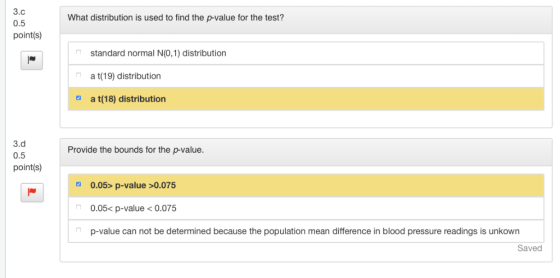
3.c What distribution is used to find the p-value for the test? 0.5 point(s) standard normal N(0,1) distribution a t(19) distribution a t(18) distribution 3.d Provide the bounds for the p-value. 0.5 point(s) 0.05> p-value >0.075 0.05
Homework Answers
a)
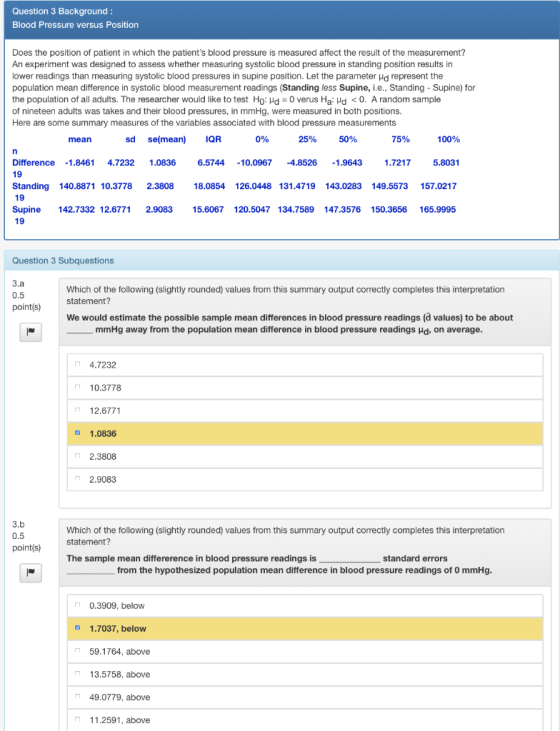
se(mean) = 1.0836
b)
TS = mean/se
TS = -1.8461/1.0836
= - 1.7037
hence 1.7037 below
c)
this is paired t-test
t-distribution
df =n-1 = 19-1 = 18
d)
p-value = P(T < -1.7037)
= =t.dist(-1.7037,18,1)
= 0.0528
hence
option A) is correct
Add Answer to:
Question 3 Background: Blood Pressure versus Position Does the position of patient in which the patient's blood pr...
Question 5 [10 points] A doctor at a walk-in clinic is studying high blood pressure among...
 Question 5 [10 points] A doctor at a walk-in clinic is studying high blood pressure among patients of the ages twenty to forty. According to the American Heart Association, a person has high blood pressure if their Systolic and Diastolic readings are above 130 and 39 respectively. A random sample of 10 patients revealed the following blood pressures, where the readings (x,y) correspond to (Systolic Diastolic blood pressures (179,109) (180,120) (11970) (130,85) (159,90) (110,79) (180,120) (119,70) (110,79) (159,90) Assume that...
answer this question BLOOD AND FLUID QUESTION 1 (0A patient's blood pressure taken at the arm...
 answer this question
BLOOD AND FLUID QUESTION 1 (0A patient's blood pressure taken at the arm is 120 mmHg systolic and 70 mmHg diastolic. What would you expect the blood pressure (systolic and diastolic pressures) to be at the top of the head given that this point is 40 cm above the measurement point? Remember blood pressure is a gauge pressure and that 1 kPa = 7.5 mmHg. (The density of blood is about 1060 kg/m.) Choose one: a. 89...
answer this question
BLOOD AND FLUID QUESTION 1 (0A patient's blood pressure taken at the arm is 120 mmHg systolic and 70 mmHg diastolic. What would you expect the blood pressure (systolic and diastolic pressures) to be at the top of the head given that this point is 40 cm above the measurement point? Remember blood pressure is a gauge pressure and that 1 kPa = 7.5 mmHg. (The density of blood is about 1060 kg/m.) Choose one: a. 89...
Vital Signs: Blood Pressure a. What is blood pressure? What is the purpose of assessing blood...
Vital Signs: Blood Pressure a. What is blood pressure? What is the purpose of assessing blood pressure? b. What is the standard unit for measuring blood pressure? What is the difference between systolic blood pressure and diastolic blood pressure? c. Various factors can affect blood pressure. Some of these are listed below. Discuss the differences with each of these factors. i) age example: BP is lower in children than in adults. ii) gender iii) race iv) diurnal rhythm v) weight...
1 A recent pilot study tested whether walking daily improved systolic blood pressure. For the three...
 1 A recent pilot study tested whether walking daily improved systolic blood pressure. For the three subjects in the study, their resting systolic blood pressure was measured at the beginning of Subject Before After a the study and again after participating in a walking program for 3 weeks. The table shows the results. Use the technology output to answer parts a through c. 125 135 i Click the icon to view the technology output. 2. 125 130 125 140 3...
A pharmaceutical company claims that its new drug reduces systolic blood pressure. The systolic blood pressure...
A pharmaceutical company claims that its new drug reduces systolic blood pressure. The systolic blood pressure (in millimeters of mercury) for nine patients before taking the new drug and 2 hours after taking the drug are shown in the table below. Using this data, find the 99% confidence interval for the true difference in blood pressure for each patient after taking the new drug. Assume that the blood pressures are normally distributed for the population of patients both before and...
When subjects were treated with a drug, their systolic blood pressure readings (in mm Hg) were...
When subjects were treated with a drug, their systolic blood pressure readings (in mm Hg) were measured before and after the drug was taken. Results are given in the table below. Assume that the paired sample data is a simple random sample and that the differences have a distribution that is approximately normal. Using a 0.05 significance level, is there sufficient evidence to support the claim that the drug is effective in lowering systolic blood pressure? Before: 188, 210, 157,...
A pharmaceutical company claims that its new drug reduces systolic blood pressure. The systolic blood pressure...
A pharmaceutical company claims that its new drug reduces systolic blood pressure. The systolic blood pressure (in millimeters of mercury) for nine patients before taking the new drug and 22 hours after taking the drug are shown in the table below. Using this data, find the 99%99% confidence interval for the true difference in blood pressure for each patient after taking the new drug. Assume that the blood pressures are normally distributed for the population of patients both before and...
Need help calculating t-statistic and P-value: Listed below are systolic blood pressure measurements (mm Hg) taken...
 Need help calculating t-statistic and P-value: Listed below are
systolic blood pressure measurements (mm Hg) taken from the right
and left arms of the same woman. Assume that the paired sample data
is a simple random sample and that the differences have a
distribution that is approximately normal. Use a 0.05 significance
level to test for a difference between the measurements from the
two arms. What can be concluded?
We were unable to transcribe this imageListed below are systolic blood...
Need help calculating t-statistic and P-value: Listed below are
systolic blood pressure measurements (mm Hg) taken from the right
and left arms of the same woman. Assume that the paired sample data
is a simple random sample and that the differences have a
distribution that is approximately normal. Use a 0.05 significance
level to test for a difference between the measurements from the
two arms. What can be concluded?
We were unable to transcribe this imageListed below are systolic blood...
Question 10 3 pts Captopril is a drug designed to lower systolic blood pressure. When subjects...
 Question 10 3 pts Captopril is a drug designed to lower systolic blood pressure. When subjects were treated with this drug, their systolic blood pressure readings (in mm Hg) were measured before and after the drug was taken. Results are given in the accompanying table. Using a 0.01 significance level, is there sufficient evidence to support the claim that captopril is effective in lowering systolic blood pressure? I J Subject Before After А 200 191 B 174 170 с 198...
please help desperately need it 7) When subjects were treated with a drug, their systolic blood...
 please help desperately need it
7) When subjects were treated with a drug, their systolic blood pressure readings (in mm Hg) were measured before and after the drug was taken. Results are given in the table below. Assume that the paired sample data is a simple random sample and that the differences have a distribution that is approximately normal. Using a 0.05 significance level, is there sufficient evidence to support the claim that the drug is effective in lowering systolic...
please help desperately need it
7) When subjects were treated with a drug, their systolic blood pressure readings (in mm Hg) were measured before and after the drug was taken. Results are given in the table below. Assume that the paired sample data is a simple random sample and that the differences have a distribution that is approximately normal. Using a 0.05 significance level, is there sufficient evidence to support the claim that the drug is effective in lowering systolic...
 Question 5 [10 points] A doctor at a walk-in clinic is studying high blood pressure among patients of the ages twenty to forty. According to the American Heart Association, a person has high blood pressure if their Systolic and Diastolic readings are above 130 and 39 respectively. A random sample of 10 patients revealed the following blood pressures, where the readings (x,y) correspond to (Systolic Diastolic blood pressures (179,109) (180,120) (11970) (130,85) (159,90) (110,79) (180,120) (119,70) (110,79) (159,90) Assume that...
 answer this question
BLOOD AND FLUID QUESTION 1 (0A patient's blood pressure taken at the arm is 120 mmHg systolic and 70 mmHg diastolic. What would you expect the blood pressure (systolic and diastolic pressures) to be at the top of the head given that this point is 40 cm above the measurement point? Remember blood pressure is a gauge pressure and that 1 kPa = 7.5 mmHg. (The density of blood is about 1060 kg/m.) Choose one: a. 89...
answer this question
BLOOD AND FLUID QUESTION 1 (0A patient's blood pressure taken at the arm is 120 mmHg systolic and 70 mmHg diastolic. What would you expect the blood pressure (systolic and diastolic pressures) to be at the top of the head given that this point is 40 cm above the measurement point? Remember blood pressure is a gauge pressure and that 1 kPa = 7.5 mmHg. (The density of blood is about 1060 kg/m.) Choose one: a. 89...
 1 A recent pilot study tested whether walking daily improved systolic blood pressure. For the three subjects in the study, their resting systolic blood pressure was measured at the beginning of Subject Before After a the study and again after participating in a walking program for 3 weeks. The table shows the results. Use the technology output to answer parts a through c. 125 135 i Click the icon to view the technology output. 2. 125 130 125 140 3...
 Need help calculating t-statistic and P-value: Listed below are
systolic blood pressure measurements (mm Hg) taken from the right
and left arms of the same woman. Assume that the paired sample data
is a simple random sample and that the differences have a
distribution that is approximately normal. Use a 0.05 significance
level to test for a difference between the measurements from the
two arms. What can be concluded?
We were unable to transcribe this imageListed below are systolic blood...
Need help calculating t-statistic and P-value: Listed below are
systolic blood pressure measurements (mm Hg) taken from the right
and left arms of the same woman. Assume that the paired sample data
is a simple random sample and that the differences have a
distribution that is approximately normal. Use a 0.05 significance
level to test for a difference between the measurements from the
two arms. What can be concluded?
We were unable to transcribe this imageListed below are systolic blood...
 Question 10 3 pts Captopril is a drug designed to lower systolic blood pressure. When subjects were treated with this drug, their systolic blood pressure readings (in mm Hg) were measured before and after the drug was taken. Results are given in the accompanying table. Using a 0.01 significance level, is there sufficient evidence to support the claim that captopril is effective in lowering systolic blood pressure? I J Subject Before After А 200 191 B 174 170 с 198...
 please help desperately need it
7) When subjects were treated with a drug, their systolic blood pressure readings (in mm Hg) were measured before and after the drug was taken. Results are given in the table below. Assume that the paired sample data is a simple random sample and that the differences have a distribution that is approximately normal. Using a 0.05 significance level, is there sufficient evidence to support the claim that the drug is effective in lowering systolic...
please help desperately need it
7) When subjects were treated with a drug, their systolic blood pressure readings (in mm Hg) were measured before and after the drug was taken. Results are given in the table below. Assume that the paired sample data is a simple random sample and that the differences have a distribution that is approximately normal. Using a 0.05 significance level, is there sufficient evidence to support the claim that the drug is effective in lowering systolic...
Most questions answered within 3 hours.
-
Where is the error in this code sequence?
String s1 = "Hello";
String s2 = "ello";...
asked 10 months ago -
Financial data for Joel de Paris, Inc., for last year
follow:
Joel de Paris, Inc.
Balance...
asked 10 months ago -
Consider this reaction:
Al2(SO4)3 (aq)+ BaCl3
(aq) Al2Cl6 (aq)- +
3BaSO4(s) . What is the...
asked 10 months ago -
Suppose that Savneet is considering increasing her
recent random sample from 20 car rentals to 40...
asked 10 months ago -
Trucks arrive at an unloading terminal at an average rate of 120
per hour.
Trucks arrive...
asked 10 months ago -
Why are methanol and ethanol completely soluble in water while
octanol is not very little soluble....
asked 10 months ago -
A facilities manager at a university reads in a research report
that the mean amount of...
asked 10 months ago -
When the CuSO4 is rehydrated by adding water to the anhydrous
compound, is this an endothermic...
asked 10 months ago -
A ray of sunlight is passing from diamond into crown glass; the
angle of incidence is...
asked 10 months ago -
A block of mass 0.249 kg is placed on top of a light, vertical
spring of...
asked 10 months ago -
how do the kidneys compensate in the presences of acidosis
a) trigger hyperventilate
b) reserve acid...
asked 10 months ago -
Question 501 pts
The rental rate of capital to the firm increases. Which of the
following...
asked 10 months ago