
Homework Answers
Add Answer to:
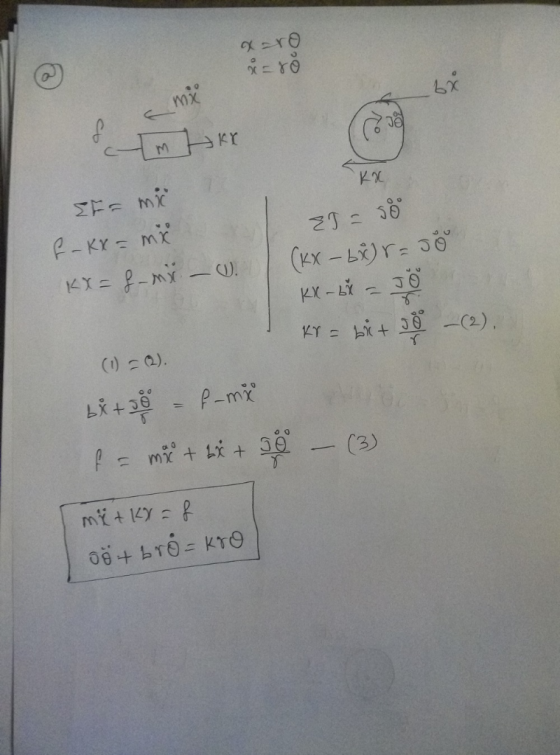
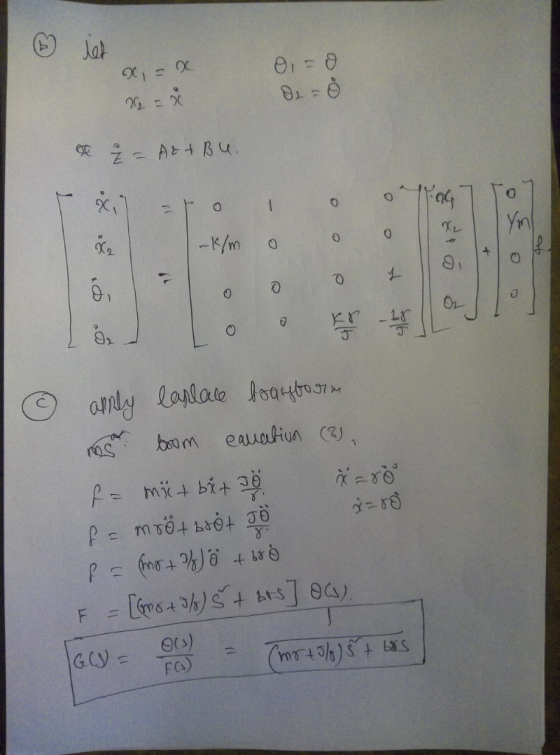
PROBLEM 1 (35 %) The mechanical system in the figure below consists of a disk of radius r, a block of mass m, a spr...
1. Given the spring-mass-damper system in the figure below T3 T1 T2 b2 b1 k3 (a) Find the equatio...
 1. Given the spring-mass-damper system in the figure below T3 T1 T2 b2 b1 k3 (a) Find the equations of motion for each of the masses 脳. Fi(s) (b) Assume F1 0 and find the transfer function (c) Assume Fs 0 and find the transfer function (d) Write the equations in matrix-vector form: M.ї + Bi + Kx-F where z is a 3 x 1 vector with the displacements r,2, r3 as components, M is the mass matrix, B is...
Please write legibly Consider an ideal mass-spring-damper system similar to Figure 3.2. Find the damping coefficient of the system if a mass of 380 g is used in combination with a spring with stif...
 Please write legibly
Consider an ideal mass-spring-damper system similar to Figure 3.2. Find the damping coefficient of the system if a mass of 380 g is used in combination with a spring with stiffness k = 17 N/m and a period of 0.945 s. If the system is released from rest 5 cm from it's equilibrium point at to = 0 s, find the trajectory of the position of the mass-spring-damper from it's release until t 3s Figure 3.2: Mass-spring-damper...
Please write legibly
Consider an ideal mass-spring-damper system similar to Figure 3.2. Find the damping coefficient of the system if a mass of 380 g is used in combination with a spring with stiffness k = 17 N/m and a period of 0.945 s. If the system is released from rest 5 cm from it's equilibrium point at to = 0 s, find the trajectory of the position of the mass-spring-damper from it's release until t 3s Figure 3.2: Mass-spring-damper...
Problem 7: Consider the two-degrees of freedom system shown in the figure below, where each disk...
 Problem 7: Consider the two-degrees of freedom system shown in the figure below, where each disk is pivoted at its mass center. The inputs are the torques τι and T2 applied to the pivot points. At t = 0, θί-B2 = τι-T2-0, and each linear spring is at its free length (undeformed). Find the equivalent inertia (la) and stiffness (K matrix T1 T2 02 J2, r2
A second order mechanical system of a mass connected to a spring and a damper is subjected to a s...
 A second order mechanical system of a mass connected to a spring and a damper is subjected to a sinusoidal input force mx+cx + kx = A sin(at) The mass is m-5 kg, the damping constant is c = 1 N-sec/m, the spring stiffness is 2 N/m, and the amplitude of the input force is A- 3 N. For this system give explicit numerical values for the damping factor 5 and the un-damped natural frequency Using the given formulas for...
44. The system shown in Fig. P7 consists of a slider block of mass m2 and a uniform slender rod of mass m3, length 13, and mass moment of inertia about its center of mass J The slider block is connec...
 44. The system shown in Fig. P7 consists of a slider block of mass m2 and a uniform slender rod of mass m3, length 13, and mass moment of inertia about its center of mass J The slider block is connected to the ground by a spring that has a stiffness coefficient k. The slider block is subjected to the force F(t), while the rod is subjected to the moment M. Obtain the differential equations of motion of this two-degree-of-freedom...
2 with spring stiffness k 1000 N/m, Consider a mass-spring-damper system shown in Figure mass m...
 2 with spring stiffness k 1000 N/m, Consider a mass-spring-damper system shown in Figure mass m = 10 kg, and damping constant c-150 N-s/m. If the initial displacement is xo-o and the initial velocity is 10 m/s (1) Find the damping ratio. (2) Is the system underdamped or overdamped? Why? (3) Calculate the damped natural frequency (4) Determine the free vibration response of the system.
For the following 2DOF linear mass-spring-damper system r2 (t) M-2kg K -18N/m C- 1.2N s/m i(t) - ...
 For the following 2DOF linear mass-spring-damper system r2 (t) M-2kg K -18N/m C- 1.2N s/m i(t) - 5 sin 2t (N) f2(t)-t (N) l. Formulate an IVP for vibration analysis in terms of xi (t) and x2(t) in a matrix form. Assume that the 2. Solve an eigenvalue problem to find the natural frequencies and modeshape vectors of the system 3. What is the modal matrix of the system? Verify the orthogonal properties of the modal matrix, Ф, with system...
2. (15 scores) Consider the mechanical system shown in Figure 1. A spring exerts a force...
 2. (15 scores) Consider the mechanical system shown in Figure 1. A spring exerts a force that is a function of its extension. A damper exerts a force that is a function of the velocity of the piston. Assume that the spring and the damper are both linear. (1) We want to describe the relation between the external force F(t) and the position yt) of the mass. Give the differential equation relating F(t) and y(t). Define this carefully as a...
Problem 2: Transfer Functions of Mechanical Systems. (20 Points) A model sketch for a two-mass mechanical...
 Problem 2: Transfer Functions of Mechanical Systems. (20 Points) A model sketch for a two-mass mechanical system subjected to fluctuations (t) at the wall is provided in figure 2. Spring k, is interconnected with both spring ka and damper Os at the nodal point. The independent displacement of mass m is denoted by 1, the independent displacement of mass m, is denoted by r2, and the independent displacement of the node is denoted by ra. Assume a linear force-displacement/velocity relationship...
Problem 1 (Harmonic Oscillators) A mass-damper-spring system is a simple harmonic oscillator whose dynamics is governed...
 Problem 1 (Harmonic Oscillators) A mass-damper-spring system is a simple harmonic oscillator whose dynamics is governed by the equation of motion where m is the mass, c is the damping coefficient of the damper, k is the stiffness of the spring, F is the net force applied on the mass, and x is the displacement of the mass from its equilibrium point. In this problem, we focus on a mass-damper-spring system with m = 1 kg, c-4 kg/s, k-3 N/m,...
 1. Given the spring-mass-damper system in the figure below T3 T1 T2 b2 b1 k3 (a) Find the equations of motion for each of the masses 脳. Fi(s) (b) Assume F1 0 and find the transfer function (c) Assume Fs 0 and find the transfer function (d) Write the equations in matrix-vector form: M.ї + Bi + Kx-F where z is a 3 x 1 vector with the displacements r,2, r3 as components, M is the mass matrix, B is...
 Please write legibly
Consider an ideal mass-spring-damper system similar to Figure 3.2. Find the damping coefficient of the system if a mass of 380 g is used in combination with a spring with stiffness k = 17 N/m and a period of 0.945 s. If the system is released from rest 5 cm from it's equilibrium point at to = 0 s, find the trajectory of the position of the mass-spring-damper from it's release until t 3s Figure 3.2: Mass-spring-damper...
Please write legibly
Consider an ideal mass-spring-damper system similar to Figure 3.2. Find the damping coefficient of the system if a mass of 380 g is used in combination with a spring with stiffness k = 17 N/m and a period of 0.945 s. If the system is released from rest 5 cm from it's equilibrium point at to = 0 s, find the trajectory of the position of the mass-spring-damper from it's release until t 3s Figure 3.2: Mass-spring-damper...
 Problem 7: Consider the two-degrees of freedom system shown in the figure below, where each disk is pivoted at its mass center. The inputs are the torques τι and T2 applied to the pivot points. At t = 0, θί-B2 = τι-T2-0, and each linear spring is at its free length (undeformed). Find the equivalent inertia (la) and stiffness (K matrix T1 T2 02 J2, r2
 A second order mechanical system of a mass connected to a spring and a damper is subjected to a sinusoidal input force mx+cx + kx = A sin(at) The mass is m-5 kg, the damping constant is c = 1 N-sec/m, the spring stiffness is 2 N/m, and the amplitude of the input force is A- 3 N. For this system give explicit numerical values for the damping factor 5 and the un-damped natural frequency Using the given formulas for...
 44. The system shown in Fig. P7 consists of a slider block of mass m2 and a uniform slender rod of mass m3, length 13, and mass moment of inertia about its center of mass J The slider block is connected to the ground by a spring that has a stiffness coefficient k. The slider block is subjected to the force F(t), while the rod is subjected to the moment M. Obtain the differential equations of motion of this two-degree-of-freedom...
 2 with spring stiffness k 1000 N/m, Consider a mass-spring-damper system shown in Figure mass m = 10 kg, and damping constant c-150 N-s/m. If the initial displacement is xo-o and the initial velocity is 10 m/s (1) Find the damping ratio. (2) Is the system underdamped or overdamped? Why? (3) Calculate the damped natural frequency (4) Determine the free vibration response of the system.
 For the following 2DOF linear mass-spring-damper system r2 (t) M-2kg K -18N/m C- 1.2N s/m i(t) - 5 sin 2t (N) f2(t)-t (N) l. Formulate an IVP for vibration analysis in terms of xi (t) and x2(t) in a matrix form. Assume that the 2. Solve an eigenvalue problem to find the natural frequencies and modeshape vectors of the system 3. What is the modal matrix of the system? Verify the orthogonal properties of the modal matrix, Ф, with system...
 2. (15 scores) Consider the mechanical system shown in Figure 1. A spring exerts a force that is a function of its extension. A damper exerts a force that is a function of the velocity of the piston. Assume that the spring and the damper are both linear. (1) We want to describe the relation between the external force F(t) and the position yt) of the mass. Give the differential equation relating F(t) and y(t). Define this carefully as a...
 Problem 2: Transfer Functions of Mechanical Systems. (20 Points) A model sketch for a two-mass mechanical system subjected to fluctuations (t) at the wall is provided in figure 2. Spring k, is interconnected with both spring ka and damper Os at the nodal point. The independent displacement of mass m is denoted by 1, the independent displacement of mass m, is denoted by r2, and the independent displacement of the node is denoted by ra. Assume a linear force-displacement/velocity relationship...
 Problem 1 (Harmonic Oscillators) A mass-damper-spring system is a simple harmonic oscillator whose dynamics is governed by the equation of motion where m is the mass, c is the damping coefficient of the damper, k is the stiffness of the spring, F is the net force applied on the mass, and x is the displacement of the mass from its equilibrium point. In this problem, we focus on a mass-damper-spring system with m = 1 kg, c-4 kg/s, k-3 N/m,...
Most questions answered within 3 hours.
-
Where is the error in this code sequence?
String s1 = "Hello";
String s2 = "ello";...
asked 10 months ago -
Financial data for Joel de Paris, Inc., for last year
follow:
Joel de Paris, Inc.
Balance...
asked 10 months ago -
Consider this reaction:
Al2(SO4)3 (aq)+ BaCl3
(aq) Al2Cl6 (aq)- +
3BaSO4(s) . What is the...
asked 10 months ago -
Suppose that Savneet is considering increasing her
recent random sample from 20 car rentals to 40...
asked 10 months ago -
Trucks arrive at an unloading terminal at an average rate of 120
per hour.
Trucks arrive...
asked 10 months ago -
Why are methanol and ethanol completely soluble in water while
octanol is not very little soluble....
asked 10 months ago -
A facilities manager at a university reads in a research report
that the mean amount of...
asked 10 months ago -
When the CuSO4 is rehydrated by adding water to the anhydrous
compound, is this an endothermic...
asked 10 months ago -
A ray of sunlight is passing from diamond into crown glass; the
angle of incidence is...
asked 10 months ago -
A block of mass 0.249 kg is placed on top of a light, vertical
spring of...
asked 10 months ago -
how do the kidneys compensate in the presences of acidosis
a) trigger hyperventilate
b) reserve acid...
asked 10 months ago -
Question 501 pts
The rental rate of capital to the firm increases. Which of the
following...
asked 10 months ago