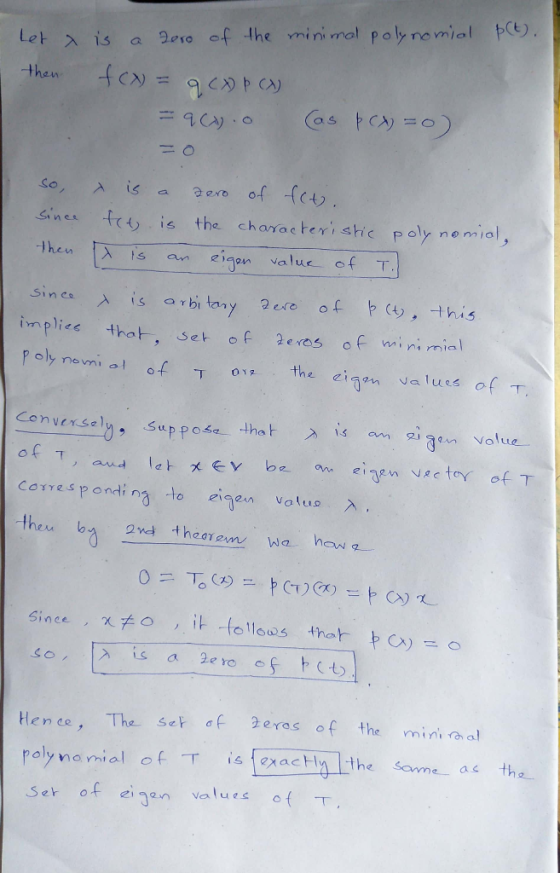
Let V be a finite-dimensional vector space over C and T in L(V). Prove that the set of zeros of the minimal polynomial o...
Let V be a finite-dimensional vector space over C and T in L(V). Prove that the set of zeros of the minimal polynomial of T is exactly the same as the set of the eigenvalues of T.
Homework Answers

Add Answer to:
Let V be a finite-dimensional vector space over C and T in L(V). Prove that the set of zeros of the minimal polynomial o...
4. Let T be a linear operator on the finite-dimensional space V with eharacteristie polynomial and minimal polynomial Let W be the null space of (T c) Elementary Canonical Forms Chap. 6 226 (a)...
 4. Let T be a linear operator on the finite-dimensional space V with eharacteristie polynomial and minimal polynomial Let W be the null space of (T c) Elementary Canonical Forms Chap. 6 226 (a) Prove that W, is the set of all vector8 α in V such that (T-cd)"a-0 for some positive integer 'n (which may depend upon α). (b) Prove that the dimension of W, is di. (Hint: If T, is the operator induced on Wi by T, then...
Let V be a finite-dimensional vector space and let T L(V) be an operator. In this problem you sh...
Let V be a finite-dimensional vector space and let T L(V) be an operator. In this problem you show that there is a nonzero polynomial such that p(T) = 0. (a) What is 0 in this context? A polynomial? A linear map? An element of V? (b) Define by . Prove that is a linear map. (c) Prove that if where V is infinite-dimensional and W is finite-dimensional, then S cannot be injective. (d) Use the preceding parts to prove...
3. Let Te L(V), where V is a finite-dimensional C-vector space. Prove that T is diago-...
 3. Let Te L(V), where V is a finite-dimensional C-vector space. Prove that T is diago- nalizable if and only if Ker(T – a id) n Im(T - a id) = {0} for all a E C.
How can I proof if V a finite dimensional vector space over a field, and T...
How can I proof if V a finite dimensional vector space over a field, and T is a linear transformation V->V, V is cyclic relative to T iff minimal polynomial of T is equal to the characteristic polynomial of T?
Question 1. Let V be a finite dimensional vector space over a field F and let...
 Question 1. Let V be a finite dimensional vector space over a field F and let W be a subspace of Prove that the quotient space V/W is finite dimensional and dimr(V/IV) = dimF(V) _ dimF(W). Hint l. Start with a basis A = {wi, . . . , w,n} for W and extend it to a basis B = {wi , . . . , wm, V1 , . . . , va) for V. Hint 2. Our goal...
3. Let V be a finite dimensional vector space with a positive definite scalar product. Let A: V-> V be a symmetr...
 3. Let V be a finite dimensional vector space with a positive definite scalar product. Let A: V-> V be a symmetric linear map. We say that A is positive definite if (Av, v) > 0 for all ve V and v 0. Prove: (a) if A is positive definite, then all eigenvalues are > 0. (b) If A is positive definite, then there exists a symmetric linear map B such that B2 = A and BA = AB. What...
Problem #6. Let V be a finite dimensional vector space over a field F. Let W...
 Problem #6. Let V be a finite dimensional vector space over a field F. Let W be a subspace of V. Define A(W) e Vw)Vw E W). Prove that A(W) is a subspace of (V).
de(V)e(A) 6· Lot V be a finite dimensional vector space, and T : V → V...
 de(V)e(A) 6· Lot V be a finite dimensional vector space, and T : V → V be a linear oper- ator. Suppose that T2-Iv, the identity operator. Prove that T is diagonalizable and that 1 and1 are the only possible eigenvalues of T
Prob le m 5 (Bonus 2 points) Let V be a finite dimensional vector space. Suppose that T : V -» V is matrix representati...
 Prob le m 5 (Bonus 2 points) Let V be a finite dimensional vector space. Suppose that T : V -» V is matrix representation with respect to every basis of V. Prove that the dimension of linear transform ation that has the same that T must be a scalar multiple of the identity transformation. You can assume V is 3
Prob le m 5 (Bonus 2 points) Let V be a finite dimensional vector space. Suppose that T :...
Prob le m 5 (Bonus 2 points) Let V be a finite dimensional vector space. Suppose that T : V -» V is matrix representation with respect to every basis of V. Prove that the dimension of linear transform ation that has the same that T must be a scalar multiple of the identity transformation. You can assume V is 3
Prob le m 5 (Bonus 2 points) Let V be a finite dimensional vector space. Suppose that T :...
4. Prove that a vector space V over F is isomorphic to the vector space L(F,V)...
 4. Prove that a vector space V over F is isomorphic to the vector space L(F,V) of all linear maps from F to V. Note: We are not assuming V is finite-dimensional.
 4. Let T be a linear operator on the finite-dimensional space V with eharacteristie polynomial and minimal polynomial Let W be the null space of (T c) Elementary Canonical Forms Chap. 6 226 (a) Prove that W, is the set of all vector8 α in V such that (T-cd)"a-0 for some positive integer 'n (which may depend upon α). (b) Prove that the dimension of W, is di. (Hint: If T, is the operator induced on Wi by T, then...
 3. Let Te L(V), where V is a finite-dimensional C-vector space. Prove that T is diago- nalizable if and only if Ker(T – a id) n Im(T - a id) = {0} for all a E C.
 Question 1. Let V be a finite dimensional vector space over a field F and let W be a subspace of Prove that the quotient space V/W is finite dimensional and dimr(V/IV) = dimF(V) _ dimF(W). Hint l. Start with a basis A = {wi, . . . , w,n} for W and extend it to a basis B = {wi , . . . , wm, V1 , . . . , va) for V. Hint 2. Our goal...
 3. Let V be a finite dimensional vector space with a positive definite scalar product. Let A: V-> V be a symmetric linear map. We say that A is positive definite if (Av, v) > 0 for all ve V and v 0. Prove: (a) if A is positive definite, then all eigenvalues are > 0. (b) If A is positive definite, then there exists a symmetric linear map B such that B2 = A and BA = AB. What...
 Problem #6. Let V be a finite dimensional vector space over a field F. Let W be a subspace of V. Define A(W) e Vw)Vw E W). Prove that A(W) is a subspace of (V).
 de(V)e(A) 6· Lot V be a finite dimensional vector space, and T : V → V be a linear oper- ator. Suppose that T2-Iv, the identity operator. Prove that T is diagonalizable and that 1 and1 are the only possible eigenvalues of T
 Prob le m 5 (Bonus 2 points) Let V be a finite dimensional vector space. Suppose that T : V -» V is matrix representation with respect to every basis of V. Prove that the dimension of linear transform ation that has the same that T must be a scalar multiple of the identity transformation. You can assume V is 3
Prob le m 5 (Bonus 2 points) Let V be a finite dimensional vector space. Suppose that T :...
Prob le m 5 (Bonus 2 points) Let V be a finite dimensional vector space. Suppose that T : V -» V is matrix representation with respect to every basis of V. Prove that the dimension of linear transform ation that has the same that T must be a scalar multiple of the identity transformation. You can assume V is 3
Prob le m 5 (Bonus 2 points) Let V be a finite dimensional vector space. Suppose that T :...
 4. Prove that a vector space V over F is isomorphic to the vector space L(F,V) of all linear maps from F to V. Note: We are not assuming V is finite-dimensional.
Most questions answered within 3 hours.
-
Where is the error in this code sequence?
String s1 = "Hello";
String s2 = "ello";...
asked 10 months ago -
Financial data for Joel de Paris, Inc., for last year
follow:
Joel de Paris, Inc.
Balance...
asked 10 months ago -
Consider this reaction:
Al2(SO4)3 (aq)+ BaCl3
(aq) Al2Cl6 (aq)- +
3BaSO4(s) . What is the...
asked 10 months ago -
Suppose that Savneet is considering increasing her
recent random sample from 20 car rentals to 40...
asked 10 months ago -
Trucks arrive at an unloading terminal at an average rate of 120
per hour.
Trucks arrive...
asked 10 months ago -
Why are methanol and ethanol completely soluble in water while
octanol is not very little soluble....
asked 10 months ago -
A facilities manager at a university reads in a research report
that the mean amount of...
asked 10 months ago -
When the CuSO4 is rehydrated by adding water to the anhydrous
compound, is this an endothermic...
asked 10 months ago -
A ray of sunlight is passing from diamond into crown glass; the
angle of incidence is...
asked 10 months ago -
A block of mass 0.249 kg is placed on top of a light, vertical
spring of...
asked 10 months ago -
how do the kidneys compensate in the presences of acidosis
a) trigger hyperventilate
b) reserve acid...
asked 10 months ago -
Question 501 pts
The rental rate of capital to the firm increases. Which of the
following...
asked 10 months ago