
Homework Answers
Add Answer to:
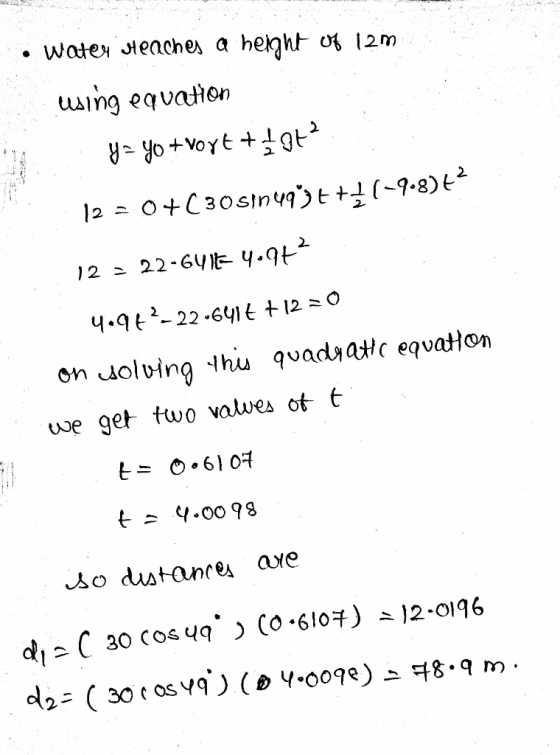
Review A firefighting crew uses a water cannon that shoots water at 30.0 m/s at a fixed angle of 49.0° above the ho...
A firefighting crew uses a water cannon that shoots water at 30.0 m/s at a fixed...
 A firefighting crew uses a water cannon that shoots water at
30.0 m/s at a fixed angle of 50.0 ∘ above the horizontal. The
firefighters want to direct the water at a blaze that is 12.0 m
above ground level.
How far from the building should they position their cannon?
There are two possibilities (d1<d2); can you get them
both? (Hint: Start with a sketch showing the trajectory of the
water.)
KHomework 5 Ch 03 fall 2019 Item 10 A...
A firefighting crew uses a water cannon that shoots water at
30.0 m/s at a fixed angle of 50.0 ∘ above the horizontal. The
firefighters want to direct the water at a blaze that is 12.0 m
above ground level.
How far from the building should they position their cannon?
There are two possibilities (d1<d2); can you get them
both? (Hint: Start with a sketch showing the trajectory of the
water.)
KHomework 5 Ch 03 fall 2019 Item 10 A...
A firefighting crew uses a water cannon that shoots water at 30.0 m/s at a fixed...
 A firefighting crew uses a water cannon that shoots water at
30.0 m/s at a fixed angle of 52.0 ∘ above the horizontal. The
firefighters want to direct the water at a blaze that is 11.0 m
above ground level.
How far from the building should they position their cannon?
There are two possibilities (d1<d2); can you get them
both? (Hint: Start with a sketch showing the trajectory of the
water.)
<Homework 5 Ch 03 fall 2019 Item 10 A...
A firefighting crew uses a water cannon that shoots water at
30.0 m/s at a fixed angle of 52.0 ∘ above the horizontal. The
firefighters want to direct the water at a blaze that is 11.0 m
above ground level.
How far from the building should they position their cannon?
There are two possibilities (d1<d2); can you get them
both? (Hint: Start with a sketch showing the trajectory of the
water.)
<Homework 5 Ch 03 fall 2019 Item 10 A...
A firefighting crew uses a water cannon that shoots water at 25.0 m/s at a fixed...
A firefighting crew uses a water cannon that shoots water at 25.0 m/s at a fixed angle of 49.0 ∘ above the horizontal. The firefighters want to direct the water at a blaze that is 12.0 m above ground level. How far from the building should they position their cannon? There are two possibilities (d1<d2); can you get them both? (Hint: Start with a sketch showing the trajectory of the water.) find D1 find D2
A firefighting crew uses a water cannon that shoots water at 26.0 m/s at a fixed...
A firefighting crew uses a water cannon that shoots water at 26.0 m/s at a fixed angle of 50.0 ∘ above the horizontal. The firefighters want to direct the water at a blaze that is 12.0 m above ground level. How far from the building should they position their cannon? There are two possibilities (d1<d2); can you get them both? (Hint: Start with a sketch showing the trajectory of the water.)
A firefighting crew uses a water cannon that shoots water at 28.0 m/s at a fixed...
A firefighting crew uses a water cannon that shoots water at 28.0 m/s at a fixed angle of 52.0 ∘ above the horizontal. The firefighters want to direct the water at a blaze that is 12.0 m above ground level. How far from the building should they position their cannon? There are two possibilities (d1<d2); can you get them both? (Hint: Start with a sketch showing the trajectory of the water.). I need to find D1 and D2
A firefighting crew uses a water cannon that shoots water at 29.0 m/s at a fixed...
A firefighting crew uses a water cannon that shoots water at 29.0 m/s at a fixed angle of 50.0 ∘ above the horizontal. The firefighters want to direct the water at a blaze that is 11.0 m above ground level. How far from the building should they position their cannon? There are two possibilities (d1<d2);can you get them both? (Hint: Start with a sketch showing the trajectory of the water.) Find d1=?, and d2=?
A firefighting crew uses a water cannon that shoots water at 27.0 m/s at a fixed...
A firefighting crew uses a water cannon that shoots water at 27.0 m/s at a fixed angle of 49.0 ∘ above the horizontal. The firefighters want to direct the water at a blaze that is 15.0 m above ground level. How far from the building should they position their cannon? There are two possibilities.
A firefighting crew uses a water cannon that shoots water at 28.0 m/s at a fixed...
A firefighting crew uses a water cannon that shoots water at 28.0 m/s at a fixed angle of 47.0 ∘ above the horizontal. The firefighters want to direct the water at a blaze that is 12.0 m above ground level. How far from the building should they position their cannon? find D1 and D2
A cannonball is fired horizontally from the top of a cit. The cannon is at height...
 A cannonball is fired horizontally from the top of a cit. The cannon is at height = 600 m above ground level and the ball is fired with initial horizontal speed to. Assume acceleration due to gravity to be 9 9.80 m/s - Part A . What is the position of the Assume that the cannon is fired at time t = 0 and that the cannonball hits the ground at time cannonball the time 27 Answer numerically in units...
On level ground a shell is fired with an initial velocity of 30.0 m/s at 55.0°...
 On level ground a shell is fired with an initial velocity of 30.0 m/s at 55.0° above the horizontal and feels no appreciable air resistance. Part A Find the horizontal and vertical components of the shell's initial velocity Express your answers in meters per second separated by a comma. PO AQ 0 2 ? VOh, Voy = Voh , Vov = m/s Submit Request Answer Part B How long does it take the shell to reach its highest point? Express...
 A firefighting crew uses a water cannon that shoots water at
30.0 m/s at a fixed angle of 50.0 ∘ above the horizontal. The
firefighters want to direct the water at a blaze that is 12.0 m
above ground level.
How far from the building should they position their cannon?
There are two possibilities (d1<d2); can you get them
both? (Hint: Start with a sketch showing the trajectory of the
water.)
KHomework 5 Ch 03 fall 2019 Item 10 A...
A firefighting crew uses a water cannon that shoots water at
30.0 m/s at a fixed angle of 50.0 ∘ above the horizontal. The
firefighters want to direct the water at a blaze that is 12.0 m
above ground level.
How far from the building should they position their cannon?
There are two possibilities (d1<d2); can you get them
both? (Hint: Start with a sketch showing the trajectory of the
water.)
KHomework 5 Ch 03 fall 2019 Item 10 A...
 A firefighting crew uses a water cannon that shoots water at
30.0 m/s at a fixed angle of 52.0 ∘ above the horizontal. The
firefighters want to direct the water at a blaze that is 11.0 m
above ground level.
How far from the building should they position their cannon?
There are two possibilities (d1<d2); can you get them
both? (Hint: Start with a sketch showing the trajectory of the
water.)
<Homework 5 Ch 03 fall 2019 Item 10 A...
A firefighting crew uses a water cannon that shoots water at
30.0 m/s at a fixed angle of 52.0 ∘ above the horizontal. The
firefighters want to direct the water at a blaze that is 11.0 m
above ground level.
How far from the building should they position their cannon?
There are two possibilities (d1<d2); can you get them
both? (Hint: Start with a sketch showing the trajectory of the
water.)
<Homework 5 Ch 03 fall 2019 Item 10 A...
 A cannonball is fired horizontally from the top of a cit. The cannon is at height = 600 m above ground level and the ball is fired with initial horizontal speed to. Assume acceleration due to gravity to be 9 9.80 m/s - Part A . What is the position of the Assume that the cannon is fired at time t = 0 and that the cannonball hits the ground at time cannonball the time 27 Answer numerically in units...
 On level ground a shell is fired with an initial velocity of 30.0 m/s at 55.0° above the horizontal and feels no appreciable air resistance. Part A Find the horizontal and vertical components of the shell's initial velocity Express your answers in meters per second separated by a comma. PO AQ 0 2 ? VOh, Voy = Voh , Vov = m/s Submit Request Answer Part B How long does it take the shell to reach its highest point? Express...
Most questions answered within 3 hours.
-
Where is the error in this code sequence?
String s1 = "Hello";
String s2 = "ello";...
asked 11 months ago -
Financial data for Joel de Paris, Inc., for last year
follow:
Joel de Paris, Inc.
Balance...
asked 11 months ago -
Consider this reaction:
Al2(SO4)3 (aq)+ BaCl3
(aq) Al2Cl6 (aq)- +
3BaSO4(s) . What is the...
asked 11 months ago -
Suppose that Savneet is considering increasing her
recent random sample from 20 car rentals to 40...
asked 11 months ago -
Trucks arrive at an unloading terminal at an average rate of 120
per hour.
Trucks arrive...
asked 11 months ago -
Why are methanol and ethanol completely soluble in water while
octanol is not very little soluble....
asked 11 months ago -
A facilities manager at a university reads in a research report
that the mean amount of...
asked 11 months ago -
When the CuSO4 is rehydrated by adding water to the anhydrous
compound, is this an endothermic...
asked 11 months ago -
A ray of sunlight is passing from diamond into crown glass; the
angle of incidence is...
asked 11 months ago -
A block of mass 0.249 kg is placed on top of a light, vertical
spring of...
asked 11 months ago -
how do the kidneys compensate in the presences of acidosis
a) trigger hyperventilate
b) reserve acid...
asked 11 months ago -
Question 501 pts
The rental rate of capital to the firm increases. Which of the
following...
asked 11 months ago