
Homework Answers


Add Answer to:
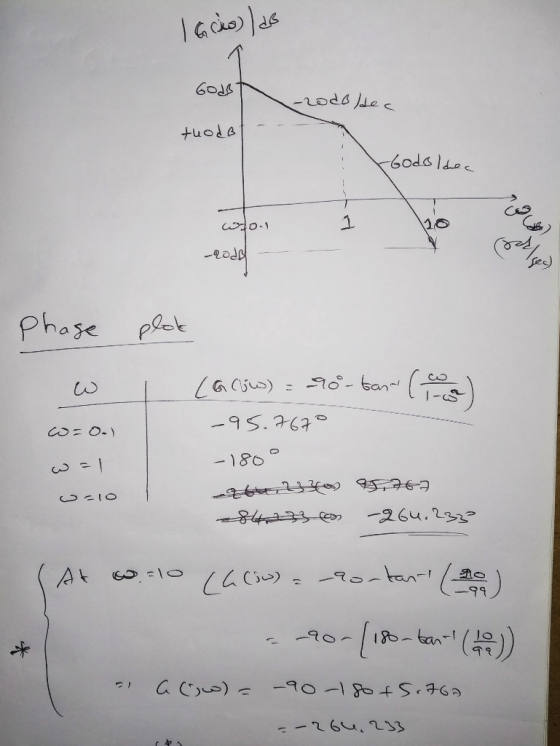
Find the Bode diagram of the following systems (Points: 25): 100( S1) G(S)S(S+1){ (S)+ S+ 1...
The forward-path transfer functions of unity-feedback control systems are given in the following equations. Plot the Bode diagram of G(ja)/K, and do the following: (1) Find the value of K so that the...
 The forward-path transfer functions of unity-feedback control systems are given in the following equations. Plot the Bode diagram of G(ja)/K, and do the following: (1) Find the value of K so that the gain margin of the system is 20 dB. (2) Find the value of K so that the phase margin of the system is 45°. (a) G(s) G+0.55) (b) Gs)- s(1 +0.1s) (1 0.2s)(10.5s) (d) Go +3 (c) G(s)-3 (s +3) (s+3)4 Ke-s G1+55) (e) G (1+0.1s+0.012 G)2...
2: Draw the Bode plot; magnitude only, for the following systems using the straight-line approximations G(s)...
 2: Draw the Bode plot; magnitude only, for the following systems using the straight-line approximations G(s) = (s+1) (s+4) (s2+2s+25)
7.5 (2 points) Given the Bode plot shown below: Bode Diagram 50 -50 E -100 150 O 45 a -90 135 180...
 7.5 (2 points) Given the Bode plot shown below: Bode Diagram 50 -50 E -100 150 O 45 a -90 135 180 10 102 Frequency (radis) 103 10 10 10 Find the associated transfer function Gs).Enter your answer symbolically in terms of s. For proper grading, do not factor out terms in the numerator or denominator, e.g., enter 5-+1015 and not5- (+2+3. G(s)-
7.5 (2 points) Given the Bode plot shown below: Bode Diagram 50 -50 E -100 150 O...
7.5 (2 points) Given the Bode plot shown below: Bode Diagram 50 -50 E -100 150 O 45 a -90 135 180 10 102 Frequency (radis) 103 10 10 10 Find the associated transfer function Gs).Enter your answer symbolically in terms of s. For proper grading, do not factor out terms in the numerator or denominator, e.g., enter 5-+1015 and not5- (+2+3. G(s)-
7.5 (2 points) Given the Bode plot shown below: Bode Diagram 50 -50 E -100 150 O...
3. You are given the following Bode diagrams for different systems. Find the transfer function for...
 3. You are given the following Bode diagrams for different systems. Find the transfer function for each one of the systems considering the asymptotes and breaking points. 2.5 An C. - - - Magnitude (dB) Magnitude (dB) 10-1 100 101 10% 10° Frequency (rad/s) Frequency (rad/s) Magnitude (dB) Magnitude (dB) 100 101 101 Frequency (rad/s) 100 101 10² Frequency (rad/s) 103 104
Draw the bode diagram for the following transfer function · Draw the Bode Diagram for the...
 Draw the bode diagram for the following transfer
function
· Draw the Bode Diagram for the following transfer function: H(s) = 100/(s + 30)
Draw the bode diagram for the following transfer
function
· Draw the Bode Diagram for the following transfer function: H(s) = 100/(s + 30)
Q1. Draw the bode plot for each of the following systems. Compare your sketches with the plots obtained using the 'bode' command in MATLAB. a) Gs)4000 (s +40) e Gs) 1005+4) s(s+Is 25+5)...
 Q1. Draw the bode plot for each of the following systems. Compare your sketches with the plots obtained using the 'bode' command in MATLAB. a) Gs)4000 (s +40) e Gs) 1005+4) s(s+Is 25+5)
Q1. Draw the bode plot for each of the following systems. Compare your sketches with the plots obtained using the 'bode' command in MATLAB. a) Gs)4000 (s +40) e Gs) 1005+4) s(s+Is 25+5)
Q1. Draw the bode plot for each of the following systems. Compare your sketches with the plots obtained using the 'bode' command in MATLAB. a) Gs)4000 (s +40) e Gs) 1005+4) s(s+Is 25+5)
Given the following Bode plot, is the system stable? Why? Bode Diagram 50 50 -100 -90 -180 10 102 10) 10 10 Frequency (rad/s) Bode Diagram 50 50 -100 -90 -180 10 102 10) 10 10 Frequency (rad/s)
Given the following Bode plot, is the system stable? Why? Bode Diagram 50 50 -100 -90 -180 10 102 10) 10 10 Frequency (rad/s) Bode Diagram 50 50 -100 -90 -180 10 102 10) 10 10 Frequency (rad/s)
16.1 For the following systems, sketch the Bode diagram, and from the straight-line approximations to the...
 16.1 For the following systems, sketch the Bode diagram, and from the straight-line approximations to the gain and phase plots, estimate the maximum value of K for which the system is stable: a. GH(s) = s(s + 1) (s + 4) b. GH(s) = = s(1 + s) KS c. GH() = 6 *21 к d. GH(s) = s(s? + 2s + 16) 5K(1 + s) e. GH(S) = f'( + s/352
Draw the Nyquist plot using the bode plot below. G(s)=1/(s+1)^2 1. Draw the Nyquist plot using...
 Draw the Nyquist plot using the bode plot below.
G(s)=1/(s+1)^2
1. Draw the Nyquist plot using the bode plot below. G(s)-1/(s+1)*2 Bode Diagram 0 -20 9 .40 -60 -80 -100 .45 -90 -135 180 10 10 10 10 Frequency (rad/sec)
Draw the Nyquist plot using the bode plot below.
G(s)=1/(s+1)^2
1. Draw the Nyquist plot using the bode plot below. G(s)-1/(s+1)*2 Bode Diagram 0 -20 9 .40 -60 -80 -100 .45 -90 -135 180 10 10 10 10 Frequency (rad/sec)
For a system with Bode diagram as follow, find out the system transfer function, discuss the...
 For a system with Bode diagram as follow, find out the system transfer function, discuss the system stability. Bode Diagram 50 40 -20 90 O. 135 -180 Frequency (rad/s ec) Show all step by step working out to get to final answer as shown below: Transfer function of the bode diagram is 100/(2jw+1)A2
 The forward-path transfer functions of unity-feedback control systems are given in the following equations. Plot the Bode diagram of G(ja)/K, and do the following: (1) Find the value of K so that the gain margin of the system is 20 dB. (2) Find the value of K so that the phase margin of the system is 45°. (a) G(s) G+0.55) (b) Gs)- s(1 +0.1s) (1 0.2s)(10.5s) (d) Go +3 (c) G(s)-3 (s +3) (s+3)4 Ke-s G1+55) (e) G (1+0.1s+0.012 G)2...
 2: Draw the Bode plot; magnitude only, for the following systems using the straight-line approximations G(s) = (s+1) (s+4) (s2+2s+25)
 7.5 (2 points) Given the Bode plot shown below: Bode Diagram 50 -50 E -100 150 O 45 a -90 135 180 10 102 Frequency (radis) 103 10 10 10 Find the associated transfer function Gs).Enter your answer symbolically in terms of s. For proper grading, do not factor out terms in the numerator or denominator, e.g., enter 5-+1015 and not5- (+2+3. G(s)-
7.5 (2 points) Given the Bode plot shown below: Bode Diagram 50 -50 E -100 150 O...
7.5 (2 points) Given the Bode plot shown below: Bode Diagram 50 -50 E -100 150 O 45 a -90 135 180 10 102 Frequency (radis) 103 10 10 10 Find the associated transfer function Gs).Enter your answer symbolically in terms of s. For proper grading, do not factor out terms in the numerator or denominator, e.g., enter 5-+1015 and not5- (+2+3. G(s)-
7.5 (2 points) Given the Bode plot shown below: Bode Diagram 50 -50 E -100 150 O...
 3. You are given the following Bode diagrams for different systems. Find the transfer function for each one of the systems considering the asymptotes and breaking points. 2.5 An C. - - - Magnitude (dB) Magnitude (dB) 10-1 100 101 10% 10° Frequency (rad/s) Frequency (rad/s) Magnitude (dB) Magnitude (dB) 100 101 101 Frequency (rad/s) 100 101 10² Frequency (rad/s) 103 104
 Draw the bode diagram for the following transfer
function
· Draw the Bode Diagram for the following transfer function: H(s) = 100/(s + 30)
Draw the bode diagram for the following transfer
function
· Draw the Bode Diagram for the following transfer function: H(s) = 100/(s + 30)
 Q1. Draw the bode plot for each of the following systems. Compare your sketches with the plots obtained using the 'bode' command in MATLAB. a) Gs)4000 (s +40) e Gs) 1005+4) s(s+Is 25+5)
Q1. Draw the bode plot for each of the following systems. Compare your sketches with the plots obtained using the 'bode' command in MATLAB. a) Gs)4000 (s +40) e Gs) 1005+4) s(s+Is 25+5)
Q1. Draw the bode plot for each of the following systems. Compare your sketches with the plots obtained using the 'bode' command in MATLAB. a) Gs)4000 (s +40) e Gs) 1005+4) s(s+Is 25+5)
 16.1 For the following systems, sketch the Bode diagram, and from the straight-line approximations to the gain and phase plots, estimate the maximum value of K for which the system is stable: a. GH(s) = s(s + 1) (s + 4) b. GH(s) = = s(1 + s) KS c. GH() = 6 *21 к d. GH(s) = s(s? + 2s + 16) 5K(1 + s) e. GH(S) = f'( + s/352
 Draw the Nyquist plot using the bode plot below.
G(s)=1/(s+1)^2
1. Draw the Nyquist plot using the bode plot below. G(s)-1/(s+1)*2 Bode Diagram 0 -20 9 .40 -60 -80 -100 .45 -90 -135 180 10 10 10 10 Frequency (rad/sec)
Draw the Nyquist plot using the bode plot below.
G(s)=1/(s+1)^2
1. Draw the Nyquist plot using the bode plot below. G(s)-1/(s+1)*2 Bode Diagram 0 -20 9 .40 -60 -80 -100 .45 -90 -135 180 10 10 10 10 Frequency (rad/sec)
 For a system with Bode diagram as follow, find out the system transfer function, discuss the system stability. Bode Diagram 50 40 -20 90 O. 135 -180 Frequency (rad/s ec) Show all step by step working out to get to final answer as shown below: Transfer function of the bode diagram is 100/(2jw+1)A2
Most questions answered within 3 hours.
-
Where is the error in this code sequence?
String s1 = "Hello";
String s2 = "ello";...
asked 11 months ago -
Financial data for Joel de Paris, Inc., for last year
follow:
Joel de Paris, Inc.
Balance...
asked 11 months ago -
Consider this reaction:
Al2(SO4)3 (aq)+ BaCl3
(aq) Al2Cl6 (aq)- +
3BaSO4(s) . What is the...
asked 11 months ago -
Suppose that Savneet is considering increasing her
recent random sample from 20 car rentals to 40...
asked 11 months ago -
Trucks arrive at an unloading terminal at an average rate of 120
per hour.
Trucks arrive...
asked 11 months ago -
Why are methanol and ethanol completely soluble in water while
octanol is not very little soluble....
asked 11 months ago -
A facilities manager at a university reads in a research report
that the mean amount of...
asked 11 months ago -
When the CuSO4 is rehydrated by adding water to the anhydrous
compound, is this an endothermic...
asked 11 months ago -
A ray of sunlight is passing from diamond into crown glass; the
angle of incidence is...
asked 11 months ago -
A block of mass 0.249 kg is placed on top of a light, vertical
spring of...
asked 11 months ago -
how do the kidneys compensate in the presences of acidosis
a) trigger hyperventilate
b) reserve acid...
asked 11 months ago -
Question 501 pts
The rental rate of capital to the firm increases. Which of the
following...
asked 11 months ago