
Homework Answers
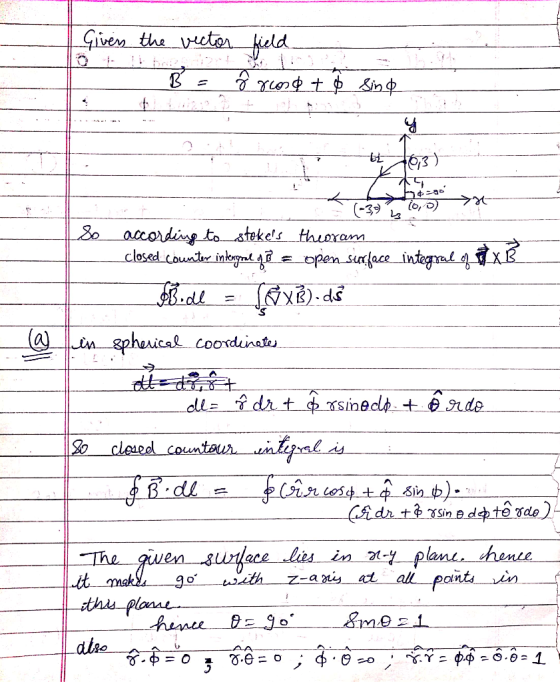
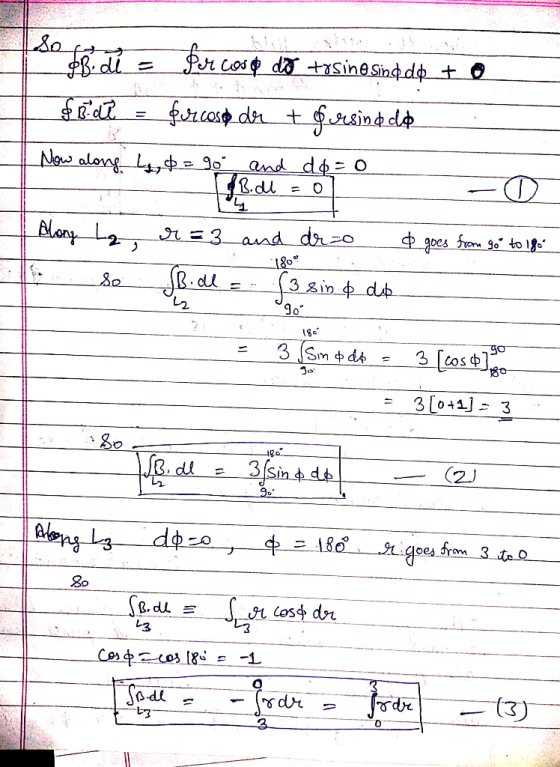
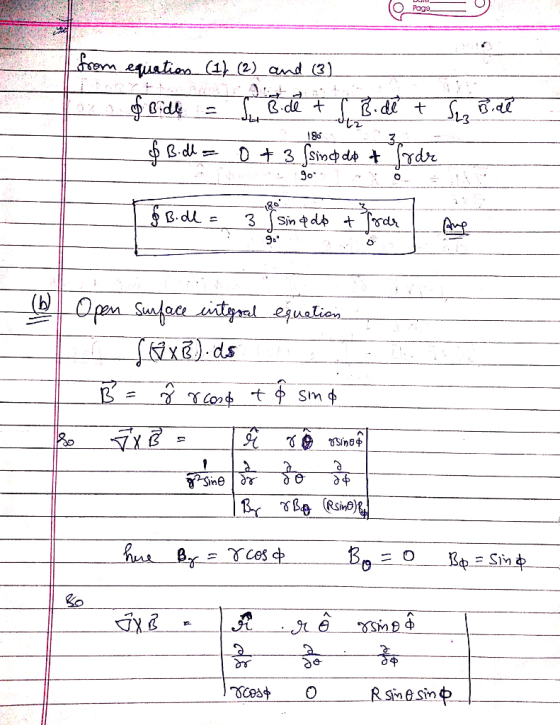
 I
have written ds in theta direction only because B is in theta
direction and hence B.ds will be 0 for ds in directions other than
theta.
I
have written ds in theta direction only because B is in theta
direction and hence B.ds will be 0 for ds in directions other than
theta.
Add Answer to:
Problem 3. Vector Calculus (30 points) Set up the equations for Stoke's theorem for the vector...
Stoke's theorem says: I (3 x 2). a3 = fh.at Verify Stoke's theorem for the vector...
 Stoke's theorem says: I (3 x 2). a3 = fh.at Verify Stoke's theorem for the vector field | A = zza +Tgây + yzam and the closed path comprising the straight lines from (0,0,0) to (0,1,0), from (0,1,0) to (0,1,1) and from (0,1,1) to (0,0,0) Hint: The limits of the surface integral are 0 <y < 1 and 0 <zsy.
a) Complete the statement of: Stoke's Theorem: Let S be an oriented surface bounded by a...
 a) Complete the statement of: Stoke's Theorem: Let S be an oriented surface bounded by a piecewise smooth simple closed curve with a positive orientation (i.e. clockwise relative to N). If F(x, y, z)=(M(x,y,z), N(x, y, z), P(x, y, z)) where M, N, and P have continuous partial derivatives in an open region containing Sand C, then: b) Use Stoke's theorem to write as an iterated integral, J. (y, -2', 1)odr where is the circle of radius 1 in the...
4.8) a) Complete the statement of: The Divergence Theorem: Let D be a closed solid in...
 4.8) a) Complete the statement of: The Divergence Theorem: Let D be a closed solid in space bounded by a closed surface s oriented by an outwardly directed unit normal vector n. If F(x, y, z)=(M(x,y,z), N(x, y, z), P(x, y, z)) where M, N, and P have continuous partial derivatives in D, then: D b) Use the Divergence Theorem to write as an iterated integral the flux of F=(x",x’y,x?:) over the closed cylindrical surface whose sides are defined by...
1. Gauß theorem / Divergence Theorenm Given the surface S(V) with surface normal vector i of...
 1. Gauß theorem / Divergence Theorenm Given the surface S(V) with surface normal vector i of the volume V. Then, we define the surface integral fs(v) F , df = fs(v) F-ndf over a vector field F. S(V) a) Evaluate the surface integral for the vector field ()ze, - yez+yz es over a cube bounded by x = 0,x = 1, y = 0, y = 1, z 0, z = 1 . Then use Gauß theorem and verify it....
Consider the following region R and the vector field F a. Compute the two-dimensional curl of the vector field. b. Evaluate both integrals in the circulation form of Green's Theorem and check for...
 Consider the following region R and the vector field F a. Compute the two-dimensional curl of the vector field. b. Evaluate both integrals in the circulation form of Green's Theorem and check for consistency. c. State whether the vector field is conservative. F-3y,3x); R is the triangle with vertices (0, 0), (1, 0), and (0, 1) a. The two-dimensional curl is D (Type an exact answer, using π as needed.) b. Set up the integral over the region R. dy...
This Test: 18 pts possible 5 of 18 (1 comnplete) the foillowing vector field and region. Check for agreement Evaluat...
 This Test: 18 pts possible 5 of 18 (1 comnplete) the foillowing vector field and region. Check for agreement Evaluate both integrals of the Divergence Theorem D= (xy.z): x2 + y2 + 22 s9) F (4x,3y,32); the Divergence Theorem. Select the correct choice below and fill in any answer boxes within your choice. Set up the volume integral OA !!! dp do d8, where the integrand does not simplity to a constant 0 0 O B. The integral simplifies to...
DETAILS 3. [2/4 Points) Consider the given vector field. F(x, y, z) = (e", ely, exy?)...
 DETAILS 3. [2/4 Points) Consider the given vector field. F(x, y, z) = (e", ely, exy?) (a) Find the curl of the vector field. - yzelyz lazenz curl Fe (b) Find the divergence of the vector field. div F = ertxely tuxely F. dr This question has several pa You will use Stokes' Theorem to rewrite the integral and C is the boundary of the plane 5x+3y +z = 1 in the fir F-(1,2-2, 2-3v7) oriented counterclockwise as viewed from...
Problem 4: Fundamental Theorem of Calculus Fundamental Theorem of Calculus I (15 Points, 3 Points Each)...
 Problem 4: Fundamental Theorem of Calculus Fundamental Theorem of Calculus I (15 Points, 3 Points Each) below, you will see the function F(u) and a graph depicting the function. Note that it is impossible to compute F(v) exactly by antidifferentiation, so please do not try as it is not the point of this problem. F(y) = y For each problem (a) through (e) that follows, you need to compare the quantities in Column 1 and Column 2 and write your...
please give some explanation to each step 15 Total Question 3 Let F: R3R3 be any...
 please give some explanation to each step
15 Total Question 3 Let F: R3R3 be any C2 vector field. 3(a). Prove that the divergence of the curl of F is zero. /4 marks 3(b). For F as defined above, a misguided professor claims that for any closed curve C, F dr 0 because of the argument: (x F)ds F-dr div (eurl F) dV X 0-APO by using Stokes' theorem, the divergence theorem, and then part (a) for an appropriately chosen...
please give some explanation to each step
15 Total Question 3 Let F: R3R3 be any C2 vector field. 3(a). Prove that the divergence of the curl of F is zero. /4 marks 3(b). For F as defined above, a misguided professor claims that for any closed curve C, F dr 0 because of the argument: (x F)ds F-dr div (eurl F) dV X 0-APO by using Stokes' theorem, the divergence theorem, and then part (a) for an appropriately chosen...
3. F is the vector field The surface S is the boundary of a solid E, where E is bounded by the sp...
 3. F is the vector field The surface S is the boundary of a solid E, where E is bounded by the sphe:93 x2 + y2 + z2 = 4 and x2 + y2 + z2-) for z > 0, Do the following (a) State the defining equation for Gauss' Theorem. (10 points) (b) Show that div F(a+y). (10 points) (c) Use Gauss' Theorem to rewrite the following integral as product of one dimensional integrals. Do not evaluate. (10 points)...
 Stoke's theorem says: I (3 x 2). a3 = fh.at Verify Stoke's theorem for the vector field | A = zza +Tgây + yzam and the closed path comprising the straight lines from (0,0,0) to (0,1,0), from (0,1,0) to (0,1,1) and from (0,1,1) to (0,0,0) Hint: The limits of the surface integral are 0 <y < 1 and 0 <zsy.
 a) Complete the statement of: Stoke's Theorem: Let S be an oriented surface bounded by a piecewise smooth simple closed curve with a positive orientation (i.e. clockwise relative to N). If F(x, y, z)=(M(x,y,z), N(x, y, z), P(x, y, z)) where M, N, and P have continuous partial derivatives in an open region containing Sand C, then: b) Use Stoke's theorem to write as an iterated integral, J. (y, -2', 1)odr where is the circle of radius 1 in the...
 4.8) a) Complete the statement of: The Divergence Theorem: Let D be a closed solid in space bounded by a closed surface s oriented by an outwardly directed unit normal vector n. If F(x, y, z)=(M(x,y,z), N(x, y, z), P(x, y, z)) where M, N, and P have continuous partial derivatives in D, then: D b) Use the Divergence Theorem to write as an iterated integral the flux of F=(x",x’y,x?:) over the closed cylindrical surface whose sides are defined by...
 1. Gauß theorem / Divergence Theorenm Given the surface S(V) with surface normal vector i of the volume V. Then, we define the surface integral fs(v) F , df = fs(v) F-ndf over a vector field F. S(V) a) Evaluate the surface integral for the vector field ()ze, - yez+yz es over a cube bounded by x = 0,x = 1, y = 0, y = 1, z 0, z = 1 . Then use Gauß theorem and verify it....
 Consider the following region R and the vector field F a. Compute the two-dimensional curl of the vector field. b. Evaluate both integrals in the circulation form of Green's Theorem and check for consistency. c. State whether the vector field is conservative. F-3y,3x); R is the triangle with vertices (0, 0), (1, 0), and (0, 1) a. The two-dimensional curl is D (Type an exact answer, using π as needed.) b. Set up the integral over the region R. dy...
 This Test: 18 pts possible 5 of 18 (1 comnplete) the foillowing vector field and region. Check for agreement Evaluate both integrals of the Divergence Theorem D= (xy.z): x2 + y2 + 22 s9) F (4x,3y,32); the Divergence Theorem. Select the correct choice below and fill in any answer boxes within your choice. Set up the volume integral OA !!! dp do d8, where the integrand does not simplity to a constant 0 0 O B. The integral simplifies to...
 DETAILS 3. [2/4 Points) Consider the given vector field. F(x, y, z) = (e", ely, exy?) (a) Find the curl of the vector field. - yzelyz lazenz curl Fe (b) Find the divergence of the vector field. div F = ertxely tuxely F. dr This question has several pa You will use Stokes' Theorem to rewrite the integral and C is the boundary of the plane 5x+3y +z = 1 in the fir F-(1,2-2, 2-3v7) oriented counterclockwise as viewed from...
 Problem 4: Fundamental Theorem of Calculus Fundamental Theorem of Calculus I (15 Points, 3 Points Each) below, you will see the function F(u) and a graph depicting the function. Note that it is impossible to compute F(v) exactly by antidifferentiation, so please do not try as it is not the point of this problem. F(y) = y For each problem (a) through (e) that follows, you need to compare the quantities in Column 1 and Column 2 and write your...
 please give some explanation to each step
15 Total Question 3 Let F: R3R3 be any C2 vector field. 3(a). Prove that the divergence of the curl of F is zero. /4 marks 3(b). For F as defined above, a misguided professor claims that for any closed curve C, F dr 0 because of the argument: (x F)ds F-dr div (eurl F) dV X 0-APO by using Stokes' theorem, the divergence theorem, and then part (a) for an appropriately chosen...
please give some explanation to each step
15 Total Question 3 Let F: R3R3 be any C2 vector field. 3(a). Prove that the divergence of the curl of F is zero. /4 marks 3(b). For F as defined above, a misguided professor claims that for any closed curve C, F dr 0 because of the argument: (x F)ds F-dr div (eurl F) dV X 0-APO by using Stokes' theorem, the divergence theorem, and then part (a) for an appropriately chosen...
 3. F is the vector field The surface S is the boundary of a solid E, where E is bounded by the sphe:93 x2 + y2 + z2 = 4 and x2 + y2 + z2-) for z > 0, Do the following (a) State the defining equation for Gauss' Theorem. (10 points) (b) Show that div F(a+y). (10 points) (c) Use Gauss' Theorem to rewrite the following integral as product of one dimensional integrals. Do not evaluate. (10 points)...
Most questions answered within 3 hours.
-
Where is the error in this code sequence?
String s1 = "Hello";
String s2 = "ello";...
asked 10 months ago -
Financial data for Joel de Paris, Inc., for last year
follow:
Joel de Paris, Inc.
Balance...
asked 10 months ago -
Consider this reaction:
Al2(SO4)3 (aq)+ BaCl3
(aq) Al2Cl6 (aq)- +
3BaSO4(s) . What is the...
asked 10 months ago -
Suppose that Savneet is considering increasing her
recent random sample from 20 car rentals to 40...
asked 10 months ago -
Trucks arrive at an unloading terminal at an average rate of 120
per hour.
Trucks arrive...
asked 10 months ago -
Why are methanol and ethanol completely soluble in water while
octanol is not very little soluble....
asked 10 months ago -
A facilities manager at a university reads in a research report
that the mean amount of...
asked 10 months ago -
When the CuSO4 is rehydrated by adding water to the anhydrous
compound, is this an endothermic...
asked 10 months ago -
A ray of sunlight is passing from diamond into crown glass; the
angle of incidence is...
asked 10 months ago -
A block of mass 0.249 kg is placed on top of a light, vertical
spring of...
asked 10 months ago -
how do the kidneys compensate in the presences of acidosis
a) trigger hyperventilate
b) reserve acid...
asked 10 months ago -
Question 501 pts
The rental rate of capital to the firm increases. Which of the
following...
asked 10 months ago