
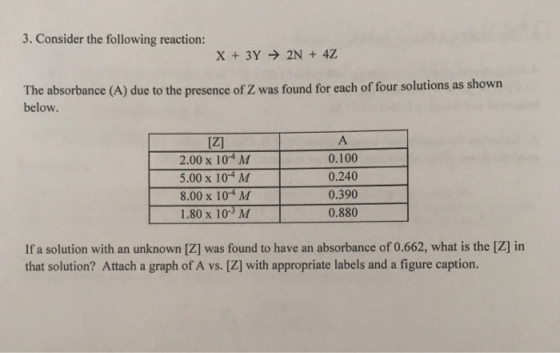
3. Consider the following reaction: X+3Y 2N +4Z The absorbance (A) due to the presence of Z was found for each of four solutions as shown below. [Z] 2.00 x 10⁴ M 0.100 5.00 x 10⁴ M 0.240 8.00 x 10⁴ M 0.390 1.80 x 10³ M 0.880 was found to have an absorbance of 0.662, what is the [Z] in If a solution with an unknown [Z] that solution? Attach a graph of A vs. [Z] with appropriate labels and a figure caption.
Homework Answers
Answer 3:
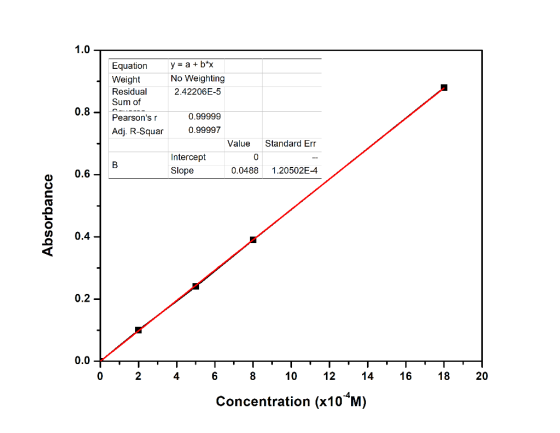
Figure 1: Plot of Absorbance vs [Z].
The values fit into the linear equation, y= a+bx, where
y is the absorbance, x is [Z] and slope, b=0.0488, intercept, a=0.
By rearranging the equation, we have x=y/b
After the substitution of values, we have x= 0.662/0.4889, x= 13.56.
Since the units are in (x 10-4 M), the concentration of Z, [Z]= 13.56 x 10⁻⁴ M or 1.356 x 10⁻⁴ M.
Add Answer to:
Name Equilibrium Constant Lab Prelab assignment 1. Determine the initial concentrations (in molarity) of Fe and...
For each equilibrium sample, calculate the initial concentrations (assuming no reaction occurred)...
 For each equilibrium sample, calculate the initial
concentrations (assuming no reaction occurred) of SCN–
and Fe3+ based on the dilution factors used.
Enter the absorbance values for each sample.
For the standard solution, assume that, when equilibrium is
reached, the [FeSCN2+]eq is equal to
[SCN–]ini. Why is this a good
assumption?
For the equilibrium solutions, calculate the
[FeSCN2+]eq (Ceq) using Eq.
4.
Using Eq. 5 and 6, calculate
[Fe3+(aq)]eq and
[SCN–(aq)]eq for each equilibrium
solution.
Calculate values for the equilibrium...
For each equilibrium sample, calculate the initial
concentrations (assuming no reaction occurred) of SCN–
and Fe3+ based on the dilution factors used.
Enter the absorbance values for each sample.
For the standard solution, assume that, when equilibrium is
reached, the [FeSCN2+]eq is equal to
[SCN–]ini. Why is this a good
assumption?
For the equilibrium solutions, calculate the
[FeSCN2+]eq (Ceq) using Eq.
4.
Using Eq. 5 and 6, calculate
[Fe3+(aq)]eq and
[SCN–(aq)]eq for each equilibrium
solution.
Calculate values for the equilibrium...
1) Consider the following equilibrium: Fe3+(aq) + SCN-(aq) ⇌ FeSCN2+(aq) Initial concentrations: [Fe3+] = 0.590; [SCN-]...
1) Consider the following equilibrium: Fe3+(aq) + SCN-(aq) ⇌ FeSCN2+(aq) Initial concentrations: [Fe3+] = 0.590; [SCN-] = 1.239; [FeSCN2+] = 0 The equilibrium concentration of [FeSCN2+]eq = 0.454 M. What is the numerical value of KC for this equilibrium? KC = __________________ 2) Consider the following equilibrium: Fe3+(aq) + SCN-(aq) ⇌ FeSCN2+(aq) Initial concentrations: [Fe3+] = 0.370; [SCN-] = 0.777; [FeSCN2+] = 0 The equilibrium concentration of [FeSCN2+]eq = 0.285 M. What is the equilibrium concentration of Fe3+? [Fe3+]eq =...
Equilibrium Constant on of an Equilibrium Constant: Data and Calculations Name Data Tables: Standard Solutions: Solutions...
 Equilibrium Constant
on of an Equilibrium Constant: Data and Calculations Name Data Tables: Standard Solutions: Solutions for finding K: Beaker Absorbance (copy this from your prelab calculations) BeakerAbsorbance reSCN T 0016 024 o-00004 lo le Best-fit line equation: ICE Charts (Fill in charts and show all the calculations clearly) Find the initial [Fe] and (SCN] by calculating from the amount of Fe(NO,), "] and [SCN] by calculating from the amount of FelNO,), and KSCN added to each beaker, using M,V...
Equilibrium Constant
on of an Equilibrium Constant: Data and Calculations Name Data Tables: Standard Solutions: Solutions for finding K: Beaker Absorbance (copy this from your prelab calculations) BeakerAbsorbance reSCN T 0016 024 o-00004 lo le Best-fit line equation: ICE Charts (Fill in charts and show all the calculations clearly) Find the initial [Fe] and (SCN] by calculating from the amount of Fe(NO,), "] and [SCN] by calculating from the amount of FelNO,), and KSCN added to each beaker, using M,V...
Write the expression for the equilibrium constant for the following reaction, Fe+3 (aq) + SCN- (aq)...
Write the expression for the equilibrium constant for the following reaction, Fe+3 (aq) + SCN- (aq) ↔ Fe(SCN) +2 (aq) The slope of the calibration curve of [Fe(SCN)+2] vs absorbance is 3.5 x 10⁴ M-1. Given that the absorbance of the solution prepared using 5.0 mL from 0.002 M Fe+3 and 3.0 mL from 0.002 SCN- is 0.422. Calculate the equilibrium constant for this solution.
Determine the equilibrium concentration of FeSCN2+ in each solution. (Page below are the initial concentrations of...
 Determine the equilibrium concentration of FeSCN2+ in each
solution. (Page below are the initial concentrations of FE3+ and
scn- for each solution )
Secondly, use stoichiometry to determine equilibrium FE3+ and
SCN -. ( concentration used for FE and KSCN are both 0.002M )
the absorbance of each standard in the same test tube used to blank the spectrophoto standards from least to most concentrated, rinsing with a small amount of the next sta tilling the test tube. Record absorbance...
Determine the equilibrium concentration of FeSCN2+ in each
solution. (Page below are the initial concentrations of FE3+ and
scn- for each solution )
Secondly, use stoichiometry to determine equilibrium FE3+ and
SCN -. ( concentration used for FE and KSCN are both 0.002M )
the absorbance of each standard in the same test tube used to blank the spectrophoto standards from least to most concentrated, rinsing with a small amount of the next sta tilling the test tube. Record absorbance...
5. A student does an experiment to determine the equili but at a higher temperature. ermine...
 5. A student does an experiment to determine the equili but at a higher temperature. ermine the equilibrium constant for the same reaction that you will study, Fe** (aq) + SCN (aq) FeSCN2+ (aq) The student prepares solution 1, by mixing 5. s Solution, by mixing 5.00 ml of 0.002 M Fe(NO2)2 solution with 5.00 mL of .00011M KSCN solution, heats the mixture, and finds that the equilibrium concentration of F and finds that the equilibrium concentration of FeSCN2+ in...
A student made solution #3 using the experimental method in this lab, and measured an absorbance of 0.559. The starting...
 A student made solution #3 using the experimental method in this
lab, and measured an absorbance of 0.559. The starting reagents are
2.00 x 10⁻³ M Fe(NO3)3 and 2.00 x
10-3 M KSCN.
The amount of absorption is proportional to the concentration
of
FeSCN2+. This relationship – true for many solutions – is called
“Beer’s Law”, and has the simple equation:
A = bc
where “A” is the absorption, “b” is 5174.6 for FeSCN2+ and “c”
is molarity
Make Five...
A student made solution #3 using the experimental method in this
lab, and measured an absorbance of 0.559. The starting reagents are
2.00 x 10⁻³ M Fe(NO3)3 and 2.00 x
10-3 M KSCN.
The amount of absorption is proportional to the concentration
of
FeSCN2+. This relationship – true for many solutions – is called
“Beer’s Law”, and has the simple equation:
A = bc
where “A” is the absorption, “b” is 5174.6 for FeSCN2+ and “c”
is molarity
Make Five...
help with finding the equilibrium of [Fe(SCN)^2+] morality value Equilibrium Solutions Data 1. Use your "Absorbance...
 help with finding the equilibrium of [Fe(SCN)^2+] morality value
Equilibrium Solutions Data 1. Use your "Absorbance of Solution" values and the graph you made above to interpolate the "Equilibrium [Fe(SCN)]" molarity values. 2. Calculate both the "Initial [Fe ]" and the "Initial [SCN']" molarity values using then dilution equation CiVi C2V2. 3. Calculate the "Equilibrium [Fe ]" molarity values by subtracting the "Equilibrium [Fe(SCN) " molarity values from the "Initial [Fe'" molarity values. 4. Calculate the "Equilibrium [SCN']" molarity values...
help with finding the equilibrium of [Fe(SCN)^2+] morality value
Equilibrium Solutions Data 1. Use your "Absorbance of Solution" values and the graph you made above to interpolate the "Equilibrium [Fe(SCN)]" molarity values. 2. Calculate both the "Initial [Fe ]" and the "Initial [SCN']" molarity values using then dilution equation CiVi C2V2. 3. Calculate the "Equilibrium [Fe ]" molarity values by subtracting the "Equilibrium [Fe(SCN) " molarity values from the "Initial [Fe'" molarity values. 4. Calculate the "Equilibrium [SCN']" molarity values...
Data and Calculations: Determination of the Equilibrium Constant for a Chemical Reaction Method II Volume in...
 Data and Calculations: Determination of the Equilibrium Constant for a Chemical Reaction Method II Volume in mL 2.00 x 10³ M Fe(NO) Volume in mL, Depth in mm Volume in ml. 2.00 x 10³ M Method I Mixture Unknówn KSCN Water Absorbance Standard FESCNP 4mL 1 5.00 x 10 M 1,00 .227 3mL 2 5,00 202 x 10 M 2,00 90 x 10 M .304 3 5,00 3.00 2mL 955 x 104 M I ImL 4 5.00 4,00 19x 10...
help with calculating the “initial [SCN^—]” M and the Equilibrium [Fe(SCN^2+)] M. i have one. just...
 help with calculating the “initial [SCN^—]” M and the Equilibrium
[Fe(SCN^2+)] M.
i
have one. just not sure how to set up the equation to find the
inital [SCN^-] . not sure if im calculating it correctly.
Data Manipulation and Calculations Calibration Solutions Data 1. Calculate the "Initial [SCN']" molarities for the solutions using the dilution equation CiVI=C2V2 2. Use the net ionic equation for the reaction, the ratio of [Fe3 [SCN'] used, and your knowledge of Le Châtelier's Principle...
help with calculating the “initial [SCN^—]” M and the Equilibrium
[Fe(SCN^2+)] M.
i
have one. just not sure how to set up the equation to find the
inital [SCN^-] . not sure if im calculating it correctly.
Data Manipulation and Calculations Calibration Solutions Data 1. Calculate the "Initial [SCN']" molarities for the solutions using the dilution equation CiVI=C2V2 2. Use the net ionic equation for the reaction, the ratio of [Fe3 [SCN'] used, and your knowledge of Le Châtelier's Principle...
 For each equilibrium sample, calculate the initial
concentrations (assuming no reaction occurred) of SCN–
and Fe3+ based on the dilution factors used.
Enter the absorbance values for each sample.
For the standard solution, assume that, when equilibrium is
reached, the [FeSCN2+]eq is equal to
[SCN–]ini. Why is this a good
assumption?
For the equilibrium solutions, calculate the
[FeSCN2+]eq (Ceq) using Eq.
4.
Using Eq. 5 and 6, calculate
[Fe3+(aq)]eq and
[SCN–(aq)]eq for each equilibrium
solution.
Calculate values for the equilibrium...
For each equilibrium sample, calculate the initial
concentrations (assuming no reaction occurred) of SCN–
and Fe3+ based on the dilution factors used.
Enter the absorbance values for each sample.
For the standard solution, assume that, when equilibrium is
reached, the [FeSCN2+]eq is equal to
[SCN–]ini. Why is this a good
assumption?
For the equilibrium solutions, calculate the
[FeSCN2+]eq (Ceq) using Eq.
4.
Using Eq. 5 and 6, calculate
[Fe3+(aq)]eq and
[SCN–(aq)]eq for each equilibrium
solution.
Calculate values for the equilibrium...
 Equilibrium Constant
on of an Equilibrium Constant: Data and Calculations Name Data Tables: Standard Solutions: Solutions for finding K: Beaker Absorbance (copy this from your prelab calculations) BeakerAbsorbance reSCN T 0016 024 o-00004 lo le Best-fit line equation: ICE Charts (Fill in charts and show all the calculations clearly) Find the initial [Fe] and (SCN] by calculating from the amount of Fe(NO,), "] and [SCN] by calculating from the amount of FelNO,), and KSCN added to each beaker, using M,V...
Equilibrium Constant
on of an Equilibrium Constant: Data and Calculations Name Data Tables: Standard Solutions: Solutions for finding K: Beaker Absorbance (copy this from your prelab calculations) BeakerAbsorbance reSCN T 0016 024 o-00004 lo le Best-fit line equation: ICE Charts (Fill in charts and show all the calculations clearly) Find the initial [Fe] and (SCN] by calculating from the amount of Fe(NO,), "] and [SCN] by calculating from the amount of FelNO,), and KSCN added to each beaker, using M,V...
 Determine the equilibrium concentration of FeSCN2+ in each
solution. (Page below are the initial concentrations of FE3+ and
scn- for each solution )
Secondly, use stoichiometry to determine equilibrium FE3+ and
SCN -. ( concentration used for FE and KSCN are both 0.002M )
the absorbance of each standard in the same test tube used to blank the spectrophoto standards from least to most concentrated, rinsing with a small amount of the next sta tilling the test tube. Record absorbance...
Determine the equilibrium concentration of FeSCN2+ in each
solution. (Page below are the initial concentrations of FE3+ and
scn- for each solution )
Secondly, use stoichiometry to determine equilibrium FE3+ and
SCN -. ( concentration used for FE and KSCN are both 0.002M )
the absorbance of each standard in the same test tube used to blank the spectrophoto standards from least to most concentrated, rinsing with a small amount of the next sta tilling the test tube. Record absorbance...
 5. A student does an experiment to determine the equili but at a higher temperature. ermine the equilibrium constant for the same reaction that you will study, Fe** (aq) + SCN (aq) FeSCN2+ (aq) The student prepares solution 1, by mixing 5. s Solution, by mixing 5.00 ml of 0.002 M Fe(NO2)2 solution with 5.00 mL of .00011M KSCN solution, heats the mixture, and finds that the equilibrium concentration of F and finds that the equilibrium concentration of FeSCN2+ in...
 A student made solution #3 using the experimental method in this
lab, and measured an absorbance of 0.559. The starting reagents are
2.00 x 10⁻³ M Fe(NO3)3 and 2.00 x
10-3 M KSCN.
The amount of absorption is proportional to the concentration
of
FeSCN2+. This relationship – true for many solutions – is called
“Beer’s Law”, and has the simple equation:
A = bc
where “A” is the absorption, “b” is 5174.6 for FeSCN2+ and “c”
is molarity
Make Five...
A student made solution #3 using the experimental method in this
lab, and measured an absorbance of 0.559. The starting reagents are
2.00 x 10⁻³ M Fe(NO3)3 and 2.00 x
10-3 M KSCN.
The amount of absorption is proportional to the concentration
of
FeSCN2+. This relationship – true for many solutions – is called
“Beer’s Law”, and has the simple equation:
A = bc
where “A” is the absorption, “b” is 5174.6 for FeSCN2+ and “c”
is molarity
Make Five...
 help with finding the equilibrium of [Fe(SCN)^2+] morality value
Equilibrium Solutions Data 1. Use your "Absorbance of Solution" values and the graph you made above to interpolate the "Equilibrium [Fe(SCN)]" molarity values. 2. Calculate both the "Initial [Fe ]" and the "Initial [SCN']" molarity values using then dilution equation CiVi C2V2. 3. Calculate the "Equilibrium [Fe ]" molarity values by subtracting the "Equilibrium [Fe(SCN) " molarity values from the "Initial [Fe'" molarity values. 4. Calculate the "Equilibrium [SCN']" molarity values...
help with finding the equilibrium of [Fe(SCN)^2+] morality value
Equilibrium Solutions Data 1. Use your "Absorbance of Solution" values and the graph you made above to interpolate the "Equilibrium [Fe(SCN)]" molarity values. 2. Calculate both the "Initial [Fe ]" and the "Initial [SCN']" molarity values using then dilution equation CiVi C2V2. 3. Calculate the "Equilibrium [Fe ]" molarity values by subtracting the "Equilibrium [Fe(SCN) " molarity values from the "Initial [Fe'" molarity values. 4. Calculate the "Equilibrium [SCN']" molarity values...
 Data and Calculations: Determination of the Equilibrium Constant for a Chemical Reaction Method II Volume in mL 2.00 x 10³ M Fe(NO) Volume in mL, Depth in mm Volume in ml. 2.00 x 10³ M Method I Mixture Unknówn KSCN Water Absorbance Standard FESCNP 4mL 1 5.00 x 10 M 1,00 .227 3mL 2 5,00 202 x 10 M 2,00 90 x 10 M .304 3 5,00 3.00 2mL 955 x 104 M I ImL 4 5.00 4,00 19x 10...
 help with calculating the “initial [SCN^—]” M and the Equilibrium
[Fe(SCN^2+)] M.
i
have one. just not sure how to set up the equation to find the
inital [SCN^-] . not sure if im calculating it correctly.
Data Manipulation and Calculations Calibration Solutions Data 1. Calculate the "Initial [SCN']" molarities for the solutions using the dilution equation CiVI=C2V2 2. Use the net ionic equation for the reaction, the ratio of [Fe3 [SCN'] used, and your knowledge of Le Châtelier's Principle...
help with calculating the “initial [SCN^—]” M and the Equilibrium
[Fe(SCN^2+)] M.
i
have one. just not sure how to set up the equation to find the
inital [SCN^-] . not sure if im calculating it correctly.
Data Manipulation and Calculations Calibration Solutions Data 1. Calculate the "Initial [SCN']" molarities for the solutions using the dilution equation CiVI=C2V2 2. Use the net ionic equation for the reaction, the ratio of [Fe3 [SCN'] used, and your knowledge of Le Châtelier's Principle...
Most questions answered within 3 hours.
-
Where is the error in this code sequence?
String s1 = "Hello";
String s2 = "ello";...
asked 10 months ago -
Financial data for Joel de Paris, Inc., for last year
follow:
Joel de Paris, Inc.
Balance...
asked 10 months ago -
Consider this reaction:
Al2(SO4)3 (aq)+ BaCl3
(aq) Al2Cl6 (aq)- +
3BaSO4(s) . What is the...
asked 10 months ago -
Suppose that Savneet is considering increasing her
recent random sample from 20 car rentals to 40...
asked 10 months ago -
Trucks arrive at an unloading terminal at an average rate of 120
per hour.
Trucks arrive...
asked 10 months ago -
Why are methanol and ethanol completely soluble in water while
octanol is not very little soluble....
asked 10 months ago -
A facilities manager at a university reads in a research report
that the mean amount of...
asked 10 months ago -
When the CuSO4 is rehydrated by adding water to the anhydrous
compound, is this an endothermic...
asked 10 months ago -
A ray of sunlight is passing from diamond into crown glass; the
angle of incidence is...
asked 10 months ago -
A block of mass 0.249 kg is placed on top of a light, vertical
spring of...
asked 10 months ago -
how do the kidneys compensate in the presences of acidosis
a) trigger hyperventilate
b) reserve acid...
asked 10 months ago -
Question 501 pts
The rental rate of capital to the firm increases. Which of the
following...
asked 10 months ago