1. Why is it not possible for total internal reflection to occur when a light beam...
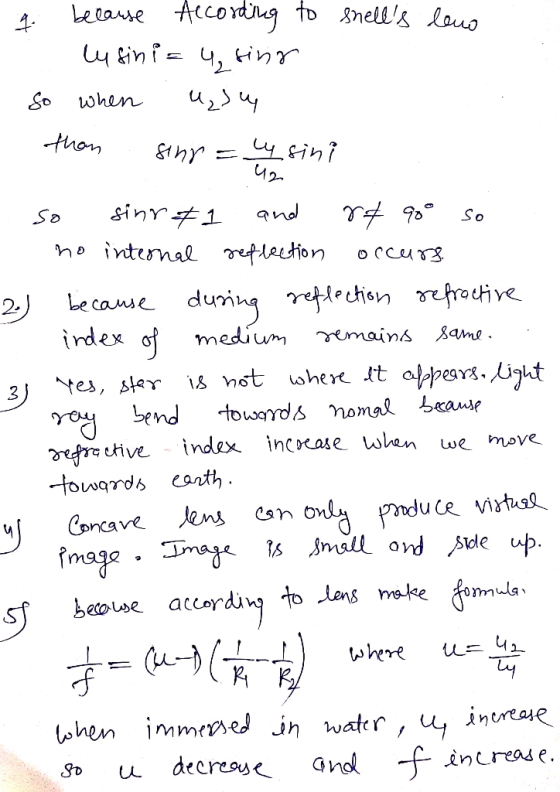
1. Why is it not possible for total internal reflection to occur when a light beam is passing from a medium of low optical density (air) into a medium of higher optical density ( glass or water). Explain fully.
2. When light is incident on an interface between two materials, the angle of the refracted ray depends on the wavelength, but the angle of the reflected ray does not. Why should this be true? Explain fully.
3. Sunlight and star light passing into and through the earth’s atmosphere is always bent towards the vertical (normal). Does this mean the star is not where it appears to be?
4. What type of lens can only produce a virtual image? Is the image larger or smaller? Is it right side up or upside down?
5. When a converging lens is immersed in water, does it’s focal length increase, decrease or stay the same? Explain.
Homework Answers
Add Answer to:
1. Why is it not possible for total internal reflection to occur when a light beam...
1. A beam of light in water (n = 1.33) enters a transparent medium at an...
1. A beam of light in water (n = 1.33) enters a transparent medium at an angle of incidence of 45.0o, and is refracted at an angle of refraction 40.0o to the normal. What is the refractive index of the medium? 2.If a converging lens forms a real, inverted image 20.0 cm to the right of the lens when the object is placed 43.0 cm to the left of a lens, determine the focal length of the lens in cm.
HOLT PHYSICS MODULE 15 Refraction Fill each blank below with the word or phrase that completes...
 HOLT PHYSICS MODULE 15 Refraction Fill each blank below with the word or phrase that completes the statement. 1. A focuses to a point light rays passing through it. The focusing effect is the result of Light waves are refracted when they pass from one medium to another because their 2. changes. 3-The normal line is an imaginary line- of to the two mediums. Light waves are bent away from the normal or toward it depending on whether the speed...
Lab 08: Reflection and Refraction of Light You will need to run a simulation to do...
Lab 08: Reflection and Refraction of Light You will need to run a simulation to do the lab. Answer the following questions as you work through the lab. Write your answers in blue. (Note that we may miss your response if it does not stand out ) Re-load the file in word or PDF format in Canvas before the due date. Overview Light bends when it enters from one medium to another. This bending of light is called Refraction of...
and it is incident at an angle greater For total internal reflection to occur light ray...
 and it is incident at an angle greater For total internal reflection to occur light ray passes from than the critical angle a. water to glass b. glass to air с oil to diamond d. air to water o
2. Use Snell's law (n, sin = n, sine,) to explain why , is greater than...
 2. Use Snell's law (n, sin = n, sine,) to explain why , is greater than 0 in Fig. 2. Total Internal Reflection When light passes from a medium of large refractive index into one of small refractive index --- for example, from water to air --- the refracted ray bends away from the surface normal, as shown in Fig. 2. As the angle of incidence increases, the angle of refraction also increases. When the angle of incidence reaches a...
3. The critical angle for total internal reflection at a liquid-air interface is 48.6'. If a...
 3. The critical angle for total internal reflection at a liquid-air interface is 48.6'. If a ray of light travelling in the liquid has an angle of incidence at the interface of 40.0º, what angle does the refracted ray in the air make with the normal? If a ray of light traveling in air has an angle of incidence at the interface of 40.0', what angle does the refracted ray in the liquid make with the normal? The focal length...
Snell's Law and the Law of Reflection explain how light is redirected when it encounters a...
Snell's Law and the Law of Reflection explain how light is redirected when it encounters a surface between two media. In the extreme, light may only reflect at a boundary, and go back into the medium it was in. More often, some of it reflects and some goes through. If the boundary is plane and flat, then these laws are easy to interpret. When the boundary is curved, they describe happens at every point on the surface. One of the...
2. Explain why light rays converge when passing through a double convex lens by describing the...
2. Explain why light rays converge when passing through a double convex lens by describing the paths of three light rays; one along the optic axis and the other two parallel to the optic axis. 3. What happens to the image if half a converging lens is covered? Explain why this occurs. 4. What are the conditions necessary to form a virtual image using a converging lens? 5. What type of lens is used in a magnifying glass? Explain how...
14) According to the law of reflection, a light ray striking a mirror at an angle...
 14) According to the law of reflection, a light ray striking a mirror at an angle of incidence of 30 degrees will leaves the miror at an angle of a. 60 degrees b. 30 degrees c. less than 30 degrees d. none of the above 15) A light ray bends when it goes from one medium to another because of a. interference b. diffraction c. specular reflection d. refraction c. polarization 16) Rank the following media in order according to...
When a light ray travels from a more dense medium to a less dense medium and...
When a light ray travels from a more dense medium to a less dense medium and the light ray intercepts the interface at some angle, the light ray will be deviated away from the normal to the interface. When the angle of the incident light ray is equal or greater than some critical angle , the light ray will be bent away from the normal unit the angle of refraction becomes 90, and total internal reflection occurs. The critical angle, , for two...
 HOLT PHYSICS MODULE 15 Refraction Fill each blank below with the word or phrase that completes the statement. 1. A focuses to a point light rays passing through it. The focusing effect is the result of Light waves are refracted when they pass from one medium to another because their 2. changes. 3-The normal line is an imaginary line- of to the two mediums. Light waves are bent away from the normal or toward it depending on whether the speed...
 and it is incident at an angle greater For total internal reflection to occur light ray passes from than the critical angle a. water to glass b. glass to air с oil to diamond d. air to water o
 2. Use Snell's law (n, sin = n, sine,) to explain why , is greater than 0 in Fig. 2. Total Internal Reflection When light passes from a medium of large refractive index into one of small refractive index --- for example, from water to air --- the refracted ray bends away from the surface normal, as shown in Fig. 2. As the angle of incidence increases, the angle of refraction also increases. When the angle of incidence reaches a...
 3. The critical angle for total internal reflection at a liquid-air interface is 48.6'. If a ray of light travelling in the liquid has an angle of incidence at the interface of 40.0º, what angle does the refracted ray in the air make with the normal? If a ray of light traveling in air has an angle of incidence at the interface of 40.0', what angle does the refracted ray in the liquid make with the normal? The focal length...
 14) According to the law of reflection, a light ray striking a mirror at an angle of incidence of 30 degrees will leaves the miror at an angle of a. 60 degrees b. 30 degrees c. less than 30 degrees d. none of the above 15) A light ray bends when it goes from one medium to another because of a. interference b. diffraction c. specular reflection d. refraction c. polarization 16) Rank the following media in order according to...
Most questions answered within 3 hours.
-
Where is the error in this code sequence?
String s1 = "Hello";
String s2 = "ello";...
asked 10 months ago -
Financial data for Joel de Paris, Inc., for last year
follow:
Joel de Paris, Inc.
Balance...
asked 10 months ago -
Consider this reaction:
Al2(SO4)3 (aq)+ BaCl3
(aq) Al2Cl6 (aq)- +
3BaSO4(s) . What is the...
asked 10 months ago -
Suppose that Savneet is considering increasing her
recent random sample from 20 car rentals to 40...
asked 10 months ago -
Trucks arrive at an unloading terminal at an average rate of 120
per hour.
Trucks arrive...
asked 10 months ago -
Why are methanol and ethanol completely soluble in water while
octanol is not very little soluble....
asked 10 months ago -
A facilities manager at a university reads in a research report
that the mean amount of...
asked 10 months ago -
When the CuSO4 is rehydrated by adding water to the anhydrous
compound, is this an endothermic...
asked 10 months ago -
A ray of sunlight is passing from diamond into crown glass; the
angle of incidence is...
asked 10 months ago -
A block of mass 0.249 kg is placed on top of a light, vertical
spring of...
asked 10 months ago -
how do the kidneys compensate in the presences of acidosis
a) trigger hyperventilate
b) reserve acid...
asked 10 months ago -
Question 501 pts
The rental rate of capital to the firm increases. Which of the
following...
asked 10 months ago