

Homework Answers
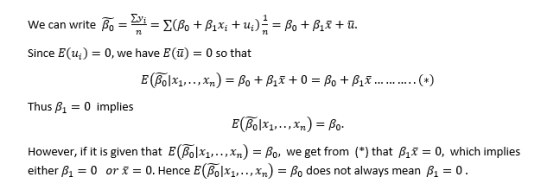

For any query in above, comment.
Add Answer to:
Type or pas 2. Let the population regression model between a dependent variable y and an...
I really need the answers to these two small questions. I post several times but no one answer. If you can answer, I will even pay you. Please state your paypal number if you answer it. Thank you! 4....
 I really need the answers to these two small questions. I post
several times but no one answer. If you can answer, I will even pay
you. Please state your paypal number if you answer it. Thank
you!
4. Suppose that (Xi,K), , (XN,Yv) denotes a random sample. Let Si-a+ bXi, T, e+dy, where a, b, c and d are constants. Let X-., Σ Xi, and σ Σ (Xi-X)2, with the analogous expressions for y, ST. Let ởXY-NT Σ(Xi-X)(y-y), and...
I really need the answers to these two small questions. I post
several times but no one answer. If you can answer, I will even pay
you. Please state your paypal number if you answer it. Thank
you!
4. Suppose that (Xi,K), , (XN,Yv) denotes a random sample. Let Si-a+ bXi, T, e+dy, where a, b, c and d are constants. Let X-., Σ Xi, and σ Σ (Xi-X)2, with the analogous expressions for y, ST. Let ởXY-NT Σ(Xi-X)(y-y), and...
Hey could someone please answer this in regards to part F ? That is the part...
 Hey could someone please answer this in regards to part
F ? That is the part of the question I am struggling
with
1. Consider the regression model Y = BX1i + 2X2 +U, for i = 1,...,n (notice that there is no intercept in the regression). (a) Specify the least squares function that is minimized by OLS. (b) Compute the derivatives of the objective function with respect to B, and B. (C) Suppose that D-1 X1 X2 = 0....
Hey could someone please answer this in regards to part
F ? That is the part of the question I am struggling
with
1. Consider the regression model Y = BX1i + 2X2 +U, for i = 1,...,n (notice that there is no intercept in the regression). (a) Specify the least squares function that is minimized by OLS. (b) Compute the derivatives of the objective function with respect to B, and B. (C) Suppose that D-1 X1 X2 = 0....
2. Consider the simple linear regression model: where e1, .. . , es, are i.i.d. N (0, o2), for i= 1,2,... , n. Suppose...
 2. Consider the simple linear regression model: where e1, .. . , es, are i.i.d. N (0, o2), for i= 1,2,... , n. Suppose that we would like to estimate the mean response at x = x*, that is we want to estimate lyx=* = Bo + B1 x*. The least squares estimator for /uyx* is = bo bi x*, where bo, b1 are the least squares estimators for Bo, Bi. ayx= (a) Show that the least squares estimator for...
Please answer all the parts neatly with all details. 3. Assume X1, X2,... are a sequence...
 Please answer all the parts neatly with all details.
3. Assume X1, X2,... are a sequence of i.i.d. random variables having finite first moment, that is, v = E(Xi oo. Let Yn = (|X1| .+ |Xn|)/n. (a) Show that Yn ->v in probability. (b) Show that E(Y,) -- v. (c) Show that E(|X, - /u|) -0 where u = E(X)
3. Assume X1, X2,... are a sequence of i.i.d. random variables having finite first moment, that is, v = E(Xi...
Please answer all the parts neatly with all details.
3. Assume X1, X2,... are a sequence of i.i.d. random variables having finite first moment, that is, v = E(Xi oo. Let Yn = (|X1| .+ |Xn|)/n. (a) Show that Yn ->v in probability. (b) Show that E(Y,) -- v. (c) Show that E(|X, - /u|) -0 where u = E(X)
3. Assume X1, X2,... are a sequence of i.i.d. random variables having finite first moment, that is, v = E(Xi...
Problem 2 (Eigenvalues and Eigenvectors). (a) If R2 4 R2 be defined by f(x,y) (y,x), then find al...
 Problem 2 (Eigenvalues and Eigenvectors). (a) If R2 4 R2 be defined by f(x,y) (y,x), then find all the eigenvalues and eigenvectors of f Hint: Use the matrix representation. (b) Let U be a vector subspace (U o, V) of a finite dimensional vector space V. Show that there exists a linear transformation V V such that U is not an invariant subspace of f Hence, or otherwise, show that: a vector subspace U-0 or U = V, if and...
1. Consider the simple linear regression model: Ү, — Во + B а; + Ei, where 1, . . , En are i.i.d. N(0,02), for i1,2,......
 1. Consider the simple linear regression model: Ү, — Во + B а; + Ei, where 1, . . , En are i.i.d. N(0,02), for i1,2,... ,n. Let b1 = s^y/8r and bo = Y - b1 t be the least squared estimators of B1 and Bo, respectively. We showed in class, that N(B; 02/) Y~N(BoB1 T;o2/n) and bi ~ are uncorrelated, i.e. o{Y;b} We also showed in class that bi and Y 0. = (a) Show that bo is...
Consider the regression equation Y = Bo+B1Xi+u; where E[u;|Xi]=0 for all i = 1, ..., n....
 Consider the regression equation Y = Bo+B1Xi+u; where E[u;|Xi]=0 for all i = 1, ..., n. Let B 1 be the OLS estimator for B 1. Which statement is the most irrelevant to the consistency of B1? Hint: see Lecture Note 2 (p.25-p.28) a. When n is large, the estimator B 1 is near the population parameter B1 O". Consistency of B1 is mathematically written as B1-B1 VB) is inversely proportional to the sample size n. Od. RMSE is close...
1. Consider a random experiment that has as an outcome the number x. Let the associated random variable be X, with true (population) and unknown probability density function fx(x), mean ux, and varia...
 1. Consider a random experiment that has as an outcome the number x. Let the associated random variable be X, with true (population) and unknown probability density function fx(x), mean ux, and variance σχ2. Assume that n 2 independent, repeated trials of the random experiment are performed, resulting in the 2-sample of numerical outcomes x] and x2. Let estimate f x of true mean ux be μΧ-(X1 + x2)/2. Then the random variable associated with estimate Axis estimator Ax- (XI...
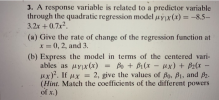
3. A response variable is related to a predictor variable through the quadratic regression model u...
 3. A response variable is related to a predictor variable through the quadratic regression model u yıx(x) = -8.5– 3.2x + 0.7x2 (a) Give the rate of change of the regression function at x = 0, 2, and 3. (b) Express the model in terms of the centered vari- ables as jyjx(x) = Bo + B1(x – ux) + B2(x - ux)2. If ux = 2, give the values of Bo, B1, and B2. (Hint. Match the coefficients of the...
#2 2. Let X, N o ?) for i=1,2. Show that Y = X1 + X,...
 #2
2. Let X, N o ?) for i=1,2. Show that Y = X1 + X, and Z X; - X2 are independent. 3. Let 2-N(0,1) and W x (n) with Z be independent of W. Show that the distribution of T- tudiatvihustion with n deerees of freedom. (Hint: create a second variable U - find the joint distribution
#2
2. Let X, N o ?) for i=1,2. Show that Y = X1 + X, and Z X; - X2 are independent. 3. Let 2-N(0,1) and W x (n) with Z be independent of W. Show that the distribution of T- tudiatvihustion with n deerees of freedom. (Hint: create a second variable U - find the joint distribution
 I really need the answers to these two small questions. I post
several times but no one answer. If you can answer, I will even pay
you. Please state your paypal number if you answer it. Thank
you!
4. Suppose that (Xi,K), , (XN,Yv) denotes a random sample. Let Si-a+ bXi, T, e+dy, where a, b, c and d are constants. Let X-., Σ Xi, and σ Σ (Xi-X)2, with the analogous expressions for y, ST. Let ởXY-NT Σ(Xi-X)(y-y), and...
I really need the answers to these two small questions. I post
several times but no one answer. If you can answer, I will even pay
you. Please state your paypal number if you answer it. Thank
you!
4. Suppose that (Xi,K), , (XN,Yv) denotes a random sample. Let Si-a+ bXi, T, e+dy, where a, b, c and d are constants. Let X-., Σ Xi, and σ Σ (Xi-X)2, with the analogous expressions for y, ST. Let ởXY-NT Σ(Xi-X)(y-y), and...
 Hey could someone please answer this in regards to part
F ? That is the part of the question I am struggling
with
1. Consider the regression model Y = BX1i + 2X2 +U, for i = 1,...,n (notice that there is no intercept in the regression). (a) Specify the least squares function that is minimized by OLS. (b) Compute the derivatives of the objective function with respect to B, and B. (C) Suppose that D-1 X1 X2 = 0....
Hey could someone please answer this in regards to part
F ? That is the part of the question I am struggling
with
1. Consider the regression model Y = BX1i + 2X2 +U, for i = 1,...,n (notice that there is no intercept in the regression). (a) Specify the least squares function that is minimized by OLS. (b) Compute the derivatives of the objective function with respect to B, and B. (C) Suppose that D-1 X1 X2 = 0....
 2. Consider the simple linear regression model: where e1, .. . , es, are i.i.d. N (0, o2), for i= 1,2,... , n. Suppose that we would like to estimate the mean response at x = x*, that is we want to estimate lyx=* = Bo + B1 x*. The least squares estimator for /uyx* is = bo bi x*, where bo, b1 are the least squares estimators for Bo, Bi. ayx= (a) Show that the least squares estimator for...
 Please answer all the parts neatly with all details.
3. Assume X1, X2,... are a sequence of i.i.d. random variables having finite first moment, that is, v = E(Xi oo. Let Yn = (|X1| .+ |Xn|)/n. (a) Show that Yn ->v in probability. (b) Show that E(Y,) -- v. (c) Show that E(|X, - /u|) -0 where u = E(X)
3. Assume X1, X2,... are a sequence of i.i.d. random variables having finite first moment, that is, v = E(Xi...
Please answer all the parts neatly with all details.
3. Assume X1, X2,... are a sequence of i.i.d. random variables having finite first moment, that is, v = E(Xi oo. Let Yn = (|X1| .+ |Xn|)/n. (a) Show that Yn ->v in probability. (b) Show that E(Y,) -- v. (c) Show that E(|X, - /u|) -0 where u = E(X)
3. Assume X1, X2,... are a sequence of i.i.d. random variables having finite first moment, that is, v = E(Xi...
 Problem 2 (Eigenvalues and Eigenvectors). (a) If R2 4 R2 be defined by f(x,y) (y,x), then find all the eigenvalues and eigenvectors of f Hint: Use the matrix representation. (b) Let U be a vector subspace (U o, V) of a finite dimensional vector space V. Show that there exists a linear transformation V V such that U is not an invariant subspace of f Hence, or otherwise, show that: a vector subspace U-0 or U = V, if and...
 1. Consider the simple linear regression model: Ү, — Во + B а; + Ei, where 1, . . , En are i.i.d. N(0,02), for i1,2,... ,n. Let b1 = s^y/8r and bo = Y - b1 t be the least squared estimators of B1 and Bo, respectively. We showed in class, that N(B; 02/) Y~N(BoB1 T;o2/n) and bi ~ are uncorrelated, i.e. o{Y;b} We also showed in class that bi and Y 0. = (a) Show that bo is...
 Consider the regression equation Y = Bo+B1Xi+u; where E[u;|Xi]=0 for all i = 1, ..., n. Let B 1 be the OLS estimator for B 1. Which statement is the most irrelevant to the consistency of B1? Hint: see Lecture Note 2 (p.25-p.28) a. When n is large, the estimator B 1 is near the population parameter B1 O". Consistency of B1 is mathematically written as B1-B1 VB) is inversely proportional to the sample size n. Od. RMSE is close...
 1. Consider a random experiment that has as an outcome the number x. Let the associated random variable be X, with true (population) and unknown probability density function fx(x), mean ux, and variance σχ2. Assume that n 2 independent, repeated trials of the random experiment are performed, resulting in the 2-sample of numerical outcomes x] and x2. Let estimate f x of true mean ux be μΧ-(X1 + x2)/2. Then the random variable associated with estimate Axis estimator Ax- (XI...
 3. A response variable is related to a predictor variable through the quadratic regression model u yıx(x) = -8.5– 3.2x + 0.7x2 (a) Give the rate of change of the regression function at x = 0, 2, and 3. (b) Express the model in terms of the centered vari- ables as jyjx(x) = Bo + B1(x – ux) + B2(x - ux)2. If ux = 2, give the values of Bo, B1, and B2. (Hint. Match the coefficients of the...
 #2
2. Let X, N o ?) for i=1,2. Show that Y = X1 + X, and Z X; - X2 are independent. 3. Let 2-N(0,1) and W x (n) with Z be independent of W. Show that the distribution of T- tudiatvihustion with n deerees of freedom. (Hint: create a second variable U - find the joint distribution
#2
2. Let X, N o ?) for i=1,2. Show that Y = X1 + X, and Z X; - X2 are independent. 3. Let 2-N(0,1) and W x (n) with Z be independent of W. Show that the distribution of T- tudiatvihustion with n deerees of freedom. (Hint: create a second variable U - find the joint distribution
Most questions answered within 3 hours.
-
Where is the error in this code sequence?
String s1 = "Hello";
String s2 = "ello";...
asked 10 months ago -
Financial data for Joel de Paris, Inc., for last year
follow:
Joel de Paris, Inc.
Balance...
asked 10 months ago -
Consider this reaction:
Al2(SO4)3 (aq)+ BaCl3
(aq) Al2Cl6 (aq)- +
3BaSO4(s) . What is the...
asked 10 months ago -
Suppose that Savneet is considering increasing her
recent random sample from 20 car rentals to 40...
asked 10 months ago -
Trucks arrive at an unloading terminal at an average rate of 120
per hour.
Trucks arrive...
asked 10 months ago -
Why are methanol and ethanol completely soluble in water while
octanol is not very little soluble....
asked 10 months ago -
A facilities manager at a university reads in a research report
that the mean amount of...
asked 10 months ago -
When the CuSO4 is rehydrated by adding water to the anhydrous
compound, is this an endothermic...
asked 10 months ago -
A ray of sunlight is passing from diamond into crown glass; the
angle of incidence is...
asked 10 months ago -
A block of mass 0.249 kg is placed on top of a light, vertical
spring of...
asked 10 months ago -
how do the kidneys compensate in the presences of acidosis
a) trigger hyperventilate
b) reserve acid...
asked 10 months ago -
Question 501 pts
The rental rate of capital to the firm increases. Which of the
following...
asked 10 months ago