

Advance Study Assignment: Rates of Chemical Reactions, II. A Clock Reaction 1. A student studied the clock reaction described in this experiment. She set up Reaction Mixture 2 by mixing 20 mlL 0.010 M KI, 10 mL. 0.001 M Na,S,O, 10 ml. 0.040 M KBrO, and 10 ml. 0.10 M HCI using the procedure given. It took about 45 seconds for the color to turn blue. She found the concentrations of each reactant in the reacting mixture by realizing that the number of moles of cach reactant did not change when that reactant was mixed with the others, but that its con- centration did. For any reactant A a. no. moles A = M, xV M A stock A mixture The volume of the mixture was 50 ml. Revising the above equation, she obtained V (mL) 50 mL M, = M..X A wak A mixture Find the concentrations of each reactant by using the above equation. (I) M; (BrO,) M; (H) b. What was the relative rate of the reaction (1000/)? c. Knowing the relative rate of reaction for Mixture 2 and the concentrations of I, BrO., and H in that mixture, she was able to set up Equation 5 for the relative rate of the reaction. The only quantities that remained unknown were k, m, n, and p. Set up Equation 5 as she did, presuming she did it properly Equation 5 is on page 172. 2. For Reaction Mixture 1 the student found that 85 seconds were required. On dividing Equation 5 for Reaction Mixture 1 by Equation 5 for Reaction Mixture 2, and after canceling out the common terms (, terms in (BrO,) and (H')), she got the following equation: 0,0020) 0.0040 -GT 11.8 22 Recognizing that 11.8/22 is about equal to 2, she obtained an approximate value for m. What was that value? m By taking logarithms of both sides of the equation, she got an exact value for m. What was that value? m Since orders of reactions are often integers, she reported her approximate value as the order of the reac- tion with respect to I
Homework Answers


Add Answer to:
This is a better photo Section Name Experiment 21 Advance Study Assignment: Rates of Chemical Reactions,...
Experiment 21 Advance Study Assignment: Rates of Chemical Reactions, II. A Clock Reaction 1. A student...
Experiment 21 Advance Study Assignment: Rates of Chemical Reactions, II. A Clock Reaction 1. A student studied the clock reaction described in this experiment. She set up Reaction Mixture 4 by mixing 10 mL 0.010 M KI, 10 mL 0.001 M Na2S2O3, 10 mL 0.040 M KBrO3, and 20 mL 0.10 M HCl using the procedure given. It took about 21 seconds for the color to turn blue. a. She found the concentrations of each reactant in the reacting mixture...
A student studied the clock reaction described in this experiment. She set up Reaction Mixture 2...
A student studied the clock reaction described in this experiment. She set up Reaction Mixture 2 by mixing 20 mL 0.010 M KI, 10 mL .001 M Na2S2O3, 10 mL .040 M KBrO3, and 10 mL 0.10 M HCl using the procedure given. It took 45 seconds for the color to turn to blue. a. She found the concentration of each reactant in the reacting mixture by realizing that the number of moles of each reactant did not change when...
need help with relative rate problems Experiment 21 Data and Calculations: Rates of Chemical Reactions, Il....
 need help with relative rate problems
Experiment 21 Data and Calculations: Rates of Chemical Reactions, Il. A Clock Reaction A. Dependence of Reaction Rate on Concentration Reaction: 61(ag + BrO,ag)+ 6H(aq)3aqp+ Brap+HO0 rate irBeO, Tr-- In all the reaction mistures used in this experiment, the color change occurred when a constant predetermined aumber of moles of BrO," had been used n in the reaction The color "clock" allows you to measue the ime mgaired for this fixed number of moles...
need help with relative rate problems
Experiment 21 Data and Calculations: Rates of Chemical Reactions, Il. A Clock Reaction A. Dependence of Reaction Rate on Concentration Reaction: 61(ag + BrO,ag)+ 6H(aq)3aqp+ Brap+HO0 rate irBeO, Tr-- In all the reaction mistures used in this experiment, the color change occurred when a constant predetermined aumber of moles of BrO," had been used n in the reaction The color "clock" allows you to measue the ime mgaired for this fixed number of moles...
how do you find them? im a bit lost. this is what we used A. Dependence...
 how do you find them? im a bit lost.
this is what we used
A. Dependence of Reaction Rate on Concentration Reaction: 61aq) + BrO,(aq) + 6H(aq)-31,(aq) + Brtaq) +3H,OD ABrO ABro,THTr rate In all the reaction mixtures used in this experiment, the color change occurred when a constant predetermined number of moles of BrO," had been used up in the reaction. The color "clock" allows you to measure the time required for this fixed number of moles of BrO,...
how do you find them? im a bit lost.
this is what we used
A. Dependence of Reaction Rate on Concentration Reaction: 61aq) + BrO,(aq) + 6H(aq)-31,(aq) + Brtaq) +3H,OD ABrO ABro,THTr rate In all the reaction mixtures used in this experiment, the color change occurred when a constant predetermined number of moles of BrO," had been used up in the reaction. The color "clock" allows you to measure the time required for this fixed number of moles of BrO,...
can you help me make sure of m,n,p values. LILAC Rection Name Section Experiment 16 Data...
 can you help me make sure of m,n,p values.
LILAC Rection Name Section Experiment 16 Data and Calculations: Rates of Chemical Reactions, H. A Clock Reaction (1) so A. Dependence of Reaction Rate on Concentration Reaction: 6 l'(aq) + Bro, (aq) + 6 Haq) +31(aq) + Br(aq) + 3H,0 rale ("BO, Hy A(Bro, In all the reaction mixtures used in the experiment, the color change curred when number of moles of Bro, had been used up by the reaction. The...
can you help me make sure of m,n,p values.
LILAC Rection Name Section Experiment 16 Data and Calculations: Rates of Chemical Reactions, H. A Clock Reaction (1) so A. Dependence of Reaction Rate on Concentration Reaction: 6 l'(aq) + Bro, (aq) + 6 Haq) +31(aq) + Br(aq) + 3H,0 rale ("BO, Hy A(Bro, In all the reaction mixtures used in the experiment, the color change curred when number of moles of Bro, had been used up by the reaction. The...
Section Name Experiment 23 Advance Study Assignment: Determination of the Equilibrium Constant for a Chemical Reaction...
 Section Name Experiment 23 Advance Study Assignment: Determination of the Equilibrium Constant for a Chemical Reaction 1. A student mixes 5.00 mL 2.00 X 10M Fe(NO), with 5.00 ml 2.00 x 10-M KSCN. She finds that in the equilibrium mixture the concentration of FeSCN is 1.40 x 10M. Find K for the reaction Fe(aq) + SCN (aq) FeSCN2(aq). Step 1 Find the number of moles Fe and SCN initially present. (Use Eq. 3.) (5.00 x103 LX (300X163) = (x 103...
2. For Reaction Mixture 1 the student found that 85 seconds were required for the blue...
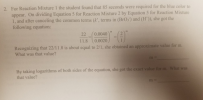 2. For Reaction Mixture 1 the student found that 85 seconds were required for the blue color to appear. On dividing Equation 5 for Reaction Mixture 2 by Equation 5 for Reaction Mixture 1, and after canceling the common terms (k', terms in (BrO;) and (H')), she got the following equation: 22(0.0040"-(2) 11.8 0.0020 Recognizing that 22/11.8 is about equal to 2/1, she obtained an approximate value for m. What was that value? By taking logarithms of both sides of...
just one example/demonstration! Data needed to be calculated is in highlighted in green boxes. And I...
 just one example/demonstration!
Data needed to be calculated is in highlighted in green boxes.
And I highlighted in red an equation (not sure if thats what you
use to calculate it) And ignore the lab instructions on completeing
a graph!! I already know how to do that in excel, just curious how
Ln (relative rate) and 1/T in K^-1 is calculated by hand*
here is the rest of that lab leading up to the question as I
know its typically...
just one example/demonstration!
Data needed to be calculated is in highlighted in green boxes.
And I highlighted in red an equation (not sure if thats what you
use to calculate it) And ignore the lab instructions on completeing
a graph!! I already know how to do that in excel, just curious how
Ln (relative rate) and 1/T in K^-1 is calculated by hand*
here is the rest of that lab leading up to the question as I
know its typically...
EXPERIMENT 3. Kinetic Study: The lodine Clock Reaction Prelaboratory Questions Name Fiza Chandning Laboratory Section 0000000000000000000000000000000000000000000000000000000000000000000000000000000...
 EXPERIMENT 3. Kinetic Study: The lodine Clock Reaction Prelaboratory Questions Name Fiza Chandning Laboratory Section 0000000000000000000000000000000000000000000000000000000000000000000000000000000 1. Consider the following reaction: 2 NO(g) + 4 NO, (g) + O2(g) The initial concentration of N, O, was 0.84 mol/L, and 35 minutes after initiating the reaction, all of the N,Os has been consumed. a) Calculate the average rate of the reaction over this 35-minute time interval. b) Is it correct to assume that the rate law is Rate = k[NO]? based...
Data and Calculations: Determination of the Equilibrium Constant for a Chemical Reaction Method II Volume in...
 Data and Calculations: Determination of the Equilibrium Constant for a Chemical Reaction Method II Volume in mL 2.00 x 10³ M Fe(NO) Volume in mL, Depth in mm Volume in ml. 2.00 x 10³ M Method I Mixture Unknówn KSCN Water Absorbance Standard FESCNP 4mL 1 5.00 x 10 M 1,00 .227 3mL 2 5,00 202 x 10 M 2,00 90 x 10 M .304 3 5,00 3.00 2mL 955 x 104 M I ImL 4 5.00 4,00 19x 10...
 need help with relative rate problems
Experiment 21 Data and Calculations: Rates of Chemical Reactions, Il. A Clock Reaction A. Dependence of Reaction Rate on Concentration Reaction: 61(ag + BrO,ag)+ 6H(aq)3aqp+ Brap+HO0 rate irBeO, Tr-- In all the reaction mistures used in this experiment, the color change occurred when a constant predetermined aumber of moles of BrO," had been used n in the reaction The color "clock" allows you to measue the ime mgaired for this fixed number of moles...
need help with relative rate problems
Experiment 21 Data and Calculations: Rates of Chemical Reactions, Il. A Clock Reaction A. Dependence of Reaction Rate on Concentration Reaction: 61(ag + BrO,ag)+ 6H(aq)3aqp+ Brap+HO0 rate irBeO, Tr-- In all the reaction mistures used in this experiment, the color change occurred when a constant predetermined aumber of moles of BrO," had been used n in the reaction The color "clock" allows you to measue the ime mgaired for this fixed number of moles...
 how do you find them? im a bit lost.
this is what we used
A. Dependence of Reaction Rate on Concentration Reaction: 61aq) + BrO,(aq) + 6H(aq)-31,(aq) + Brtaq) +3H,OD ABrO ABro,THTr rate In all the reaction mixtures used in this experiment, the color change occurred when a constant predetermined number of moles of BrO," had been used up in the reaction. The color "clock" allows you to measure the time required for this fixed number of moles of BrO,...
how do you find them? im a bit lost.
this is what we used
A. Dependence of Reaction Rate on Concentration Reaction: 61aq) + BrO,(aq) + 6H(aq)-31,(aq) + Brtaq) +3H,OD ABrO ABro,THTr rate In all the reaction mixtures used in this experiment, the color change occurred when a constant predetermined number of moles of BrO," had been used up in the reaction. The color "clock" allows you to measure the time required for this fixed number of moles of BrO,...
 can you help me make sure of m,n,p values.
LILAC Rection Name Section Experiment 16 Data and Calculations: Rates of Chemical Reactions, H. A Clock Reaction (1) so A. Dependence of Reaction Rate on Concentration Reaction: 6 l'(aq) + Bro, (aq) + 6 Haq) +31(aq) + Br(aq) + 3H,0 rale ("BO, Hy A(Bro, In all the reaction mixtures used in the experiment, the color change curred when number of moles of Bro, had been used up by the reaction. The...
can you help me make sure of m,n,p values.
LILAC Rection Name Section Experiment 16 Data and Calculations: Rates of Chemical Reactions, H. A Clock Reaction (1) so A. Dependence of Reaction Rate on Concentration Reaction: 6 l'(aq) + Bro, (aq) + 6 Haq) +31(aq) + Br(aq) + 3H,0 rale ("BO, Hy A(Bro, In all the reaction mixtures used in the experiment, the color change curred when number of moles of Bro, had been used up by the reaction. The...
 Section Name Experiment 23 Advance Study Assignment: Determination of the Equilibrium Constant for a Chemical Reaction 1. A student mixes 5.00 mL 2.00 X 10M Fe(NO), with 5.00 ml 2.00 x 10-M KSCN. She finds that in the equilibrium mixture the concentration of FeSCN is 1.40 x 10M. Find K for the reaction Fe(aq) + SCN (aq) FeSCN2(aq). Step 1 Find the number of moles Fe and SCN initially present. (Use Eq. 3.) (5.00 x103 LX (300X163) = (x 103...
 2. For Reaction Mixture 1 the student found that 85 seconds were required for the blue color to appear. On dividing Equation 5 for Reaction Mixture 2 by Equation 5 for Reaction Mixture 1, and after canceling the common terms (k', terms in (BrO;) and (H')), she got the following equation: 22(0.0040"-(2) 11.8 0.0020 Recognizing that 22/11.8 is about equal to 2/1, she obtained an approximate value for m. What was that value? By taking logarithms of both sides of...
 just one example/demonstration!
Data needed to be calculated is in highlighted in green boxes.
And I highlighted in red an equation (not sure if thats what you
use to calculate it) And ignore the lab instructions on completeing
a graph!! I already know how to do that in excel, just curious how
Ln (relative rate) and 1/T in K^-1 is calculated by hand*
here is the rest of that lab leading up to the question as I
know its typically...
just one example/demonstration!
Data needed to be calculated is in highlighted in green boxes.
And I highlighted in red an equation (not sure if thats what you
use to calculate it) And ignore the lab instructions on completeing
a graph!! I already know how to do that in excel, just curious how
Ln (relative rate) and 1/T in K^-1 is calculated by hand*
here is the rest of that lab leading up to the question as I
know its typically...
 EXPERIMENT 3. Kinetic Study: The lodine Clock Reaction Prelaboratory Questions Name Fiza Chandning Laboratory Section 0000000000000000000000000000000000000000000000000000000000000000000000000000000 1. Consider the following reaction: 2 NO(g) + 4 NO, (g) + O2(g) The initial concentration of N, O, was 0.84 mol/L, and 35 minutes after initiating the reaction, all of the N,Os has been consumed. a) Calculate the average rate of the reaction over this 35-minute time interval. b) Is it correct to assume that the rate law is Rate = k[NO]? based...
 Data and Calculations: Determination of the Equilibrium Constant for a Chemical Reaction Method II Volume in mL 2.00 x 10³ M Fe(NO) Volume in mL, Depth in mm Volume in ml. 2.00 x 10³ M Method I Mixture Unknówn KSCN Water Absorbance Standard FESCNP 4mL 1 5.00 x 10 M 1,00 .227 3mL 2 5,00 202 x 10 M 2,00 90 x 10 M .304 3 5,00 3.00 2mL 955 x 104 M I ImL 4 5.00 4,00 19x 10...
Most questions answered within 3 hours.
-
Where is the error in this code sequence?
String s1 = "Hello";
String s2 = "ello";...
asked 11 months ago -
Financial data for Joel de Paris, Inc., for last year
follow:
Joel de Paris, Inc.
Balance...
asked 11 months ago -
Consider this reaction:
Al2(SO4)3 (aq)+ BaCl3
(aq) Al2Cl6 (aq)- +
3BaSO4(s) . What is the...
asked 11 months ago -
Suppose that Savneet is considering increasing her
recent random sample from 20 car rentals to 40...
asked 11 months ago -
Trucks arrive at an unloading terminal at an average rate of 120
per hour.
Trucks arrive...
asked 11 months ago -
Why are methanol and ethanol completely soluble in water while
octanol is not very little soluble....
asked 11 months ago -
A facilities manager at a university reads in a research report
that the mean amount of...
asked 11 months ago -
When the CuSO4 is rehydrated by adding water to the anhydrous
compound, is this an endothermic...
asked 11 months ago -
A ray of sunlight is passing from diamond into crown glass; the
angle of incidence is...
asked 11 months ago -
A block of mass 0.249 kg is placed on top of a light, vertical
spring of...
asked 11 months ago -
how do the kidneys compensate in the presences of acidosis
a) trigger hyperventilate
b) reserve acid...
asked 11 months ago -
Question 501 pts
The rental rate of capital to the firm increases. Which of the
following...
asked 11 months ago