
Homework Answers
Add Answer to:
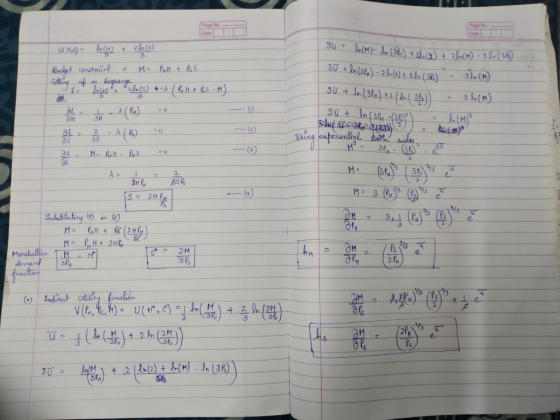
For the rest of the question, assume that Stephen's utility function is 1 2 n (S)...
Exercise 2: Expenditure minimization We assume an individual whose preferences can be represented by the utility...
 Exercise 2: Expenditure minimization We assume an individual whose preferences can be represented by the utility functions | Ưới a) = 8 * @a An expenditure-minimizing consumer would try to minimize the amount they spend on both and rach that their utility is at least as high as some set level of utility U. Mathematically, we thus have minha + P such that Ul. 22) 20 1. Please write the Lagrangan formula corresponding to this particular optimization set up oynundo...
1. Consider the utility function: u(x1,x2) = x1 + x2. Find the corresponding Hicksian demand function....
 1. Consider the utility function: u(x1,x2) = x1 + x2. Find the corresponding Hicksian demand function. 2. For each of the three utility functions below, find the substitution effect, the income effect, and the total effect that result when prices change from p = (2,1) to p' = (2,4). Assume the consumer has income I = 20. (a) Before doing any calculation, make an educated guess about the relative magnitude of the three substitution effects and the three income effects...
1. Consider the utility function: u(x1,x2) = x1 + x2. Find the corresponding Hicksian demand function....
 1. Consider the utility function: u(x1,x2) = x1 + x2. Find the corresponding Hicksian demand function. 2. For each of the three utility functions below, find the substitution effect, the income effect, and the total effect that result when prices change from p =(2, 1) to p' = (2,4). Assume the consumer has income I = 20. (a) Before doing any calculation, make an educated guess about the relative magnitude of the three substitution effects and the three income effects...
Figure 1 shows a closed-loop control system in which G(S)=40/[ (S+2) (S+3)], and H(S)=1/(S+4) R(S) E(S)...
 Figure 1 shows a closed-loop control system in which G(S)=40/[ (S+2) (S+3)], and H(S)=1/(S+4) R(S) E(S) Y(s) G(S) HS) Figure 2 shows the Nyquist plot for the open-loop transfer function. Figure 2 shows the Nyquist plot for the open-loop transfer function System: sys Real: -0.187 Imag: 2.56e-05 Frequency: (rad/s): -5.16 Using the Nyquist criterion: a) Find out the gain margin expressed in dB. Is the system stable or unstable? (25 points) b) What is the value of the gain expressed...
10. Find the product(s) of the following reaction: 1. NaOCH 2. H,0 3. Ethanol 2. 3...
 10. Find the product(s) of the following reaction: 1. NaOCH 2. H,0 3. Ethanol 2. 3 5 6 8 9 W E IR U А. S D G Н K Z С B N M
р Question 3 Consider the transfer function, H(s), of a non-causal LTI system H(S) = s+2...
 р Question 3 Consider the transfer function, H(s), of a non-causal LTI system H(S) = s+2 (8+3)(82 +8+5) (82–8+5) 1. Determine ROC for H(s) = = = xx, E P T
Problem Set 1 Due Date: Wednesday, January 25,2017 1. Consider the following demand function of an...
 Problem Set 1 Due Date: Wednesday, January 25,2017 1. Consider the following demand function of an individual for good 1: where p" p2, ps are the prices of good 12, and 3, respectively, and Y represents the income the individual. Suppose good 1 and 2 are substitutes while good 1 and 3 are complements. (a) Describe in words what B,,B,, B, and B, measure. (b) Can you say anything about the expected signs of p.B.B, and B, in the demand...
For each reacuon ere s only as an aid for you. 1) KOH, H-O, heat Diethyl malonate B 1) Ph3P, ether 2) nBuLi, ether CIH1...
 For each reacuon ere s only as an aid for you. 1) KOH, H-O, heat Diethyl malonate B 1) Ph3P, ether 2) nBuLi, ether CIH1204 2) H, H2O, heat C1SH2406 CHH1202 NaOEt, EtOH Br OCH2CH3 3) PHCHO NH/heat Note: The C-13 NMRS for Structures C, D, and E each show 7 resonances LIAIH D E C1HNO ether C1H1SN Br 1) SOCI2, pyridine F 2) CH3OH 1) CH2COCI,AICI3 1) Mg(s), Et20 H 2) diisopropyl amine, pH 4.5, NaBH3CN 2) CO2 (s)...
Question Three: The system function of a discrete-time system is 2 1-e-0.22-1 1 1-e-0.42-1 a) Assume...
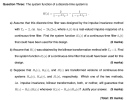 Question Three: The system function of a discrete-time system is 2 1-e-0.22-1 1 1-e-0.42-1 a) Assume that this discrete-time filter was designed by the impulse invariance method with Td = 2, i.e. h[n] = 2h.(2n), where he(t) is a real-valued impulse response of a continuous-time filter. Find the system function H.(s) of a continuous-time filter he(t) that could have been used for this design. (8 marks) b) Assume that H(2) was obtained by the bilinear transformation method with Td =...
1.The following function does not have a Laplace transformation 2.The Laplace transformation for () is 3.If...
 1.The following function does not have
a Laplace transformation
2.The Laplace transformation for ()
is
3.If f(s). g(s) represent the Laplace
transformations for f(t). g(t) respectively, then the transform of
h(t)= () is h(s)=
PS:
D is for none of the above
Please justify answer
Thanks in advance
1. La siguiente funcion NO tiene transformada de Laplace a. f(t) = eta b. g(t) = sin 4t c. h(t) = 21 d. ninguna de las anteriores 2. La transformada de Laplace...
1.The following function does not have
a Laplace transformation
2.The Laplace transformation for ()
is
3.If f(s). g(s) represent the Laplace
transformations for f(t). g(t) respectively, then the transform of
h(t)= () is h(s)=
PS:
D is for none of the above
Please justify answer
Thanks in advance
1. La siguiente funcion NO tiene transformada de Laplace a. f(t) = eta b. g(t) = sin 4t c. h(t) = 21 d. ninguna de las anteriores 2. La transformada de Laplace...
 Exercise 2: Expenditure minimization We assume an individual whose preferences can be represented by the utility functions | Ưới a) = 8 * @a An expenditure-minimizing consumer would try to minimize the amount they spend on both and rach that their utility is at least as high as some set level of utility U. Mathematically, we thus have minha + P such that Ul. 22) 20 1. Please write the Lagrangan formula corresponding to this particular optimization set up oynundo...
 1. Consider the utility function: u(x1,x2) = x1 + x2. Find the corresponding Hicksian demand function. 2. For each of the three utility functions below, find the substitution effect, the income effect, and the total effect that result when prices change from p = (2,1) to p' = (2,4). Assume the consumer has income I = 20. (a) Before doing any calculation, make an educated guess about the relative magnitude of the three substitution effects and the three income effects...
 1. Consider the utility function: u(x1,x2) = x1 + x2. Find the corresponding Hicksian demand function. 2. For each of the three utility functions below, find the substitution effect, the income effect, and the total effect that result when prices change from p =(2, 1) to p' = (2,4). Assume the consumer has income I = 20. (a) Before doing any calculation, make an educated guess about the relative magnitude of the three substitution effects and the three income effects...
 Figure 1 shows a closed-loop control system in which G(S)=40/[ (S+2) (S+3)], and H(S)=1/(S+4) R(S) E(S) Y(s) G(S) HS) Figure 2 shows the Nyquist plot for the open-loop transfer function. Figure 2 shows the Nyquist plot for the open-loop transfer function System: sys Real: -0.187 Imag: 2.56e-05 Frequency: (rad/s): -5.16 Using the Nyquist criterion: a) Find out the gain margin expressed in dB. Is the system stable or unstable? (25 points) b) What is the value of the gain expressed...
 10. Find the product(s) of the following reaction: 1. NaOCH 2. H,0 3. Ethanol 2. 3 5 6 8 9 W E IR U А. S D G Н K Z С B N M
 р Question 3 Consider the transfer function, H(s), of a non-causal LTI system H(S) = s+2 (8+3)(82 +8+5) (82–8+5) 1. Determine ROC for H(s) = = = xx, E P T
 Problem Set 1 Due Date: Wednesday, January 25,2017 1. Consider the following demand function of an individual for good 1: where p" p2, ps are the prices of good 12, and 3, respectively, and Y represents the income the individual. Suppose good 1 and 2 are substitutes while good 1 and 3 are complements. (a) Describe in words what B,,B,, B, and B, measure. (b) Can you say anything about the expected signs of p.B.B, and B, in the demand...
 For each reacuon ere s only as an aid for you. 1) KOH, H-O, heat Diethyl malonate B 1) Ph3P, ether 2) nBuLi, ether CIH1204 2) H, H2O, heat C1SH2406 CHH1202 NaOEt, EtOH Br OCH2CH3 3) PHCHO NH/heat Note: The C-13 NMRS for Structures C, D, and E each show 7 resonances LIAIH D E C1HNO ether C1H1SN Br 1) SOCI2, pyridine F 2) CH3OH 1) CH2COCI,AICI3 1) Mg(s), Et20 H 2) diisopropyl amine, pH 4.5, NaBH3CN 2) CO2 (s)...
 Question Three: The system function of a discrete-time system is 2 1-e-0.22-1 1 1-e-0.42-1 a) Assume that this discrete-time filter was designed by the impulse invariance method with Td = 2, i.e. h[n] = 2h.(2n), where he(t) is a real-valued impulse response of a continuous-time filter. Find the system function H.(s) of a continuous-time filter he(t) that could have been used for this design. (8 marks) b) Assume that H(2) was obtained by the bilinear transformation method with Td =...
 1.The following function does not have
a Laplace transformation
2.The Laplace transformation for ()
is
3.If f(s). g(s) represent the Laplace
transformations for f(t). g(t) respectively, then the transform of
h(t)= () is h(s)=
PS:
D is for none of the above
Please justify answer
Thanks in advance
1. La siguiente funcion NO tiene transformada de Laplace a. f(t) = eta b. g(t) = sin 4t c. h(t) = 21 d. ninguna de las anteriores 2. La transformada de Laplace...
1.The following function does not have
a Laplace transformation
2.The Laplace transformation for ()
is
3.If f(s). g(s) represent the Laplace
transformations for f(t). g(t) respectively, then the transform of
h(t)= () is h(s)=
PS:
D is for none of the above
Please justify answer
Thanks in advance
1. La siguiente funcion NO tiene transformada de Laplace a. f(t) = eta b. g(t) = sin 4t c. h(t) = 21 d. ninguna de las anteriores 2. La transformada de Laplace...
Most questions answered within 3 hours.
-
Where is the error in this code sequence?
String s1 = "Hello";
String s2 = "ello";...
asked 11 months ago -
Financial data for Joel de Paris, Inc., for last year
follow:
Joel de Paris, Inc.
Balance...
asked 11 months ago -
Consider this reaction:
Al2(SO4)3 (aq)+ BaCl3
(aq) Al2Cl6 (aq)- +
3BaSO4(s) . What is the...
asked 11 months ago -
Suppose that Savneet is considering increasing her
recent random sample from 20 car rentals to 40...
asked 11 months ago -
Trucks arrive at an unloading terminal at an average rate of 120
per hour.
Trucks arrive...
asked 11 months ago -
Why are methanol and ethanol completely soluble in water while
octanol is not very little soluble....
asked 11 months ago -
A facilities manager at a university reads in a research report
that the mean amount of...
asked 11 months ago -
When the CuSO4 is rehydrated by adding water to the anhydrous
compound, is this an endothermic...
asked 11 months ago -
A ray of sunlight is passing from diamond into crown glass; the
angle of incidence is...
asked 11 months ago -
A block of mass 0.249 kg is placed on top of a light, vertical
spring of...
asked 11 months ago -
how do the kidneys compensate in the presences of acidosis
a) trigger hyperventilate
b) reserve acid...
asked 11 months ago -
Question 501 pts
The rental rate of capital to the firm increases. Which of the
following...
asked 11 months ago